PART 2 — THE NAME SAVANNAH NEVER EXPECTED
The coordinator’s finger stayed pressed against the note as if the paper itself had become evidence in a trial.
Every whisper in the Texas State Capitol died at once.
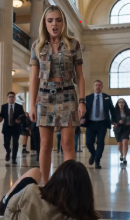
The marble hall seemed too bright, too polished, too full of people pretending they were not watching a disaster unfold in real time. My scattered speech pages still lay at my feet. My shoulder ached from where Savannah Grant had slammed into me, and my hands were still trembling, but nobody was looking at my hands anymore.
They were looking at the guest book.
Savannah’s face had gone pale beneath her perfect makeup.
The event coordinator, Mr. Bell, adjusted his glasses and read the note again silently before speaking.
“The special student guest for the private civic leadership luncheon last spring was not Savannah Grant.”
Savannah’s jaw tightened. “That is impossible.”
Mr. Bell looked up.
“It says the student guest was Emma Lewis.”
The world tilted.
For a moment, I thought I had misheard him.
A student behind me whispered, “Emma?”
Another said, “Wait, what?”
Savannah let out a sharp laugh. “That is ridiculous. She probably does not even know anyone here.”
I could not speak.
Because I did know what he was talking about.
Last spring, my community library had hosted a literacy drive after a flood damaged two elementary school reading rooms. I had spent three weeks sorting donated books, repairing torn covers, and making handwritten labels for classroom boxes. A woman from a state education office visited, asked me questions, and later invited me to a luncheon honoring youth volunteers.
I had not bragged about it.
I had not even told many people.
I remembered standing quietly at the edge of that luncheon in my same stitched uniform, eating tiny sandwiches and feeling like I had wandered into someone else’s dream. I remembered signing a guest book at the entrance. I remembered being too nervous to write neatly.
Mr. Bell turned the book so everyone could see.
There it was.
Emma Lewis — Youth Literacy Volunteer, Austin Community Library.
My handwriting.
My name.
My existence in ink.
Savannah stared at it as if the letters had betrayed her personally.
“That does not prove anything,” she snapped. “My father arranged meetings privately. Not everything goes in some dusty book.”
One of the staff members beside Mr. Bell frowned. “Official student invitations are always logged.”
A security officer stepped closer. “Miss Grant, please lower your voice.”
Savannah ignored him and pointed at me.
“She probably copied my story after hearing me talk about it. Everyone knows I was supposed to be selected today. This whole thing was arranged to embarrass me.”
The accusation struck like cold water.
A few months ago, that sentence might have crushed me. I might have folded into myself, ashamed to be publicly questioned by someone who wore confidence like a crown.
But something had changed when my name appeared in that book.
The guest book had not only proven Savannah lied. It had reminded me that I had been in important rooms before, even when no one at school cared to notice.
I bent down and gathered my speech pages.
One sheet had a shoe print across it.
Savannah’s boot.
I held it up.
“You stepped on my speech,” I said quietly.
Savannah rolled her eyes. “Do you want sympathy for paper now?”
“No,” I said. “I want you to stop pretending your cruelty is leadership.”
A gasp moved through the students.
Savannah’s eyes widened, not because my words were loud, but because they were calm.
Teachers hurried closer. My civics teacher, Mrs. Ramirez, touched my arm. “Emma, are you hurt?”
“I am fine,” I said, even though I was not.
Mr. Bell closed the book gently.
“Given what just occurred,” he said, “this matter needs to be reported to program leadership before the Governor arrives.”
Savannah’s expression sharpened with panic. “You cannot do that.”
“I have to,” he replied.
Her phone buzzed in her hand. She looked down, then away. I saw the name flashing across the screen before she turned it.
Dad.
Her father was calling.
That was when I understood the fear beneath her anger.
Savannah had not simply lied to impress students.
She had been building a version of herself other people had invested in.
And now, in front of cameras, staff, teachers, and security, that version was falling apart.
PART 3 — THE CALL FROM HER FATHER
Savannah answered the phone with her back half-turned, but the Capitol hall was too quiet.
Everyone heard enough.
“Daddy, I can explain,” she whispered.
A man’s voice boomed faintly through the speaker.
Savannah flinched.
“No, it is not my fault. Emma started—”
She stopped.
Her face changed.
Whatever her father said next drained the last of her confidence.
Mrs. Ramirez guided me toward a bench near the wall. I sat down and tried to smooth my speech pages, but my fingers kept catching on the torn corner.
I had written my remarks the night before at the library after closing, sitting beneath the old reading lamp while rain ticked against the window. I had planned to speak about public service as something ordinary people practiced every day. Returning books. Helping neighbors fill out forms. Translating notices. Showing up.
Now the pages looked damaged.
So did I.
Across the hall, Savannah lowered the phone. Her eyes were wet, but not soft.
“My father wants to speak to the coordinator,” she said.
Mr. Bell did not move. “He may contact the program office.”
Savannah’s lips parted. “Do you know who he is?”
Mr. Bell’s face remained professional. “Yes.”
That single word embarrassed her more than a lecture could have.
A few students snickered. Savannah heard them. Her head snapped around.
“You are all enjoying this,” she said.
Nobody answered.
Then she looked at me.
“You think this makes you special?”
I stood slowly.
“No,” I said. “I think pushing someone down in a government building because you did not get picked makes you unfit to represent anyone.”
Her face twisted.
Before she could respond, a new voice cut through the hall.
“Emma Lewis?”
Everyone turned.
A woman in a navy suit walked toward us with two staff members behind her. She had silver-streaked hair, a calm face, and the kind of authority that made people straighten without being told.
“I am Deputy Director Elaine Porter,” she said. “I oversee today’s Youth Leadership Program.”
I nodded, suddenly aware of every patch on my uniform.
“Yes, ma’am.”
Her eyes moved from my torn speech pages to Savannah, then to Mr. Bell and the guest book.
“I have been briefed,” she said. “Miss Grant, you will wait with your teacher while we review the incident.”
Savannah’s teacher looked mortified.
Savannah crossed her arms. “This is unfair.”
Ms. Porter’s gaze hardened. “What is unfair is a participant being knocked to the floor and publicly insulted moments before delivering remarks.”
Savannah looked away.
Then Ms. Porter turned to me.
“Emma, are you still able to speak?”
My breath caught.
I looked down at my pages.
The safe answer was no.
No would let me disappear. No would let me go home, take off my old uniform, and cry where nobody could record it.
But I thought of the library.
Of little kids waiting for repaired books.
Of my mother sewing my sleeve beneath the kitchen light because we could not afford a new uniform.
Of all the times I had swallowed humiliation because honest work was not supposed to embarrass me.
If I walked away now, Savannah’s shove would have done exactly what it was meant to do.
I lifted my head.
“Yes,” I said. “But I need a clean copy.”
Ms. Porter’s expression softened. “We can print one.”
I looked at the shoe print on my page.
“No,” I said. “I think I will speak from memory.”
Mrs. Ramirez squeezed my arm.
Ms. Porter nodded once. “Then we continue.”
Savannah stared at me like she could not understand why I was still standing.
Maybe that was the part she had never learned.
Some people are raised to expect rooms to open for them.
Others learn how to stand after doors slam shut.
PART 4 — THE SPEECH WITHOUT PAPER
The Governor arrived fifteen minutes later.
By then, the official reception area had been reset with terrifying efficiency. The guest line formed again. Cameras found their angles. Staff members whispered into earpieces. Teachers told students to behave as if nothing unusual had happened, which made everyone behave like something historic had happened.
Savannah stood near the back with her teacher.
She was still there, but no longer at the center.
That seemed to wound her more than being corrected.
I waited near the podium with Mrs. Ramirez beside me. My speech pages were folded in my pocket, damaged and useless. My heart hammered so hard I wondered if the microphone would pick it up.
Ms. Porter leaned toward me. “Take your time.”
Then the Governor stepped forward.
I shook his hand.
His palm was warm. His smile was practiced but not unkind.
“Emma Lewis,” he said. “I hear you have done meaningful work in your community.”
The words nearly undid me.
Not brilliant work.
Not glamorous work.
Meaningful work.
“Yes, sir,” I managed.
The program began.
There were introductions, polite applause, a few jokes from officials. Then my name was called again.
This time, when I walked to the podium, the hall did not feel celebratory.
It felt watchful.
Everyone knew what had happened. Everyone wanted to see whether I would crack.
I placed my hands on both sides of the podium.
My notes were not in front of me.
Only the seal of Texas.
Only hundreds of faces.
Only Savannah’s cold stare from the back.
I inhaled.
“My name is Emma Lewis,” I began, “and every afternoon after school, I work at a community library.”
My voice shook on the first sentence.
Then steadied.
“I organize returned books. I repair torn pages. I tape broken spines. I help children find stories they can take home for free. Some people think that kind of work is small.”
I paused.
My eyes moved through the hall.
“But I have learned that leadership is not always standing behind a podium. Sometimes leadership is making sure a child can read the last chapter because someone repaired the page before they got there.”
A silence settled.
Not empty.
Listening.
I continued.
“Today, I was chosen to speak for students across Texas. I know there are people here with more polished uniforms, more powerful last names, and more experience being photographed in important places.”
A few students shifted.
Savannah’s face tightened.
“But public service cannot belong only to people who already have access. It must belong to the student shelving books after school. The girl translating for her grandmother at a clinic. The boy helping his younger siblings with homework while his parents work late. The teenager cleaning up a neighborhood park when nobody is watching.”
My throat burned.
“Because if leadership only recognizes privilege, it is not leadership. It is inheritance wearing a badge.”
The hall went completely still.
I had not written that line in my original speech.
It came from the bruise forming on my shoulder.
It came from the guest book.
It came from years of watching people mistake money for merit.
I looked toward the back of the room.
Savannah looked away first.
“So I am honored to be here,” I said. “Not because I have always felt like I belonged in rooms like this, but because I know now that belonging is not proven by who announces you, who sponsors you, or who stands beside you for a photograph.”
I touched my pocket, where the damaged pages rested.
“Sometimes belonging is proven by the record you leave behind when nobody expected you to matter.”
For one heartbeat, there was silence.
Then applause exploded.
It rolled through the hall, rising from students first, then teachers, then staff, then officials. Mrs. Ramirez was crying openly. Mr. Bell clapped with the guest book tucked under one arm.
The Governor stood.
Then everyone stood.
The standing ovation did not feel like being rescued. It felt like finally being heard.
When I stepped away from the podium, Ms. Porter whispered, “That was not a speech. That was a turning point.”
I did not know then how true that would become.
PART 5 — THE SECOND BOOK
After the ceremony, reporters surrounded me.
They asked about the shove. The guest book. Savannah. My library work. My uniform. My speech. My family.
I answered carefully.
I did not want to become cruel just because someone had been cruel to me.
But I also refused to make the truth smaller.
“Yes, Savannah pushed me.”
“Yes, she claimed leadership belonged to influential families.”
“Yes, the records showed she had not attended the events she described.”
“No, I do not think public service should be inherited.”
That last answer spread faster than everything else.
By evening, clips of the speech appeared online. Students from other schools began posting stories about being overlooked by wealthy classmates. Library volunteers wrote messages. Teachers shared the line about repaired pages.
At home, my mother watched the video with both hands pressed against her mouth.
She had come to America from Mexico before I was born and worked in a medical laundry facility where heat and steam turned every shift into a test of endurance. My father drove buses. Neither of them had been able to attend the Capitol event because missing work meant missing rent.
When the video reached the part where the hall stood for me, my mother began to cry.
“Mi hija,” she whispered. “They saw you.”
My father cleared his throat three times before giving up and hugging me.
The next morning, everything changed again.
Ms. Porter called the library.
I was repairing a torn copy of Charlotte’s Web when the front desk phone rang.
The head librarian, Mrs. Chen, answered, listened, then turned toward me with wide eyes.
“Emma,” she said, covering the receiver. “It is the Capitol office.”
My stomach dropped.
Had I said too much?
Had Savannah’s father complained?
I took the phone.
“Emma Lewis speaking.”
Ms. Porter’s voice came through firm and calm.
“Emma, I apologize for contacting you at work. We have found something related to yesterday’s guest records.”
My fingers tightened around the receiver.
“What kind of something?”
“A second guest book.”
I looked at Mrs. Chen.
“What does that mean?”
Ms. Porter lowered her voice. “During the review of Savannah Grant’s claims, staff discovered unofficial access logs connected to private donor tours. Her family name appears repeatedly.”
My heart sank.
“So she was telling the truth?”
“Not exactly,” Ms. Porter said. “Savannah was never invited as a student leadership participant. But her father did bring her to closed donor visits. Those visits were not educational events. They were meetings about property development, including land near several public libraries.”
I stopped breathing.
“Libraries?”
“Yes,” Ms. Porter said. “Including yours.”
My eyes moved across the community library.
The children’s corner with mismatched chairs.
The wall of repaired paperbacks.
The donation box.
The little bulletin board advertising free tutoring and citizenship classes.
“Our library?” I whispered.
“There is more,” she said. “A redevelopment proposal lists the library building as a potential private retail site. The project was connected to Grant Development.”
The room seemed to tilt again.
Savannah had not only lied about attending leadership meetings.
Her family had been meeting behind closed doors about buying the ground beneath my second home.
The place where I worked.
The place where children read for free.
The place where families without computers applied for jobs.
Ms. Porter continued, “The proposal has not been approved. But after yesterday, several officials want the process reviewed publicly.”
A strange cold anger filled me.
Not hot.
Clear.
“Can I see the records?” I asked.
There was a pause.
Then Ms. Porter said, “Yes. And Emma?”
“Yes?”
“Bring your library card.”
PART 6 — THE LIBRARY THEY WANTED TO ERASE
The public review meeting was held the following week.
This time, it was not in the grand Capitol hall.
It was in our community library.
That mattered.
The building was old brick with chipped steps and a front door that stuck when it rained. The air-conditioning complained in summer. The roof leaked near the biography shelves. But to the neighborhood, it was more than a building.
It was where kids waited safely after school.
Where seniors read newspapers.
Where mothers printed resumes.
Where people who owned nothing still had access to knowledge.
On the night of the meeting, the library was packed.
Neighbors stood between shelves. Children sat cross-legged on the floor. Teachers lined the back wall. Reporters squeezed near the circulation desk. My parents stood beside Mrs. Chen, both still in work clothes.
Then Savannah entered.
The room hardened.
She came with her father, Richard Grant, a tall man in a tailored suit with silver hair and a smile so polished it felt sharpened.
Savannah looked smaller beside him.
Not innocent.
But smaller.
Richard Grant shook hands with officials as if the meeting belonged to him.
When he reached me, he smiled.
“Emma Lewis,” he said. “You have caused quite a stir.”
I did not take his hand.
“I told the truth.”
His smile did not change. “Truth is often a matter of context.”
Mrs. Chen stepped beside me. “Not in a library.”
A few people murmured approval.
The meeting began.
City representatives explained that Grant Development had proposed purchasing several aging public properties for “revitalization.” The language sounded clean. Efficient. Harmless.
Then Ms. Porter presented the access logs.
Savannah’s name appeared as a guest on donor visits.
Not leadership events.
Not civic student programs.
Private development briefings.
Each entry had been signed by Richard Grant.
The room grew angry.
A mother near the children’s section raised her hand. “So while our kids were reading here, they were planning to sell it?”
An official tried to answer carefully.
Richard Grant stood instead.
“No one is taking anything from anyone,” he said smoothly. “This community deserves investment. Modern facilities. Commercial opportunity. Jobs.”
Mrs. Chen asked, “Where would the library go?”
He smiled. “A smaller digital resource center could be included in the redevelopment.”
A smaller digital resource center.
The words landed like dust over a grave.
My father muttered, “They want to replace books with a kiosk.”
People began talking at once.
Then Savannah stood.
Her father turned sharply.
“Sit down,” he said under his breath.
She did not.
For one strange second, I saw the same expression she had worn at the Capitol after the guest book exposed her.
Fear.
But this time, it was not fear of being embarrassed.
It was fear of knowing something and deciding whether to say it.
Savannah looked at the crowd.
“My father told me these meetings were leadership opportunities,” she said.
Richard’s face darkened. “Savannah.”
She flinched, but continued.
“He said I should tell people I was involved in state programs because someday appearances would matter. I thought that was normal.”
People stared.
Savannah swallowed.
“I did lie. I lied at school. I lied at the Capitol. I treated Emma terribly because I thought someone like her getting chosen meant something had been stolen from me.”
Her eyes found mine.
“I was wrong.”
The room stayed silent.
She turned toward her father.
“And this library was not supposed to get a public hearing. He said the paperwork would move quietly after the Youth Leadership event, because positive publicity would make the family look civic-minded.”
Richard Grant’s voice cut like a blade. “Enough.”
Savannah shook now. “No.”
The word was small.
But it held.
“No,” she repeated. “You used me too.”
Richard’s polished mask cracked.
“You ungrateful child.”
The room erupted.
Reporters shouted questions. Officials called for order. Mrs. Chen pulled me slightly behind her as if I needed protection from the truth flying through the air.
Then Ms. Porter lifted a folder.
“There will be a full ethics review,” she announced. “The redevelopment proposal is suspended immediately.”
People cheered.
Not politely.
Not elegantly.
Like a neighborhood discovering the bulldozer had stopped at the edge of its street.
I looked at Savannah.
She was crying, but she did not run.
For the first time, I wondered how lonely it must be to be raised as a symbol instead of a daughter.
Still, what she had done to me remained real.
Apology did not erase impact.
But truth, even late, could stop more harm.
PART 7 — THE PAGE EVERYONE SIGNED
Two months passed.
The Capitol incident became bigger than anyone expected. The Youth Leadership Program changed its selection process to include verified community service. The guest records policy was strengthened. Private donor access connected to student programs was restricted.
Grant Development faced investigations.
Richard Grant resigned from two boards.
Savannah disappeared from school for several weeks, then returned quieter.
She no longer moved like hallways belonged to her.
Some students mocked her. Others avoided her. A few still defended her because wealth always has loyal shadows.
I did not mock her.
But I did not comfort her either.
I had my own work to do.
The library became the center of a campaign called Keep the Doors Open. Students volunteered. Parents donated. Local artists painted murals. Retired teachers ran reading circles. My mother cooked trays of tamales for fundraiser nights. My father organized bus drivers to help families reach public meetings.
And every afternoon, I still repaired books.
That was the part reporters found surprising.
One asked, “After everything that happened, why keep doing the same job?”
I held up a children’s book with a torn spine.
“Because the work did not become less important just because people noticed it.”
The reporter wrote that down.
On the final day of the campaign, the library hosted a community signing event.
Not a petition.
A guest book.
Mrs. Chen placed it on the front desk, wide and blank, with a blue ribbon marker tucked inside. Anyone who had ever needed the library was invited to sign their name and write one sentence about why it mattered.
By noon, the pages were filling.
My father wrote: This library helped my daughter become braver than me.
My mother wrote: Aquí aprendimos que nuestra voz también cuenta.
Mrs. Chen wrote: A public library is a promise that no one has to earn the right to learn.
Children drew stars, cats, dinosaurs, crooked hearts.
Elderly neighbors wrote shaky notes about newspapers and warmth and not being alone.
Then Savannah came in.
The room noticed.
She walked to the desk slowly, holding a pen.
I stood behind the counter with a stack of returned books.
For a long moment, she stared at the guest book.
Then she wrote.
Her handwriting was elegant but uneven.
When she finished, she stepped back.
I looked down.
I thought belonging meant being seen in important places. This library taught me it means protecting places where everyone can be seen. — Savannah Grant
I read it twice.
Savannah looked at me. “I know it does not fix what I did.”
“No,” I said.
She nodded.
“But it helps the library,” I added.
Her eyes filled. “That is all I wanted today.”
I believed her.
Not completely.
But enough for that moment.
That evening, the city council voted.
The library would remain public.
A renovation grant would repair the roof, expand the children’s room, and add computers without removing the books. The vote was unanimous.
When the announcement came, people screamed, cried, hugged between shelves, and clapped until dust floated down from the old ceiling like confetti.
Mrs. Chen handed me the community guest book.
“You should keep this for the archive,” she said.
I ran my fingers over the cover.
The Capitol guest book had exposed a lie.
This guest book had saved a home.
For the first time, I understood that records are not just proof of where someone has been. They are proof of who refused to disappear.
PART 8 — THE END — THE INVITATION THAT FINALLY BELONGED TO EVERYONE
One year later, I returned to the Texas State Capitol.
This time, I did not come alone.
Two buses pulled up outside carrying students from our neighborhood library program. Some wore school uniforms. Some wore borrowed blazers. Some wore sneakers with peeling soles. Every single one carried a book.
The state had created a new Youth Civic Service Award after the reforms.
The first ceremony would honor community projects led by students, not families, sponsors, or donors.
Our library campaign had won.
I stepped off the bus wearing a simple navy dress my mother had altered from a thrift-store find. Inside the hem, hidden where no camera could see, she had stitched a tiny piece of my old patched uniform.
“So you remember,” she said that morning.
I did.
I remembered the marble floor.
The shove.
The scattered pages.
The guest book turned toward the crowd.
The speech I gave without paper.
Inside the Capitol, students gathered again beneath the high ceilings and bright lights. But this time, the room felt different because I was different.
I no longer wondered whether I belonged.
I had brought proof with me.
Not in a file.
In people.
Mrs. Chen came. My parents came. Ms. Porter came. Even Mr. Bell stood near the guest table, smiling when he saw me.
Savannah came too.
She stood quietly with a group of volunteers from a youth ethics project she had joined after transferring schools. Her father was not there. I had heard he was still fighting legal consequences and civil complaints.
When Savannah saw me, she gave a small nod.
I returned it.
That was all.
Some endings do not need dramatic forgiveness.
Sometimes peace is simply standing in the same room without fear.
Before the ceremony, Mr. Bell opened a new official guest book.
“Would you like to sign first?” he asked me.
I looked at the page.
Blank.
Waiting.
My hand hovered over the line.
Then I shook my head.
“Let the younger students sign first.”
A little girl named Maya stepped forward. She was nine, tiny, fierce, and always asking for mystery books with brave heroines. She wrote her name carefully, tongue caught between her teeth.
Then another student signed.
Then another.
Soon the page filled with names from children who had once thought places like this were only for field trips and famous people.
The Governor recognized the library campaign during the ceremony. I delivered remarks again, but this time my voice did not shake.
I spoke about books.
About doors.
About how a community saved a place because people signed their names and stood behind them.
Then came the surprise.
Ms. Porter stepped to the podium.
“Today,” she announced, “the state is establishing the Emma Lewis Public Service Fellowship for students whose leadership begins in overlooked places.”
My breath vanished.
The audience rose before I could even understand.
My mother sobbed into my father’s shoulder. Mrs. Chen laughed and cried at the same time. The younger students shouted my name like I was someone from a story they loved.
I stood frozen, overwhelmed.
Then Maya ran up and hugged me around the waist.
“You get your own fellowship?” she asked.
I looked down at her shining face.
“No,” I whispered. “We do.”
And that was the happiest shock of all.
Not that my name would be remembered.
But that it would open doors for students whose names had not yet been called.
After the ceremony, I walked past the reception area where Savannah had pushed me one year earlier. The marble floor gleamed as if nothing had happened there.
But I knew.
Places remember differently than people do.
Sometimes they hold echoes.
Sometimes they wait for someone to return stronger.
At the guest table, I opened the book and found the first page filled with children’s names. Beneath them, there was one empty line left.
I signed it slowly.
Emma Lewis — Community Library Volunteer.
Not “special guest.”
Not “chosen speaker.”
Not “fellowship namesake.”
Those things mattered, but they were not where my story began.
It began after school, repairing pages no one thought important enough to save.
It began with an old uniform stitched together by hand.
It began with honest work.
As I closed the guest book, sunlight poured through the Capitol windows and spread across the marble floor where I had once fallen.
This time, I did not look down.
I looked ahead.
Outside, two buses waited to take us back to the library, where children would return books, ask questions, and sign their names on reading cards as if every name mattered.
Because it did.
Because it always had.
And because now, no one could pretend otherwise.
