PART 2 — THE SCREEN THAT CHANGED EVERYTHING
The shout from the front of the crowd seemed to freeze the entire staging area.
“Wait… if Emma has more verified volunteer hours than anyone else in Ohio, then how could anyone argue she doesn’t deserve to lead this parade?”
For one long second, no one moved.
The wind tugged at the parade banners. A trumpet player lowered his instrument. A reporter’s camera light blinked red, capturing everything. Somewhere behind me, a little girl whispered, “That’s her? That’s Emma?”
My scalp still burned where Charlotte had yanked my ponytail, but I barely felt the pain anymore. I was staring at the giant screen, unable to understand why my name was there in letters taller than my bicycle handlebars.
EMMA HAYES — 4,862 VERIFIED SERVICE HOURS
Under my name came dozens of entries.
Food pantry assistant.
Senior companion volunteer.
Animal shelter weekend aide.
Neighborhood cleanup coordinator.
Winter coat drive organizer.
Youth literacy tutor.
Disaster relief supply sorter.
Emergency meal delivery helper.
The list kept going.
And going.
And going.
I heard the crowd begin to murmur, but the sound felt far away, like waves crashing behind a closed door.
Charlotte’s face turned pale.
The state coordinator, a tall woman named Ms. Evelyn Price, adjusted the microphone.
“Every year,” she said, her voice ringing across the stage, “the Ohio Youth Service Council selects one student to lead this parade. This is not a popularity contest. This is not based on social media followers, family influence, school trophies, or public image. It is based on verified service, leadership, sacrifice, and impact.”
Her eyes moved toward me.
“This year, the decision was unanimous.”
I swallowed hard.
Unanimous?
I had not even known people were paying attention.
Ms. Price turned a page in the binder.
“Emma Hayes began volunteering at age nine after helping deliver food baskets with her mother. At ten, she organized a small canned-goods collection on her street. At eleven, she began reading to residents at Maple Grove Senior Center every Thursday after school. At twelve, she started delivering newspapers before sunrise to help with household bills while still maintaining her volunteer schedule.”
A gasp moved through the crowd.
Charlotte looked away.
I felt my cheeks burn. I had never wanted anyone to know about the newspapers. I had never wanted pity.
My mother stood near the side barricade in her faded blue coat, one hand over her mouth. Her eyes were shining.
Ms. Price continued.
“At thirteen, Emma used money from her newspaper route to buy blankets for a winter shelter after donations fell short. At fourteen, she coordinated students from three schools to clean over eight miles of public park trails. At fifteen, she logged more verified service hours than any youth volunteer in the state.”
The screen changed again.
Photographs appeared.
Me in muddy sneakers holding trash bags with a group of children.
Me carrying grocery boxes to an elderly man’s porch.
Me sitting beside Mrs. Alvarez at the senior center while she held my hand.
Me wrapped in a raincoat at an animal shelter, laughing as a wet golden retriever shook water all over me.
I heard people clapping softly at first.
Then louder.
Then the applause rose so suddenly it felt like thunder.
I stood there with my old jacket, worn shoes, and aching scalp while an entire crowd applauded a life I had thought nobody saw.
Charlotte’s mouth opened, but no words came out.
Ms. Price looked directly at her now.
“Charlotte Kensington,” she said calmly, “you questioned whether Emma Hayes deserved to lead this parade.”
Charlotte stiffened.
“You also physically assaulted her in front of students, families, organizers, and members of the press.”
The crowd went silent again.
Charlotte’s mother, standing near the VIP section in a white designer coat, rushed forward.
“Surely we don’t need to dramatize this,” Mrs. Kensington said sharply. “The girls are emotional. Charlotte is a leader too. She has worked very hard.”
Ms. Price did not flinch.
“So has Emma.”
Mrs. Kensington’s smile tightened.
“My daughter has represented this state in competitions. She has brought national attention to youth fitness programs. She has sponsors, interviews, commitments—”
“And Emma has brought food to hungry families before school,” Ms. Price interrupted. “She has held the hands of lonely seniors after school. She has cleaned parks on weekends, delivered supplies during storms, and given away money she needed for herself.”
The words struck the air like bells.
My mother started crying.
I wanted to run to her, but my feet felt rooted to the ground.
Charlotte suddenly snapped, “Nobody told me any of that!”
I stared at her.
That was the first thing she had said that sounded less angry than afraid.
Ms. Price closed the binder halfway.
“That is exactly the point,” she said. “True service is not always announced.”
Charlotte’s eyes flickered to the screen again, and for a moment, I saw something crack beneath her polished confidence.
Not kindness.
Not yet.
But fear.
Because for the first time that day, she could not perform her way out of the truth.
PART 3 — THE GIRL EVERYONE THOUGHT THEY KNEW
The parade was delayed.
Organizers moved quickly, speaking into radios and guiding students back into their lines. Reporters whispered into microphones. Parents craned their necks to see what would happen next.
I stood behind the platform while a medic checked my head.
“Any dizziness?” she asked.
“No,” I whispered.
“Blurred vision?”
“No.”
She lowered her voice. “Do you want to press charges?”
The question hit me harder than Charlotte’s hand had.
I looked across the staging area.
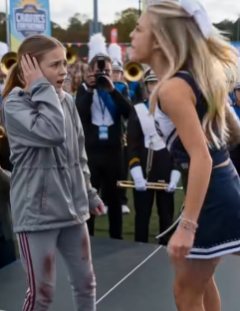
Charlotte was standing beside her mother, surrounded by committee members. Her arms were folded tightly, but her chin was trembling. Mrs. Kensington was speaking fast, waving one manicured hand through the air as though money and reputation could erase what hundreds had witnessed.
I did not answer the medic right away.
Because the truth was, I was angry.
Not the loud kind of angry Charlotte had shown.
Mine was quieter.
Deeper.
The kind that had been collecting for years.
I was angry that people like Charlotte could walk into a place and assume the brightest spot belonged to them. I was angry that my old shoes made people underestimate me. I was angry that my mother worked double shifts and still apologized when dinner was simple. I was angry that I had spent so much of my life trying not to take up space.
But beneath the anger was something heavier.
Exhaustion.
I was tired of proving I mattered.
My best friend, Mia, slipped under the rope barrier and ran to me. Her dark curls bounced around her face.
“Emma,” she breathed, grabbing my hands. “That was insane. Are you okay?”
“I think so.”
“She pulled your hair like a cartoon villain.”
Despite everything, I almost laughed.
Then Mia’s eyes softened.
“They finally saw you,” she said.
I looked down.
“I wasn’t trying to be seen.”
“I know,” she whispered. “That’s why it matters.”
Before I could respond, a voice came from behind us.
“Emma Hayes?”
I turned.
A man in a navy coat stood there with a microphone clipped to his collar. Beside him was a camera operator.
“I’m Daniel Reed from Channel 8. Would you be willing to give a brief interview?”
My stomach dropped.
“No,” I said immediately.
Mia squeezed my hand, trying not to smile at my panic.
The reporter nodded respectfully. “Completely understandable.”
But before he could leave, Ms. Price approached.
“Emma,” she said gently, “you do not have to speak to anyone. But there are many children here who just watched something ugly happen. Sometimes the person who was hurt has the power to decide what the moment becomes.”
I hated how right that sounded.
My mouth went dry.
I looked at the crowd.
Students were watching me. Younger kids. Volunteers in matching shirts. Band members holding drums. Girls from Charlotte’s cheer squad looking embarrassed and unsure.
Then I saw a small boy near the front clutching a donation box. He was wearing sneakers with duct tape across one toe.
He was staring at my shoes.
Something in my chest tightened.
I stepped toward the reporter.
“Okay,” I said. “One question.”
The camera light came on.
Daniel Reed gave me a soft smile.
“Emma, after everything that just happened, what do you want people to understand?”
I looked at the giant screen, where my name still glowed above years of service I had never spoken about.
Then I looked at Charlotte.
She looked away.
I took a breath.
“I want people to understand that service isn’t supposed to be a ladder,” I said. “It’s not something you climb so people clap for you at the top. It’s something you do because someone else needs your hands for a while.”
The crowd quieted.
My voice shook, but I kept going.
“I didn’t help people because I thought it would put me at the front of a parade. Most days, I was just trying to make someone’s day less heavy. And I think… I think nobody should have to be famous to be respected.”
Mia’s eyes filled with tears.
The reporter lowered his microphone slightly, as if he knew not to interrupt.
Then he asked, “Do you still want to lead the parade?”
I looked at the road ahead.
The street was lined with flags. Families waited on sidewalks. Children sat on shoulders. Balloons lifted into the gray Ohio sky.
For a second, fear rushed through me.
Then I remembered every porch I had delivered newspapers to in the cold. Every soup ladle I had lifted. Every animal cage I had cleaned. Every trembling senior hand I had held.
I had walked through harder mornings than this.
“Yes,” I said. “But not because I’m better than anyone.”
I turned back toward the waiting volunteers.
“I’ll lead it because every person here who served deserves to be seen too.”
The applause returned, but this time it felt different.
Less like thunder.
More like a promise.
PART 4 — CHARLOTTE’S PERFECT LIFE BEGINS TO CRACK
The parade began twenty-three minutes late.
I led from the front beside the state banner, my bicycle rolling at my side because the director insisted I should walk where people could see me.
At first, I hated it.
Every cheer felt too bright. Every camera felt too close. I could still feel the sting at my scalp, and I worried people were clapping because they felt sorry for me.
But then something changed.
An elderly woman near the curb stood up from her folding chair.
“Emma!” she called.
I turned.
It was Mrs. Alvarez from Maple Grove Senior Center. She was wrapped in a purple scarf, leaning on her cane, tears streaming down her wrinkled cheeks.
“You never missed a Thursday!” she shouted.
My throat closed.
I pressed my hand over my heart.
A few blocks later, children from the animal shelter waved handmade signs.
THANK YOU, EMMA!
One of the dogs I used to walk barked wildly from behind a volunteer’s legs.
Then came families from the food pantry.
A man I recognized from winter deliveries lifted his little daughter onto his shoulders.
“She brought us groceries when our car broke down!” he yelled to the crowd.
People turned to look at me.
Not as a poor girl.
Not as a girl with worn shoes.
As someone whose small acts had left fingerprints all over the city.
By the time we reached the main square, I was crying openly.
I was not ashamed.
Behind me, the bands played louder. Volunteers marched with new energy. The entire parade seemed to swell around one idea: maybe quiet kindness was not invisible after all.
But Charlotte did not march.
She had been removed from her position with the cheer squad pending review. Her teammates continued without her, though their smiles looked uncertain.
I did not see Charlotte again until after the parade, when everyone gathered near the civic auditorium for the awards ceremony.
She was standing behind a column, alone.
Her mother was nowhere nearby.
For once, Charlotte did not look polished. Her ponytail had loosened. Her makeup had smudged. Her arms hung at her sides.
I should have kept walking.
Part of me wanted to.
But something about her expression stopped me.
She looked like a person watching her own reflection break.
I approached slowly.
“Charlotte.”
She flinched when she heard my voice.
Then she laughed bitterly. “Come to enjoy it?”
“No.”
“You should. Everyone else is.”
“That’s not true.”
Her eyes flashed. “Please. I saw them filming me. I saw the posts going up. My mom is furious. The committee is probably going to ban me. My team won’t even look at me.”
I said nothing.
Charlotte wiped under one eye quickly, angry at the tear before it could fall.
“I made one mistake.”
I felt the old anger rise again.
“You didn’t make one mistake,” I said quietly. “You decided I wasn’t worth respecting before you knew anything about me. Then you hurt me because you thought losing a spotlight was worse than hurting a person.”
Her face crumpled for half a second.
Then she whispered, “You don’t know what it’s like.”
I almost laughed, but there was too much pain in her voice.
“What what’s like?”
“To have everyone watching,” she said. “All the time. Waiting for you to win. Waiting for you to be perfect. Waiting for you to prove your family deserves their name on every billboard in the state.”
I stared at her.
For the first time, I noticed how young she looked.
Not glamorous.
Not powerful.
Just sixteen and terrified.
“My mom told everyone I was going to lead,” Charlotte said. “Before the committee announced it. She said it was obvious. She said people like us create opportunity, and people like you should be grateful to participate.”
The words landed between us like broken glass.
Charlotte looked ashamed the moment she said them.
“That’s horrible,” I whispered.
“I know.”
“Do you believe that?”
She did not answer.
That was answer enough.
Then the auditorium doors opened, and Ms. Price stepped out.
“Emma,” she called. “We’re ready for you.”
Charlotte stepped back into the shadow.
I looked from Ms. Price to Charlotte.
Something inside me shifted.
Not forgiveness.
Not yet.
But understanding had opened a small, painful door.
“Come inside,” I said.
Charlotte stared at me.
“What?”
“You should hear the awards.”
Her face twisted. “Why would I do that?”
“Because running away won’t make today disappear.”
For a moment, I thought she would snap at me again.
Instead, she whispered, “I don’t think I can walk in there.”
I remembered the boy with duct-taped shoes. I remembered being looked at and underestimated. I remembered wanting to vanish.
So I said the one thing no one had said to me when I needed it.
“You don’t have to walk in alone.”
PART 5 — THE AWARD NO ONE EXPECTED
The auditorium was packed.
Rows of students filled the seats. Parents stood along the walls. Reporters clustered in the back. The stage lights glowed gold against a deep blue curtain.
When I entered, the room erupted.
I froze.
Charlotte froze beside me.
Every head turned.
The applause was for me, but the whispers were for her.
I could feel Charlotte shrinking under them.
For a strange moment, I understood that being hated publicly was its own kind of cage.
I walked forward, and after one hesitant second, Charlotte followed at a distance.
Ms. Price met my eyes. She noticed Charlotte, but her expression did not change. That made me respect her even more.
The ceremony began with music from a youth orchestra. Then came speeches from state leaders, scholarship announcements, and recognition for student groups.
I tried to listen, but my mind kept drifting.
My mother sat in the second row beside Mia, clutching tissues in both hands. Every time I looked at her, she smiled like she was trying to hold herself together for me.
Then Ms. Price returned to the podium.
“And now,” she said, “we present the highest individual honor awarded by the Ohio Youth Service Council.”
My stomach tightened.
“This year’s recipient has demonstrated extraordinary commitment not only through hours served, but through consistency, humility, and measurable impact. Her work has reached food-insecure families, isolated seniors, animal rescue organizations, public schools, emergency drives, and neighborhood safety efforts.”
The screen behind her lit up again.
My name appeared.
THE HEART OF OHIO YOUTH SERVICE AWARD — EMMA HAYES
Everyone stood.
I could not breathe.
Mia screamed so loudly that several people laughed through their tears.
My mother pressed both hands to her face.
I walked onto the stage in a daze.
Ms. Price handed me a glass plaque shaped like a flame.
It was heavier than I expected.
“This award includes a full scholarship fund,” she said softly, away from the microphone. “Enough for college tuition at any Ohio public university.”
For a second, I thought I had misheard.
“What?”
She smiled.
“You earned it.”
The room blurred.
College had always been a dream I kept folded quietly in the back of my mind, like a letter I was afraid to open. My mother and I never talked about it directly because numbers had a way of crushing hope before it could stand.
But now Ms. Price was placing the future in my hands.
I turned toward the audience.
My mother was sobbing.
So was I.
The microphone waited.
I had not prepared a speech. I had not prepared for any of this. My hands trembled around the plaque.
“I don’t know what to say,” I began.
A gentle laugh moved through the room.
Then I looked at my mother.
Actually looked.
At the tiredness under her eyes. At the coat she had patched twice. At the hands that had packed my lunches even when there was barely enough for dinner.
“My mom used to tell me something when things got hard,” I said. “She said, ‘Emma, when you don’t have much to give, give what you can carry.’”
My voice broke.
“So I carried grocery bags. I carried newspapers. I carried blankets. I carried books into senior homes. I carried scared cats at the shelter and trash bags in the park.”
I wiped my cheek.
“But I need everyone to know something. I did not carry any of it alone.”
The audience quieted.
“There were volunteers beside me every time. Teachers who signed forms. Drivers who gave rides. Pantry workers who stayed late. Seniors who told me stories when I thought I was there to help them, but really they were helping me. And my mom…”
I turned fully toward her.
“My mom carried me.”
She bent forward, crying into her hands.
The room stood again.
I waited until the applause softened.
Then my eyes found Charlotte near the side aisle.
She looked devastated.
I do not know why I said what I said next. Maybe because the day had already become impossible. Maybe because my heart had been cracked open and something brave slipped out.
“I also want to say,” I continued, “that today started with pain. Someone hurt me. Someone said I didn’t belong.”
The room became stone-still.
Charlotte’s face went white.
I held the plaque tighter.
“But I don’t want this award to become a weapon. I don’t want anyone using my service to humiliate another girl.”
A murmur spread.
I kept going.
“What happened was wrong. It matters. It should have consequences. But if service has taught me anything, it’s that people are more than their worst moment.”
Charlotte’s eyes filled.
“And sometimes the people who seem strongest are carrying things we cannot see.”
The room was silent now.
Completely silent.
I took a breath.
“So I accept this award with gratitude. But I also ask that we remember why we are here. Not to decide who deserves shame. To decide what kind of people we become after we are shown the truth.”
When I stepped back, no one clapped at first.
Then one person did.
My mother.
Slowly, the entire auditorium followed.
And in the side aisle, Charlotte Kensington covered her face and cried.
PART 6 — THE APOLOGY THAT WASN’T ENOUGH
After the ceremony, everything became chaos.
People wanted photos. Reporters wanted interviews. Students wanted to shake my hand. Volunteers hugged me until my ribs hurt.
But all I wanted was my mother.
I pushed through the crowd and fell into her arms.
She held me like I was still small enough to carry.
“My brave girl,” she whispered.
“I got a scholarship, Mom.”
“I heard.”
“I can go.”
Her arms tightened.
“You were always going to go,” she said, though we both knew how much fear had lived beneath that hope.
Mia joined us, crying and laughing at the same time.
“Emma Hayes, parade queen, state legend, future college genius,” she said.
“Please stop.”
“Never.”
For a few minutes, happiness was simple.
Then Charlotte appeared.
The crowd around us slowly noticed. Conversations faded. Phones lifted.
Charlotte looked at them and swallowed.
Her mother was behind her, gripping her elbow.
“Stand straight,” Mrs. Kensington muttered.
Charlotte pulled her arm away.
That small movement changed the air.
She stepped toward me.
“I need to apologize,” she said.
A dozen cameras turned.
I glanced at them.
Charlotte did too. Her face hardened with embarrassment, but she did not run.
“I’m sorry,” she said. “For grabbing your hair. For saying you didn’t deserve the parade. For acting like being known was the same as being worthy.”
Her voice shook.
“I was jealous. And humiliated. And scared of disappointing my mother.”
Mrs. Kensington made a sharp sound.
“Charlotte.”
But Charlotte kept speaking.
“That doesn’t excuse it. Nothing excuses it. I hurt you because I thought losing made me small. But I was already making myself small by treating you like you were beneath me.”
The room seemed to hold its breath.
I studied her face.
There was no performance in it now.
Only shame.
Only a girl standing in the wreckage of what she had chosen.
“Thank you,” I said quietly.
Relief flickered across her face.
But I was not finished.
“I’m not ready to forgive you.”
Her relief vanished.
Mrs. Kensington’s mouth tightened.
I forced myself to continue.
“I appreciate the apology. I believe you mean it right now. But you embarrassed me, hurt me, and tried to take something from me in front of everyone. Forgiveness isn’t something I owe you because you feel bad.”
Charlotte nodded slowly.
A tear slipped down her cheek.
“You’re right.”
That surprised me.
Her mother looked furious.
Ms. Price stepped forward.
“Charlotte, the council has reviewed the incident. You will not participate in the remainder of today’s honors. Your leadership eligibility is suspended pending a restorative review.”
Mrs. Kensington exploded.
“This is absurd. Do you know how much our foundation contributes to youth programs in this state?”
Ms. Price’s expression cooled.
“Yes,” she said. “And do you know how many young people here contribute without asking what their name buys them?”
The words sliced cleanly through the room.
Mrs. Kensington went red.
Charlotte whispered, “Mom, stop.”
“No. I will not stop. This family has built opportunities for girls like you.”
She looked at me when she said it.
My mother stepped forward.
The entire room shifted.
My mother was not rich. She was not powerful. She did not own a fitness empire or have billboards across Ohio.
But when she stood between Mrs. Kensington and me, she looked taller than anyone there.
“Girls like my daughter,” my mother said, voice trembling but firm, “do not need you to build them worth. They already have it.”
A silence fell so sharp it almost hurt.
Mrs. Kensington looked stunned.
Charlotte looked at my mother as if she had just seen a kind of courage she had never been taught.
Then Charlotte did the second surprising thing of the day.
She turned to Ms. Price and said, “I accept the suspension.”
Her mother stared at her.
“What did you say?”
Charlotte inhaled shakily.
“I said I accept it. And I want to complete the restorative review without your lawyers.”
Mrs. Kensington’s face hardened into something cold and wounded.
“You are embarrassing this family.”
Charlotte’s voice became very small.
“No, Mom. I think I already did. But I’m trying not to keep doing it.”
For the first time all day, I felt something like hope for her.
Not because she apologized.
Because she had begun telling the truth when it cost her something.
PART 7 — THE SECRET BENEATH THE BINDER
Two weeks passed.
The video went viral.
I hated that phrase, but there was no escaping it. The clip of Charlotte grabbing my hair, the achievement list appearing, my speech, my mother’s words — all of it spread across the state and then beyond.
People called me inspiring.
People called Charlotte spoiled.
People called my mother a hero.
Reporters wanted our story. Schools requested me as a speaker. Donations poured into the food pantry and senior center.
And yet, real life continued.
My alarm still rang before sunrise.
The newspapers still needed delivering.
My bicycle still rattled.
But now, people waved when I passed.
One morning, I found a new pair of sneakers on our porch with a note that read:
For the girl who walked Ohio into remembering what matters.
I cried before school.
Charlotte disappeared from social media.
Rumors said her mother had taken away her phone, then that Charlotte had quit cheerleading, then that she had been sent to some private training camp. I did not know what was true.
Then, on a rainy Thursday, I arrived at Maple Grove Senior Center and found her in the lobby.
Charlotte Kensington stood beside the volunteer desk wearing plain jeans, a gray hoodie, and no makeup. Her blond hair was tied back simply.
She looked terrified.
“What are you doing here?” I asked.
She held up a volunteer form.
“Restorative review requirement,” she said. Then, after a pause, “And… I wanted to.”
I did not know what to say.
Mrs. Alvarez rolled her wheelchair toward us from the common room.
“Oh good,” she said brightly. “Another young person. My bingo luck has been terrible, and I require witnesses.”
Charlotte blinked.
I laughed before I could stop myself.
That first afternoon was awkward.
Charlotte did not know how to talk to the residents. She spoke too loudly, like she was addressing judges at a competition. She tried to compliment everyone and somehow made half of it sound rehearsed.
But then Mr. Donnelly asked her to help sort old photographs.
Something changed.
He showed her a black-and-white picture of his wife at nineteen.
Charlotte leaned closer.
“She was beautiful,” she said softly.
“She was a menace,” Mr. Donnelly replied. “Stole my car twice before she agreed to marry me.”
Charlotte laughed.
Not her polished laugh.
A real one.
By the end of the afternoon, she was sitting cross-legged on the floor, organizing photographs into shoeboxes while three residents argued over whether the 1978 county fair had been ruined by rain or goats.
When we left, she stood with me under the awning.
Rain dripped from the edge of the roof.
“I didn’t know places like this were so…” She searched for the word.
“Alive?” I offered.
She nodded.
“Yeah.”
For weeks, she kept coming.
At first, people watched her suspiciously. Some still whispered. But Charlotte showed up every Thursday. Then Saturdays. Then she volunteered at the food pantry too.
She made mistakes.
A lot of them.
She once put canned peaches in the cleaning supply box. She cried after a senior snapped at her. She wore expensive white shoes to a muddy park cleanup and ruined them in ten minutes.
Mia still did not trust her.
“She’s doing community service because she got caught,” Mia said one afternoon.
“Maybe.”
“Emma.”
“I know.”
“You don’t have to rescue everybody.”
I looked across the food pantry, where Charlotte was helping a little boy choose cereal. She crouched down so they were eye-level and listened seriously as he explained why marshmallow shapes mattered.
“I’m not rescuing her,” I said. “I’m watching what she chooses.”
Then came the day everything changed again.
Ms. Price called me to the council office.
When I arrived, Charlotte was already there, sitting rigidly in a chair. Her face was white.
On the desk between us lay the same large binder from the parade.
But this time, it was open to a page I had never seen.
Ms. Price looked troubled.
“Emma,” she said, “there is something you need to know.”
My stomach tightened.
“What happened?”
She turned the binder toward me.
It showed nomination records for the parade leader.
My name appeared several times, submitted by volunteer supervisors, teachers, and community members.
Then I saw another nomination.
Submitted three months before the parade.
For me.
By Charlotte Kensington.
I stared at the page.
“That can’t be right.”
Charlotte looked down at her hands.
Ms. Price spoke gently.
“It is right. Charlotte nominated you before she knew her mother expected her to receive the position.”
My mind went blank.
I turned to Charlotte.
“You nominated me?”
Her voice was barely audible.
“Yes.”
“Why?”
She swallowed hard.
“Because I saw you once.”
I frowned.
“At the winter shelter,” she said. “Last year. My mother’s foundation made a donation, and we went for photographs. I was supposed to hand out branded water bottles and smile.”
Her face twisted with embarrassment.
“There was a woman outside who wouldn’t come in. She was crying because her son was sick, and she thought people would judge her. Everyone kept walking past because the photographer was waiting. But you sat down on the curb with her in the snow.”
The memory returned slowly.
A woman in a green coat.
A little boy coughing into her scarf.
Me sitting beside them until she trusted me enough to come inside.
Charlotte’s eyes filled.
“You gave her your gloves,” she said. “Then you went back to carrying boxes like nothing happened. No camera. No speech. No one praising you.”
She wiped her cheek.
“I went home and couldn’t stop thinking about it. So I found out who you were and nominated you.”
I could barely breathe.
“Then why did you act like that?”
Charlotte gave a broken laugh.
“Because my mother found out I nominated someone else. She was furious. She said I had humiliated her by admitting another girl was more deserving. Then she started telling sponsors I was going to lead anyway. She said the committee would come around.”
Her voice cracked.
“When they chose you, I didn’t just lose. I had to face the fact that I was the one who helped them see you. And instead of being proud, I panicked. I became exactly the kind of person I hated watching my mother be.”
The room was silent.
The shocking truth settled over me.
The girl who tried to take the parade from me was the same girl who had secretly opened the door.
I did not know whether to feel angry, grateful, or heartbroken.
Maybe all three.
Ms. Price closed the binder.
“I thought you deserved to know,” she said.
Charlotte stood abruptly.
“I’m sorry,” she whispered. “Again. For all of it.”
She walked out before I could answer.
I sat there staring at the closed binder.
And for the first time, forgiveness did not feel like letting her off the hook.
It felt like unlocking a door neither of us knew we were trapped behind.
PART 8 — THE END — THE PARADE THAT CAME BACK HOME
Spring arrived slowly in Ohio.
Snow melted from sidewalks. Bare trees filled with green. The city smelled like rain, cut grass, and new beginnings.
The Youth Service Council announced a new initiative inspired by the parade controversy: a statewide youth volunteer challenge called Carry What You Can.
They asked me to help launch it.
I said yes on one condition.
Charlotte had to help too.
Ms. Price raised an eyebrow when I told her.
“Are you sure?”
“No,” I admitted. “But I think it matters.”
The launch event was held in our city park on a Saturday morning. No giant stage. No VIP section. No polished spotlight.
Just folding tables, donation bins, work gloves, paint buckets, food pantry vans, shelter volunteers, students, parents, seniors, and kids with eager faces.
I arrived wearing my new sneakers.
My old shoes were in my closet now. I could not throw them away. They had carried me through too much.
Charlotte arrived early.
She wore a volunteer shirt and jeans with paint stains from the week before. Her mother was not with her.
“You came,” I said.
She smiled nervously.
“I said I would.”
Together, we unpacked boxes of supplies.
For the first hour, things went smoothly. Students registered for projects. Families dropped off canned food. Animal shelter volunteers brought dogs for adoption. Seniors from Maple Grove ran a storytelling table where children wrote down their memories.
Then a black car pulled up near the curb.
Mrs. Kensington stepped out.
The air around Charlotte changed instantly.
Her shoulders tightened. Her smile disappeared.
Mrs. Kensington walked toward us with purpose, dressed as if she had mistaken a park cleanup for a business gala.
“Charlotte,” she said. “We need to talk.”
Charlotte glanced at me.
I stayed beside her.
Mrs. Kensington noticed and sighed.
“This has gone far enough. You have made your point. You volunteered. You apologized. Now it is time to return to your actual life.”
Charlotte’s hands curled around a cardboard box.
“This is my actual life.”
Her mother’s eyes narrowed.
“Do not be dramatic.”
“I’m not.”
“You have training. Interviews. Your team needs you. Our brand needs stability.”
Charlotte looked pale, but she did not step back.
“For years, you told me leadership meant being admired,” she said. “But Emma showed me something else.”
Mrs. Kensington’s gaze flicked to me with irritation.
I expected Charlotte to stop there.
She didn’t.
“Leadership is not standing where cameras point,” Charlotte said. “It’s staying when nobody claps. It’s doing the work when your name isn’t on the banner. It’s admitting when you hurt someone and changing even when people still remember.”
Her voice trembled, but it grew stronger.
“I don’t want to be your billboard anymore.”
People nearby had gone quiet.
Mrs. Kensington’s face hardened.
“You would throw away everything we built?”
Charlotte shook her head.
“No. I’m trying to save whatever part of me is still real.”
For a moment, Mrs. Kensington looked less angry than wounded. Then she turned and walked back to the car without another word.
Charlotte watched her go, tears slipping silently down her face.
I touched her arm.
“You okay?”
“No,” she whispered. Then she breathed in. “But I think I will be.”
The event continued.
By noon, the park was alive with motion.
Students painted benches. Families packed meal kits. Seniors laughed with teenagers. Volunteers loaded trucks with coats, books, canned goods, and pet supplies.
And then came the final surprise.
Ms. Price called everyone toward the small pavilion.
“I have one more announcement,” she said.
I groaned softly. “Why do announcements keep happening around me?”
Charlotte laughed.
Ms. Price smiled at us both.
“The Carry What You Can challenge has already received commitments from schools in all eighty-eight counties. But it also received an anonymous donation this morning.”
The crowd murmured.
“This donation will fund transportation for low-income students who want to volunteer but cannot reach service sites.”
My chest tightened.
Transportation.
Rides.
The one thing that had almost stopped me so many times.
Ms. Price continued.
“The donor requested that the fund be named after the student whose example inspired it.”
She turned toward me.
“The Emma Hayes Access Fund.”
I covered my mouth.
My mother, standing near the pantry van, burst into tears immediately.
But Ms. Price was not done.
“The donor also requested that the first volunteer van be dedicated to someone else.”
She looked at Charlotte.
“To the young person who reminded us that people can change when truth is stronger than pride.”
Charlotte stared.
Ms. Price gestured toward the parking lot.
A white passenger van rolled forward slowly, decorated with blue ribbons.
On the side, painted in bold letters, were the words:
THE SECOND CHANCE VAN
Underneath, in smaller letters:
NO ONE WALKS ALONE WHEN THEY ARE TRYING TO DO BETTER.
Charlotte broke.
She sat down on the grass and cried so hard that Mia, after weeks of suspicion, walked over and handed her a tissue.
“Don’t make it weird,” Mia muttered.
Charlotte laughed through her tears.
“I won’t.”
I turned to Ms. Price.
“Who donated it?”
She only smiled.
Then I saw him.
Mr. Donnelly from Maple Grove, sitting in his wheelchair near the pavilion, wearing his best hat.
He winked at me.
Later, I learned he had quietly sold a collection of rare baseball cards he had kept for fifty years.
When I asked him why, he shrugged.
“Couldn’t take them with me,” he said. “Figured a van would do more good than cardboard in a drawer.”
That was when I cried again.
The day ended with no parade route, no stage lights, and no competition for the front position.
Instead, everyone walked together through the park carrying boxes to the waiting trucks.
I walked beside my mother.
Charlotte walked beside Mia.
Mrs. Alvarez rolled proudly ahead of us holding a tiny flag.
The little boy with duct-taped shoes rode in the new van’s passenger seat for its first delivery, grinning like royalty.
As the sun lowered over the park, Charlotte came to stand beside me.
“I don’t know if I deserve to be here,” she said.
I looked at the volunteers, the filled trucks, the laughing seniors, the children running across the grass.
“Maybe deserving isn’t the first step,” I said. “Maybe showing up is.”
She nodded.
Then, after a long silence, she said, “Do you forgive me?”
The question hung between us.
This time, it did not feel like pressure.
It felt like a bridge.
I thought about the pain, the humiliation, the apology, the secret nomination, the van, the work, and the girl beside me who was still learning how to become herself.
Finally, I said, “I’m starting to.”
Charlotte smiled through fresh tears.
“That’s more than I expected.”
“It’s more than I expected too.”
We stood together as the last truck pulled away, carrying food, blankets, books, and hope into neighborhoods that needed them.
And I realized the shocking ending was not that I had led a parade.
It was not the award, the scholarship, the viral video, or even the secret that Charlotte had nominated me.
The real surprise was that the girl who tried to pull me backward had accidentally helped push me forward — and in the end, we both learned how to walk differently.
Months later, when I left for college, I packed the glass award, my volunteer shirts, and my old worn-out shoes.
On the first page of a new notebook, I wrote my mother’s words:
When you don’t have much to give, give what you can carry.
Then I added one line of my own.
And when your hands get tired, let someone learning kindness carry it with you.
Because service was never about standing at the front.
It was about making sure no one was left behind.
And that was the parade I wanted to lead for the rest of my life.
