PART 2 — THE RECORDING THAT SILENCED THE SHIP
“Commander Shaw ordered us to delay the first rescue approach.”
Those were the first words that came from the satellite phone.
No one moved.
The Gulf wind swept across the deck, carrying the smell of smoke, salt, diesel, and burned metal. Behind us, the rescue vessel rocked gently in the harbor as if the sea itself was holding its breath.
I was still on one knee.
My leg throbbed where Travis had kicked me, but the pain in my body was nothing compared to the shock spreading through the crew.
Commander Travis Shaw froze.
The color drained from his face, but only for a second. Then his jaw tightened, and he turned toward the oil rig supervisor like a man preparing to attack a witness in court.
“Turn that off,” Travis barked.
The supervisor, a broad-shouldered man named Daniel Mercer, did not obey.
He raised the phone higher.
The audio continued.
There was static, then a voice.
Travis’s voice.
“Do not authorize Cole for primary extraction. Hold her team in pattern until my command.”
A murmur moved through the deck.
My heart slammed against my ribs.
I remembered that moment.
We had been approaching the rig from the east, wind hammering the aircraft, smoke swallowing half the horizon. I had radioed that we had visual on at least four trapped workers. I had asked for clearance to begin hoist operations.
For nearly two minutes, no clearance came.
Two minutes in a burning rig is not a delay.
It is a death sentence.
I had broken formation anyway.
I had made the call.
I had told my crew, “We’re going in.”
At the time, I assumed the silence was communication overload.
Now I knew better.
Travis lunged toward Daniel. “That recording is classified operational material.”
Daniel stepped back, eyes blazing. “Classified? My men were burning alive.”
A second voice came through the phone. It was me, strained but steady over the helicopter comms.
“Rescue One requesting immediate authorization. I have workers visible on the upper west platform. Fire is moving toward them.”
Then Travis again.
“Negative. Maintain position.”
My flight mechanic, Ortiz, whispered, “Oh my God.”
Another voice entered the recording, younger, terrified. It belonged to one of the trapped workers.
“Please, we can see the helicopter. Why aren’t they coming? Please!”
The deck changed after that.
It was not silence anymore.
It was judgment.
Every eye shifted from the phone to Travis.
Travis’s mouth opened, but no words came out.
Daniel lowered the satellite phone slowly. “Federal investigators pulled communications from our emergency system. They wanted to know why the first extraction was delayed.”
I stood, ignoring the pain shooting down my leg.
“Why?” I asked.
One word.
That was all I could force out.
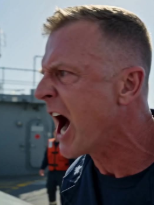
Travis looked at me with pure hatred.
Not embarrassment.
Not guilt.
Hatred.
“You think this is about you?” he snapped. “You were reckless. You disobeyed command. You put the crew at risk.”
I took one step toward him. “I saved men you ordered me to leave behind.”
His eyes flashed.
“You saved your career.”
That struck harder than the kick.
Because for years I had watched Travis Shaw build himself into a legend. He smiled for cameras, shook hands with politicians, gave speeches about sacrifice and courage. He wore heroism like a uniform pressed cleaner than anyone else’s.
But behind closed doors, he had always treated people like pieces on a board.
Especially me.
At first, it had been small.
A mission reassigned.
A commendation delayed.
A training slot mysteriously denied.
Then came the whispers. Too emotional. Too ambitious. Too visible.
And now this.
A federal investigator stepped onto the deck from the gangway.
She wore a navy jacket, her hair pulled into a tight bun, her expression sharp enough to cut rope.
“Commander Shaw,” she said, “step away from Lieutenant Commander Cole.”
Travis stared at her. “Who the hell are you?”
“Special Agent Mara Vance. Department of Homeland Security, Office of Inspector General.”
That name spread through the crew like lightning.
Agent Vance walked directly to me first.
“Lieutenant Commander Cole, are you injured?”
I looked at Travis, then back at her.
“My leg hurts,” I said. “But I’m standing.”
Her gaze softened for half a second.
Then she turned toward Travis.
“Commander Shaw, you are being relieved of operational authority pending investigation.”
The deck erupted.
Travis laughed once, a sharp, ugly sound. “You can’t relieve me on the deck of my own vessel.”
Agent Vance held up a folder.
“Actually, Commander, your own emergency communication records already did.”
Two Coast Guard officers stepped forward.
For the first time since I had known him, Travis Shaw looked afraid.
Not because he had kicked me.
Not because he had endangered workers.
But because cameras were gone.
He had no audience left to manipulate.
PART 3 — THE HERO THEY TRIED TO BURY
They escorted Travis off the deck without handcuffs, but everyone saw the truth.
His shoulders were stiff.
His face was red.
His hands curled and uncurled at his sides as if he was fighting the urge to explode.
When he passed me, he leaned close enough that only I could hear him.
“This isn’t over, Jasmine.”
I did not flinch.
“No,” I said quietly. “It’s finally starting.”
His eyes burned.
Then he was gone.
The crew remained frozen for several seconds, caught between celebration and fear. We had rescued every worker alive. We should have been laughing, crying, calling families, thanking God.
Instead, we stood on deck beside the wreckage of something more poisonous than fire.
Power.
Agent Vance asked to speak with me privately.
She led me into a small conference room below deck. The walls vibrated softly with the ship’s engines. Someone had placed a pot of coffee on the table, but it smelled old and bitter.
I sat across from her.
She did not waste time.
“Lieutenant Commander Cole, how long has Commander Shaw interfered with your assignments?”
I almost answered like an officer.
Carefully.
Professionally.
With clean words that did not bleed.
Then I remembered the worker hanging from damaged steel. I remembered his hands slipping. I remembered the way his eyes had met mine when we pulled him into the helicopter.
And I remembered Travis kicking me in front of everyone.
So I told the truth.
“All of it?” I asked.
Agent Vance clicked her pen.
“All of it.”
I told her about the rescue in Barataria Bay, when my report disappeared and Travis received praise for decisions he never made.
I told her about the hurricane evacuation when he grounded me for “fatigue concerns” after I questioned a dangerous route he had approved.
I told her about the training evaluation he altered, the commendation he blocked, the rumors he spread.
Then I told her something I had never told anyone outside my family.
“My father served with him.”
Agent Vance looked up.
“Chief Petty Officer Marcus Cole?”
My breath caught.
She already knew.
I nodded.
“My father died during a rescue operation twelve years ago. Travis was the ranking officer coordinating from shore.”
Agent Vance’s expression changed—not surprise, but confirmation.
“Did your father ever speak to you about Commander Shaw before his death?”
I stared at the table.
The ship groaned around us.
“Yes,” I said. “He said Travis was dangerous.”
Agent Vance waited.
I swallowed.
“He said Travis cared more about appearing heroic than being useful. He said one day people would die because of his pride.”
The words hurt coming out.
Because my father had been right.
Agent Vance opened the folder.
Inside were printed transcripts, call logs, internal memos, and photographs of the burning rig.
“There is more,” she said.
My stomach tightened.
She slid a page toward me.
It was a personnel transfer request.
My name was on it.
Denied.
Signed by Travis Shaw.
Reason: “Emotional instability connected to unresolved family trauma.”
A cold laugh escaped me.
“He used my father’s death against me.”
Agent Vance nodded. “Repeatedly.”
I looked at the page until the letters blurred.
For years I had blamed myself for every door that closed.
I had worked harder.
Flown longer.
Trained until my hands shook.
I had believed excellence would eventually become undeniable.
But Travis had not been competing with me.
He had been burying me.
Agent Vance leaned forward.
“Lieutenant Commander Cole, I need to ask you something difficult.”
I looked up.
“During today’s rescue, when Commander Shaw ordered you to hold position, why did you disobey?”
The question took me back to the smoke.
To the alarm tones.
To my crew watching me.
To the trapped workers waving desperately through flames.
I answered without hesitation.
“Because I could see them.”
Agent Vance’s pen stopped.
I continued.
“And because when people are dying in front of you, rank does not excuse cowardice.”
She studied me for a long moment.
Then she closed the folder.
“That sentence may matter more than you realize.”
PART 4 — THE MAN IN BED SEVEN
That evening, I went to the hospital.
Not because anyone ordered me to.
Because Daniel Mercer called and said one of the rescued workers had asked for me by name.
My leg had swollen badly by then, but I refused a wheelchair. I limped through the hallway in a borrowed jacket, past nurses, families, and reporters camped near vending machines like vultures with cameras.
The burn unit smelled like antiseptic and fear.
Daniel met me outside room seven.
“He’s awake,” he said softly. “His name is Eli Navarro. He was the one hanging from the west support beam.”
I remembered him instantly.
He had been suspended above a section of twisted platform, smoke whipping around him, one boot gone, blood on his forehead. When Ortiz lowered the basket, Eli had hesitated.
Not from fear.
From guilt.
He kept pointing downward.
There were men below him.
I had shouted into the headset, “Tell him we’ll come back.”
Ortiz had screamed over the rotor noise, “He says take them first!”
But there was no time.
We took Eli.
Then we went back.
Now Eli was in bed seven, his left arm bandaged, one side of his face bruised purple, but his eyes were alive.
When he saw me, he tried to sit up.
“Don’t,” I said, rushing forward.
He smiled weakly.
“You’re shorter than you looked from the sky.”
A laugh broke out of me before I could stop it.
“You were upside down and covered in smoke. Your perspective was compromised.”
His smile faded.
Then tears filled his eyes.
“My daughter,” he whispered. “She turns six next month.”
I nodded.
“You’ll be there.”
He covered his mouth with his bandaged hand.
For a moment, he was not an oil worker, not a survivor, not a news headline.
He was just a father who had almost vanished before breakfast.
“Thank you,” he said. “Not just for me.”
He pointed toward the chair beside him.
A woman sat there, small and trembling, clutching a pink backpack to her chest. I had not noticed her in the dim light.
“This is my wife, Rosa.”
Rosa stood slowly.
She did not speak.
She crossed the room and wrapped her arms around me.
The hug was gentle because of my uniform and her fear of hurting me, but it broke something open inside my chest.
I had held myself together through fire, accusation, pain, investigation.
But Rosa whispered, “You brought my home back,” and I almost fell apart.
When she released me, Eli reached toward the drawer beside his bed.
“There’s something you need to see,” he said.
Daniel stiffened.
“Eli—”
“No,” Eli said. “She deserves to know.”
From the drawer, Rosa pulled out a plastic evidence bag.
Inside was a small waterproof action camera, cracked along one corner.
Eli looked at me.
“I wore it on my helmet. It recorded everything before I fell.”
My pulse quickened.
“What did it record?”
His eyes moved to Daniel.
Daniel exhaled heavily.
“It recorded the first explosion,” he said. “And something before it.”
Rosa handed the bag to me.
I did not open it.
The camera felt heavier than it should have.
Eli’s voice dropped.
“Before the rig blew, one of our maintenance supervisors was arguing over radio with someone from command support. He kept saying the pressure readings were wrong and the evacuation should start immediately.”
I gripped the edge of the bed.
“And?”
Eli’s eyes hardened.
“And the voice told him to keep production steady until the inspection team arrived.”
The room seemed to tilt.
“Whose voice?” I asked.
Eli’s answer was barely above a whisper.
“I heard it today on the deck.”
My blood turned cold.
“Travis.”
Eli nodded.
“He didn’t just delay your rescue, Lieutenant Commander.”
His eyes filled with horror.
“I think he helped delay the evacuation before the rig exploded.”
PART 5 — THE FIRE BEFORE THE FIRE
Agent Vance arrived at the hospital less than twenty minutes later.
She watched the footage in a closed administrative office with Daniel, me, and two federal evidence technicians.
The video began in darkness.
Eli’s helmet light swept over pipes, steel grating, warning labels, and men moving quickly through narrow walkways. Alarms sounded in the background, not full emergency alarms yet, but enough to make every person in the room tense.
A maintenance supervisor appeared on camera.
His name badge read K. BARNES.
He was holding a radio.
“Control, this is Barnes. We have abnormal pressure on Line Three and heat spikes near the lower manifold. I’m recommending immediate shutdown and partial evacuation.”
Static.
Then a voice answered.
Not perfectly clear.
But clear enough.
“Negative. Maintain operations. Inspection team is inbound. Do not trigger evacuation unless fire is confirmed.”
Daniel cursed under his breath.
Barnes shouted back, “If we wait until fire is confirmed, we’ll be evacuating through it!”
Then another burst of static.
“Stand down, Barnes. That instruction comes from Shaw.”
I stopped breathing.
Agent Vance rewound the clip.
Played it again.
Then again.
No one spoke.
The camera shook as Eli turned toward another worker.
“Who’s Shaw?” Eli asked on the recording.
The worker answered, “Coast Guard liaison. Big shot. Been riding the company all week about false alarms making the district look bad.”
Daniel closed his eyes.
The video continued.
A deep metallic groan rolled through the structure.
Men shouted.
The camera swung hard.
Then the world became white.
The explosion blasted the image into chaos.
For several seconds there was only noise—screaming steel, roaring flame, Eli gasping, alarms wailing like living creatures.
The video cut out when he fell.
Agent Vance looked at the technician.
“Secure this immediately.”
The technician placed the camera into a federal evidence case.
Daniel slammed his fist against the desk.
“Eleven minutes,” he said.
We looked at him.
He held up a report with shaking hands.
“From Barnes’s first warning to the explosion. Eleven minutes. That was enough time to clear the west crew.”
My stomach twisted.
The west crew.
Eli’s crew.
The men I had seen trapped above fire.
The men Travis had later ordered me not to rescue first.
A pattern emerged, hideous and deliberate.
He had ignored the danger before the explosion.
Then he had tried to control the rescue afterward.
Why?
Agent Vance asked the same question aloud.
Daniel’s face turned pale.
“Because there was supposed to be a press inspection that morning,” he said slowly. “A safety compliance visit. Industry journalists, regulators, company executives. Everyone was coming.”
“And a shutdown before they arrived would embarrass people,” I said.
Daniel nodded.
“But Travis didn’t work for the company,” I said. “Why would he protect them?”
Agent Vance’s eyes were dark.
“Because he was retiring in six months.”
Daniel looked at her.
She continued.
“We are investigating whether Commander Shaw had accepted a future consulting position with a private offshore safety firm connected to the rig operator.”
The words landed like stones.
A job.
A title.
A bigger office.
A richer future.
Men had nearly died because Travis Shaw could not tolerate looking weak before people who might pay him later.
I walked to the window.
Outside, reporters gathered under hospital lights. They wanted the hero story. The clean version. Pilot saves workers. Crew celebrated. Everyone goes home.
But real rescue stories are rarely clean.
Sometimes the fire starts long before anything burns.
My phone buzzed.
A message from an unknown number.
No words.
Just a photograph.
My mother’s front porch.
Taken from the street.
Then another message.
“Tell Vance to back off, or your family learns what accidents feel like.”
I showed it to Agent Vance.
Her expression sharpened instantly.
Daniel swore again.
I felt fear rise inside me, cold and animal.
My mother lived alone in Mobile. She had already buried my father. I would not let Travis drag her into this.
Agent Vance took my phone.
“We’ll send protection.”
But I was already moving.
“Lieutenant Commander Cole,” she said.
I turned at the door.
She stepped closer.
“You are a witness now. You cannot confront him.”
I laughed once, though nothing was funny.
“Agent Vance, I don’t need to confront him.”
My hands were shaking, but my voice was not.
“I need to make sure my mother is alive.”
PART 6 — THE WOMAN WHO RAISED A STORM
My mother opened her front door holding a cast-iron skillet.
For the first time that day, I nearly smiled.
“Mom.”
She looked me up and down, saw my limp, my smoke-stained jacket, my swollen eyes, and her face changed.
“Jasmine.”
I stepped inside and locked the door behind me.
Two federal agents sat in an unmarked car outside. Another team had searched the property before I arrived. No one had found the person who took the photograph.
But fear does not leave just because danger hides.
Mom touched my cheek.
“I saw you on television,” she whispered. “Your father would have cried himself foolish.”
That broke me more than the threat.
I sank into the kitchen chair I had sat in as a child, the same chair where my father used to polish his boots, the same chair where he once taught me knots using yellow rope and patient hands.
Mom made tea because that was what she did when the world collapsed.
Then she sat across from me and said, “Tell me everything.”
So I did.
I told her about the rig, the rescue, Travis’s kick, the recording, Eli’s helmet camera, the threat.
She listened without interrupting.
When I finished, she stared into her tea.
“I knew he would come for you one day,” she said.
I frowned.
“What?”
She stood and walked to the hallway closet.
From the top shelf, she pulled down an old metal lockbox.
My father’s lockbox.
I had not seen it opened since the funeral.
Mom set it on the table and took a key from the chain around her neck.
Inside were folded uniforms, photographs, letters, and a sealed envelope with my name written in my father’s handwriting.
My throat closed.
Mom pushed it toward me.
“He told me to give you this when you were ready to know why he never trusted Travis Shaw.”
My hands trembled as I opened it.
Inside was a letter and a small flash drive.
The letter began:
My Jasmine, If you are reading this, it means the truth has finally found its way to you. I am sorry I could not carry it farther.
Tears blurred the page.
My father wrote that years before his death, Travis had falsified a rescue timeline after a failed mission. A fishing vessel had capsized in severe weather. Travis claimed he had dispatched assets immediately.
But he had waited.
He had delayed because a senior admiral was visiting the command center, and Travis did not want a messy operation unfolding during a formal briefing.
Two fishermen died.
My father discovered the altered logs.
He planned to report Travis.
Then came the rescue mission where my father died.
According to official records, severe weather caused the helicopter support delay.
But my father’s letter suggested something else.
He believed Travis had intentionally reassigned the nearest aircraft, leaving my father’s boat crew exposed without air support.
I covered my mouth.
Mom reached for my hand.
“I wanted to tell you,” she said. “But Marcus made me promise. He said evidence mattered more than grief.”
The flash drive contained copied dispatch logs, handwritten notes, and one audio file.
Mom called Agent Vance.
When Vance arrived and heard the file, she did not speak for almost a full minute.
It was my father’s voice.
Calm.
Tired.
Furious.
“This is Chief Marcus Cole. I am recording this because Commander Travis Shaw has altered operational records before, and I believe he will do it again.”
The room blurred.
My father had been dead twelve years, but his voice filled the kitchen like he had just stepped outside to check the weather.
Vance looked at me with something like sorrow.
“This changes everything.”
I wiped my face.
“No,” I said. “It explains everything.”
Then the phone rang.
Unknown number.
Agent Vance signaled for silence and activated recording.
I answered.
For three seconds, there was only breathing.
Then Travis spoke.
“You should have left the past buried.”
My mother’s hand tightened around mine.
I looked at the agents.
Then I said, “You first.”
PART 7 — THE TRAP THAT CAUGHT A LEGEND
Travis laughed softly through the phone.
“You always had your father’s arrogance.”
“And you always mistook courage for arrogance because you never had any.”
Silence.
Then his voice dropped.
“You think Vance can protect you? You think a few recordings undo decades of service?”
“No,” I said. “Your choices do.”
He breathed hard.
“You disobeyed a direct order during an active rescue. I can make this about you. I can make the public wonder whether you caused unnecessary risk. Heroes fall fast, Jasmine.”
There it was.
The old Travis.
Control the story.
Poison the witness.
Smile for cameras while burying bodies under paperwork.
Agent Vance wrote on a notepad and pushed it toward me.
KEEP HIM TALKING.
I swallowed.
“Why delay the evacuation?” I asked.
His answer came too quickly.
“I didn’t.”
“Eli’s camera says otherwise.”
Another silence.
Then a sharp inhale.
“You don’t understand what was happening.”
“Then explain it.”
“You think emergency management is simple? You think every alarm means panic? False evacuations cost millions. They weaken confidence. They create chaos.”
“Men were trapped in fire.”
“They lived.”
“Because I ignored you.”
His voice turned vicious.
“You ruined everything.”
The agents looked up.
I pressed the phone harder to my ear.
“What did I ruin, Travis?”
He spoke like a man pacing now.
“The transition. The advisory board. The federal-private partnership. Years of work. I was going to fix offshore safety from the inside.”
I almost laughed.
“You tried to fix safety by ignoring a safety warning?”
“You sound like your father.”
“Good.”
He snapped.
“Your father was going to destroy careers over one bad call. He never understood leadership. Leaders protect institutions.”
“No,” I said. “Leaders protect people.”
That was when Mom stood.
She took the phone gently from my hand before Agent Vance could stop her.
Her voice was quiet.
“Travis, this is Evelyn Cole.”
The line went dead silent.
Mom’s face was pale, but her eyes were fierce.
“I listened to my husband blame himself for those fishermen until the day he died. I watched my daughter work twice as hard because you made her believe she was never enough. I buried Marcus with questions in my heart.”
Her voice broke, then hardened.
“But tonight, I heard his voice again. And now I know something.”
Travis whispered, “Evelyn—”
“No. You don’t get to say my name like we are old friends.”
She stood straighter.
“You were never a hero. You were just a coward standing close enough to brave people that cameras got confused.”
Even Agent Vance looked stunned.
Travis screamed something unintelligible, then disconnected.
But it was enough.
The call was recorded.
The admissions were recorded.
The threat trace placed him near a private marina forty minutes away, where investigators believed he was preparing to board a vessel owned by one of the consulting firm executives.
Federal agents moved immediately.
By dawn, Travis Shaw was arrested.
Not on a stage.
Not behind a podium.
Not with medals gleaming on his chest.
He was found in a storage cabin below deck, holding a duffel bag with cash, passports, and a burner phone containing the photograph of my mother’s porch.
When the news broke, the same networks that had praised the rescue began asking harder questions.
The story was no longer just about a burning oil rig.
It was about delayed evacuations.
Falsified records.
Retaliation.
A dead rescue chief whose evidence had waited twelve years to be heard.
And a daughter who had flown into fire while the man who buried her father’s truth ordered her to wait.
PART 8 — THE END — THE SKY REMEMBERED
Three months later, I stood on a stage in Washington, D.C., wearing dress blues that still felt too heavy.
The official ceremony was supposed to honor the entire rescue crew, and I made sure it did.
Ortiz stood beside me, uncomfortable in polished shoes.
Daniel Mercer sat in the front row with Eli Navarro, Rosa, and their little daughter, Lucia, who wore a yellow dress and waved at everyone like she personally owned the room.
My mother sat beside them.
In her lap, she held my father’s old service cap.
Commander Travis Shaw was awaiting trial.
The investigations had widened. Other families had come forward. Old records were reopened. Men and women who had been silenced for years began speaking.
But that day was not about him.
I refused to let him own one more room.
When they called my name, applause rose.
I walked to the podium carefully. My leg had healed, but sometimes pain leaves a memory in the body. As I looked out at the crowd, cameras flashed, but I no longer saw them as hungry eyes.
I saw faces.
Workers.
Families.
My crew.
My mother.
The people who mattered.
The official citation praised “extraordinary courage under hazardous conditions.” It described wind shear, fire spread, multiple hoist rescues, and “decisive action despite communication failure.”
Communication failure.
That phrase almost made me laugh.
When it was my turn to speak, I did not read the prepared remarks.
I folded the paper and placed it on the podium.
“My father taught me that rescue work is not about glory,” I began. “It is not about headlines, medals, or who gets thanked first.”
My voice trembled, but I continued.
“It is about the person waving from the water. The worker trapped above fire. The child waiting at home who does not know yet that their whole world is in danger.”
Lucia leaned against Eli’s shoulder.
I looked at her and smiled.
“On the morning of the rig explosion, my crew did what rescue crews do everywhere. They moved toward danger because someone needed them.”
I turned slightly toward Ortiz.
“They did not ask who would get credit. They did not ask whether the cameras were watching. They simply went.”
Applause began, but I raised my hand gently.
“There is something else I need to say.”
The room quieted.
“For too long, some people have confused authority with leadership. They are not the same. Authority can give orders. Leadership takes responsibility. Authority can silence a room. Leadership listens when someone says people are in danger.”
My mother pressed my father’s cap to her chest.
I took a breath.
“And sometimes, doing the right thing means disobeying the wrong order.”
The applause that followed shook the hall.
After the ceremony, Eli’s daughter ran toward me with a folded piece of paper.
“I made you something!” Lucia announced.
I knelt.
On the paper was a crayon drawing of a helicopter above orange flames. The people below were smiling, which was not accurate, but somehow perfect. Above the helicopter, in big uneven letters, she had written:
THE SKY LADY BROUGHT DADDY HOME.
I could not speak.
Eli stood behind her, eyes wet.
“She insisted that was your official name.”
“It might be now,” I whispered.
Mom came to my side.
For a moment, neither of us said anything.
Then she placed my father’s cap in my hands.
“He would want you to have it.”
I held it like something sacred.
That night, after the crowds and speeches and handshakes ended, I went alone to the memorial wall where my father’s name was engraved.
Chief Petty Officer Marcus Cole.
I touched the letters.
For twelve years, I had thought grief was a locked room.
But grief is not a room.
It is a tide.
It pulls away, returns, reshapes the shore, and sometimes leaves something shining behind.
“I heard you, Dad,” I whispered. “We all did.”
A breeze moved through the memorial courtyard.
Behind me, Mom said softly, “Jasmine.”
I turned.
She was standing with Agent Vance, Daniel, Eli, Rosa, Lucia, Ortiz, and my entire crew.
But there was one person I did not recognize.
An older man in a dark suit stepped forward.
He introduced himself as the director of a new federal maritime safety task force formed after the investigation.
“We need field leadership,” he said. “Real leadership. People who know what happens when warnings are ignored.”
I stared at him.
“I’m a pilot.”
He smiled.
“That is why we came to you.”
I looked past him at my crew.
At Eli holding Lucia.
At my mother holding back tears.
At my father’s name on the wall.
For years, Travis Shaw had tried to keep me beneath him.
He blocked doors, twisted records, and used my grief as a weapon.
But he had forgotten something my father taught me when I was eight years old, standing on a dock in a storm too stubborn to stop raining.
“The sky doesn’t belong to the loudest man, Jasmine. It belongs to the one brave enough to rise.”
Six months later, the new safety protocols were signed into federal policy.
Emergency warnings from offshore platforms could no longer be overridden by a single liaison.
Rescue delays required automatic review.
Whistleblower protections expanded.
And every trainee at the district academy studied the oil rig rescue—not as a story of one hero, but as a warning about what happens when pride is given command.
On the first anniversary of the explosion, our crew returned to the Gulf.
Not for ceremony.
For training.
The morning was clear. The water glowed gold beneath the sunrise.
I sat in the pilot seat, hands steady on the controls, listening as a new trainee nervously reviewed the checklist.
Ortiz leaned over and muttered, “Kid looks like he might pass out.”
I smiled.
“So did you on your first hoist.”
“Lies and slander.”
The trainee looked back. “Ma’am, rescue pattern confirmed. Awaiting authorization.”
I looked out at the endless blue.
For a second, I saw smoke.
Fire.
A man hanging from steel.
My father’s handwriting.
My mother’s skillet raised like a weapon.
Travis’s furious face as the truth rose around him.
Then I saw the present.
A clean horizon.
A crew that trusted one another.
A sky wide enough for every honest person who dared to climb.
I keyed the radio.
“Authorization granted,” I said.
Then I added the words my father used to say before every mission.
“Bring them home.”
The helicopter surged forward into sunlight.
And this time, no one told us to wait.
THE END
