PART 2 — THE NAME AUDREY NEVER EXPECTED TO SEE
The gymnasium went silent so completely that I could hear the soft electric hum of the scoreboard I had repaired with my own hands.
My cheek burned.
Not just from Audrey Sinclair’s slap, but from the thousand eyes watching me decide whether I was going to crumble.
The event coordinator, Mrs. Elena Park, stood between us with the Official Proof binder open in her hands. Her glasses had slipped down her nose. Her face had lost all its ceremony polish.
She looked at the final entry again.
Then she looked at Audrey.
Then at Audrey’s mother.
The Sinclairs sat in the front row beneath a banner that read THANK YOU TO OUR GENEROUS SPONSORS. Mr. Sinclair wore a charcoal suit and a smile that had purchased obedience for years. Mrs. Sinclair looked like a porcelain statue wrapped in silk.
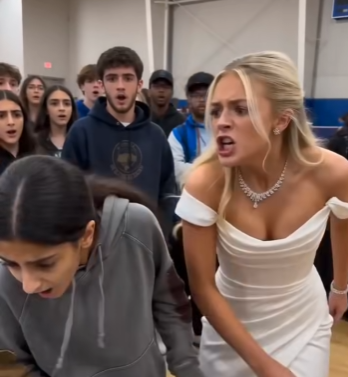
Audrey stood in front of me in her white evening gown and diamond necklace, looking suddenly less like royalty and more like a girl who had opened the wrong door in a burning house.
Mrs. Park’s voice entered the microphone.
“Administrative access was used at 8:16 this morning to remove Yara Habib’s name from the official technical recognition file.”
The projector behind her flickered.
A record appeared on the huge screen.
USER: SINCLAIR-EVENT-ADMIN
A wave of whispers rolled across the gym.
My knees felt weak, but I stayed standing.
The next line appeared.
REQUEST: REMOVE TECHNICAL CREDIT — YARA HABIB
Someone in the student section gasped, “No way.”
Audrey whispered, “That’s not real.”
But her voice was thin.
Mrs. Park turned another page in the binder. “The file also shows a replacement request.”
Another line appeared.
REPLACE WITH: AUDREY SINCLAIR — EVENT TECHNICAL SUPPORT
A laugh escaped someone near the bleachers. Not a happy laugh. A shocked, disbelieving one.
Audrey’s face flushed bright red.
“That’s a mistake,” she snapped. “My family funded the equipment.”
My hand rose to my cheek. It still stung under my fingertips.
“You funded the new banners,” I said quietly. “Not the scoreboard.”
Audrey turned on me. “You think anyone would believe you fixed that ancient thing?”
The scoreboard above the court glowed behind her, bright green digits waiting for the first match.
I looked at it.
The machine everyone ignored.
The machine that had kept the tournament from being canceled.
The machine I had found dead in a storage closet with dust in its buttons, cracked wiring behind the panel, and a power relay so old the replacement part had to be pulled from another broken unit.
My name was in those repair logs because I had written everything down.
Every hour.
Every wire.
Every failed test.
Every fix.
Mrs. Park lifted the binder higher. “Yara submitted the repair records three weeks ago. The signatures are from Coach Alvarez, Mr. Pritchard from maintenance, and myself.”
Coach Alvarez stood from the side of the court.
“That’s true,” he said. “Without Yara, there would be no scoring system tonight.”
The gym changed.
I felt it.
A few seconds earlier, people had been watching my humiliation like entertainment. Now they were watching a lie collapse in public.
Audrey’s mother stood.
“This is inappropriate,” she said coldly. “This tournament should not become a spectacle.”
Mrs. Park looked at her. “Your daughter slapped a student in front of cameras.”
Mrs. Sinclair’s mouth tightened.
Mr. Sinclair rose slowly. “Elena, I suggest you handle this privately.”
The way he said her first name made the room feel smaller.
Mrs. Park’s hand tightened around the binder. For one terrifying moment, I thought she might fold. I thought the weight of Sinclair money might press the truth back into silence.
Then she looked at me.
My patched sleeves.
My worn canvas shoes.
My burning cheek.
And her expression hardened.
“No,” she said. “This became public when Audrey made it public.”
A sound moved through the students. Not applause yet. Something better.
Recognition.
Audrey’s eyes widened, as if the world had betrayed her by not obeying.
“She stole my moment,” Audrey said. “This was supposed to be my family’s event.”
I finally found my voice.
“It was supposed to be a student tournament.”
She laughed. “You repaired a scoreboard. Don’t act like you saved lives.”
“No,” I said. “I saved the tournament.”
The words surprised even me.
But once they came out, I knew they were true.
Mrs. Park turned toward the court. “The first match will begin with Yara Habib scoring, as planned.”
Mr. Sinclair’s voice cracked like a whip.
“Absolutely not.”
Every head turned.
He stepped into the aisle. His smile was gone. “My family paid for this venue upgrade. My daughter has been publicly embarrassed. I will not allow this event to continue under these conditions.”
Coach Alvarez walked onto the court.
“With respect,” he said, though his tone held very little, “your daughter assaulted my student.”
Audrey looked around wildly.
Her friends had stopped standing close to her. The cameras were still raised, but they no longer felt like weapons pointed at me.
They felt like mirrors pointed at her.
Then the scoreboard beeped.
Once.
Loudly.
Everyone looked up.
The display changed by itself.
WELCOME TO ATLANTA STUDENT BADMINTON TOURNAMENT
Then:
TECHNICAL RESTORATION: YARA HABIB
My breath caught.
I had programmed that message as a test weeks ago.
I had forgotten it was still in the startup cycle.
The gym erupted.
Students clapped. Some stood. Someone shouted my name from the back row.
Yara! Yara! Yara!
My cheek still hurt.
But for the first time that night, I smiled.
Audrey looked at the scoreboard as though it had slapped her back.
PART 3 — THE SCOREBOARD REMEMBERED EVERYTHING
Mrs. Park asked the media team to pause the livestream.
A student near the front shouted, “Too late! It’s already online!”
The room buzzed like a struck wire.
Mr. Sinclair moved toward the display table, but Coach Alvarez blocked him before he could touch the binder.
“Sir,” Coach said, “step back.”
Mr. Sinclair stared at him. “Do you know who I am?”
Coach Alvarez did not blink. “Yes. A man standing too close to evidence.”
The word evidence landed hard.
My stomach twisted.
Until that moment, I had thought this was about Audrey’s jealousy, her need to be centered, her belief that anything beautiful or important must belong to her.
But Mr. Sinclair’s face told another story.
He wasn’t angry like a father defending his daughter.
He was afraid.
Mrs. Park turned another page in the Official Proof binder and frowned.
“There’s a digital attachment,” she said.
Audrey’s head snapped up. “Don’t open that.”
The gym went quiet again.
Mrs. Park slowly looked at her. “Why not?”
Audrey swallowed. “Because it’s probably private sponsor information.”
“No,” Mrs. Park said. “It’s attached to Yara’s technical file.”
She tapped the tablet linked to the projector.
A folder appeared.
SCOREBOARD RESTORATION BACKUP — SYSTEM LOG EXPORT
My heart jumped.
I had made that export myself the night before.
Not because I expected sabotage.
Because old machines taught you caution. They failed without warning. They forgot things unless you forced them to remember.
Mrs. Park opened the log.
Lines of timestamps filled the screen.
Power cycles.
Controller resets.
Manual overrides.
Test matches.
Then one entry, highlighted in red.
7:58 AM — UNAUTHORIZED ACCESS ATTEMPT
A murmur moved through the bleachers.
Another line.
7:59 AM — SCOREBOARD CONFIGURATION ALTERED
Mrs. Park read aloud. “Match One ceremonial scorer changed from Yara Habib to Audrey Sinclair.”
The students exploded.
Audrey shouted, “That doesn’t prove anything!”
But the next line appeared.
LOGIN DEVICE: SINCLAIR PRIVATE NETWORK
Mr. Sinclair’s jaw tightened.
Mrs. Sinclair sat very still.
My hands began to shake.
Mrs. Park scrolled.
There was more.
8:02 AM — TECHNICAL CREDIT DISPLAY DISABLED
8:03 AM — RESTORATION MESSAGE DELETED
8:04 AM — MANUAL OVERRIDE FAILED
I stared at the screen.
Someone had tried to erase me from the scoreboard too.
Not only from the official file.
From the machine itself.
And failed.
Because I had locked the final restoration record behind a maintenance password only I knew.
Audrey stared at the lines like they were written in a language she had never imagined could accuse her.
Coach Alvarez turned to me. “Yara, did you authorize any changes this morning?”
“No.”
“Did you give anyone your maintenance password?”
“No.”
Mrs. Park asked, “Do you know why the override failed?”
I nodded slowly.
“The old controller rejects changes if the repair signature isn’t verified. I built that patch after the memory board kept wiping.”
A tech volunteer near the media table leaned forward. “You built a verification patch?”
I nodded again, embarrassed suddenly by everyone looking.
“It was simple. Just a checksum tied to the repair log.”
He stared at me. “That is not simple.”
The applause came again, stronger this time.
But I couldn’t enjoy it.
Because Mrs. Park had scrolled further.
And one more file sat at the bottom of the export.
AUDIO RECORD — MAINTENANCE ROOM — AUTO SAVED
My mouth went dry.
I knew that file.
The scoreboard microphone.
It was supposed to capture referee calls during matches. During testing, I had routed it through the central controller to check delay.
I had forgotten to disable automatic logging.
Mrs. Park looked at me.
“Yara?”
I whispered, “It records during active diagnostics.”
“When was this recorded?”
She clicked the file.
8:06 AM
The gym held its breath.
Then Audrey’s voice came through the speakers.
Clear.
Sharp.
Cruel.
“She is not scoring the first match. I don’t care what they promised her.”
Another voice answered.
Mr. Sinclair.
“Calm down. The file will be corrected.”
Audrey again.
“She looks ridiculous. Patched sleeves? Worn shoes? Next to us? People will think this event is charity.”
My face burned worse than the slap.
Then Mr. Sinclair spoke, lower.
“The Habib girl is useful until she is visible. That is all.”
The gym went dead silent.
My chest squeezed.
Useful until visible.
The sentence entered me like a blade.
I looked at Audrey, expecting victory in her face, or panic, or denial.
But she was staring at her father.
Because the recording continued.
Mr. Sinclair said, “Once your name is on the ceremony file, nobody will question it. They never question the person who pays.”
Audrey whispered in the recording, “And if she complains?”
Mr. Sinclair laughed softly.
“Girls like her are trained not to.”
The speakers crackled.
Then the file ended.
For three seconds, nobody moved.
Then the gym erupted.
PART 4 — THE LIE BENEATH THE TOURNAMENT
I did not cry.
That surprised me.
Maybe the hurt had gone too deep too quickly. Maybe my body had decided tears were a luxury for later.
Audrey cried first.
Not loudly. Just one hand over her mouth, eyes shining with horror as she stared at her father.
“Dad,” she whispered. “You said you were only fixing the program.”
Mr. Sinclair’s face twisted. “Audrey, stop.”
“You said she exaggerated her role.”
“Be quiet.”
That command cracked across the gym.
Audrey flinched.
And in that flinch, I saw something I did not want to see.
Fear.
She had slapped me. She had humiliated me. She had called me pity and theft.
But her father had built the stage beneath her cruelty.
He had taught her that people like me were background labor. He had taught her that visibility could be purchased. He had taught her that a lie became truth if the right family printed it on thick paper.
That did not excuse her.
But it explained the poison.
Mrs. Park stepped to the microphone. Her voice shook, but she held firm.
“Due to the seriousness of what has been revealed, the tournament will be paused while the committee reviews the attempted manipulation of official records.”
Students booed.
Not at her.
At the Sinclairs.
Coach Alvarez raised both hands. “Listen! The matches will happen. But not under a stolen record.”
Mr. Sinclair turned toward the exit.
Two school security officers moved into the aisle.
One of them said, “Sir, we need you to remain available for questioning.”
He laughed. “Questioning? This is a school event.”
Mrs. Park lifted the binder. “And this is potential fraud involving student awards, sponsor funds, and tournament administration.”
The word fraud changed the adults’ faces.
Suddenly, the slap was not only a viral clip. The erased name was not only a personal insult.
It was part of something official.
Something punishable.
Mrs. Sinclair rose with trembling dignity. “We will not be treated like criminals.”
From the bleachers, a student called, “Then stop acting like them.”
The gym gasped, then roared.
Audrey stood alone near the court, mascara beginning to streak. Her diamond necklace glittered against her throat like evidence of a world she no longer understood.
She looked at me.
For one second, I thought she might apologize.
Instead, she whispered, “I didn’t know he said that.”
My voice came out flat.
“But you knew what you said.”
Her mouth closed.
There it was.
The truth she could not escape.
A phone rang near the entrance. Then another. Reporters had already started calling. Parents rushed toward teachers. Students replayed the audio clip in clusters, their faces lit by screens.
My teacher, Ms. Nasser, reached me at last.
She was small, fierce, and usually calm. Tonight, her eyes were wet with fury.
“Yara,” she said softly, “come here.”
She touched my cheek with careful fingers.
I winced.
Her face changed.
“I should have protected you sooner.”
I wanted to say I was fine.
I had said it so many times in life that the words waited automatically on my tongue.
But I was tired.
Tired of being grateful for crumbs.
Tired of working in corners and watching other people pose beside the results.
Tired of rich people acting like kindness was a donation receipt.
“I’m not fine,” I said.
Ms. Nasser nodded like that answer mattered more than any polite lie.
“I know.”
My mother arrived twenty minutes later.
She came straight from her shift at the clinic, still wearing navy scrubs under her coat. Her dark hair was pulled back, her face exhausted.
Then she saw the red mark on my cheek.
Everything about her became still.
“Who hit my daughter?”
Audrey looked down.
I pointed.
My mother walked toward her.
No shouting.
No dramatic scene.
Just a mother crossing a gymnasium with such controlled rage that even security stepped aside.
She stopped in front of Audrey.
“You thought her face was yours to touch?”
Audrey whispered, “I’m sorry.”
My mother’s eyes hardened. “No. You are exposed. That is different.”
The words cut deeper than shouting ever could.
Then my mother turned to me and pulled me into her arms.
I finally broke.
The tears came hot and silent. She held me as if I were both seventeen and seven, both strong and wounded, both the girl who repaired the scoreboard and the child who still needed someone to say, You did not deserve this.
Over my mother’s shoulder, I saw the scoreboard glowing.
It still displayed my name.
TECHNICAL RESTORATION: YARA HABIB
For the first time all night, I believed it would stay there.
PART 5 — THE OLD SCOREBOOK IN THE LOCKED ROOM
The tournament did not resume that night.
It became impossible. Too many parents demanded answers. Too many students had already posted the recording. Too many sponsors quietly removed their names from the Sinclair banner before morning.
By sunrise, the story had spread beyond Atlanta.
Some headlines focused on the slap.
Some focused on the hidden audio.
The better ones focused on the sentence that had made my mother cry when she heard it later:
“The Habib girl is useful until she is visible.”
I hated seeing myself reduced to a symbol.
But I hated silence more.
Two days later, Mrs. Park called us back to the school athletic office. My mother came with me. Ms. Nasser sat on my other side. Coach Alvarez stood by the window, arms crossed.
On the table lay the Official Proof binder, my repair logs, and an old leather scorebook none of us had seen before.
Mrs. Park looked pale.
“We found this in a locked cabinet behind the equipment room.”
Coach Alvarez said, “The cabinet was installed during the first Sinclair-sponsored tournament twelve years ago.”
My mother frowned. “What does that have to do with Yara?”
Mrs. Park opened the scorebook.
Names filled the pages. Students. Volunteers. Repair assistants. Referee aides. Technical crews.
Some names had been crossed out.
Others had been written over in darker ink.
At the top of several pages was a familiar surname.
SINCLAIR
My stomach tightened.
Mrs. Park turned the book toward me.
“There is a pattern,” she said. “For years, student work was reassigned in final programs to sponsor family members or their selected students.”
Ms. Nasser whispered, “My God.”
Coach Alvarez pointed to a page from five years earlier.
“A maintenance student rebuilt the shuttle sensor system. Final credit went to a Sinclair cousin.”
Another page.
“A scholarship applicant organized volunteer scheduling. Final credit went to Audrey’s older brother.”
Another.
“A student from South Atlanta repaired lighting controls. Removed from recognition list after sponsor review.”
My breath came shallow.
This was bigger than me.
I was just the first one whose machine remembered.
Then Mrs. Park turned to the last page.
There was my name.
YARA HABIB — SCOREBOARD RESTORATION, CONTROL PATCH, CEREMONIAL SCORER
Beside it, in fresh ink, someone had written:
REMOVE. SUBSTITUTE A. SINCLAIR.
Below that, a note:
FATHER APPROVED.
My mother stood so fast her chair scraped the floor.
“They have been stealing children’s work?”
No one answered.
Because the answer sat open in front of us.
Mrs. Park pressed her hands together. “The school board is opening an investigation. So is the state athletic association. We are also reviewing scholarship decisions connected to Sinclair sponsorship.”
I stared at the crossed-out names.
How many students had swallowed the hurt because they thought no one would believe them?
How many had watched someone richer stand in their place?
How many had been trained not to complain?
Ms. Nasser touched my arm.
“Yara.”
I looked up.
“You don’t have to carry all of this.”
But I already felt it settling on my shoulders.
Not as punishment.
As responsibility.
That afternoon, Audrey came to school for the first time since the tournament.
People stared. Some laughed. Some recorded her walking down the hallway.
I did not enjoy it.
That surprised me too.
She found me outside the equipment room.
No gown. No crystals. No necklace.
Just a gray sweater, jeans, and a face stripped of confidence.
“I didn’t know about the old scorebook,” she said.
I almost walked away.
But something in her voice stopped me.
“I believe you,” I said. “I also know you were happy to benefit from it.”
Her eyes filled.
“I was raised to think it was normal.”
“That makes it worse.”
She nodded.
For once, she did not argue.
Then she held out a key.
“This opens a storage closet at my house. My father keeps old tournament files there. After the video, he told my mother to destroy anything with student names.”
My pulse jumped.
“Why are you giving this to me?”
“Because I heard the recording again,” she whispered. “The part where he said girls like you are trained not to complain.”
She swallowed hard.
“And I realized girls like me are trained to make sure you don’t.”
The hallway noise faded.
I took the key.
Not because I trusted Audrey.
Because truth had a habit of hiding behind locked doors.
PART 6 — THE STORAGE CLOSET FULL OF STOLEN NAMES
We did not go to Audrey’s house alone.
My mother insisted on that.
Mrs. Park contacted the school board attorney, who contacted investigators. By evening, two officials, Coach Alvarez, Ms. Nasser, my mother, and I stood in the Sinclair estate’s marble foyer while Audrey waited near the stairs like a ghost in her own home.
Mrs. Sinclair tried to stop us.
“This is harassment,” she said, voice shaking.
The investigator showed her the authorization.
“This concerns school property and records connected to public student awards.”
Mr. Sinclair was not home.
That made Audrey more frightened, not less.
She led us down a hallway lined with framed photographs of charity galas and ribbon cuttings. In every picture, the Sinclairs smiled beside students whose names were probably forgotten by the time dessert was served.
At the end of the hall stood a narrow white door.
Audrey handed me the key.
My mother gently took my wrist.
“You don’t have to be the one.”
I looked at the door.
“Yes,” I said. “I do.”
The key turned.
Inside were boxes.
Dozens of them.
Tournament records. Donor agreements. Scholarship lists. Volunteer logs. Final ceremony scripts.
And folders labeled by year.
The investigator began photographing everything.
Mrs. Park opened the nearest box and went rigid.
“These are original student submissions.”
Ms. Nasser opened another folder and covered her mouth.
Inside were essays, technical reports, project descriptions, maintenance logs.
Names circled.
Names crossed out.
Names replaced.
The room smelled like paper, dust, and stolen futures.
Then I found a folder marked:
HABIB
My fingers went cold.
Inside were printed emails about me.
My repair proposal.
My request for replacement parts.
A note from Coach Alvarez saying my work made the tournament possible.
And a sponsor comment written in blue ink:
Strong story, but visually off-brand for opening ceremony. Consider private thank-you instead.
Visually off-brand.
That meant my hoodie.
My patched sleeves.
My brown skin.
My worn shoes.
Me.
My mother read it over my shoulder.
Her face collapsed for one second before rage rebuilt it.
“They looked at my child and called her off-brand.”
Audrey began to cry.
“I’m sorry,” she said.
This time, my mother did not answer.
The investigator found the worst file in a locked metal box.
Scholarship rankings.
For twelve years, Sinclair sponsorship had influenced which students received athletic leadership grants. Several top-ranked applicants had been moved down after private sponsor notes.
Reasons included:
Not donor-facing.
Limited polish.
Family background concerns.
Better suited for support role.
I read those phrases until they blurred.
They were polite words for ugly things.
Poor.
Brown.
Immigrant.
Quiet.
Unconnected.
Useful until visible.
Coach Alvarez slammed his hand against the wall.
“I recommended some of these kids.”
Mrs. Park’s voice shook. “We all did.”
Audrey stood in the doorway, staring at the boxes like she was seeing her family clearly for the first time.
“My awards,” she whispered. “My leadership certificates. My scholarship nomination.”
No one comforted her.
Because she was doing the math.
And the math was brutal.
Her life had been padded with stolen recognition.
The investigation became official by morning.
The Sinclair family’s sponsorship was suspended. The school board froze all awards connected to their foundation. Former students were contacted. Some responded with anger. Some with disbelief. Some with stories they had held inside for years.
One former student wrote that she had designed the tournament volunteer system but watched Audrey’s brother receive the honor.
Another said he had repaired court lights and was told sponsors preferred a “cleaner presentation.”
Another wrote only one sentence:
I thought nobody remembered me.
But the scoreboard had remembered.
The scorebook had remembered.
The storage closet had remembered.
And now we did too.
The rescheduled tournament was announced for the following month.
This time, there would be no Sinclair banner.
No sponsor family spotlight.
No private donor edits.
The opening ceremony would begin with a roll call of every student whose work had been erased from previous years.
Mrs. Park asked if I still wanted to score the first match.
I said yes.
Not because I wasn’t afraid.
Because fear had already taken enough.
PART 7 — THE MATCH THAT BECAME A TRIAL
The gym was packed on the night of the rescheduled tournament.
Not crowded.
Packed.
Parents filled the bleachers. Reporters lined the back wall. Former students returned, some older now, some with children of their own. A state athletic association representative sat near the court with a clipboard.
The scoreboard glowed above us, repaired, polished, and impossible to ignore.
I stood at the scoring table wearing my patched hoodie.
I had other clothes now. People had offered to buy me something “more appropriate.” My mother had even held up a pretty blue blouse that morning and said gently, “Only if you want.”
I chose the hoodie.
Because shame had touched it.
And I wanted shame to see what happened when it failed.
Mrs. Park stepped to the microphone.
“Tonight,” she said, “we begin by correcting the record.”
One by one, names appeared on the scoreboard.
Students whose work had been erased.
Students whose credit had been reassigned.
Students who had been told to be grateful for private thanks while others stood in public applause.
Some were present.
Some watched remotely.
Some could not be found.
But their names were read anyway.
Every name landed like a bell.
Then mine appeared.
YARA HABIB — SCOREBOARD RESTORATION, CONTROL PATCH, OFFICIAL SCORER
The applause rose so loudly I felt it in the table beneath my hands.
My mother stood in the front row, crying and smiling at once. Ms. Nasser clapped with both hands pressed high. Coach Alvarez looked like he might burst from pride.
Then Audrey walked in.
The gym noticed immediately.
She wore a plain black dress. No diamonds. No crystal heels. Her blonde hair was tied back. Her face was pale, but she kept walking.
Murmurs followed her.
She stopped near the microphone.
Mrs. Park looked surprised.
So did I.
Audrey unfolded a piece of paper.
“My name is Audrey Sinclair,” she began.
Her voice trembled.
“I lied.”
The gym went silent.
“I claimed credit for work I did not do. I humiliated Yara Habib because I believed recognition belonged to me more than it belonged to the person who earned it.”
She swallowed.
“My family benefited from a system that erased students for years. I benefited too. Some of the awards I received were not truly mine.”
Her hands shook harder.
“I have given investigators access to my records. I have withdrawn my scholarship nomination. And I am here tonight to say publicly what I should have said the moment I saw Yara’s name in that file.”
She turned toward me.
“I am sorry.”
The words were small.
But they did not hide.
“I’m sorry for hitting you. I’m sorry for calling you pity. I’m sorry for trying to stand where you belonged. I know apology does not repair what I broke.”
I stared at her.
Part of me wanted to reject it in front of everyone.
Part of me wanted to punish her with silence.
But another part remembered the locked closet key in my palm.
Audrey had done harm.
She had also opened the door that exposed more harm.
Both things were true.
I leaned toward my microphone at the scoring table.
“I hear you,” I said.
That was all.
Not forgiveness.
Not absolution.
But truth deserved accuracy.
The first match began.
The shuttlecock snapped across the net, white and fast beneath the lights. Shoes squeaked. Rackets cracked through the air. The scoreboard responded perfectly to every point I entered.
For the first time, I was not in the background.
I was part of the rhythm.
At 10–10, the old machine suddenly flickered.
My heart stopped.
Then a hidden diagnostic message appeared.
Not an error.
A file.
ARCHIVED AUDIO FOUND — RESTORE?
The gym murmured.
I stared at the prompt.
Coach Alvarez approached carefully. “Yara?”
“I don’t know what that is,” I whispered.
Mrs. Park came over. “Is it safe to open?”
The investigator nodded from the front row. “Document it first.”
A camera zoomed in.
I pressed restore.
Static burst through the speakers.
Then a voice emerged.
An older man.
Tired.
Angry.
“I don’t care what Sinclair promised. The Habib repair log is legitimate. If they remove that girl’s name, they’re doing what they did to Samira, Luis, Devon, and all the others.”
Mrs. Park gasped.
Coach Alvarez whispered, “That’s Mr. Pritchard.”
The maintenance supervisor.
He had died suddenly two weeks before the tournament.
The recording continued.
“I’m saving this in the controller archive. Machines keep better records than people around here.”
My eyes filled.
Mr. Pritchard had signed my repair log.
He had watched me work after school, bringing me vending machine coffee and pretending not to notice when I was too tired to stand.
His voice crackled again.
“Yara, if you find this, don’t let them make you small.”
The gym blurred.
My hands covered my mouth.
The scoreboard had not only remembered the lie.
It had remembered someone who tried to protect me.
PART 8 — THE END: THE GIRL WHO CHANGED THE SCORE
The final match ended at 21–19.
I barely remembered entering the last point.
The gym exploded as the winning team embraced at center court, but the sound reached me from far away. I was still hearing Mr. Pritchard’s voice.
Machines keep better records than people around here.
After the tournament, the school dedicated the restored scoring system in his name.
A small plaque was installed beneath the control panel:
IN MEMORY OF SAMUEL PRITCHARD, WHO BELIEVED EVERY STUDENT’S WORK DESERVED A NAME.
Beside it, another plaque was added after a student vote:
RESTORED BY YARA HABIB.
Not donated by.
Not sponsored by.
Restored by.
The investigation lasted months.
The Sinclair Foundation lost its partnership with the school district. Several scholarship decisions were reversed. Former students received corrected certificates, public apologies, and in some cases financial awards that should have been theirs years earlier.
Mr. Sinclair faced charges for fraud, records manipulation, and misuse of restricted educational funds.
Mrs. Sinclair disappeared from public events.
Audrey transferred schools after completing her testimony.
Before she left, she placed a letter in my locker.
I opened it alone in the equipment room.
Yara,
I used to think spotlight was something you took before someone else could have it. I know now that real light does not work that way. It shows what is true. You were true before anyone applauded. I am sorry I was too spoiled and cruel to see it.
I will spend a long time becoming someone who would never do that again.
Audrey
I folded the letter and put it in my backpack.
I did not know whether I forgave her.
Maybe forgiveness was not a door you walked through once. Maybe it was a hallway. Maybe some people only earned the right to stand at the beginning.
But I knew this:
I was not carrying her lie anymore.
Spring came soft to Atlanta.
The badminton program grew. Students from schools across the city came to compete, volunteer, repair, organize, score, design, and lead. Mrs. Park created a transparent credit system where every contribution was logged publicly from the beginning.
Ms. Nasser asked me to help teach younger students basic electronics.
At first, I said no.
Then a freshman named Lina brought in a broken timer and looked at me with the same nervous hope I used to hide.
So I sat beside her and said, “First rule: label everything. Second rule: back it up. Third rule: never let anyone tell you quiet work does not count.”
She grinned.
I saw myself in her.
Not the humiliated girl with a red cheek.
The girl before that.
The one who stayed late with wires and dust and stubborn faith.
The year ended with an awards night in the same gym.
This time, there were no sponsor thrones in the front row. No diamond necklaces glittering above stolen credit. No private edits hidden behind polite smiles.
When Mrs. Park called my name, I walked to the court slowly.
Not because I was afraid.
Because I wanted to feel every step.
My hoodie sleeves had been repaired again by my mother with neat blue thread. My canvas shoes were still worn. My hair was tied low. My cheek had healed long ago, but sometimes I still remembered the slap when cameras flashed.
Then I looked up at the scoreboard.
It lit before Mrs. Park spoke.
YARA HABIB — STUDENT TECHNICAL LEADERSHIP AWARD
Under it, another message scrolled.
QUIET WORK COUNTS. HIDDEN NAMES RETURN.
The applause rose.
My mother pressed both hands to her heart. Coach Alvarez shouted louder than anyone. Ms. Nasser cried without pretending not to. Former students stood in the bleachers, holding corrected certificates with their names finally printed where they belonged.
I reached the microphone.
For a second, I could not speak.
Then I saw the plaque for Mr. Pritchard.
I saw the scoring table.
I saw Lina in the front row, holding the timer she had fixed herself.
And I knew exactly what to say.
“I used to think recognition meant someone powerful deciding you were worth seeing,” I said. “But I was wrong.”
The gym quieted.
“Recognition begins before applause. It begins when we tell the truth about who worked, who helped, who repaired, who stayed late, who carried the part nobody noticed.”
My voice grew stronger.
“They told me I was useful until visible. But visibility was never theirs to give. My name was already attached to my work. The hidden record only proved what was always true.”
The applause came like thunder.
But the best sound was not the cheering.
It was the scoreboard beep that followed.
One bright note.
Clean.
Steady.
Alive.
The same old machine that had once sat dead in a storage closet now glowed above all of us, remembering every point, every name, every correction.
And as I stood beneath it, holding my award with my mother crying in the front row, I understood the ending no one had predicted.
Audrey Sinclair had wanted to steal the spotlight.
Her lie had turned every camera toward me.
Her slap had exposed her family.
Her cruelty had opened a locked room full of stolen names.
And the scoreboard I repaired in silence became the voice that spoke for all of us.
I smiled through my tears.
Because I had wanted one clean moment where my name was said without pity.
Now my name was not whispered.
It was displayed in light.
And this time, no one could remove it.
