PART 2 — THE NAME WRITTEN IN THE MARGIN
The coordinator’s fingers stopped on the final page, and for one breath, the entire room seemed to forget how to move.
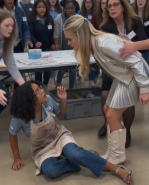
I was still on the floor.
My palms burned from catching myself. My knees stung. One lens of my old glasses had gone crooked, and the faded apron tied around my waist suddenly felt like proof of every insult Brooke had ever whispered about me.
But I could not look away from the Letter Log.
The coordinator, Ms. Harrow, was a woman with silver hair, calm eyes, and the terrifying patience of someone who never raised her voice because she never needed to. She looked at the page once, then again.
Brooke’s father, Mr. Winslow, stepped forward from the sponsor row.
“Surely,” he said smoothly, “there’s been some misunderstanding.”
His voice was warm enough to fool people who wanted to be fooled.
Ms. Harrow did not answer him.
She turned the book outward.
There, in blue ink, beneath a crossed-out version of my name, was a new handwritten note:
REMOVE JUNIPER LEE FROM PUBLIC RECOGNITION. CREDIT TO WINSLOW FAMILY FOUNDATION.
And underneath it was a signature.
Not Brooke’s.
Not her father’s.
It belonged to Mrs. Adele Winslow, Brooke’s mother, the woman sitting in the front row with pearl earrings, a cream coat, and the frozen smile of a portrait that had just cracked.
Someone gasped.
Then another person did.
Then the silence broke into whispers.
Brooke’s face changed from pale to furious.
“That’s not what it looks like,” she snapped.
Ms. Harrow looked at her. “Then explain what it looks like.”
Brooke’s eyes flicked to her mother.
Mrs. Winslow rose slowly, one gloved hand gripping her purse. “This is inappropriate. This event exists because families like ours support schools like this.”
Schools like this.
Students like me.
People like them.
I pushed myself to my feet before anyone could help me. My legs trembled, but I stood.
Ms. Harrow turned to me. “Juniper, are you all right?”
I wanted to say yes. I wanted to be strong and elegant and unbothered. But my throat hurt, and my pride hurt worse.
“No,” I said.
The word came out small, but it traveled.
“No,” I repeated, louder. “I’m not all right.”
Phones were still recording. Teachers stood frozen. Students leaned forward. The sponsors looked anywhere but at me.
Brooke laughed once, sharp and ugly. “Oh, please. Now she’s performing.”
That was when something inside me finally snapped—not loudly, not dramatically, but cleanly, like a string pulled too tight.
I looked at her, this girl dressed like a magazine cover, this girl who had shoved me to the floor in front of the city and expected me to stay there.
“You told me I didn’t belong in your spotlight,” I said. “But it was never yours.”
Brooke’s mouth tightened.
I pointed at the Letter Log. “I painted that mailbox after school for three weeks. I sorted letters. I repaired the rusted hinge. I labeled routes. I walked blocks after dark because the community center needed the thank-you notes delivered before tonight.”
My voice shook, but I kept going.
“Your family arrived this morning for photographs.”
A ripple moved through the crowd.
Mr. Winslow’s charming smile disappeared.
Mrs. Winslow said, “Young lady, you should be careful.”
And for some reason, that warning gave me courage.
I turned to her. “I have been careful my whole life.”
My mother had taught me to be careful when people mispronounced my name. Careful when teachers praised my “hard work” but not my ideas. Careful when rich students called my clothes “vintage” with laughter hiding behind the word. Careful when I wanted too much.
But careful had not protected me.
Careful had only made me easier to erase.
So I said the thing I had never said out loud.
“I am done being careful so other people can steal from me politely.”
The room went dead quiet again.
Then someone clapped.
One clap.
Two.
I turned.
It was Mr. Alvarez, the janitor who had helped me carry paint cans when the handle broke. His eyes were wet.
Then another person clapped.
A student from the art club.
Then a teacher.
Then ten people.
Then the applause spread through the hall like rain finally falling after a brutal summer.
Brooke stared around as if the room had betrayed her.
But I knew better.
The room had finally seen her.
PART 3 — THE CAMERA NEVER BLINKED
Ms. Harrow closed the Letter Log with both hands.
“This ceremony will continue,” she said, her voice cutting clean through the noise. “And it will continue honestly.”
Mr. Winslow stepped toward her. “I strongly advise you not to embarrass generous donors.”
Ms. Harrow looked at him without flinching. “I strongly advise generous donors not to falsify student records.”
People murmured louder.
Brooke grabbed her mother’s arm. “Mom, do something.”
Mrs. Winslow’s eyes flashed. “This is a private administrative matter.”
“No,” said a voice from the side aisle. “It isn’t.”
Everyone turned.
A boy named Mateo Cruz stood there holding his phone high. He was a quiet senior from media club, the kind of person people forgot until they needed footage edited. His dark curls fell into his eyes, and his hand trembled only slightly.
“I was filming the setup this morning,” he said. “For the school archive.”
Brooke’s expression faltered.
Mateo swallowed. “I have video.”
Brooke whispered, “No.”
It was so soft that maybe only I heard it.
Ms. Harrow looked at Mateo. “Video of what?”
Mateo walked to the projector table. The media teacher, Mrs. Lennox, helped him connect the phone. The big screen behind the stage flickered from the Handwritten Letter Day logo to a shaky morning recording.
The hall watched.
There was the display table.
There was the Letter Log.
There was me in the background, carrying folded route maps.
Then Mrs. Winslow appeared in the frame, leaning over the book with a pen.
Brooke stood beside her.
The audio crackled.
Mrs. Winslow’s voice came through the speakers: “A handwritten record is charming, but it creates problems when the wrong names are attached.”
Brooke answered, “Juniper won’t fight it. She never does.”
A cold wave passed through me.
Onscreen, Mrs. Winslow crossed out my name.
Brooke laughed.
My stomach turned.
Then Brooke leaned closer to the log and said, “By tonight, everyone will remember the Winslow Foundation saved the project.”
The video ended.
No one clapped this time.
No one whispered.
This silence was different.
It was not hungry for drama.
It was ashamed.
Brooke looked smaller than I had ever seen her, but not sorry. Her eyes burned with the anger of someone caught, not someone changed.
Mr. Winslow stepped away from his wife as if distance could erase ink.
Mrs. Winslow’s face hardened. “That recording was taken without consent.”
Mateo said, “It was a public school event.”
Mrs. Lennox added, “And it was school documentation.”
A sponsor from a local bookstore stood up. “My company donated paper and postage. We did not donate to support fraud.”
Another sponsor said, “Nor did we.”
One by one, people began pulling away from the Winslows—not physically at first, but morally. Their faces changed. Their shoulders turned. Their silence shifted sides.
Brooke saw it happening.
So she did the only thing she had left.
She cried.
Not soft tears. Not broken tears.
Strategic tears.
She pressed her hands to her face and whispered loudly, “I can’t believe everyone is attacking me.”
A month earlier, that might have worked.
A week earlier, maybe.
But now the screen behind her still held the frozen image of her smiling over my erased name.
Ms. Harrow said, “Brooke, you pushed Juniper in front of witnesses. You also participated in an attempt to falsify project records. You need to leave the stage area.”
Brooke dropped her hands. “You can’t make me.”
“Actually,” said Principal Ward from the front row, his face gray with horror, “we can.”
Two staff members moved gently but firmly toward Brooke.
For the first time, fear crossed her face.
Not fear of me.
Fear of consequences.
As she passed me, she leaned close one last time.
“You think this makes you special?” she hissed. “Tomorrow, everyone will forget you.”
I looked at her ruined mascara, her shaking mouth, her perfect outfit that suddenly seemed like costume jewelry over rot.
“No,” I said. “Tomorrow, they’ll remember what you did.”
Her eyes widened.
Then she was led away.
And somehow, after all that, Ms. Harrow turned to the audience and said, “Juniper Lee, please come forward.”
My heart lurched.
The ceremony marker waited near the community mailbox.
The same mailbox I had sanded, painted, lettered, and repaired until my fingers blistered.
I walked toward it slowly.
Not because I was afraid.
Because I wanted to remember every step.
PART 4 — THE GIRL WHO PAINTED THE MAILBOX
When I reached the mailbox, the overhead lights made the fresh blue paint shine like water at dusk.
Along one side, in white lettering, I had painted:
LETTERS CARRY WHAT VOICES CANNOT.
At the time, I thought it sounded pretty.
Now it felt like prophecy.
Ms. Harrow handed me the first bundle of thank-you letters tied with yellow ribbon. “Juniper, this route opens because of you.”
My fingers closed around the envelopes.
The applause began again, but this time it did not feel like noise. It felt like warmth. Like people making room.
Then Principal Ward approached the microphone.
“I owe Miss Lee an apology,” he said.
That startled me more than Brooke’s shove.
Adults rarely apologized in public. Especially not to students like me.
He continued, “I accepted sponsor claims too easily. I allowed a student’s labor to be overshadowed by donor influence. That was a failure of leadership.”
His voice cracked slightly.
“And Juniper, I am sorry.”
I did not know what to do with that.
So I nodded.
Then he said, “The school will be opening a formal review into the Winslow Foundation’s involvement with student programs.”
Mrs. Winslow made a strangled sound, but nobody turned toward her.
For once, the room’s attention did not obey money.
The ceremony continued in a strange, electric mood. Students read letters. Parents cried. Volunteers smiled at me like they had been rooting for me all along, though many of them had not known my name an hour before.
Afterward, people gathered around me.
“I saw you painting after school,” one freshman said. “I should’ve helped.”
A teacher squeezed my shoulder. “You were brave.”
Mateo approached last.
“I’m sorry I didn’t say something sooner,” he said.
I looked at him carefully. “Why did you film it?”
He shifted. “I was supposed to get footage of the setup. But when I heard them say your name, I kept recording.”
“Why didn’t you show anyone?”
His face reddened. “I was scared.”
The honesty softened me.
“Me too,” I said.
He gave a small, relieved laugh. “You didn’t look scared up there.”
“I was terrified.”
“Still counted.”
Maybe it did.
Across the hall, my mother arrived breathless, still in her grocery store uniform. Someone must have called her. Her black hair was coming loose from its clip, and her eyes searched the room until they found me.
“Junie.”
That was all she said.
Then she pulled me into her arms so tightly the letters crinkled between us.
I had not cried when Brooke shoved me.
I had not cried when the video played.
But when my mother held me and whispered, “I knew they would see you someday,” I broke.
Not because I was weak.
Because I was seventeen, exhausted, and had spent too long pretending humiliation did not hurt.
My mother cupped my face and adjusted my crooked glasses with trembling fingers.
“You are not what they tried to make you,” she said.
I nodded against her palm.
Then she looked over my shoulder at the Winslow family across the room. Her expression changed.
My mother was small, gentle, and usually careful with everyone.
But in that moment, she looked like a locked door.
Mrs. Winslow tried to pass us with her chin lifted.
My mother stepped into her path.
“Adele,” she said quietly.
I froze.
Mrs. Winslow froze too.
Because my mother had not said Mrs. Winslow.
She had said Adele.
Like they knew each other.
PART 5 — THE SECRET BEFORE THE CEREMONY
Mrs. Winslow’s face drained of color for the second time that night.
My mother did not raise her voice. That made it worse.
“You knew exactly whose daughter she was,” Mom said.
The air around us changed.
I stared at her. “Mom?”
Mrs. Winslow’s smile twitched back into place, brittle and false. “I don’t know what you’re implying.”
“Yes,” Mom said. “You do.”
Brooke stood behind her father near the exit, arms crossed, eyes narrowed. She looked annoyed, but not confused.
Mr. Winslow looked deeply confused.
That scared me.
Mom turned to me, and for the first time all evening, she looked uncertain. “Junie, there are things I planned to tell you when you were older.”
“I’m seventeen.”
She gave a sad little smile. “I know.”
Mrs. Winslow snapped, “This is neither the time nor place.”
Mom faced her again. “You made it the time and place when you tried to erase my daughter.”
My daughter.
The words wrapped around me like armor.
Ms. Harrow moved closer, sensing the storm before the lightning.
Mom took a breath.
“When I was twenty,” she said, “I won a city design fellowship. It was supposed to fund a public art project across Kansas City neighborhoods.”
Mrs. Winslow looked away.
Mom continued, “Adele and I were finalists together. My proposal used community mailboxes as art installations—places where residents could write notes of gratitude, grief, apology, memory. The project was called Letters Home.”
My heart began pounding.
Letters carry what voices cannot.
The words on my mailbox.
My idea.
Or so I had thought.
Mom’s eyes glistened. “I sketched the first version in a notebook. Adele saw it. A week later, my notebook disappeared. Then she presented a modified version under her name.”
I whispered, “She stole it?”
Mom nodded once.
Mrs. Winslow hissed, “You had no proof.”
“No,” Mom said. “I didn’t. I was young, broke, pregnant, and terrified. You had lawyers. I had morning sickness and two part-time jobs.”
Pregnant.
Me.
The room blurred.
Mom looked at me. “That fellowship could have changed everything for us. But after I lost it, I stopped designing. I told myself survival mattered more than art.”
Her voice trembled.
“Then you came home talking about Handwritten Letter Day. About painting a mailbox. About building routes so people could thank one another.”
She laughed once, broken and amazed.
“I never told you about my old proposal, Junie. Never. But somehow you found your way to the same idea.”
A chill moved through me.
Not fear.
Recognition.
Like some hidden thread had been running between my mother’s unfinished dream and my blistered hands.
Mrs. Winslow said coldly, “Sentimental nonsense.”
Mom stepped closer. “No. Pattern.”
Ms. Harrow opened the Letter Log again. “Mrs. Lee, do you have documentation of your original proposal?”
Mom hesitated.
Then she reached into her tote bag and pulled out an old plastic folder, edges cracked with age.
“I brought this because I was proud of Juniper tonight,” she said. “I wanted to show her afterward. Not like this.”
Inside were yellowed pages, pencil sketches, city forms, rejection letters, and a hand-drawn mailbox covered in painted vines and words.
At the top of one page was my mother’s maiden name:
Mina Park.
And beneath it:
LETTERS HOME: A COMMUNITY MAILBOX PROJECT.
My chest ached.
The design was not identical to mine.
But the soul was the same.
Ms. Harrow looked at the documents, then at Mrs. Winslow.
Mr. Winslow whispered, “Adele?”
For the first time, his polished confidence shattered.
Brooke’s expression shifted from irritation to something darker.
Not surprise.
Understanding.
She had learned theft somewhere.
She had inherited entitlement like jewelry.
Mrs. Winslow’s voice shook with rage. “You people always want to take down successful women.”
My mother flinched at you people.
I did not.
I stepped forward.
“No,” I said. “We want our names back.”
PART 6 — WHEN THE SPOTLIGHT CHANGED SHAPE
The next morning, my shove became a video.
By lunch, the video became a scandal.
By sunset, the scandal had a headline.
SPONSOR FAMILY ACCUSED OF ALTERING STUDENT RECORD AT HANDWRITTEN LETTER EVENT.
I hated that headline.
It made me sound like a detail.
But then Mateo posted a second clip—the full one, including my speech.
By midnight, people were sharing a different line:
I AM DONE BEING CAREFUL SO OTHER PEOPLE CAN STEAL FROM ME POLITELY.
I woke up to hundreds of messages.
Some were kind.
Some were cruel.
Some called me brave.
Some called me dramatic.
One anonymous account wrote: Enjoy your fifteen minutes.
I stared at that message for a long time.
Then I deleted it.
At school, everything felt changed and unchanged at once. The lockers were still dented. The fluorescent lights still buzzed. Someone still spilled orange soda near the cafeteria doors.
But people looked at me differently.
Some with admiration.
Some with guilt.
Some with hunger, because even sympathy can be another kind of spotlight.
Brooke was not at school.
Her absence was louder than her presence had ever been.
At third period, Principal Ward called me to his office. My mother was already there, sitting stiffly beside Ms. Harrow and two district officials.
A lawyer from the district explained that the Winslow Foundation’s sponsorships were suspended pending review. Brooke faced disciplinary action. Mrs. Winslow had denied wrongdoing despite the video.
Then Ms. Harrow slid my mother’s old proposal across the table.
“There may be grounds to recognize Mrs. Lee’s original contribution publicly,” she said.
Mom folded her hands tightly. “I don’t want revenge.”
I looked at her.
She added, “But I do want the truth recorded.”
That sentence changed something in me.
Revenge burns hot and disappears.
Truth stays.
Over the next week, investigators interviewed staff, students, sponsors, and alumni. It turned out the Letter Log was not the only thing altered. Three other student projects had been quietly rebranded over the years under sponsor names.
A mural.
A garden.
A winter coat drive.
Brooke’s family had not built a legacy.
They had collected one.
When the district announced a public accountability meeting, I almost refused to attend. I was tired of being watched. Tired of being discussed. Tired of people turning my pain into content.
But Mom placed her old folder on the kitchen table and said, “You don’t have to go.”
I looked at the cracked plastic, the faded sketches, the dream she had buried because someone powerful had convinced her no one would believe her.
Then I thought of Brooke saying, Juniper won’t fight it. She never does.
“I’m going,” I said.
The meeting was held in the same hall.
This time, there were no ribbons.
No sponsor banners.
No glossy smiles.
Brooke sat with her parents near the front. Her hair was tied back simply, her face bare of makeup. For one strange second, she looked like any other frightened girl.
Then she saw me and looked away.
The district chair read the findings. Mrs. Winslow had attempted to alter the Letter Log. Brooke had participated. The Winslow Foundation had repeatedly pressured schools for inflated public credit.
Then came the surprise.
The city arts council had reviewed my mother’s old documents.
A representative stood and announced that the original Letters Home proposal would be formally archived under Mina Park Lee’s name.
My mother covered her mouth.
Then the representative turned toward me.
“And because Juniper Lee independently revived this community concept through the Handwritten Letter project, the council is offering a youth public arts grant in her name.”
I could not breathe.
A grant.
In my name.
Not as charity.
Not as pity.
As recognition.
The applause came again.
But this time, I was not thinking about Brooke.
I was looking at my mother.
She was crying.
And smiling.
For the first time in my life, I saw what she might have looked like if the world had not stolen so much from her.
PART 7 — BROOKE WINSLOW’S LAST LETTER
Two weeks later, a letter appeared in the community mailbox.
No return address.
Cream envelope.
Expensive paper.
My name written in careful script.
I knew before I opened it.
Juniper,
I am supposed to write an apology.
My parents’ lawyer says it should be sincere but not legally damaging. The school says restorative action matters. My father says silence is best. My mother says people like you always win by making people feel sorry for you.
I do not know what I think.
That sentence stopped me.
I kept reading.
I hated you because everyone praised you for things I was told should belong to me. Attention. Admiration. A story. I thought if my family paid for something, then we owned the moment too.
When you stood up after I pushed you, I wanted you to cry because then I could believe you were weak.
But you spoke.
And everyone listened.
I have replayed that part more than I want to admit.
I am not writing this because I expect forgiveness. I do not deserve it. I am writing because Ms. Harrow said a letter is not a performance unless you make it one.
So here is the truth.
I knew my mother changed the log.
I knew you did the work.
I shoved you because I was afraid.
Not of losing credit.
Of everyone seeing that without my last name, I had nothing impressive to offer.
Brooke
I read the letter three times.
I wanted to hate it.
Part of me did.
But another part of me recognized something ugly and human inside it. Not innocence. Not excuse.
Fear.
I folded the letter and placed it in the Letter Log archive.
Mateo found me there after school.
“Was it from her?” he asked.
I nodded.
“Are you going to answer?”
“I don’t know.”
He leaned against the table. “You don’t owe her anything.”
“I know.”
But that night, I wrote anyway.
Brooke,
You are right. I do not owe you forgiveness.
You hurt me in public because you thought my humiliation could protect your image. That was cruel.
But I also believe people are more than the worst thing they did, if they stop protecting it.
Do not apologize to become liked again.
Apologize until you become honest.
Juniper
I did not send it at first.
I kept it on my desk for three days.
Then I placed it in the mailbox.
Not because Brooke deserved peace.
Because I did.
Spring came slowly to Kansas City. The grant allowed me to build three new community mailboxes across different neighborhoods. My mother helped with the designs. She held a paintbrush like someone touching a lost instrument.
At the first installation, she painted vines around the base.
I painted stars.
Mateo filmed the whole thing, but this time, I did not feel like footage.
I felt like a person leaving evidence of joy.
Brooke did not return to school for a month. When she did, people stared. She kept her head down. The private-label jacket disappeared. So did the brand-new boots.
One afternoon, I found her standing by the mailbox.
She looked at me like she expected me to strike first.
I did not.
She held out a stack of envelopes.
“Ms. Harrow said I could help sort,” she said.
I looked at the envelopes.
Then at her.
“This does not fix anything.”
“I know.”
“You don’t get credit.”
“I know.”
“And if you try to take mine again—”
“I won’t,” she said quickly.
For the first time, her voice sounded stripped of performance.
I took half the envelopes and handed them back.
“Route B,” I said.
She blinked.
“That way.” I pointed.
She nodded and walked off.
Mateo, watching from the doorway, raised his eyebrows.
I shrugged. “Restorative action matters, apparently.”
He smiled. “You’re terrifying now.”
“No,” I said, looking at the painted mailbox shining in the afternoon sun. “Just visible.”
PART 8 — THE END: THE LETTER NO ONE EXPECTED
By graduation, the mailbox project had spread farther than any of us imagined.
Libraries asked for one.
A hospital asked for one.
A retirement home asked for one so residents could send letters to people they missed, people they loved, and people they had never had the courage to forgive.
My mother’s archived proposal became part of a city exhibit called Letters Home: Lost Dreams Returned.
Her name appeared on a plaque.
MINA PARK LEE — ORIGINAL CREATOR.
The first time she saw it, she touched the letters with two fingers.
Then she whispered, “There I am.”
I turned away because I did not want her to see me cry.
Brooke graduated too.
She did not become my friend. Life is not that simple, and pain does not turn sweet just because someone regrets causing it.
But she changed.
Quietly.
Imperfectly.
She volunteered without cameras. She listened more than she spoke. Once, when a younger student tried to call me “the scholarship girl” in that sneering way rich kids learn too early, Brooke turned around and said, “Her name is Juniper Lee.”
That did not erase what she had done.
But I remembered it.
On graduation night, I wore a simple white dress Mom found on sale and altered with tiny embroidered flowers along the hem. My curls were pinned back with pearl clips borrowed from my auntie. My glasses were still old, but clean, and when I looked in the mirror, I did not see someone worn down.
I saw a girl who had survived being erased.
The ceremony was held under a sky flushed pink and gold. Families filled the seats. Cameras flashed. Students laughed too loudly because endings make everyone nervous.
When my name was called, I walked across the stage.
Juniper Lee.
No pity.
No correction.
No stolen credit.
Just my name, clear in the evening air.
After the ceremony, Ms. Harrow found me near the edge of the field.
“One more letter came for you,” she said.
She handed me a plain envelope.
The handwriting was unfamiliar.
Inside was a single page.
Dear Juniper Lee,
You do not know me, but twenty-one years ago I served on the city fellowship committee that rejected your mother’s Letters Home proposal.
I was young then, eager to please powerful people. I knew something was wrong when a similar proposal appeared under another applicant’s name. I said nothing.
I have regretted it for most of my life.
After reading about your project, I searched my old files. I found the original committee notes. Your mother’s proposal was ranked first before it was removed from consideration.
I have submitted those records to the arts council.
There is one more thing.
The fellowship money was never fully distributed. A reserve account remained attached to the abandoned project category. With interest, it has grown.
The council has voted to release those funds to support Letters Home under the names of Mina Park Lee and Juniper Lee.
The amount made my knees weaken.
It was enough for my mother to quit one of her jobs.
Enough for me to attend college without drowning in debt.
Enough to build mailboxes in every district that wanted one.
Mom read the letter beside me.
Her hand flew to her mouth.
For a moment, neither of us spoke.
Then she laughed.
Not a polite laugh.
Not a tired laugh.
A wild, disbelieving, beautiful laugh that broke open the years.
I started laughing too.
Then crying.
Then both.
Across the field, Brooke stood with her father. Mrs. Winslow was not there. I had heard she left the city after the investigation, still denying everything to anyone who would listen.
Brooke saw the letter in my hand and seemed to understand something had happened.
She did not come over.
She simply nodded once.
Not like a queen granting approval.
Like a person acknowledging the truth.
I nodded back.
That was enough.
Later that night, Mom and I drove to the original community mailbox. The city lights shimmered around us. The air smelled like cut grass, warm pavement, and the beginning of summer.
We placed a new letter inside.
It was addressed to nobody and everybody.
Mom wrote the first line.
I wrote the second.
Together, we wrote the last.
To anyone who has ever been erased,
Your name still belongs to you.
Your work still matters.
Your voice may be buried, delayed, mocked, or stolen, but it is not gone.
One day, somewhere, someone will open the record.
And when they do, let the truth find you standing.
We folded the letter carefully.
Then I slipped it into the mailbox.
For a long time, we stood side by side beneath the streetlamp.
My mother leaned her head on my shoulder.
“Junie,” she whispered, “you brought it back.”
I looked at the painted words glowing softly in the dark.
LETTERS CARRY WHAT VOICES CANNOT.
“No,” I said.
I took her hand.
“We did.”
And in the quiet Kansas City night, the mailbox stood bright and blue, no longer just a project, no longer just proof, but a promise.
A promise that some stories do not end when powerful people bury them.
A promise that some daughters are born carrying the dreams their mothers were forced to leave behind.
A promise that the truth, like a letter sealed with trembling hands, can travel through years of silence and still arrive exactly where it belongs.
THE END
