PART 2 — THE NAME IN THE AUTHORIZATION FILE
The giant screens illuminated the entire venue.
No one moved.
No one spoke.
The national operations director stood beside the display with a calm expression while thousands of eyes remained fixed on the authorization record.
Victoria Kensington looked frozen.
For the first time all day, she appeared genuinely frightened.
The director clicked the file open.
A digital signature appeared.
Then a name.
The crowd collectively gasped.
Victoria staggered backward.
Because the executive who had first approved my logistics system was not a stranger.
It was Robert Kensington.
Her grandfather.
The founder of the Kensington logistics empire.
Reporters immediately started shouting questions.
“Is that authentic?”
“When was this approved?”
“Did the Kensington family know?”
The director raised a hand.
“The authorization is fully verified.”
A date appeared beside the signature.
Seven years earlier.
Long before the public launch.
Long before the media attention.
Long before anyone had heard my name.
Victoria’s face turned white.
She stared at the screen as though it had betrayed her.
The director continued.
“Mr. Kensington personally reviewed the prototype after observing warehouse operations during a tornado response.”
Whispers swept through the crowd.
The director opened another document.
It contained Robert Kensington’s handwritten notes.
The first line stunned everyone.
‘The volunteer who created this system understands disaster response better than most executives.’
The audience erupted.
Victoria looked like she couldn’t breathe.
But the director wasn’t finished.
There was another note.
One nobody expected.
And it would change everything.
PART 3 — THE LETTER HER FAMILY HID
The director displayed a scanned letter.
The paper was old.
The handwriting was unmistakably Robert Kensington’s.
He began reading aloud.
“‘If this system performs as projected, credit must remain with its creator regardless of future partnerships or corporate involvement.'”
The crowd became silent again.
“‘No company should claim ownership of work that originated in community service.'”
Several reporters exchanged shocked looks.
Then came the final paragraph.
“‘Should this project ever become national, I expect the creator to be publicly recognized.'”
The director lowered the letter.
The venue exploded with murmurs.
Victoria stared at the screen.
“That’s impossible,” she whispered.
But the evidence was impossible to deny.
The founder of her family’s empire had explicitly ordered that recognition remain with me.
A volunteer.
A teenager.
Someone outside the Kensington dynasty.
Then a journalist raised a question that changed the atmosphere completely.
“If Robert Kensington approved this, why was the creator never publicly acknowledged?”
Silence.
The director’s expression darkened.
Because investigators had asked the same question.
And they had already found the answer.
PART 4 — THE EXECUTIVE MEETING RECORDINGS
The following day, the story dominated national headlines.
Videos of Victoria shoving me spread everywhere.
But the larger scandal was only beginning.
Investigators reviewing archived company records discovered meeting transcripts.
The documents revealed discussions that occurred shortly after Robert Kensington retired.
A special review board was assembled.
Government officials attended.
Media representatives observed.
The transcripts were displayed on large screens.
One executive voice stood out repeatedly.
Victoria’s father.
Thomas Kensington.
The audience listened in disbelief.
One passage read:
“The system is valuable, but attaching it to an unknown volunteer limits its strategic impact.”
Another statement followed.
“The public will trust the program more if it appears connected to the Kensington brand.”
Gasps echoed through the room.
Then came the worst line.
“The creator can remain involved behind the scenes.”
I felt sick.
Years of confusion suddenly made sense.
Every time I wondered why my work was praised privately but ignored publicly.
Every time opportunities mysteriously disappeared.
Every time someone else stood in front of cameras discussing a system I built.
The answer had been sitting in those records.
Someone had decided my name wasn’t useful.
So they tried to replace it.
PART 5 — THE WOMAN WHO REMEMBERED EVERYTHING
Three days later, an unexpected visitor arrived at the relief warehouse.
She was elderly.
Elegant.
And immediately recognizable.
The room fell silent when she entered.
Because she was Margaret Kensington.
Robert Kensington’s widow.
Victoria’s grandmother.
Even Victoria looked shocked to see her.
Margaret carried a worn leather folder.
“I’ve been searching for these for years,” she said quietly.
Inside were photographs.
Notes.
Development sketches.
Prototype routing maps.
My prototype routing maps.
The ones I thought had disappeared years ago.
Margaret smiled sadly.
“Robert kept copies.”
My throat tightened.
She carefully removed another document.
A notebook.
Robert’s personal notebook.
Inside were dozens of entries discussing disaster relief.
Many mentioned me by name.
One passage read:
‘She never asks who gets credit. She only asks whether families receive supplies on time.’
I couldn’t speak.
The warehouse became completely silent.
Margaret turned another page.
Then another.
Every entry painted the same picture.
Robert had admired something many executives overlooked.
Not technical talent.
Character.
And then she revealed the secret he had protected until his death.
PART 6 — THE SURPRISING TRUTH
Margaret gathered everyone together.
Volunteers.
Officials.
Journalists.
Even Victoria.
Then she revealed something nobody expected.
The logistics system wasn’t the only project Robert had quietly supported.
For years he had funded community innovation grants through anonymous donations.
Most recipients never knew where the money came from.
One of those grants had purchased the warehouse computers I used to build the platform.
Another had funded emergency route testing.
A third had helped expand volunteer training.
My eyes widened.
The support that allowed my project to survive had originated from Robert all along.
Margaret smiled.
“He believed talent exists everywhere.”
Then her expression softened.
“He just hated seeing it overlooked.”
Victoria lowered her head.
The truth was becoming impossible to escape.
The family story she had grown up believing wasn’t reality.
Her grandfather had never wanted the company to own everything.
He wanted communities to thrive.
And suddenly her anger seemed less like arrogance and more like fear.
Fear that the image she inherited had never been true.
PART 7 — THE DECISION THAT CHANGED THE CAMPAIGN
A week later, national relief officials held a public ceremony.
Attendance broke records.
Thousands watched online.
The operations director stepped onto the stage.
“We have reached a unanimous decision.”
The audience became silent.
He smiled.
“The national disaster response platform will be permanently renamed.”
A massive screen lit up behind him.
The new title appeared.
THE COMMUNITY RESPONSE NETWORK.
Thunderous applause filled the venue.
But another announcement followed.
“The original creator will lead the youth innovation council responsible for future improvements.”
I froze.
Me?
The crowd erupted.
Volunteers cheered.
Reporters scrambled to take photographs.
My coworkers hugged me.
Then came another surprise.
A national scholarship fund was established for students developing humanitarian technology.
The first scholarship would carry Robert Kensington’s name.
Even Margaret appeared emotional.
The audience stood and applauded.
But one final twist remained.
A twist nobody could have predicted.
PART 8 — THE END
The new campaign launch took place one month later.
This time the atmosphere felt completely different.
There were no arguments.
No corporate rivalries.
No hidden agendas.
Only volunteers.
Families.
And hope.
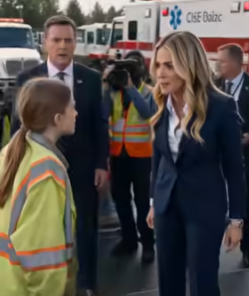
I stood beside a convoy of relief trucks preparing for deployment.
The same trucks Victoria had pointed at when she claimed ownership of everything.
Now they represented something larger.
A shared effort.
A community mission.
As the ceremony began, someone approached me.
Victoria.
The crowd immediately noticed.
Silence spread.
She stopped several feet away.
For a moment, neither of us spoke.
Then she took a deep breath.
“My grandfather was right.”
The words surprised everyone.
Including me.
She looked toward the trucks.
“I spent years believing leadership meant being recognized.”
Her voice trembled.
“He believed leadership meant helping people.”
The cameras recorded every second.
Victoria swallowed hard.
“I’m sorry.”
No excuses.
No blame.
No performance.
Just honesty.
Then she did something nobody expected.
She handed me a framed photograph.
It showed Robert Kensington standing inside the warehouse years earlier.
I was in the background explaining routing maps to volunteers.
Neither of us had known the photo existed.
On the back was a handwritten note.
‘One day the world will know who built this.’
I couldn’t hold back tears.
Neither could Margaret.
The convoy engines started.
The trucks slowly rolled forward.
Volunteers waved.
Families cheered.
The campaign officially began.
As the vehicles disappeared toward the horizon, I realized something important.
The database had never been about software.
It wasn’t about algorithms.
It wasn’t about logistics.
It was about people.
The records had preserved the truth when powerful voices tried to rewrite it.
The timestamps remembered.
The reports remembered.
The database remembered.
And because it remembered, the truth eventually surfaced.
Victoria’s family story collapsed.
Robert Kensington’s real legacy emerged.
Thousands of future volunteers gained opportunities.
And a teenager who spent afternoons organizing warehouse inventory finally received the recognition she never asked for.
The lie failed.
The records survived.
And the logistics database told the truth when nobody else would.
