PART 2 — THE NAME WRITTEN IN THE MORNING
The event coordinator’s hand trembled only once before she steadied the page, and somehow that tiny shake felt louder than the gasps around me.
The book was open. The truth was visible. And every camera in the Dallas exhibition hall had turned toward the same line.
For a second, nobody spoke.
The bright lights over the student interior design displays hummed softly above us. The white curtains I had sewn after school—stitched by my tired fingers until my knuckles ached—hung behind the stage like quiet witnesses. The room smelled of fresh paint, polished wood, expensive perfume, and panic.
Victoria Kensington stood beside the coordinator with her face emptied of color.
Her mother, Claudia Kensington, was at the front row in a pearl-colored suit, one manicured hand gripping her clutch so tightly the metal clasp looked ready to snap.
The coordinator, Ms. Alvarez, swallowed and read aloud.
“Request made at 8:14 a.m. to remove Jade Lin’s name from the primary design credit. Request submitted by… Claudia Kensington.”
The room erupted.
It was not one sound. It was dozens.
A shocked inhale. A whispered curse. A chair scraping backward. A sponsor muttering, “Oh my God.” A teacher saying, “That cannot be right,” even though her voice already knew it was.
Victoria spun toward her mother. “Mom?”
Claudia rose smoothly, but her smoothness had cracks. “This is a misunderstanding.”
Ms. Alvarez did not close the book.
That was what terrified Victoria.
The Sewing Measurement Book was not fancy. It was a thick, scuffed binder with frayed edges, divided by colored tabs and filled with measurements, sketches, cloth samples, curtain lengths, wall spacing, lighting notes, handwritten calculations, timestamps, and signatures. It had been treated like a backstage tool, something only useful to the person doing the real work when no one was watching.
But now, that battered book had become the most important object in the room.
Claudia Kensington stepped forward. “The Kensington Foundation contributed materials, labor coordination, and professional consultation. My daughter was encouraged to supervise. There may have been clerical confusion.”
“Clerical confusion?” I repeated.
My voice came out rough, but it came out.
Every eye turned back to me.
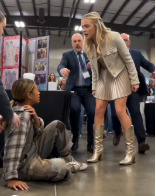
I was still on the floor.
That realization hit me with a fresh sting. Victoria had shoved me, accused me, tried to bury me, and the whole time everyone had stood around waiting to see if the poor girl would cry.
I pushed myself up.
My palms burned from the fall. My knees hurt. A patch on my overall leg had torn loose.
But I stood.
And when I stood, the cameras rose with me.
“I measured every window,” I said. “I cut the fabric in the sewing room because the donation bolts were uneven. I redid the west curtain because the first hem dragged. I stayed three nights until the janitor told me the building was closing. I wrote all of it down because nobody listened unless there was a form.”
Victoria’s lips parted. “You are making yourself sound like some kind of martyr.”
I looked at her then.
Really looked.
Not at her perfect hair or her expensive boots or the confidence she wore like armor, but at the fear beneath it.
“You pushed me because you knew the book would be opened,” I said.
A murmur rolled through the room.
Victoria’s eyes flashed. “You do not know anything about me.”
“No,” I said quietly. “But I know my own handwriting.”
Ms. Alvarez turned another page.
She found the sketches.
There they were: the window treatment plan, the layered curtain concept, the adjustable fabric panels designed to change the room’s mood depending on lighting angle. My notes explained why the cheap donated fabric could be folded into depth instead of stretched flat. My name appeared in the corner of each page: Jade Lin.
Next to the final plan was another signature.
Victoria Kensington.
But it had been added later.
Ms. Alvarez looked up. “The ink is different.”
The principal, Mr. Holloway, finally moved. He walked toward the stage with the careful expression of a man realizing his prestigious event was collapsing in front of donors.
“We need to pause the ceremony,” he said.
“No,” a voice called from the back.
Everyone turned.
A woman in a navy suit stood near the media table, holding a small press badge. I recognized her from the local arts blog that covered student showcases.
She said, “You invited press to witness student achievement. We are witnessing it.”
A strange silence followed.
Then someone clapped.
One clap.
It came from the janitor, Mr. Boone, standing near the double doors with a broom still in his hand.
He nodded at me.
Then my design teacher, Mrs. Patel, began clapping too.
Then three students.
Then ten.
The applause spread through the exhibition hall slowly at first, uncertain, then louder, fuller, until it washed over me like rain after a long drought.
I had imagined applause before.
In secret.
While measuring fabric alone, I had imagined people saying my name with respect. But I had never imagined it like this—standing in torn overalls, knees aching, while the girl who tried to erase me stared like the world had betrayed her.
The applause did not feel like victory. It felt like being pulled back from disappearing.
Victoria backed away.
Her mother grabbed her wrist.
“Do not say anything else,” Claudia hissed.
But Victoria did say something else.
She looked at me, and with cameras recording, whispered loudly enough for the front row to hear, “You ruined us.”
I stared at her.
“No,” I said. “I just kept records.”
PART 3 — THE CURTAIN THAT OPENED TOO SOON
Mr. Holloway tried to regain control.
He cleared his throat, adjusted his tie, and announced that the committee would “review the matter internally,” which was the kind of phrase adults used when they wanted truth to go somewhere quiet and die.
But Ms. Alvarez did something no one expected.
She walked to me and placed the Sewing Measurement Book in my hands.
“This belongs with the person who made the work,” she said.
The binder was heavy.
Heavier than it had ever felt.
Maybe because it now carried more than measurements. It carried every hour I thought nobody would count. Every stitch I made while other students left laughing in groups. Every time someone said, “Jade is good with practical tasks,” when what they meant was, Jade can do the labor while someone else gets the shine.
The stage curtain still covered the main exhibit.
The ceremony marker stood untouched.
Victoria had shoved me before I reached it, before I could pull the cord, before the room could see what I had built.
Mrs. Patel came to my side, her dark eyes shining. “Jade,” she said softly, “do you still want to do it?”
My fingers tightened around the book.
I looked at the audience.
Sponsors. Parents. Students. Teachers. Cameras. People who had noticed me only after humiliation made me interesting.
Then I looked at Victoria.
She looked smaller now, but not sorry.
That mattered.
Because shame and regret are not the same thing.
“I do,” I said.
Mr. Holloway hesitated. “Perhaps we should wait until—”
“No,” Ms. Alvarez said.
The word was calm, but final.
So I walked.
My sneakers squeaked against the polished floor. My heart was pounding so hard I could feel it in the scrape on my palm. The distance to the ceremony marker seemed impossibly long.
Halfway there, a voice cut through the room.
“Jade!”
It was my father.
I had not even known he had arrived.
He stood near the back in his work uniform from the delivery warehouse, cap in his hands, breathless like he had run from the parking lot. His face was tired. His eyes were red.
Beside him stood my grandmother, Nai Nai, small and straight-backed, wearing her best blue cardigan. She held a cloth tote bag against her chest.
My father lifted one hand.
Not waving.
Steadying me.
That almost broke me.
Because I had told him not to come if work made it hard. I had said it was “just school stuff.” I had said I understood.
But there he was.
And somehow, seeing him made me remember who I was before the room decided what I looked like.
I was the daughter of a man who worked double shifts without complaining.
The granddaughter of a woman who taught me how to sew a straight hem by making me rip it out until I learned patience.
The girl who had built beauty out of scraps because scraps were what I had.
I reached the cord.
My hand closed around it.
The hall fell silent.
I pulled.
The curtain opened.
And the room changed.
Soft golden light spilled over the exhibit like sunrise. The fabric panels I had sewn unfolded in layered waves, each section catching light differently—cream, amber, pale sage, muted blue. The cheap donated cloth no longer looked cheap. It looked intentional, textured, alive. Shadows crossed the wall in gentle patterns, transforming the student-built room into something warm and elegant and surprisingly intimate.
People leaned forward.
The design was not loud.
It did not scream wealth.
It whispered home.
There were gasps, real ones this time.
The local reporter lifted her camera.
Mrs. Patel covered her mouth.
My father stared at the curtains, then at me, and his expression did something I would remember for the rest of my life.
He looked proud before anyone else told him he was allowed to be.
Then Nai Nai walked forward.
Slowly.
The audience parted for her without understanding why.
She reached the stage steps, and I hurried down to help her, but she shook her head.
“I can climb,” she said.
Her voice was soft but sharp as a needle.
When she reached me, she opened her tote bag and pulled out something wrapped in faded red silk.
Victoria’s mother narrowed her eyes.
Nai Nai unwrapped it.
Inside was an old brass measuring tape, worn smooth at the edges, its numbers faded but visible.
“My mother used this in Guangzhou,” Nai Nai said. “Then I used it when I came here. Then Jade used it for this.”
She held it up.
The cameras turned again.
Nai Nai looked at the audience. “People think sewing is small work because women do it quietly. But measure wrong, cut wrong, stitch wrong, and the whole room falls apart.”
Her eyes moved to Victoria.
“Some people only know how to stand in finished rooms.”
The applause this time came instantly.
Loud.
Thunderous.
Victoria’s mouth twisted.
Her mother whispered something urgent to her, but Victoria was no longer listening. Her stare had fixed on the exhibit wall, where the project title plaque had been mounted.
It read:
KENSINGTON FOUNDATION STUDENT DESIGN INSTALLATION
Lead Concept: Victoria Kensington
Fabrication Assistance: Jade Lin
My stomach dropped.
The book had exposed the record.
But the plaque still told the lie.
PART 4 — THE PLAQUE ON THE WALL
The applause faded as people noticed where I was staring.
One by one, heads turned toward the plaque.
The room chilled.
Mrs. Patel’s face hardened. Ms. Alvarez closed her eyes for a moment, as if silently counting to keep from shouting. Mr. Holloway looked like he wanted to peel himself out of his own skin and disappear into the wallpaper.
Victoria saw the plaque too.
For one dangerous second, hope returned to her face.
“There,” she said. “The official display clearly says—”
“It says what someone printed,” I interrupted.
My voice was steadier now.
Not loud.
Steady.
Victoria stepped closer. “You cannot just rewrite the school’s formal installation.”
“No,” I said. “But I can tell the truth standing next to it.”
The reporter raised her microphone. “Jade, did you approve that credit line?”
“No,” I said.
“Did anyone ask you?”
“No.”
“Were you told Victoria Kensington was listed as lead concept?”
I looked at the plaque.
All the long nights came back at once. The empty classroom. The pins between my lips. The ache in my shoulders. The way Victoria had drifted in twice, wrinkled her nose at the fabric, and said, “Make it look less homemade.”
“No,” I said. “I found out with everyone else.”
Claudia Kensington moved quickly then.
She walked to Mr. Holloway and spoke low, but the microphones were everywhere now.
“This is becoming defamatory,” she said. “The foundation has been generous to this school. Very generous.”
There it was.
The invisible hand on the throat.
Money.
The thing that made adults smile at cruelty and call it diplomacy.
Mr. Holloway looked at me, then at Claudia, then at the cameras.
His fear was obvious.
And I hated that I understood it.
The Kensington Foundation paid for scholarships, equipment, gallery rentals, publicity. Their name was on walls. On programs. On donor boards. On plaques like the one stealing my work.
Claudia was not simply a mother defending her daughter.
She was a gatekeeper reminding everyone what obedience cost.
Then my father stepped forward.
He did not shout. He did not accuse. He just spoke from the back of the hall.
“My daughter came home with bleeding fingers.”
The room turned.
He held his cap in both hands.
“I told her to sleep. She said the curtains would not hang right. I told her nobody would notice. She said she would notice.”
His voice cracked once, but he kept going.
“I do not know about foundations. I do not know about plaques. But I know my child. She does not steal. She finishes what other people leave behind.”
A silence followed so deep it felt sacred.
Then something happened near the side aisle.
A boy named Marcus, who had helped build the display shelves, raised his hand.
“I saw Jade working on the panels every day,” he said. “Victoria came in for photos.”
A girl from the lighting team spoke next. “Jade adjusted the fabric after we changed the bulbs. She knew the whole concept.”
Another student added, “Victoria told us not to bother Jade because she was ‘just sewing.’”
Then another voice.
And another.
The truth did not arrive like lightning.
It arrived like stitches.
Small pieces pulled together until the shape could not be denied.
Victoria’s eyes filled with tears, but they were angry tears.
“You are all jealous,” she said. “You always wanted to embarrass me because my family actually matters.”
That was the sentence that doomed her.
Someone near the front gasped, “Wow.”
Claudia grabbed her daughter’s arm again, but Victoria shook her off.
“No! I am tired of pretending these people deserve the same opportunities when they do not even know how to act in them.”
The hall went dead.
Even the cameras seemed to freeze.
Victoria realized too late what she had said.
My chest hurt.
Not because I was surprised.
Because I was not.
Sometimes the cruelest thing is hearing someone finally say out loud what they have been quietly proving all along.
Ms. Alvarez stepped toward the plaque.
She removed it from the wall.
The sound of the Velcro tearing away was strangely satisfying.
Rrrrip.
Then she turned it around so the blank back faced the crowd.
“This credit line is under review,” she said. “For the remainder of this exhibition, the installation will be introduced verbally with documented authorship.”
Mr. Holloway opened his mouth.
Ms. Alvarez looked at him.
He closed it.
The reporter asked, “And documented authorship belongs to whom?”
Ms. Alvarez handed me the Sewing Measurement Book.
“Jade Lin,” she said.
My name moved through the room like a match struck in darkness.
Jade Lin.
For once, no pity followed it.
PART 5 — THE OFFER WITH TEETH
By evening, the video was everywhere.
Someone posted the shove. Someone posted Ms. Alvarez reading the entry. Someone posted Nai Nai holding up the brass measuring tape, and that clip spread fastest because people loved the line about finished rooms.
The next morning, I woke to my phone vibrating nonstop.
Messages from classmates who had ignored me all year.
You were amazing.
I always knew Victoria was fake.
We should hang out sometime.
I stared at them without replying.
Praise can feel strange when it arrives from people who were comfortable with your silence yesterday.
At school, everything had changed and nothing had changed.
People looked at me differently, but they still looked. Some with admiration. Some with guilt. Some with curiosity sharp enough to hurt.
Victoria was absent.
Her locker had been cleared of the photos taped inside.
By noon, rumors bloomed everywhere.
The Kensingtons were threatening legal action.
The school board was investigating.
Ms. Alvarez had been asked to “take leave,” which made my blood go cold until Mrs. Patel whispered that she had refused.
Then, during fifth period, the office called me.
My father was there.
So was Mr. Holloway.
And Claudia Kensington.
She sat in the conference room like nothing had happened, wearing a charcoal suit and diamond earrings. Victoria was not with her.
A lawyer sat beside her.
My father stiffened when he saw them.
I did too.
Mr. Holloway gestured weakly. “Jade, Mr. Lin, thank you for coming.”
Claudia smiled.
It was worse than her anger.
“Jade,” she said, “yesterday became emotional. My daughter behaved poorly. We acknowledge that.”
My father’s jaw tightened.
Claudia placed a folder on the table.
“We would like to resolve this constructively.”
I did not touch the folder.
“What does that mean?” I asked.
The lawyer answered. “The Kensington Foundation is prepared to offer a private educational grant. Full summer tuition at a design program, plus materials support.”
My heart betrayed me.
It jumped.
Summer design programs were impossible dreams. I had researched them late at night and closed the tabs before hope could become pain.
My father looked at me, and I could see the same thought in his eyes.
This could help.
Claudia continued gently, “In exchange, all parties would agree not to inflame the situation publicly. The school would issue a shared statement recognizing collaborative contributions.”
There it was.
The teeth inside the gift.
I opened the folder.
The words blurred at first, then sharpened.
Collaborative misunderstanding.
Mutual distress.
No further public comment.
Restoration of donor relationship.
My fingers went cold.
“You want me to say it was a misunderstanding,” I said.
“We want fairness,” Claudia replied.
“No,” I said. “You want quiet.”
Her smile thinned.
“Jade, you are young. You do not yet understand how opportunity works.”
My father stood. “She understands enough.”
Claudia ignored him and looked only at me.
“You have talent. Real talent. But talent needs doors. My family opens doors.”
I thought of the plaque.
Lead Concept: Victoria Kensington.
I thought of all the doors that had opened for Victoria before she even touched the handle.
Then I thought of Nai Nai’s measuring tape.
Measure wrong, cut wrong, stitch wrong, and the whole room falls apart.
I closed the folder.
“I will not trade my name for a scholarship.”
Mr. Holloway looked miserable.
The lawyer scribbled something.
Claudia leaned back. For the first time, her mask slipped.
“Pride is expensive,” she said.
“So is lying,” I answered.
The room went very still.
Then the conference door opened.
Ms. Alvarez stepped in.
No one had called her. No one expected her.
She held a tablet in her hand and looked directly at Claudia.
“You should know,” she said, “the district archive backed up the original submission file before your alteration request.”
Claudia’s face sharpened.
Ms. Alvarez continued, “And there is more.”
The lawyer stood. “This meeting is over.”
“No,” Ms. Alvarez said. “It is just getting honest.”
She turned the tablet toward us.
On the screen was an email chain.
My name appeared.
So did Victoria’s.
So did another name I did not recognize.
Eleanor Vale.
My eyes caught on the subject line:
Regarding original concept ownership — urgent.
I looked up. “Who is Eleanor Vale?”
Ms. Alvarez’s expression changed.
For the first time since the exhibition, she looked not angry, but afraid.
“She was the first student who accused the Kensington Foundation of stealing her work,” she said. “Three years ago.”
PART 6 — THE GIRL WHO DISAPPEARED FROM THE WALL
Eleanor Vale had been a senior when I was still in middle school.
Her project had been a modular community library design—low-cost, portable, warm, beautiful. According to Ms. Alvarez, it won a district award, then somehow reappeared months later under the Kensington Foundation’s youth initiative with Victoria’s older cousin listed as creative lead.
Eleanor complained.
Then her recommendation letters vanished.
Her portfolio link stopped working.
A scholarship committee mysteriously withdrew interest.
By graduation, people said she had “overreacted” and “damaged her reputation.”
I listened to Ms. Alvarez speak, and my anger changed shape.
It was no longer only about me.
That was frightening.
Personal pain can make you want justice.
Patterned pain demands something larger.
Ms. Alvarez had kept copies because Eleanor had begged someone to believe her. At the time, Ms. Alvarez had been an assistant coordinator with no power, no protection, and too much fear. She had lived with that guilt for three years.
“When Jade’s file was altered,” she said, “I checked the archive immediately. Then I checked old records.”
Claudia’s lawyer pointed at her. “You are making serious allegations.”
“Yes,” Ms. Alvarez said. “Documented ones.”
My father touched my shoulder.
I realized I was shaking.
Not with fear.
With fury.
The story broke wider that night.
Not because I posted anything—I still could barely breathe around the thought of strangers discussing my life—but because the reporter did her job. She found Eleanor Vale.
Eleanor was nineteen now, working at a furniture repair shop outside Austin, saving money to reapply to design school. In the interview, she sat beneath fluorescent lights with sawdust on her sleeves and said she had thought she was alone.
When she mentioned my name, her voice broke.
“I hope Jade knows she is not crazy,” she said. “That is what they make you feel first. Crazy. Then grateful for whatever crumbs they leave you.”
I watched the clip three times.
Then I cried so hard Nai Nai sat beside me and put one hand on my back without saying anything.
The next day, the school board suspended the Kensington Foundation partnership pending review.
Victoria returned to school under a storm cloud of whispers.
She moved through the hallway with her head high, but her eyes were swollen.
When she saw me near the art wing, she stopped.
For a moment, I thought she would insult me.
Instead, she said, “My mother says you are trying to destroy our family.”
“I am trying to keep my name on my work.”
She laughed once, bitterly. “You think this ends with your name? You have no idea what people will do when money is involved.”
“I am learning.”
Her face twisted.
Then she said something I did not expect.
“I did not change the file.”
I stared at her.
“I believed the project should be mine,” she said quickly, defensively. “I thought you were just helping. I thought… I thought that is how these things worked.”
“That does not make it better.”
“I know.”
The words sounded painful coming out of her.
She looked down at her boots.
“They told me my whole life that our family creates opportunities. That people should be grateful. That being generous means getting to shape the story.”
“And you believed them.”
Her eyes lifted.
“Yes.”
There was no excuse in it.
Only confession.
I wanted to hate her cleanly. It would have been easier. But people are rarely kind enough to be only villains.
Still, pity was not forgiveness.
“You shoved me,” I said.
She flinched.
“I know.”
“In front of everyone.”
“I know.”
“You tried to make them laugh at me.”
Her eyes filled again. “I know.”
The hallway noise seemed far away.
Then Victoria whispered, “There is something else.”
My breath caught.
She looked over her shoulder, then opened her bag and pulled out a slim black flash drive.
“My mother told me to destroy this.”
I did not take it immediately.
“What is on it?”
Victoria’s hand trembled.
“Files. Old project files. Names. Before-and-after credits. I copied them from her laptop last night.”
“Why?”
She wiped her cheek angrily, as if tears offended her.
“Because yesterday when everyone looked at me, I realized I did not know whether anything I had ever been praised for was mine.”
That sentence landed harder than I wanted it to.
Victoria held out the drive.
“I am still angry at you,” she said.
“I am still angry at you too.”
“Good.”
I took the flash drive.
Our fingers did not touch.
But something passed between us anyway.
Not friendship.
Not trust.
A fragile, uneasy understanding that the truth had grown too large for either of us to carry alone.
PART 7 — THE ROOM BUILT FROM SCRAPS
The review hearing was scheduled for Friday evening in the same exhibition hall where Victoria had shoved me.
That choice felt cruel at first.
Then it felt right.
Because the room remembered.
The curtains still hung there, glowing softly in the late-afternoon light. My repaired patch was sewn back onto my overalls with red thread. Nai Nai said visible mending was a good philosophy: do not hide where something tore; make the repair part of the design.
By six o’clock, the hall was full.
Students. Parents. Teachers. Board members. Press. Former students. Donors who looked nervous. People who had once believed the Kensington name was a guarantee of elegance now watched it like a crack in the ceiling.
Eleanor Vale came.
I recognized her immediately from the interview. She had short dark hair, tired eyes, and a smile that looked like it had survived bad weather.
When she saw me, she hugged me without asking, and I hugged her back.
“Your curtains are beautiful,” she whispered.
“Your library design was beautiful,” I said.
She pulled away, eyes wet. “I never thought I would hear someone say that again.”
The hearing began with statements.
Mr. Holloway apologized in the careful language of institutions.
Ms. Alvarez presented the records.
The district technology officer confirmed the archived file alteration.
Then came the flash drive.
No one knew Victoria had provided it.
Not yet.
The files showed more than altered credits.
They showed a system.
Student sketches absorbed into foundation proposals.
Donor presentations repackaged from class portfolios.
Names replaced, softened, removed.
Students thanked for “assistance” after building entire concepts.
Some had graduated years ago. Some had quit design entirely.
The room grew heavier with every slide.
Claudia Kensington sat at the front with her lawyer, expression carved from ice.
Victoria sat three seats away from her mother.
Alone.
When the board chair asked if anyone had further testimony, I stood.
My legs shook, but I stood.
“I used to think being overlooked meant I had failed to be impressive enough,” I began. “So I worked harder. I stayed later. I made myself useful. I thought eventually someone would notice.”
I looked at the curtains.
“But people did notice. They noticed exactly how much they could take from someone who had been taught to be grateful for being allowed in the room.”
A few people bowed their heads.
“My work matters,” I said. “Eleanor’s work matters. Every student’s work matters. Not because a sponsor approves it. Not because a rich family puts a plaque on it. It matters because we made it.”
My voice trembled.
Then strengthened.
“I do not want revenge. I want records corrected. I want students notified. I want stolen credits restored. I want no student after me to need a measurement book to prove they exist.”
The applause hit like a wave.
This time, I did not shrink from it.
Then Victoria stood.
Her mother turned sharply. “Sit down.”
Victoria did not.
The room went silent.
She walked to the microphone, pale but upright.
“My name is Victoria Kensington,” she said.
The cameras moved.
She swallowed.
“I shoved Jade Lin. I lied about her role. I repeated things I was taught because they benefited me. I am responsible for that.”
Claudia stood. “Victoria.”
Victoria’s voice shook harder. “But I did not alter the file. My mother did. And the files presented tonight came from me.”
A collective gasp tore through the hall.
Claudia looked as if her daughter had struck her.
Victoria continued, crying openly now.
“I do not deserve praise for telling the truth late. But I am telling it. Jade designed the installation. Eleanor designed the library project. Other students were erased too. My family called it opportunity. It was theft.”
Her mother whispered, “How could you?”
Victoria looked at her.
The answer was quiet.
“Because you taught me what stealing looks like.”
The room did not applaud.
Some moments are too sharp for applause.
The board voted that night.
The Kensington Foundation partnership was terminated.
An independent review would restore credits to affected students.
Scholarship recommendations would be reissued.
Ms. Alvarez would lead a new student authorship policy.
The exhibition plaque would be replaced.
When the new plaque was unveiled, it read:
ROOM BUILT FROM SCRAPS
Lead Designer: Jade Lin
Fabrication, Concept, Textile Design: Jade Lin
Lighting Support: Student Exhibition Team
Dedicated to every student whose work deserved a name.
I stared at it until the letters blurred.
Then Eleanor slipped her hand into mine.
“Believe it,” she said.
I tried.
PART 8 — THE END — THE MEASUREMENT THAT SAVED US ALL
Two months later, a letter arrived in a plain white envelope.
I almost threw it away with the grocery coupons.
My father was making tea in the kitchen. Nai Nai was hemming a neighbor’s dress by the window. The apartment smelled of ginger, steam, and laundry soap.
I opened the envelope standing by the counter.
Then stopped breathing.
The letter was from the Harrington Young Designers Institute in New York.
My hands began to shake so violently the paper rattled.
My father turned. “Jade?”
I read the first line again.
Then the second.
Then the word that changed everything.
Accepted.
Not waitlisted.
Not considered.
Accepted.
With full tuition.
And housing.
And a materials stipend.
I slid down the kitchen cabinet and sat on the floor, laughing and crying at the same time.
My father thought something was wrong and rushed to me. Nai Nai moved faster than I had seen her move in years.
“What happened?” he asked.
I held up the letter.
“I got in.”
He took it, read it, and covered his mouth.
Nai Nai snatched it from him impatiently, scanned it, then nodded once like she had expected nothing less.
“Good,” she said. “Now you need better scissors.”
That made all of us laugh until we cried again.
But the strangest part was not the acceptance.
It was the final paragraph.
The institute had created a new annual award for student designers whose work emphasized resourcefulness, ethical authorship, and community-centered interiors.
The first award would be named after the project.
The Room Built From Scraps Fellowship.
My project.
My scraps.
My name.
And then came the shocking part none of us saw coming.
The fellowship’s anonymous founding donation had been made in honor of Mei Lin, my grandmother’s mother—the woman who had first owned the brass measuring tape.
I looked up slowly.
“Nai Nai?”
She was very still.
My father frowned. “Ma?”
Nai Nai took the letter. Her eyes moved over the paragraph. Once. Twice.
Then she sat down.
For a long moment, she said nothing.
Finally, she whispered, “Mei Lin worked for a woman named Harrington when she first came to America.”
My heart thudded.
“What?”
Nai Nai’s voice had gone distant, traveling backward through decades.
“She sewed drapes in houses she could never enter through the front door. She made rooms beautiful for people who never learned her name. One woman did learn it. Mrs. Harrington. She wanted Mei to study design, but Mei had children to feed.”
She touched the brass measuring tape on the table.
“Before Mrs. Harrington died, she wrote that Mei Lin had taught her the difference between decoration and dignity.”
My father sat slowly.
I read the letter again, barely able to understand.
The Harrington family had found the viral video. They had seen Nai Nai holding the brass measuring tape. They recognized the name Mei Lin from old family journals and letters preserved in their archive. The fellowship was not charity.
It was a debt finally paid.
I pressed the letter to my chest.
All my life, I thought I was starting from nothing.
But I had been carrying an inheritance no one could see.
Not money.
Not status.
A measuring tape.
A skill.
A stubborn record of hands that made beauty where they were told they did not belong.
A week later, I returned to the exhibition hall one final time before the installation came down.
The room was empty except for the curtains and the late sunlight.
Victoria was there.
I stopped in the doorway.
She looked different. Less polished. Her hair was tied back simply. She wore jeans, no designer jacket, no armor.
“I heard about New York,” she said.
I nodded. “I leave in August.”
“That is good.”
Silence stretched between us.
Then she said, “I am transferring schools.”
I did not know what to say.
She looked at the floor. “My mother is under investigation. My father moved out. Everything is… not fine.”
“I am sorry,” I said, and meant it in a complicated way.
Victoria nodded.
“I am not asking you to forgive me.”
“Good,” I said softly. “I am not ready.”
A small, sad smile touched her face. “Fair.”
She reached into her bag and pulled out a folded piece of fabric.
It was one of the damaged curtain scraps from the first failed west panel.
“I kept this,” she admitted. “I do not know why. Maybe because it was the first thing I saw that looked ordinary until you changed where the light hit it.”
She held it out.
I took it.
For a moment, we were just two girls standing in a room that had cost us both our illusions.
“I hope you make something that is actually yours someday,” I said.
Her eyes filled.
“Me too.”
After she left, I walked to the curtains and ran my fingers along the hem.
Each stitch was slightly imperfect. Human. Mine.
The room glowed around me.
I thought the Sewing Measurement Book had saved me because it proved what I did.
But I understood then that it had done something bigger.
It had measured the distance between silence and truth.
Between being used and being seen.
Between inheritance and destiny.
On the last page of the book, beneath the final measurements, I wrote one more entry.
Jade Lin. Lead Designer. Daughter. Granddaughter. Not erased.
Then I closed the book.
Outside, Dallas blazed gold in the evening sun, and my father waited by the car with Nai Nai, who was already complaining that New York winters would ruin my shoes.
I laughed as I ran toward them.
For the first time, the future did not look like a door someone else had to open.
It looked like fabric in my own hands.
Uncut.
Unclaimed.
Ready.
