PART 2 — THE FACE ON THE SCREEN
When the second video appeared on the giant screens above Daytona, the entire speedway seemed to stop breathing.
The first person visible in the footage was not a mechanic.
Not a confused volunteer.
Not a careless young driver who had wandered where he should not have been.
It was Victoria Harrington.
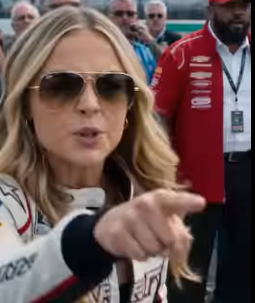
Her blonde hair was tucked beneath a designer racing cap. Her white team jacket carried the embroidered crest of Harrington Motorsports, a name so powerful in student racing that people whispered it like royalty. She stood near the pit wall, holding a radio, her eyes fixed on the young driver who had been waving frantically for help.
On the screen, the boy looked panicked.
He pointed toward the restricted zone.
He shouted something.
Victoria glanced at him.
Then she turned away.
A ripple moved through the grandstands.
Someone near the front row said, “No…”
The footage continued.
The young driver stepped closer to Victoria, still trying to warn her. His helmet was under one arm. His face was pale. He gestured toward the moving vehicle being released from the garage lane. Victoria lifted one hand as if annoyed, then pushed past him.
The chief safety marshal paused the footage.
The image froze with Victoria’s back turned while the young driver stood helpless behind her.
The marshal’s voice carried through the stadium speakers.
“Before the incident, Driver Eli Morgan reported that he warned a team representative about an unsafe release from pit lane. At the time, the report was dismissed due to lack of supporting testimony.”
The crowd turned toward Victoria.
Victoria looked as if the sun had vanished from the sky.
Her smirk was gone.
Her hands trembled at her sides.
The marshal pressed play again.
On the screen, Victoria walked toward a television reporter near the pit entrance. She adjusted her hair, smiled brightly, and began speaking into the camera as if nothing else existed.
Behind her, the young driver stumbled backward into the restricted area.
Behind him, a race vehicle rolled forward.
And then I appeared.
I was holding a broom in one hand and a trash bag in the other. I heard the boy shout. I looked up. I dropped everything.
I ran without thinking.
The giant screen showed me sprinting across the pit lane, my worn work shoes slipping slightly on the concrete. I grabbed Eli by the back of his fire suit and yanked him away so hard we both fell.
A heartbeat later, the vehicle shot through the space where he had been standing.
No music played.
No announcer spoke.
Only the ugly truth filled the speedway.
Victoria had ignored the warning because a camera was pointed at her.
The marshal stopped the video.
Then he turned slowly toward her.
“Miss Harrington,” he said, “this second file was retrieved from an internal camera after additional review. It appears you were informed of a danger and chose not to respond.”
Victoria opened her mouth, but no words came out.
Her father, Charles Harrington, stepped from the VIP box near the starting line. He wore a silver suit and the expression of a man used to controlling rooms, crowds, and consequences.
“This is outrageous,” he snapped. “My daughter is a student athlete, not a safety official.”
The marshal did not flinch.
“No one said she was a safety official,” he replied. “But she had access to a radio. She was standing beside a warning station. She was told someone was in danger.”
Charles’s eyes narrowed.
“This is a misunderstanding.”
Then Eli Morgan himself stepped forward from behind one of the pit boxes.
The crowd recognized him immediately.
He was the young driver from the footage.
His arm had been in a sling for weeks after that incident, though no one had ever been told why. His team had quietly withdrawn from two races. Rumors had spread, but no truth had surfaced.
Until now.
Eli looked nervous, but determined.
He took the microphone from a reporter and faced the grandstands.
“I tried to tell her,” he said, his voice shaking. “I told her the release was unsafe. I told her someone needed to stop the car. She looked at me and said…”
He swallowed.
Victoria whispered, “Don’t.”
Eli looked directly at her.
“She said, ‘Don’t ruin my interview.’”
The grandstands exploded.
Boos crashed over the track like thunder.
Victoria covered her ears.
Charles Harrington stepped in front of her, shouting at the marshal, but his words disappeared beneath the roar of the crowd.
I stood frozen near the platform, my palms scraped, my knees burning from the shove. All I could think was that, months earlier, I had gone home without telling anyone what happened. I had washed dust from my hands, patched my work shoes with glue, and returned the next morning before sunrise.
I never imagined anyone had seen.
I never imagined the moment would matter.
Then the race director came to me.
He picked up the green flag from the pavement and placed it back in my hands.
His voice softened.
“Lena,” he said, “are you ready?”
The crowd quieted.
Every camera turned again.
Victoria stared at me with hatred, humiliation, and something else now.
Fear.
I climbed onto the starter’s platform with shaking legs.
The wind whipped the flag beside me.
Below, drivers waited in their cars.
Thousands watched.
My chest tightened.
For a second, I thought about stepping down. I thought about returning to the shadows where people like me were supposed to stay. Behind fences. Behind brooms. Behind names nobody remembered.
Then Eli lifted his good hand from pit lane.
He nodded.
And from somewhere deep inside me, a courage I did not know I had finally stood up.
I raised the green flag.
The engines roared.
And I waved.
PART 3 — THE GIRL WHO SWEPT THE TRACK
The race began with the kind of fury only Daytona could hold.
Cars screamed past the grandstands in flashes of color. The air shook with engine noise. Cameras followed the leaders, commentators shouted over one another, and the crowd slowly shifted from scandal to speed.
But I could still feel Victoria’s shove in my bones.
I climbed down from the platform after the opening lap, trying to disappear into the work crew. That was what I knew best. Disappearing.
My name was Lena Brooks. I was nineteen years old, a community college student when I could afford classes, and a track maintenance worker every weekend I could get scheduled. My mother used to say I was born listening for engines. My father had loved racing, though he never raced anything faster than an old pickup that coughed smoke on cold mornings.
After he died, the track became the one place where grief did not swallow me whole.
I swept rubber from corners.
I collected broken plastic after crashes.
I checked fence lines after storms.
I worked while future champions walked past me without seeing my face.
And somehow, I loved it.
Because racing was not just glamour. It was not only champagne, sponsors, and cameras.
Racing was the mechanic burning his hand and refusing to quit.
It was the mother in the stands wearing her son’s number on her shirt.
It was the volunteer handing out water under brutal heat.
It was the invisible army making sure young drivers went home alive.
That was the part I belonged to.
Or at least, that was what I believed before the Harringtons decided I had taken something from them.
Halfway through the race, I was sent back toward the maintenance garage. I thought the worst was over.
I was wrong.
A black SUV rolled slowly beside the service road. The passenger window lowered.
Charles Harrington sat inside.
“Miss Brooks,” he called.
I stopped.
Every instinct told me to keep walking.
He smiled, but there was no warmth in it.
“You’ve had quite a morning.”
I said nothing.
He opened the door and stepped out. Two men in dark suits stood behind him. They looked less like assistants and more like walls.
Charles adjusted his cufflinks.
“Public moments can be confusing,” he said. “People misunderstand what they see. My daughter is emotional. You were in the right place at the right time. No need for this to become something ugly.”
“It already became ugly when she shoved me,” I said.
His smile faded.
“She made a mistake.”
“She ignored Eli.”
His eyes hardened.
“You should be careful repeating accusations.”
I felt my throat dry.
He stepped closer.
“You work here, yes? Hourly? Seasonal?”
The word hit exactly where he aimed it.
Seasonal.
Replaceable.
Small.
“I work hard,” I said.
“I’m sure you do.” He reached into his jacket and pulled out an envelope. “There are ways to make this easier for everyone.”
I looked at the envelope.
My mother’s rent was due in six days.
My tuition balance had already locked my account.
My car needed two tires.
Charles Harrington knew nothing about me, yet somehow rich men always knew where poor people hurt.
“Take it,” he said. “You tell the reporters the shove was accidental. You say the old footage was taken out of context. You say Victoria apologized privately.”
“She didn’t.”
“She will, if necessary.”
The envelope remained between us.
For one terrible second, I imagined opening it.
I imagined my mother crying with relief.
I imagined going back to school full time.
I imagined not choosing between groceries and gas.
Then I remembered Eli’s face on the video.
I remembered his body being pulled from the path of that car.
I remembered Victoria saying, “That should be me!” after throwing me onto the pavement.
I pushed the envelope back.
“No.”
Charles stared at me.
“Excuse me?”
“No,” I repeated, stronger this time. “You can keep your money.”
The two suited men shifted.
Charles leaned close enough that I smelled expensive cologne.
“People like you do not win fights against families like mine.”
My heart pounded.
But my voice did not break.
“Maybe not,” I said. “But people like me clean up after people like you crash.”
His face changed.
For a moment, the mask slipped, and I saw the rage beneath it.
Then a reporter’s voice called from behind us.
“Mr. Harrington! Care to comment?”
Charles stepped back instantly.
A camera crew hurried toward us.
The envelope disappeared into his jacket.
His smile returned like a curtain falling into place.
“No comment,” he said smoothly.
But the camera had seen enough.
And so had I.
PART 4 — WHEN THE CROWD CHANGED SIDES
By the end of the race, no one cared who won.
The official winner climbed from his car beneath a shower of confetti, but every microphone seemed pointed in another direction.
At me.
At Eli.
At Victoria.
At the Harrington empire cracking in public view.
I tried to hide behind the maintenance trailer, but the race director found me again. His name was Mr. Alvarez, and he had the tired eyes of someone who had spent decades preventing disasters nobody thanked him for.
“Lena,” he said gently, “there’s a press conference.”
“I don’t want a press conference.”
“I know.”
“Then why are you telling me?”
“Because they are already making statements without you.”
He handed me his phone.
A livestream showed Charles Harrington standing before a wall of sponsor logos. Victoria stood beside him wearing sunglasses, though we were indoors.
Charles spoke calmly.
“My daughter was assaulted by false accusations today. A maintenance employee was elevated into a ceremonial role without proper vetting, leading to an unfortunate emotional misunderstanding.”
My stomach turned.
Maintenance employee.
Not Lena.
Not the girl who saved Eli.
Just a title small enough to step on.
Victoria leaned toward the microphone.
“I was under a lot of pressure,” she said, her voice trembling in a way that sounded rehearsed. “I felt blindsided. I never meant to hurt anyone. But people are using edited footage to destroy my future.”
Edited footage.
Destroy my future.
The comments beneath the livestream moved too fast to read.
Some defended her.
Many did not.
But the Harrington name still carried weight, and weight could crush truth if enough money leaned on it.
Mr. Alvarez took the phone back.
“You don’t have to speak,” he said. “But silence gives them room.”
I closed my eyes.
I wanted my old life back.
I wanted to sweep corners and go home unnoticed.
But there are moments when the world puts a microphone in your hand not because you wanted attention, but because someone powerful is counting on your fear.
So I went.
The media room smelled of coffee, sweat, and electrical equipment. Reporters packed shoulder to shoulder. Cameras turned when I entered, and a hush spread through the room.
I sat beside Eli.
His mother sat behind him, crying quietly.
Mr. Alvarez stood at the podium.
“Lena Brooks will make a brief statement,” he said.
My hands shook as I adjusted the microphone.
For a second, all I saw were lenses.
Black circles.
Unblinking.
Hungry.
Then I looked past them and saw the cleaning crew gathered near the back wall. Men and women in faded vests, dusty boots, and sunburned faces.
My people.
I breathed in.
“My name is Lena Brooks,” I said. “I work at this speedway. I clean the track. I pick up debris. I do whatever needs doing so drivers can race safely.”
The room stilled.
“I didn’t ask to wave the flag today. I was honored. I was nervous. And then Victoria Harrington shoved me because she believed the moment belonged to her.”
A reporter asked, “Did Mr. Harrington offer you money?”
The room sharpened.
I hesitated.
Charles was watching somewhere.
I knew it.
“Yes,” I said.
A burst of voices erupted.
“How much?”
“What did he want?”
“Did you accept?”
“I don’t know how much,” I answered. “I didn’t open the envelope. He wanted me to say the footage was misunderstood.”
Eli leaned toward his microphone.
“It wasn’t misunderstood,” he said. “She saved my life.”
His voice cracked on the last word.
His mother covered her mouth.
I looked at him, and my own eyes burned.
“I didn’t save him because I wanted cameras,” I said. “I saved him because he was in danger. That should be normal. That should be what all of us do.”
A journalist in the front row raised her hand.
“Lena, what do you want to happen now?”
I thought of Victoria’s face when the crowd cheered for me.
I thought of Charles’s envelope.
I thought of every worker who had ever been ignored until something went wrong.
“I want the truth to matter,” I said. “Even when the person telling it has no money, no sponsor, and no famous last name.”
For once, nobody interrupted.
Then, from the back of the room, someone began clapping.
It was one of the janitors.
Then a mechanic.
Then Eli’s mother.
Soon the whole room filled with applause.
Not the wild applause from the grandstands.
This was different.
Heavier.
Real.
And for the first time that day, I did not feel like the girl who had been pushed down.
I felt like the girl who had stood back up.
PART 5 — THE HARRINGTON MACHINE STRIKES BACK
The backlash came before sunset.
By evening, my phone was flooded with messages. Some called me brave. Some called me a liar. Some strangers said I had ruined a young woman’s life for attention. Others said Victoria should never race again.
I turned the phone off after reading one message that said, “People like you should stay in your lane.”
My mother found me sitting on the kitchen floor.
Our apartment was small, with thin walls and a refrigerator that hummed like an exhausted machine. She still wore her grocery store uniform. Her shoes were damp from rain.
She lowered herself beside me without asking questions.
For a while, we sat shoulder to shoulder.
Then she said, “Your father would have been proud.”
That broke me.
I cried so hard I could not breathe.
My mother held me the way she had when I was little and thunder scared me. She smelled like laundry soap and tiredness.
“I didn’t want this,” I whispered.
“I know.”
“I just wanted to work.”
“I know.”
“What if they fire me?”
She brushed hair from my face.
“Then we survive that too.”
But survival is easier to promise at night than to face in the morning.
The next day, a letter arrived from Harrington Motorsports’ legal team. It accused me of defamation. It demanded a public apology. It warned that failure to retract my statement would result in legal action.
I read the letter three times before my hands went numb.
Mr. Alvarez called moments later.
“They sent us one too,” he said.
“What happens now?”
“The championship board is opening an investigation.”
“Into Victoria?”
A pause.
“Into the incident. All of it.”
All of it.
That meant me too.
The Harringtons had turned the blade.
By noon, old photos from my social media were circulating online. A picture of me at seventeen with a cracked phone and messy hair became proof that I was “unprofessional.” A post where I joked about being broke became proof that I wanted money. Someone found my father’s obituary and twisted it into a story about resentment toward wealthy racing families.
The cruelty was organized.
Precise.
Expensive.
Victoria remained silent publicly, but her friends did not.
One posted, “Funny how some people trip into fame and suddenly remember things differently.”
Another wrote, “Jealousy is dangerous.”
By the third day, I could not walk through the grocery store without feeling watched.
Then something unexpected happened.
A mechanic named Darnell Price posted his own video.
He had worked at Daytona for twenty-two years. In the video, he stood in his garage bay with grease on his hands.
“I saw Lena run that day,” he said. “I saw what she did. Nobody asked me because nobody asks workers anything unless something is broken. So I’m saying it now. That girl is telling the truth.”
The video spread.
Then a tire specialist posted.
Then a fuel technician.
Then two volunteers from the corner crew.
Then a retired driver who remembered my father.
One by one, the invisible people became visible.
They used one phrase again and again:
“I saw Lena.”
Not as a worker.
Not as a poor girl.
Not as a problem.
As a person.
And then, on Friday morning, Eli Morgan released a statement through his family.
He was withdrawing from any event involving Harrington Motorsports until the investigation concluded.
By afternoon, three other student drivers joined him.
Sponsors began asking questions.
Television networks requested the full footage.
The Harrington machine was still powerful.
But for the first time, it was not the only machine moving.
Truth had gears too.
And they were beginning to turn.
PART 6 — THE SECRET IN GARAGE NINE
The investigation meeting took place in Garage Nine.
It was an old building near the far side of the speedway, used mostly for storage and private technical reviews. Rain hammered the roof that morning, turning the air silver and cold.
I arrived with my mother, Mr. Alvarez, Eli, and a volunteer attorney named Grace Chen, who had offered to represent us after seeing the press conference.
Victoria arrived with her father and three lawyers.
She looked smaller than before.
No sunglasses this time.
No perfect smile.
Just a pale girl in an expensive coat, staring at the floor.
The championship board sat at a long folding table. Laptops glowed. Files were stacked in neat piles.
The chairwoman, Denise Rowe, spoke first.
“We are here to review the safety incident, the public altercation, and any relevant conduct by involved parties.”
Charles Harrington folded his hands.
“We welcome a fair review.”
Grace leaned toward me and whispered, “That means he thinks he already knows the outcome.”
The first hour was painful.
They played the footage again.
They questioned Eli.
They questioned me.
They questioned Mr. Alvarez.
Victoria’s lawyers tried to suggest the video lacked audio, that gestures could be misunderstood, that stress affected memory. They spoke in polished circles designed to make truth sound blurry.
Then Denise Rowe opened a sealed file.
“We also received an anonymous submission last night.”
Charles’s expression flickered.
One of his lawyers sat up straighter.
Denise continued, “It includes internal team communications from Harrington Motorsports on the day of the incident.”
Victoria looked at her father.
For the first time, he did not look back.
A technician connected a laptop to the monitor.
Emails appeared.
Radio logs.
Message transcripts.
The room tightened.
One message from a Harrington crew coordinator read:
“Unsafe release flagged. Hold car.”
Another, sent seconds later from Charles Harrington’s account:
“Release anyway. Cameras are live. Do not delay segment.”
A sound escaped Victoria’s mouth.
Not a word.
A wounded, frightened breath.
Denise Rowe read the message aloud.
The room went silent.
Charles stood so abruptly his chair scraped the floor.
“This is fabricated.”
The technician shook his head.
“Metadata confirms the source server.”
His lawyers whispered urgently.
Grace looked stunned.
Eli’s mother began crying again, but this time it sounded like anger.
Denise turned to Victoria.
“Miss Harrington, did you know your father ordered the release?”
Victoria’s lips parted.
Charles snapped, “She will not answer that.”
Denise’s eyes hardened.
“She is old enough to shove a worker in front of national cameras. She is old enough to answer.”
Victoria stared at the monitor.
Something inside her seemed to collapse.
“I knew there was pressure,” she whispered.
“Victoria,” Charles warned.
She flinched.
And suddenly I understood something I had not expected.
Victoria was cruel.
She was spoiled.
She had hurt me.
But she was also terrified of him.
The room waited.
Victoria’s voice shook.
“I didn’t know he sent that exact message until later. But I knew Eli warned me. I knew something was wrong. I ignored him because my father told me my job was to keep the cameras focused on our team.”
Charles slammed his palm on the table.
“Enough.”
Victoria turned to him, tears shining in her eyes.
“No. It’s never enough for you.”
Everyone froze.
She looked at me then.
Really looked.
Not at my vest.
Not at my job.
At me.
“I hated you because they cheered for you,” she said. “But they should have. You did what I should have done.”
Her voice broke.
“I’m sorry, Lena.”
I did not know what to say.
Part of me wanted to reject it.
Part of me wanted to scream that sorry did not erase pavement burns, threats, or sleepless nights.
But another part of me saw a girl whose golden cage had finally cracked.
Denise Rowe closed the file.
“The board will deliberate.”
But the truth had already crossed the finish line.
PART 7 — THE FALL OF A DYNASTY
The ruling came two days later.
Harrington Motorsports was suspended from the student championship pending a full external safety audit. Charles Harrington was banned from all championship facilities for five years. Victoria received a one-season suspension, mandatory safety training, and community service with track operations.
When the announcement hit, the racing world erupted.
Some people said the punishment was too harsh.
Others said it was too light.
But the biggest shock came an hour later.
Victoria posted a video.
She sat alone in what looked like a plain bedroom, without makeup, team logos, or dramatic lighting.
“I blamed Lena Brooks for taking my moment,” she said. “The truth is, it was never mine. I ignored a warning. I shoved her. I lied by omission. My father’s team endangered a driver to protect a television segment. Lena saved Eli Morgan, and then she told the truth when my family tried to pressure her.”
She paused, wiping her face.
“I am sorry. Not because I got caught. Because I finally watched myself and hated what I saw.”
The video ended there.
No music.
No excuses.
No comments enabled.
I watched it on Mr. Alvarez’s phone in the maintenance office.
Outside, the track shimmered under afternoon heat.
Darnell leaned against a toolbox and whistled softly.
“Well,” he said, “that was not what I expected.”
“Me neither,” I admitted.
Mr. Alvarez looked at me carefully.
“How do you feel?”
I thought about it.
“Still angry.”
“Good,” Darnell said. “Means you’re awake.”
“But also…” I searched for the word. “Lighter.”
The next week, I returned to work.
People recognized me now.
Spectators waved.
Drivers thanked me.
A little girl asked for my autograph on a program, and I nearly cried right there beside the trash bins.
But fame was strange.
It warmed you from one side and burned you from the other.
I still had bills.
I still had class registration problems.
My mother still came home exhausted.
Then Grace Chen called.
“Lena,” she said, “are you sitting down?”
“No.”
“You may want to.”
I sat on an overturned bucket.
Grace laughed once, breathless.
“A group of sponsors and safety organizations created a scholarship fund in your name. Full tuition. Any accredited motorsports safety, engineering, or operations program you choose.”
I could not speak.
She continued, “There is more. Daytona wants to offer you a permanent position in track safety operations. Not seasonal. Full benefits.”
The bucket seemed to vanish beneath me.
Darnell caught my elbow.
“What happened?”
I covered my mouth.
For years, my future had felt like a locked door.
Suddenly someone had not only opened it.
They had handed me the keys.
That evening, I took my mother to the speedway after the crowds were gone. The sun was setting orange beyond the grandstands. The track lay quiet, enormous and holy.
I told her everything.
She cried before I finished.
Then she looked toward the starter’s platform.
“You know,” she said, “your father always said you belonged near the front.”
I laughed through tears.
“I thought he meant the front row.”
My mother smiled.
“Maybe he meant the front of your own life.”
PART 8 — THE END — THE FINAL LAP NO ONE SAW COMING
Three months later, I stood again at Daytona.
But this time, I was not holding a broom.
I wore a new safety operations uniform with my name stitched over the heart:
LENA BROOKS — TRACK SAFETY TRAINEE
The student championship had returned after reforms. New safety protocols were in place. Pit lane release procedures had changed. Radio warnings were recorded and monitored by independent officials.
The sport had not become perfect.
Nothing human ever does.
But it had become safer because people had finally listened to the ones standing closest to danger.
Eli Morgan was racing again.
His car carried a small decal near the rear wheel:
I SAW LENA
I pretended not to cry when I saw it.
Before the opening ceremony, Mr. Alvarez called me to the main platform.
“I have someone who asked to speak with you,” he said.
Victoria stood there.
Not in designer white.
Not surrounded by cameras.
She wore a plain orange safety vest over jeans. Her hair was tied back. Her hands were dirty from moving barrier pads.
For several seconds, neither of us spoke.
Then she said, “I start my service hours today.”
“I heard.”
“I asked for track cleanup.”
That surprised me.
She gave a small, embarrassed smile.
“I figured I should learn what I thought I was above.”
The old anger stirred in me, but it no longer controlled the room.
“Cleanup starts before sunrise,” I said.
“I know.”
“It’s hot.”
“I know.”
“People won’t clap.”
She nodded.
“I know.”
That was when I noticed her father was nowhere around.
Victoria followed my gaze.
“He tried to appeal the ban,” she said. “Then sponsors found more messages. He stepped down from the company last week.”
I blinked.
That news had not reached me yet.
“My mother is taking over operations,” Victoria continued. “She wants to rebuild it differently.”
“And you?”
Victoria looked toward the track.
“I don’t know if I deserve to race again.”
I studied her face.
There was no performance in it now.
Only a young woman standing in the wreckage of who she had been.
“Deserving is not the same as changing,” I said. “One is about the past. The other is about what you do next.”
She absorbed that quietly.
Then she reached into her pocket and pulled out something folded.
The green flag.
Not the ceremonial one I had dropped.
An older practice flag, faded at the edges, with a tear near one corner.
“My father kept this in our private garage,” she said. “It belonged to your dad.”
The world tilted.
“What?”
Victoria’s eyes filled.
“He worked a regional race years ago, before I was old enough to remember. There was an accident during a storm delay. He warned officials about standing water in Turn Three, but nobody listened at first. Afterward, they kept the flag from that day in storage. My father had it because Harrington sponsored the event.”
My hands shook as I took it.
My father’s initials were written on the wooden handle in black marker.
M.B.
Michael Brooks.
I had not seen anything that belonged to him in years besides photographs and one old jacket my mother kept in her closet.
“How did you know?” I whispered.
Victoria swallowed.
“My mother found it while clearing my father’s office. She said your dad once stood up to him too.”
A sound broke from my chest.
Half laugh.
Half sob.
All miracle.
For years, I thought I had found Daytona because I missed my father.
But maybe, in a way I would never fully understand, he had left a piece of himself there for me to find when I needed it most.
The ceremony began.
This time, I was not chosen as a symbol.
I was part of the team.
A real one.
Mr. Alvarez handed me the radio.
“Safety control ready?” he asked.
I looked at the track, at Eli in his car, at the crews waiting, at my mother in the stands holding both hands over her heart.
Then I looked at Victoria, standing near the cleanup cart with a broom in her hand.
She gave me one small nod.
Not envy.
Not resentment.
Respect.
I lifted the radio.
“Safety control ready.”
The engines ignited.
The crowd rose.
The flagman climbed the platform.
And as the cars rolled toward the start, I held my father’s old flag against my chest.
I had spent so long believing life was a race where people like Victoria started miles ahead and people like me swept up behind them.
But I finally understood.
The finish line was not fame.
It was not applause.
It was not proving someone else wrong.
The real finish line was becoming someone no shove, no threat, no rich man, and no cruel crowd could erase.
The green flag dropped.
The cars roared forward.
My radio crackled with voices.
My mother cheered.
Eli flashed past with the words I SAW LENA shining in the sun.
And beside the pit wall, Victoria Harrington bent down, picked up a piece of debris from the track, and placed it carefully into a safety bin.
No cameras turned toward her.
No crowd applauded.
But I saw her.
And somehow, after everything, that was enough.
THE END
