PART 2 — THE NAME IN THE FILE
The room did not simply go quiet.
It collapsed into silence.
Every camera stayed lifted. Every sponsor leaned forward. Every student who had been whispering behind manicured hands suddenly looked as if they were afraid to breathe too loudly.
The event coordinator, Ms. Alvarez, stared at the page in the official record book. Her lips parted, then pressed together. Her fingers tightened around the folder so hard the paper bent.
Brooke Winslow, still standing above me in her perfect boots and expensive jacket, looked like someone had drained the color from her body.
Ms. Alvarez lifted her eyes.
“Brooke,” she said slowly, “why is your name attached to a deletion request for Hana Novak’s file?”
The sentence moved through the exhibition hall like a blade.
Someone gasped.
A phone camera zoomed in.
Brooke’s mother, Celeste Winslow, rose from the front row with a sharp scrape of her chair against the floor. She wore ivory silk, pearls, and the expression of a woman who believed every room existed to obey her.
“That is impossible,” Celeste said. “My daughter would never touch official records.”
But Ms. Alvarez did not look at Celeste. She looked at Brooke.
“This request was entered at 8:14 this morning from a school-access tablet in the sponsor lounge,” she said. “And it was approved using your student event ID.”
Brooke swallowed.
I was still on the floor.
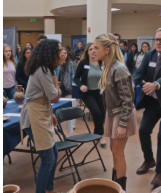
My palms burned from catching myself. My knee throbbed. My apron was twisted, and one of my torn flats had slipped halfway off my heel. I could feel everyone looking at me now, but not the way they had before. Not with pity.
This time, they were looking as if I had become the center of something none of them could control.
Ms. Alvarez turned toward me.
“Hana,” she said gently, “can you stand?”
Before I could answer, Mr. Bell, my ceramics teacher, hurried to my side. His face was red with anger, but his hands were careful as he helped me up.
“I’m sorry,” he whispered. “I should have stopped this sooner.”
The words hit harder than the floor had.
Because part of me had been waiting for someone to see it sooner.
The snickers when Brooke called my work “charity art.” The way my name kept disappearing from display notes. The way sponsors praised the “Winslow heritage glaze” when I had mixed every pigment after school with stained fingers and tired eyes.
I stood, trembling, and faced the room.
Brooke pointed at me again, but this time her hand was shaking.
“She’s lying,” Brooke snapped. “She probably forged the signatures under the vase. She wanted attention. She always acts humble, but she’s obsessed with being noticed.”
A murmur rose.
I looked at the vase.
It sat on the central pedestal, tall and earth-red, painted with black geometric bands and softened blue accents inspired by old Southwestern pottery patterns we had studied. Every line had taken patience. Every curve had required breath control. Every mark carried the hours I had given when the school hallways were empty and the janitor’s radio was the only sound keeping me company.
Underneath it, hidden from view unless lifted, was my tiny signature.
H.N.
Not carved boldly. Not demanded.
Just placed there because Mr. Bell once told me, “Never let the world enjoy your hands while forgetting your name.”
Ms. Alvarez inhaled.
“We will not argue over this in public,” she said, though the public was already devouring every second. “But the record is clear.”
Brooke laughed once, harsh and desperate.
“The record?” she said. “My family funded this exhibition. Without us, none of you would even be standing here pretending student pottery matters.”
That was when the room changed again.
Not loudly.
Not dramatically.
But sharply.
Several sponsors looked away. A few teachers stiffened. Students exchanged glances. Even the mayor’s assistant, who had been smiling all evening, lowered her program.
Celeste Winslow stepped into the aisle.
“Brooke,” she warned.
But Brooke was beyond warnings now. Her humiliation had cracked open something uglier.
“No,” Brooke said, her voice rising. “Everyone knows how this works. My family gave money. My family name brings press. My family makes this place look important. And she—”
Her eyes landed on me with pure resentment.
“—she cleans brushes after school and suddenly everyone acts like she’s special?”
My face burned.
Then, from somewhere near the back, a quiet voice said, “She is special.”
Everyone turned.
A small elderly woman stood near the entrance, wrapped in a dark blue shawl, silver hair braided over one shoulder. I recognized her instantly, though I had only met her twice.
Mrs. Irena Novak.
My grandmother.
My breath caught.
She was supposed to be resting at home. Her arthritis had been terrible all week. I had told her not to come because I did not want her to see people stare at my uniform or hear them whisper about scholarship kids.
But there she stood, holding her cane in one hand and an old cloth pouch in the other.
Her eyes were wet.
Her voice did not shake.
“Hana’s hands remember what others tried to forget,” she said.
The hall seemed to hold its breath.
Brooke rolled her eyes. “Great. Now we’re doing a family drama?”
My grandmother walked forward slowly.
Each tap of her cane sounded like a small judgment.
When she reached the front, she looked first at the vase, then at me. Her face softened.
“You used the mountain spiral,” she whispered.
I nodded, unable to speak.
She touched the air near the pattern without touching the vase.
“My mother painted that on clay before war took her village,” she said. “She said the spiral meant a road that returns you to yourself.”
Ms. Alvarez looked stunned.
Mr. Bell stared at the vase as if seeing it for the first time.
Celeste Winslow’s expression hardened.
“This is inappropriate,” Celeste said. “This exhibition is not the place for sentimental claims.”
My grandmother turned to her.
“No,” she said. “It is the place for truth.”
Then she opened the cloth pouch.
Inside was a small broken pottery shard, old and smoke-darkened, with a faded black spiral painted across its edge.
The same spiral I had painted near the base of the vase.
The same spiral Brooke had called “her family’s historic design.”
Celeste’s pearl necklace trembled against her throat.
Brooke stared at the shard.
For the first time that evening, she looked truly afraid.
PART 3 — THE SHARD FROM THE PAST
Ms. Alvarez carefully placed the cloth pouch on the display table.
“Mrs. Novak,” she said softly, “what is that?”
My grandmother’s fingers rested on the old shard like it was a sleeping bird.
“This,” she said, “is the last piece of a water jar my mother carried across Europe when she fled. She kept it after the jar broke. Years later, when my son married Hana’s mother, I gave the story to Hana.”
A strange warmth moved through my chest.
I remembered sitting at my grandmother’s kitchen table as a child, eating plum dumplings while she traced patterns on napkins. Spirals. Steps. Rain marks. Mountain teeth.
She never called them valuable.
She called them memory.
Mr. Bell stepped forward. “Hana incorporated those elements into her design study. She submitted sketches months ago.”
“I did,” I whispered.
He turned toward the room. “I have those sketches in my classroom portfolio.”
Brooke’s face twisted. “So what? Patterns repeat. Nobody owns a spiral.”
“No,” my grandmother said. “But people do steal stories.”
Celeste Winslow moved fast.
Too fast.
She reached for the cloth pouch, but Ms. Alvarez blocked her hand.
“Do not touch that,” Ms. Alvarez said.
Celeste smiled, but it was brittle. “I was only looking.”
“No,” said a man in the second row.
Everyone turned again.
He was tall, gray-haired, wearing a simple black suit instead of sponsor glitter. I had noticed him earlier standing near the wall, quiet and watchful.
Ms. Alvarez blinked. “Dr. Marquez?”
A whisper rippled through the crowd.
Dr. Rafael Marquez was the guest evaluator from the New Mexico Museum of Cultural Arts. I had seen his name printed in the program. He had been invited to select one student piece for a youth preservation grant.
He came forward with a seriousness that made even Celeste step back.
“I would like to examine the shard and the vase,” he said. “With permission.”
My grandmother nodded.
I nodded too, though my hands had gone cold.
Dr. Marquez took out white gloves from his pocket. The carefulness of that small action made my throat tighten. All evening, Brooke had treated the vase like a trophy. He treated it like it had a soul.
He crouched near the pedestal and studied the painted bands.
“This lower pattern,” he said, “is unusual. Not standard Pueblo revival, not commercial Southwestern imitation. It shows Eastern European folk rhythm adapted into regional ceramic form.”
He glanced at me.
“You made a bridge.”
I had never heard it described that way.
A bridge.
Between my Slovak grandmother and my American classroom. Between old grief and new clay. Between the girl in the faded apron and the room full of people who had almost let her be erased.
Brooke snapped, “That doesn’t prove anything.”
Dr. Marquez stood.
“No,” he said. “But the official record, the submitted sketches, the signature, and the attempted deletion do.”
Celeste’s voice chilled. “Be careful, Doctor. Accusing a Winslow publicly is not a small thing.”
He met her eyes.
“Neither is stealing a student’s work.”
The room erupted.
Not with chaos, but with whispers that finally chose a side.
“I recorded Brooke pushing her.”
“She really tried to delete the file?”
“Did the Winslows steal the design?”
“Wasn’t their family foundation promoting that same pattern last year?”
That last whisper made Celeste go rigid.
Dr. Marquez heard it too.
His brows lowered.
“What foundation pattern?” he asked.
A student named Maya raised her phone. She was in my ceramics group and had barely spoken to me all semester, but now her voice was steady.
“The Winslow Foundation used a similar spiral on their gala invitations,” she said. “They called it the Winslow Legacy Motif.”
I stared at her.
The screen showed a glossy invitation from the previous year. Gold letters. Expensive design. Celeste Winslow’s name at the bottom.
And in the corner, almost exactly like my grandmother’s shard, was the spiral.
My grandmother’s hand found mine.
Her skin was thin and warm.
Celeste laughed, but the sound had no life in it.
“That motif has belonged to our family collection for decades,” she said.
My grandmother’s eyes narrowed.
“Collection?” she asked.
Celeste looked away.
Dr. Marquez stepped closer. “Mrs. Winslow, what collection?”
Brooke whispered, “Mom.”
It was the first time she had sounded like a frightened daughter instead of a queen.
Celeste ignored her.
“Our family has supported cultural preservation for generations,” she said. “We own many artifacts.”
My grandmother’s grip tightened.
“What kind of artifacts?”
Celeste’s mouth opened.
But before she could answer, a loud voice came from the side entrance.
“Artifacts they were told to return.”
A man in a security uniform entered, holding a sealed envelope. Beside him walked Principal Harren, pale and sweating.
Principal Harren looked as if the night had aged him ten years.
He stopped in front of Ms. Alvarez.
“I need everyone to remain calm,” he said.
Nobody moved.
The security guard handed him the envelope.
Principal Harren opened it, scanned the documents inside, and closed his eyes.
Then he looked at Celeste Winslow.
“Mrs. Winslow,” he said, voice breaking, “the school board received an emergency legal notice this afternoon.”
Celeste’s face became stone.
Principal Harren continued.
“It concerns allegations that items displayed through your family foundation may have been misattributed, including a ceramic fragment registered decades ago under the Novak family name.”
My grandmother inhaled sharply.
I felt the world tilt.
Brooke shook her head. “No. No, that’s not—”
Principal Harren turned to me.
“Hana,” he said, “I am so sorry. This goes far beyond tonight.”
PART 4 — WHEN THE POWERFUL PANIC
For a few seconds, nobody spoke.
Then Celeste Winslow smiled.
It was terrifying because it was calm.
“Principal Harren,” she said, “I suggest you stop before you damage this institution permanently.”
He flinched.
Everyone saw it.
That small flinch told the entire room what months of rumors had not.
The Winslows did not simply donate money.
They controlled fear.
Brooke’s eyes darted from her mother to the phones still recording. “Mom, make them stop filming.”
Celeste turned sharply toward the students.
“Put your phones down,” she commanded.
No one did.
Not one person.
A boy near the back said, “It’s a public exhibition.”
Maya added, “And you’re threatening school staff in public.”
Celeste’s perfect mask cracked.
“You children have no idea what you are interfering with.”
My grandmother lifted her cane and pointed it at Celeste, not aggressively, but with such dignity that Celeste took half a step back.
“We know exactly,” Grandma said. “A girl made something beautiful. Your daughter tried to take it. You tried to bury it. And now the buried thing is breathing.”
Those words entered me and stayed.
The buried thing is breathing.
Dr. Marquez asked Principal Harren for the legal notice. He read silently while the hall waited.
His face changed.
“This fragment,” he said, looking at my grandmother, “was donated for temporary study in 1989 by Irena Novak?”
Grandma’s lips trembled.
“Yes,” she whispered. “To a regional heritage program. They said it would be photographed and returned. It disappeared.”
My heart hurt.
“You never told me that,” I said.
She looked at me with sorrow. “Some losses become too heavy to keep handing down.”
Dr. Marquez turned to Celeste.
“According to this notice, a similar fragment appeared in a private Winslow Foundation exhibit eight years later.”
Celeste said nothing.
Brooke whispered, “You said it was ours.”
Celeste’s eyes flashed toward her.
“Be quiet.”
That command was crueler than all of Brooke’s insults. For the first time, I saw Brooke not as the polished villain of my humiliation, but as a girl raised under a chandelier that could fall at any moment.
It did not excuse her.
But it explained the terror in her eyes.
Ms. Alvarez closed the official record book.
“The award ceremony is suspended,” she said. “Until the ownership and authorship concerns are resolved, no sponsor family will present or claim student work.”
Celeste spun toward her. “You do not have the authority.”
“I do,” Ms. Alvarez said. “And I have already notified the district arts board.”
Principal Harren rubbed his face. “The board chair is on her way.”
Celeste’s phone began to ring.
Then Brooke’s phone.
Then another sponsor’s.
The videos were already spreading.
The room became a storm of buzzing devices and whispered headlines.
I stood in the center of it all, feeling strangely small again. My knee hurt. My apron was dirty. My grandmother’s hand shook in mine.
And yet something inside me had changed.
I was still afraid.
But I was no longer alone inside that fear.
Brooke looked at me.
For one heartbeat, I expected another insult.
Instead, she whispered, “I didn’t know about the fragment.”
I stared at her.
“But you knew about my file,” I said.
Her mouth closed.
The truth stood between us.
She had not stolen the old shard.
But she had tried to steal me.
Her eyes filled, though she blinked the tears away angrily.
“I just wanted one thing that was mine,” she said.
I almost laughed because the cruelty of that sentence was unbearable.
“One thing?” I said. “You had the sponsor table. The cameras. The jacket. The name everyone lowered their voice for. I had a signature under a vase, and you tried to erase even that.”
Brooke looked down.
Celeste grabbed her daughter’s arm.
“We’re leaving.”
But as they turned, the side doors opened again.
A woman entered with two board members and a district attorney’s aide. She had short silver hair, a navy suit, and a face that made excuses die before they were spoken.
Principal Harren whispered, “Board Chair Ellison.”
Celeste stopped.
Board Chair Ellison walked to the front and looked at the vase.
Then at me.
Then at the shattered expression on Brooke’s face.
“I have reviewed the emergency complaint,” she said. “And I have one question before anyone leaves.”
Her eyes landed on Celeste.
“Where is the original Novak fragment now?”
Celeste said nothing.
The hall waited.
Then Brooke looked at her mother and whispered something that changed everything.
“It’s in the house.”
Celeste’s head snapped toward her.
Brooke stepped away from her mother’s grip.
Her voice shook, but she kept going.
“It’s in the west library. In the glass cabinet behind the donor awards.”
Grandma’s knees nearly gave out.
I caught her.
Celeste’s face turned wild.
“You foolish girl,” she hissed.
Brooke flinched, but she did not take it back.
And I realized the shocking truth.
Brooke Winslow had just betrayed her own mother in front of everyone.
PART 5 — THE GIRL WHO BROKE THE GLASS HOUSE
The exhibition did not end.
It transformed.
Nobody looked at the pottery the same way after that. The vases and bowls and painted plates no longer seemed like school projects arranged beneath rented lights. They looked like witnesses.
Board Chair Ellison ordered security to preserve the records. Ms. Alvarez sealed the submission folder. Dr. Marquez photographed the vase, my signature, my sketches, and my grandmother’s shard.
Celeste Winslow stood near the front row with her arms crossed, speaking rapidly into her phone. Her voice was low, but every word looked expensive.
Brooke sat alone on a folding chair.
No one approached her.
For most of the year, students had circled Brooke like planets around the sun. Now they avoided her as if disgrace could stain their clothes.
I should have felt satisfied.
Instead, I felt exhausted.
Grandma sat beside me, holding a paper cup of water with both hands. “You were brave,” she said.
“I was pushed,” I said.
“Sometimes that is how brave begins.”
I looked across the hall at Brooke.
She was staring at the floor, her blonde hair falling around her face. Without her smile, without her audience, she looked younger than seventeen.
Mr. Bell came over carrying my sketch portfolio.
“I found them,” he said.
Inside were months of drawings. My notes. Color tests. Pattern studies. The first shaky version of the mountain spiral. The revised one. The final one.
Every page had my name.
He handed the portfolio to Ms. Alvarez, then turned to me.
“I failed you,” he said.
I shook my head automatically. “No, you helped me.”
“Not enough,” he said. “I saw Brooke hovering near your work. I heard comments. I told myself it was teenage jealousy. That was easier than confronting the sponsor family.”
His honesty hurt, but it also healed something.
“Thank you for saying that,” I whispered.
Then Brooke stood.
The room tensed.
Celeste noticed and snapped, “Sit down.”
But Brooke did not.
She walked toward me, each step slow, as if crossing the hall cost her more than the expensive boots had.
Students lifted phones again.
Brooke stopped a few feet away.
Her eyes were red.
“I’m sorry,” she said.
The words came out stiff, unfamiliar.
I did not answer.
She swallowed. “I’m sorry I pushed you. I’m sorry I lied. I’m sorry I tried to remove your name.”
The hall was silent.
I looked at her carefully.
“Are you sorry because everyone knows,” I asked, “or because you know?”
Brooke’s face crumpled.
For the first time all night, she looked fully human.
“I don’t know,” she whispered. “Both. Maybe at first because everyone knew. But now… I keep seeing your grandmother’s face.”
Grandma looked away, tears shining.
Brooke continued, voice breaking.
“My mom told me the motif was ours. She told me families like ours protect culture because people like—”
She stopped.
“People like me?” I asked.
Brooke covered her mouth.
Celeste’s voice cut across the room. “Enough.”
But Brooke turned on her.
“No,” she cried. “You made me think kindness was weakness. You made me think money was proof. You made me think if someone had less, it meant they deserved less.”
Celeste’s face went white with rage.
“I gave you everything.”
Brooke laughed through tears.
“You gave me a mirror and taught me to worship it.”
That sentence broke something open.
Not just in Celeste.
In the room.
Students who had envied Brooke now stared at her with stunned pity. Teachers looked ashamed. Sponsors shifted uncomfortably, forced to watch the cost of the world they had applauded.
Board Chair Ellison stepped between mother and daughter.
“Brooke Winslow,” she said, “your admission regarding the deletion request has been heard by multiple school officials. You will be required to provide a formal statement.”
Brooke nodded.
Celeste grabbed her purse.
“My attorneys will handle this.”
Dr. Marquez said, “So will the museum.”
Grandma’s voice was small but firm. “So will I.”
Celeste looked at her with hatred.
“You have no idea what you are challenging.”
Grandma smiled sadly.
“I survived men who burned houses and borders that swallowed names,” she said. “I am not afraid of a woman with pearls.”
A sound moved through the room.
Not laughter exactly.
Something better.
Relief.
The district attorney’s aide approached Celeste and spoke quietly. Celeste’s expression shifted from rage to calculation. Then, without another word to Brooke, she walked out.
The doors closed behind her.
Brooke stood abandoned in the center of the hall.
And somehow the girl who had shoved me down now looked as if she had been the one dropped from a height.
I did not forgive her.
Not then.
But I understood that the night had taken something from both of us.
From me, it had taken silence.
From Brooke, it had taken the lie she lived inside.
PART 6 — THE TRUTH BENEATH THE CLAY
Three days later, the video had been viewed over two million times.
People online gave it names.
The Vase Scandal.
The Santa Fe Signature.
Rich Girl Exposed By Hidden Mark.
I hated all of them.
Because none of those names understood what the vase meant.
It was not a scandal to me.
It was hours after school when my stomach growled and I pretended not to care. It was clay beneath my fingernails. It was Grandma teaching me that memory could survive even when people tried to rename it. It was my shy smile in a room that had almost decided I did not matter.
The school issued a statement confirming that my authorship had been verified. Brooke was suspended pending review. Celeste resigned from three charity boards within forty-eight hours. The Winslow Foundation announced an “independent audit,” which sounded noble until Dr. Marquez told us it usually meant people were searching for what they had to hide.
Then came the surprise.
Brooke asked to meet me.
I said no.
Then Grandma said, “Meet her.”
I stared at her across the kitchen table. “She pushed me.”
“I know.”
“She humiliated me.”
“I know.”
“She tried to delete my name.”
Grandma stirred honey into tea. “Yes. And now she may help us find something stolen before you were born.”
So I went.
Not for Brooke.
For Grandma.
We met in the school ceramics room after hours, with Mr. Bell and Board Chair Ellison present. Brooke arrived without makeup, without her private-label jacket, without the polished armor of her old life. She wore jeans and a gray sweater. She looked tired.
“I brought pictures,” she said.
Her hands shook as she placed printed photos on the table.
The Winslow west library.
Glass cabinets.
Donor awards.
And there, behind a silver plaque, was a pottery fragment.
My grandmother’s breath left her body.
“That is it,” she whispered.
But Brooke placed one more photo down.
“This was behind it.”
The image showed a folded letter, yellowed with age, tucked under the display stand.
Dr. Marquez leaned close.
“Can you read it?”
Brooke nodded.
“My grandmother wrote it,” she said. “Not my mom. My father’s mother. She died when I was little.”
She unfolded a copy.
Her voice trembled as she read.
“To whoever inherits this house: the fragment in this cabinet was never ours. My husband acquired it from a regional heritage office through pressure and payment. I begged him to return it. He refused. The woman who gave it for study was named Irena Novak. If decency survives in this family, send it home.”
Grandma began to cry.
Not loudly.
Not dramatically.
Just tears slipping down a face that had waited thirty-seven years to be believed.
I put my arms around her.
Brooke cried too.
Mr. Bell took off his glasses and wiped his eyes.
Board Chair Ellison looked at the ceiling as if gathering strength.
Dr. Marquez said quietly, “This letter changes everything.”
And it did.
Because now the story was not only about Brooke’s lie.
It was about a family legacy built on polished theft.
The next week, lawyers came. Museum representatives came. Reporters came.
I avoided most of them.
But Grandma agreed to one interview, sitting beside me with the old shard on the table between us.
When the reporter asked what she wanted, Grandma did not say money.
She did not say revenge.
She said, “I want the name returned.”
That became the headline.
I WANT THE NAME RETURNED.
The museum confirmed the fragment’s provenance. The Winslow Foundation’s collection was investigated. Several items were quietly removed from public display. Celeste Winslow claimed she had inherited everything and knew nothing.
Maybe that was true.
Maybe it was not.
But Brooke gave a sworn statement.
She admitted deleting my file after her mother told her the central vase “needed a better story attached to it.”
She admitted pushing me because she panicked.
She admitted the Winslow legacy motif was copied from the fragment in their library.
The school held a new ceremony one month later.
This time, there were no sponsor banners.
No Winslow table.
No private spotlight.
Just students, families, teachers, and the work.
I wore a simple blue dress Grandma had altered for me. My curls were pinned back with a silver clip. My flats were still old, but polished.
When Ms. Alvarez called my name, I walked forward without shaking.
Then Dr. Marquez stepped to the microphone.
“The youth preservation grant,” he said, “is awarded to Hana Novak, for a ceramic work that does not merely imitate tradition, but restores memory with courage.”
The applause rose.
Grandma stood first.
Then Mr. Bell.
Then Maya.
Then almost everyone.
And in the back of the room, half-hidden near the door, Brooke Winslow stood clapping with tears on her face.
PART 7 — THE OFFER NO ONE EXPECTED
After the ceremony, Brooke waited outside under the fading Santa Fe sky.
The sunset painted everything copper and rose, as if the whole city had been glazed by a careful hand.
I saw her before she saw me.
For a second, I considered walking the other way.
Then she turned.
“Hana,” she said.
Grandma squeezed my hand. “I will be by the car.”
I faced Brooke alone.
She looked nervous.
“I’m not here to ask forgiveness,” she said quickly. “I know I don’t deserve that.”
I folded my arms. “Then why are you here?”
She reached into her bag and pulled out a small envelope.
“My grandmother left more letters,” she said. “My mom’s lawyers tried to block me from giving them to the museum, but my father helped me. They list other families. Other objects. Other names.”
I stared at the envelope.
Brooke held it out.
“I thought you should know first.”
I did not take it immediately.
“Why?” I asked.
“Because you were the first person I ever tried to erase,” she said. “And somehow you became the reason I stopped erasing myself.”
That answer unsettled me.
Not because it was perfect.
Because it sounded true.
I took the envelope.
Brooke wiped her cheek. “My mother left town. She says I destroyed the family.”
“Did you?”
“Maybe I destroyed the lie that was holding it up.”
I looked toward the parking lot, where Grandma was waiting beneath a cottonwood tree.
“What will you do now?” I asked.
Brooke gave a tiny, broken laugh.
“Learn how to be nobody important.”
I almost smiled. “That might be good for you.”
“I think so too.”
For a moment, we were just two girls standing outside a school, both changed by a vase neither of us fully understood at first.
Then Brooke said, “There’s something else.”
Of course there was.
She reached back into her bag and pulled out a folded document.
“My father is transferring the west library collection to the museum for review. But the house has a studio behind it. Nobody uses it. It belonged to my grandmother. She made pottery before my grandfather made her stop.”
I blinked.
Brooke pushed the document toward me.
“He wants to donate the studio to the school district. For student artists who don’t have space or supplies. He asked if… if it could be named after your grandmother.”
My breath caught.
“Irena Novak Studio,” Brooke said softly. “Only if she agrees.”
I could not speak.
Grandma, who had pretended not to listen from the parking lot, covered her mouth.
When I looked at her, tears were already streaming down her face.
The studio opened six months later.
It smelled of cedar shelves, wet clay, and sunlight.
Students came after school, not only the wealthy ones, not only the confident ones. Quiet kids. Scholarship kids. Kids who ate lunch alone. Kids whose hands had stories nobody had asked about yet.
Above the door hung a simple sign:
IRENA NOVAK MEMORY STUDIO
On opening day, Grandma placed the returned fragment in a museum-grade case near the entrance. Beside it stood my vase, on loan for the first year.
Under both, a plaque read:
A NAME HIDDEN IS NOT A NAME LOST.
Brooke came to the opening.
She stayed in the back.
But when a freshman spilled glaze all over the floor and looked ready to cry, Brooke grabbed towels and knelt to help clean it.
No cameras watched.
No one applauded.
That was how I knew she was changing.
Not because she gave speeches.
Because she did background labor without needing it renamed as glory.
PART 8 — THE END: THE SECRET INSIDE THE VASE
A year later, Dr. Marquez invited Grandma and me to the museum for the official exhibition.
My vase was displayed under warm lights, beside the restored Novak fragment and several returned artifacts from families whose names had been buried under wealthy plaques.
The exhibition title was:
THE MEMORY RETURNS.
I walked through the gallery in disbelief.
There were names everywhere.
Not donor names.
Maker names.
Keeper names.
Grandmother names.
Lost names.
Found names.
Brooke attended with her father. Celeste did not come. I heard she was living in another state, still insisting she had been misunderstood by history itself.
Maybe some people spend their whole lives mistaking exposure for injustice.
The museum director gave a speech. Dr. Marquez thanked the families. Grandma cried before anyone even reached our section.
Then something unexpected happened.
A museum conservator approached us, holding a tablet.
“Hana,” she said, “during imaging of your vase, we found something unusual beneath the base layer.”
My stomach tightened.
“What do you mean?”
She showed me the scan.
Under the paint, beneath the final glaze, hidden in the clay itself, was a faint impression.
Not my signature.
Something older.
A tiny spiral pressed into the base from the worktable where I had shaped it.
Grandma stared.
“That mark,” she whispered.
Dr. Marquez leaned in. “Do you recognize it?”
Grandma began laughing through tears.
“That was from my mother’s ring,” she said. “The ring had that spiral. I lost it years ago after Hana was born.”
I looked at her, confused.
Grandma gripped my hand.
“When you were little, I gave you clay to play with in my kitchen. You pressed everything into it. Spoons, buttons, my ring. I thought the ring was lost forever.”
The conservator smiled.
“We found a small metal object embedded deep in the hollow foot of the vase. It must have fallen into the clay during preparation and been sealed inside when Hana formed the base.”
My heart stopped.
“No,” I whispered.
They brought it out in a padded tray.
A small old ring.
Tarnished silver.
At its center, the mountain spiral.
Grandma made a sound I had never heard before, half sob and half prayer.
She touched the ring with trembling fingers.
“My mother’s ring,” she said. “It came home inside your vase.”
Everyone around us fell silent.
I began to cry.
Not because the cameras were there.
Not because the museum guests were watching.
But because the ending was too impossible, too gentle, too perfectly strange.
Brooke stood nearby with tears in her eyes.
“I thought the vase exposed a lie,” she whispered.
Grandma slipped the ring onto her finger. It fit.
“No,” Grandma said. “It carried the truth home.”
That night, I stood before the display and looked at my name.
HANA NOVAK.
Not hidden under the vase anymore.
Not whispered.
Not almost deleted.
There.
Clear.
Permanent.
Beside my grandmother’s name.
Beside her mother’s memory.
Beside a ring that had waited in darkness until the world was ready to see it.
Brooke came to stand next to me.
“I’m sorry,” she said again.
This time, I looked at her for a long while.
Then I said, “I know.”
It was not full forgiveness.
Not yet.
But it was a door opened just enough for light.
Years later, people would still talk about the night Brooke Winslow shoved me at the pottery exhibition and accidentally exposed her family’s stolen legacy.
But that was not the real story.
The real story was that a poor girl in a faded apron signed her work where no one could see it, believing maybe that was enough.
The real story was that her grandmother carried grief like a shard in a cloth pouch and lived long enough to watch the name return.
The real story was that clay remembers pressure.
Hands.
Loss.
Love.
Even lies.
And sometimes, when the powerful try to bury the truth, they only press it deeper into the earth—where it waits, hardens, survives, and rises again in the shape of something beautiful.
Because my signature was never just under the vase.
It was inside the story.
And at last, the whole world knew where it belonged.
THE END
