PART 2 — THE NAME IN THE FILE
The event coordinator’s finger stopped on the final entry, and for one breathless second, the entire Handmade Paper Fair seemed to stop breathing with her.
Her name was Mrs. Evelyn Hart, a small woman with silver glasses and the kind of calm voice adults used when they were trying not to show anger. But her hand trembled as she held the record book open beneath the stage lights.
Victoria Kensington stood beside the display table, her perfect blonde hair shining like she had stepped out of a magazine, but her face had lost every drop of confidence. Her lips parted. Her eyes flicked from the record to me, then to the cameras, then to her mother.
Mrs. Kensington was in the front row.
She wore cream-colored cashmere, diamond earrings, and a smile that had frozen into something sharp and dead.
Mrs. Hart read the entry aloud.
“Request made at 8:13 this morning to amend student contributor file. Original name: Amara Okafor. Replacement name requested: Victoria Elise Kensington. Submitted by… Patricia Kensington.”
A sound moved through the crowd.
Not a gasp exactly.
More like three hundred people realizing at the same time that the truth had just walked into the room wearing muddy old sneakers.
I was still on the floor.
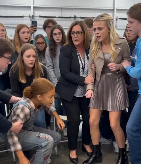
My palms burned from catching myself. My knee throbbed. My overalls were dusty. One of my patches had torn halfway loose. And yet every camera, every phone, every eye had turned away from Victoria and toward the open file.
Mrs. Kensington rose slowly.
“That is a misunderstanding,” she said, her voice sweet enough to poison tea.
Mrs. Hart did not look at her. “The request was logged by the registration desk.”
“My assistant handles these things.”
“The email came from your verified foundation account.”
Victoria whispered, “Mom.”
That one word cracked something open.
Because until then, Victoria had looked like the villain. Cruel, spoiled, jealous. But now, for the first time, she looked seventeen. Not innocent. Not sorry. But terrified.
Mrs. Kensington lifted her chin. “Our family funded half this event. We have supported this school for years. Surely no one believes that a girl like—”
She stopped.
But everyone heard the words she did not say.
A girl like me.
The silence after that was different. It was not hungry anymore. It was ashamed.
Mr. Alvarez, my science teacher, rushed to help me stand. His hands were gentle, and his voice cracked when he said, “Amara, are you hurt?”
I wanted to say no. I wanted to be proud. I wanted to be untouchable.
But my eyes were hot, and my whole body was shaking.
“I’m okay,” I lied.
The microphone above the stage caught it.
Everyone heard.
And somehow that made it worse.
Because the room softened all at once, and I hated that too. I did not want pity. I had not dried paper after school for months to become the girl everyone felt sorry for. I had stayed late in the damp back room, turning pulp, pressing sheets, testing fibers, logging failures, adjusting starch ratios, and writing notes until my fingers cramped because I wanted to make something real.
Mrs. Hart closed the record book slowly.
“Miss Okafor,” she said, “would you like to continue?”
The ceremony marker waited on the table.
A carved wooden stamp lay beside it, designed to press the fair emblem into the commemorative paper. I had imagined this moment a hundred times. I would walk forward. I would stamp the sheet. People would clap politely. My name would be said once. Maybe my mother would cry when I told her.
Now the whole room watched me like the next step might decide who I was.
Victoria’s shove still burned in my shoulder.
Her words still rang in my ear.
You do not belong in my spotlight.
I looked at the table.
There it was.
The Test Paper Sample.
It did not look magical. Just a sheet of handmade paper with faint gold threads and pressed milkweed fibers running through its surface like tiny veins of sunlight. But I knew every mark in it. I knew the soft uneven edge on the bottom left. I knew the faint blue-gray tint from the recycled denim pulp. I knew the tiny specks of marigold I had added after reading that old paper traditions sometimes used flowers not for decoration, but for memory.
I took one step forward.
Then another.
Victoria moved as if to block me.
Mrs. Hart said sharply, “Do not.”
Victoria stopped.
I picked up the stamp.
My hands were shaking so badly I almost dropped it.
Then I heard a voice from the back.
“Stand tall, Amara.”
My mother.
She had come straight from her shift at the clinic, still wearing her navy scrubs under an old winter coat. Her hair was wrapped in a green scarf, and her tired eyes were shining. She had probably parked far away. Probably hurried through the cold. Probably stood at the back because she did not want anyone to notice she arrived late.
But now everyone noticed her.
And for once, I did not feel embarrassed by what we lacked.
I felt anchored by what we had survived.
So I straightened.
I pressed the stamp into the ink.
Then I brought it down on the commemorative sheet with all the strength left in me.
The mark bloomed dark and perfect.
Applause began somewhere near the student section.
Then spread.
Then thundered.
Not polite applause.
Not sponsor applause.
Real applause.
The kind that rises because people have witnessed something they will remember.
Victoria looked at me like she hated me more than ever.
But underneath the hate, I saw panic.
Because the record had exposed the attempted theft.
The cameras had captured the shove.
And the paper itself still held one secret nobody else knew.
Not yet.
PART 3 — WHAT THE PAPER REMEMBERED
After the ceremony, the fair dissolved into chaos.
Reporters cornered Mrs. Hart. Teachers whispered near the refreshment table. Students replayed videos on their phones, their faces lit blue and white. The Kensington family’s private photographer quietly packed his equipment and disappeared.
Victoria’s mother tried to pull her toward the exit, but Principal Rowe intercepted them near the sponsor banner.
“This needs to be discussed privately,” Mrs. Kensington said.
Principal Rowe’s voice was low, but I heard enough.
“Your daughter assaulted a student in front of witnesses. You attempted to alter official school records. This is no longer a private matter.”
Mrs. Kensington’s smile vanished.
“You should remember who pays for your art wing.”
Principal Rowe did not blink. “And you should remember who was recording.”
That was the first time I saw fear cross Mrs. Kensington’s face.
Mr. Alvarez guided me to a side room used for judging entries. My mother followed us, one arm wrapped around my shoulders. The second the door closed, I fell apart.
Not loudly.
That would have been easier.
Instead, my breath came in small broken pieces, and tears slid down my face while I stared at my dusty sneakers.
My mother knelt in front of me.
“Look at me, my star,” she whispered.
“I didn’t do anything wrong,” I said.
“I know.”
“Then why does it feel like I did?”
Her face changed. Not with surprise. With recognition.
Because my mother knew that feeling. The feeling of walking into rooms where people had already decided your place. The feeling of being polite while insulted. The feeling of working twice as hard and still being treated like a visitor.
She took my hands and kissed my knuckles.
“Because some people are so used to taking space, they make you feel guilty for standing in yours.”
Mr. Alvarez turned away to wipe his eyes.
Mrs. Hart entered a few minutes later carrying the Test Paper Sample inside a protective sleeve.
“Amara,” she said carefully, “there is something else.”
I looked up.
She placed the sample on the table.
“When I reviewed your notes, I found references to milkweed fiber, denim pulp, marigold, and an experimental binder. But your sample behaved differently from the others. It resisted moisture. It held ink without feathering. It was stronger than handmade student paper should be.”
I swallowed.
“I was still testing it.”
“You wrote that the mixture changed after the boiler malfunction.”
My heart jumped.
Nobody was supposed to care about that detail.
One Thursday in March, the old heating system in the paper room had hissed itself into a tantrum. Steam had filled the drying cabinet. Everyone else had left early because the room felt like a swamp. I stayed because we had only two working drying racks, and if the sheets molded overnight, we would lose a week of work.
The next day, one batch had dried wrong.
Or so I thought.
It came out stronger.
Smoother.
Almost waterproof.
I had written everything down because Mr. Alvarez always said failure was only failure if you did not document it.
Mrs. Hart tapped the sleeve.
“A visiting conservation scientist asked to examine this after the ceremony. She believes you may have accidentally created a biodegradable paper treatment with unusual archival qualities.”
I stared at her.
“I made paper.”
Mrs. Hart smiled gently. “Yes. And perhaps something more.”
My mother went still.
“How much more?” she asked.
Mrs. Hart hesitated. “Enough that Victoria’s mother may have understood its value before any of us did.”
The room chilled.
Suddenly, Mrs. Kensington’s attempt to remove my name looked bigger than embarrassment. Bigger than vanity. Bigger than a rich family wanting credit at a school fair.
“She knew?” I whispered.
Mrs. Hart’s mouth tightened. “The Kensington Foundation requested copies of all winning student project files last week. They claimed it was for scholarship review.”
Mr. Alvarez cursed under his breath.
My mother stood up. “Who has access to my daughter’s notes?”
“Officially? The judging committee, faculty advisors, and the foundation review office.”
“And unofficially?”
No one answered.
That was answer enough.
A knock came at the door.
Principal Rowe stepped in, followed by a woman I had never seen before. She was tall, brown-skinned, with cropped gray hair and a wool coat dusted with snow. She carried herself with quiet authority.
“This is Dr. Lena Whitcomb,” Principal Rowe said. “She works with the Northeast Archive Conservation Lab.”
Dr. Whitcomb smiled at me like she knew I was scared and refused to make that my whole identity.
“Amara, I looked at your sample under a portable lens,” she said. “I cannot make any formal claim without testing. But I can say this plainly. Your work is original, valuable, and it needs protection immediately.”
My mother’s hand tightened around mine.
Outside the room, someone shouted.
Then another voice.
Victoria’s.
“You can’t do this to us!”
The door opened before anyone could stop it.
Victoria stood there with mascara streaked beneath her eyes, her mother behind her like a storm in human form.
Mrs. Kensington pointed at the paper.
“That material was developed using resources funded by my foundation.”
I rose from the chair before I knew I was moving.
“No,” I said.
Everyone looked at me.
My voice shook, but it did not break.
“You funded banners. You funded photo opportunities. You funded your name printed on programs. You did not stay after school scraping pulp out of clogged drains. You did not burn your fingers on drying trays. You did not write my notes. You did not make this.”
Victoria flinched.
Her mother did not.
“Careful,” Mrs. Kensington said softly. “Girls like you can lose opportunities very quickly.”
My mother stepped forward.
“And women like me know exactly what threats sound like.”
For a second, the two mothers faced each other, and the air between them felt electric.
Then Dr. Whitcomb lifted the sample.
“This paper will remain in school custody until ownership and authorship are secured.”
Mrs. Kensington laughed once. “You think a high school record book can stand against my attorneys?”
“No,” Dr. Whitcomb said. “But timestamps, lab notes, witness statements, video footage, and chain-of-custody documentation can.”
Mrs. Kensington’s expression hardened.
Victoria looked at me again.
And there, beneath the jealousy and fear, I saw something I did not expect.
A question.
Not forgiveness. Not friendship.
A desperate question.
How far will my mother go?
PART 4 — THE OFFER THAT FELT LIKE A TRAP
By Monday morning, the video had spread everywhere.
Someone posted it with the caption: RICH SPONSOR GIRL SHOVES STUDENT AFTER TRYING TO STEAL HER INVENTION.
By lunch, local news had called the school.
By evening, my name was online.
Amara Okafor.
Seventeen.
Student paper maker.
Victim.
Inventor.
I hated that last word almost as much as I loved it.
People who had never spoken to me suddenly wanted to sit beside me. Teachers smiled too brightly. Students apologized for things they had laughed at only two days before. One girl from my history class cried while telling me she had always thought I was talented, though I could not remember her ever saying hello.
Victoria did not come to school.
Neither did three of her friends.
The Kensington Foundation released a statement calling the incident “an unfortunate misunderstanding during an emotionally charged student event.” They praised youth creativity, promised cooperation, and never once said my name.
My mother read the statement at our kitchen table and made a sound that was not quite a laugh.
“An unfortunate misunderstanding,” she said. “Is that what they call pushing someone to the floor now?”
I sat across from her, eating reheated rice and stew, though every bite tasted like cardboard.
“What happens now?”
She looked older in the yellow kitchen light. Tired in the way adults try to hide until their children are asleep.
“We protect you.”
“How?”
“We find help.”
Help arrived the next afternoon in the form of Dr. Whitcomb, Principal Rowe, Mr. Alvarez, and a lawyer named Naomi Bell, who wore red glasses and carried a folder thick enough to scare people.
Naomi explained everything gently.
My lab notes mattered.
My timestamps mattered.
The school record mattered.
The video mattered.
But the Kensingtons had money, influence, and lawyers who could twist a student project into a foundation-funded discovery if nobody pushed back.
“So we push back,” my mother said.
Naomi nodded. “Yes. But carefully.”
Then came the part that made my stomach drop.
A paper technology company had heard about the sample. So had a university materials department. So had three journalists. Everyone wanted access. Interviews. Testing. Rights. A story.
A story.
That word made me feel like my life had been taken from my hands and turned into something strangers could consume.
“I don’t want to be famous,” I said.
Naomi softened. “Then we do only what protects your work.”
Dr. Whitcomb leaned forward. “The sample should be tested under neutral supervision. If it performs the way I suspect, Amara may qualify for youth innovation protections, scholarships, and possibly provisional intellectual property filings.”
My mother closed her eyes for one second.
Scholarships.
That word lived in our house like a prayer.
College was something we talked about with hope and fear braided together. I had grades. I had work ethic. I had dreams too large for our savings account. My mother never said we could not afford it, but I saw the bills. I saw her work double shifts. I saw her choose between repairing the car and replacing her cracked phone.
Then my phone buzzed.
Unknown number.
A message appeared.
Meet me behind the old gym after school. I know what my mother did. — Victoria
I stared at it.
My first feeling was anger.
My second was curiosity.
My third was the kind of fear that tells you curiosity might be dangerous.
I showed my mother.
“No,” she said instantly.
Naomi took the phone. “Do not meet her alone.”
“I wasn’t going to.”
But I had thought about it.
That was the truth.
Because Victoria had shoved me. Humiliated me. Tried to make me disappear.
And yet her face in that doorway haunted me.
How far will my mother go?
The next day, Victoria came back to school.
People turned to stare as she walked down the hall. Without her usual circle, she looked strangely smaller. Her boots still looked expensive. Her hair was still perfect. But the armor had cracks.
At the end of the day, she waited outside the science wing.
Mr. Alvarez stood ten feet away. Principal Rowe watched from her office window. My mother knew where I was.
Victoria approached slowly.
“I’m not here to apologize,” she said.
“Good,” I answered. “Because I wouldn’t believe you.”
Her jaw tightened. Then, unexpectedly, she nodded.
“I wouldn’t either.”
That surprised me.
She looked down at her hands.
“My mother found your notes in the foundation review packet. She told me your sample was probably a fluke and that our family could develop it properly. She said people like you get attention for sad stories, but people like us turn ideas into companies.”
My face went hot.
Victoria continued, voice thinner now.
“She asked me to distract from the ceremony. She said if you looked unstable, if people questioned why you were chosen, the committee might delay recognition.”
I felt sick.
“So you shoved me?”
“She didn’t tell me to shove you.”
“But you did.”
“Yes.”
The word hung there.
No excuse followed.
Victoria’s eyes shone, but no tears fell.
“I was angry,” she whispered. “Because she kept saying you were nobody, but everyone was looking at your work like it mattered. And I realized she was afraid of you.”
I laughed once, sharp and humorless.
“She was afraid of me?”
Victoria looked directly at me.
“Yes. Because you made something she could not buy.”
For the first time, neither of us spoke.
Then Victoria reached into her bag and pulled out a flash drive.
“My mother’s assistant copied your scanned notes before the file change. There are emails. Messages. A draft press release naming me as lead student innovator under the Kensington Foundation.”
My heartbeat pounded in my ears.
“Why give me this?”
Victoria’s mouth twisted.
“Because last night, I heard my mother on the phone. She said if this got worse, she would claim I acted alone.”
I stared at her.
There it was.
The twist inside the twist.
Victoria Kensington had not suddenly grown a conscience.
She had realized she was disposable too.
I took the flash drive without touching her fingers.
“I still don’t forgive you,” I said.
“I know.”
“And this doesn’t make us friends.”
“I know.”
Then she said the last thing I expected.
“But it might make us witnesses.”
PART 5 — THE ROOM WHERE MONEY STOPPED TALKING
The hearing took place in the school library three days later.
It was not a courtroom, but it felt like one.
Long tables had been pushed together. The district superintendent sat at the center. Principal Rowe sat to one side with a stack of documents. Naomi Bell sat beside my mother and me. Across from us were Mrs. Kensington, her attorney, and Victoria.
Victoria did not look at me.
Her mother did not stop looking at me.
The Kensington attorney began with polished sympathy.
He called me “a promising young woman.”
He called Victoria “overwhelmed.”
He called the file alteration “administrative confusion.”
He called the shove “a regrettable physical interaction.”
Naomi let him talk.
Then she opened her folder.
One by one, she placed copies on the table.
The original file entry.
The attempted name change.
My signed lab notes.
Security footage showing Mrs. Kensington’s assistant entering the registration office.
Email drafts.
The press release.
And finally, a printed message from Mrs. Kensington to her assistant:
Make sure Amara Okafor is not listed anywhere public until we decide how to position the discovery.
The library went cold.
Mrs. Kensington’s attorney stopped smiling.
The superintendent removed his glasses.
Principal Rowe looked like she wanted to throw something and had chosen professionalism instead.
Mrs. Kensington turned slowly toward Victoria.
Victoria stared at the table.
“You gave them private foundation materials,” her mother said.
Victoria’s face went white.
Naomi spoke before anyone else could.
“Victoria provided evidence relevant to an investigation involving fraud, record tampering, and student misconduct.”
Mrs. Kensington laughed softly.
“You all have no idea what you are doing.”
My mother leaned forward.
“Actually,” she said, “we do.”
I looked at her then.
Really looked.
At the lines around her eyes. At the hands folded tightly together. At the woman who had crossed an ocean before I was born, built a life, lost my father, raised me, worked until her feet swelled, and still came to every science fair she could.
My mother was not rich.
She was not powerful in the way people usually meant.
But in that library, she looked like a queen who had simply chosen not to wear a crown.
Dr. Whitcomb joined by video call. She explained the preliminary test results.
The room listened as she said my sample showed unusual durability, moisture resistance, and compatibility with natural pigments. Nothing was final yet, but the material deserved formal study.
Then the superintendent asked me to speak.
My throat tightened.
I stood anyway.
“I don’t know what this paper will become,” I said. “Maybe it is something big. Maybe testing will show it isn’t. But I know I made it. I know I wrote down every step. I know I was shoved because someone thought hurting me would make the truth quieter.”
I looked at Victoria.
She flinched, but did not look away.
Then I looked at Mrs. Kensington.
“I am not background labor. I am not a sad story. And I am not available for people to erase.”
No one spoke.
Then Victoria stood.
Her chair scraped loudly against the floor.
Her attorney reached for her arm, but she pulled away.
“My mother knew,” Victoria said.
Mrs. Kensington snapped, “Sit down.”
Victoria’s voice shook. “No.”
That single word seemed to cost her everything.
She turned to the superintendent.
“My mother told me Amara’s project could be valuable. She told me recognition was strategy, not truth. She said if I helped redirect attention, the foundation would handle the paperwork later.”
Her face crumpled, but she kept going.
“I shoved Amara. No one made me do that. I wanted to hurt her because I hated that she had something real. I’m responsible for that.”
A tear slipped down her cheek.
“But my mother tried to steal her work.”
Mrs. Kensington stood so fast her chair nearly fell.
“This meeting is over.”
Naomi smiled for the first time.
“No,” she said. “I think it has finally begun.”
The outcome did not happen all at once.
Real life rarely gives justice in one clean lightning strike.
But by the end of that week, the Kensington Foundation’s sponsorship was suspended pending investigation. Victoria was removed from student ambassador programs and assigned disciplinary review. Mrs. Kensington resigned from the school arts council “to avoid distraction,” which was rich-people language for the walls are closing in.
The school issued a public correction naming me as the creator of the Test Paper Sample.
The local news asked for an interview.
I almost refused.
Then my mother said, “Your silence has protected others long enough.”
So I said yes.
PART 6 — THE INTERVIEW THAT CHANGED EVERYTHING
The interview was filmed in the paper room.
Not the auditorium. Not the sponsor hall. Not beneath banners with rich people’s names.
The paper room.
The place where everything smelled like wet cotton, old wood, and possibility.
I wore my faded plaid shirt again. My overalls had been repaired with a new patch my mother sewed on the night before. It was green fabric with tiny yellow stars.
The reporter asked easy questions first.
How did I become interested in handmade paper?
What materials did I use?
What did I hope would happen next?
I answered carefully. My voice trembled at the beginning, but steadied when I started talking about process. Fiber length. Drying time. Steam exposure. Natural binders. Failed batches. Accidental discoveries.
Then she asked, “What did it feel like when someone tried to take credit for your work?”
The room became very quiet.
I thought about giving the polite answer.
It was hurtful.
It was disappointing.
I am grateful for support.
But I remembered Victoria’s hand against my shoulder. Mrs. Kensington’s unfinished sentence. The way people watched me fall.
So I told the truth.
“It felt familiar,” I said.
The reporter blinked.
I continued.
“Not the exact situation. But the feeling. Working hard and being unseen. Having people assume I was helping, not leading. Being treated like I should be grateful to stand near opportunity instead of recognized for earning it.”
My mother stood behind the camera, her hands pressed to her mouth.
“So what do you want people to learn from this?” the reporter asked.
I looked at the drying racks.
At the sheets hanging like pale flags.
“I want people to check whose names are missing,” I said. “In classrooms. In labs. In offices. Everywhere. Because sometimes the person who kept the whole thing from falling apart is standing quietly in old sneakers, hoping someone will notice before someone else steals the credit.”
That clip went farther than the shove.
Farther than the scandal.
People shared it with captions about invisible labor, student creators, race, class, and stolen work. Messages flooded my school email. Some were strange. Some were cruel. But many were from people who understood.
A woman who worked in a museum wrote that she had spent years preserving artifacts while donors got all the applause.
A college student said her lab partner had taken credit for her code.
A janitor from Ohio wrote, I hope my daughter sees this and knows quiet does not mean small.
That one made me cry.
Meanwhile, testing continued.
Dr. Whitcomb arranged for the sample to be analyzed under my name, with Naomi reviewing every document before anyone touched anything. Mr. Alvarez helped me organize my notes into a formal research timeline.
And Victoria?
She became a ghost at school.
Not because she was invisible, but because everyone saw her too clearly now.
One Friday afternoon, I found her in the paper room.
She stood by the sink, staring at a bucket of soaked pulp.
“You’re not supposed to be here,” I said.
“I know.”
I waited.
She swallowed. “I’m transferring after winter break.”
I did not know what to say.
Part of me was relieved. Part of me felt nothing. Part of me remembered that she had stood up in the library when she could have stayed silent.
“My mother says I ruined the family,” Victoria said.
“She ruined it herself.”
Victoria gave a tiny, broken laugh. “That’s what my therapist says.”
“You have a therapist?”
“My father insisted.”
I had never heard much about her father. He was always absent in the way wealthy fathers sometimes were, represented by donations and last names instead of actual presence.
Victoria touched the edge of a drying frame.
“I don’t expect forgiveness.”
“You said that already.”
“I know.” She looked at me. “But I wanted to say something else.”
I folded my arms.
She breathed in.
“When I pushed you, I thought I was protecting what was mine. But the truth is, I didn’t have anything that was mine. Not my achievements. Not my image. Not even my cruelty, really. It was all inherited.”
Her eyes filled.
“That doesn’t excuse it. It makes it worse. Because you built something, and I tried to destroy it just to feel like I existed.”
For a moment, I saw her not as the girl who shoved me, but as someone trapped inside a golden cage, taught that love was performance and worth was ownership.
I did not hug her.
I did not comfort her.
But I said, “Then build something that is yours. Something that doesn’t require stealing.”
She nodded like I had handed her a sentence and a key.
Before she left, she placed a small envelope on the table.
Inside was a handwritten statement.
Not for lawyers.
Not for school.
For me.
It said: I lied. Amara Okafor made the sample. I tried to take her moment because I was jealous and afraid. I am sorry for the harm I caused. I will not ask her to make my apology easier.
I read it three times.
Then I put it in my notebook.
Not because it fixed anything.
Because it proved something.
Even people raised inside lies can choose, painfully and late, to tell the truth.
PART 7 — THE SECRET IN THE FIBERS
Two months later, Dr. Whitcomb called while my mother and I were making dinner.
The snow outside had turned the windows white. Steam rose from a pot of pepper soup. My mother answered on speaker because her hands were covered in spices.
“Amara,” Dr. Whitcomb said, “are you sitting down?”
My mother and I froze.
“Is something wrong?” I asked.
“No. Something is very right.”
The final test results had come in.
My paper treatment was not just moisture resistant. It was unusually stable, low-cost, biodegradable, and made mostly from waste fibers and common plant materials. It was not ready for industry. It was not a miracle product. But it was promising enough that the university wanted to invite me into a youth research partnership.
There would be mentorship.
Legal protection.
A scholarship fund.
And my name on the project.
My name.
Not as a footnote.
Not as inspiration.
As creator.
My mother sank into a chair and began to cry.
I had seen her cry only a few times in my life. Quietly after my father died. Once when the car broke down and she thought I was asleep. Once when a medical bill arrived with red letters.
But this crying was different.
It was relief leaving the body after years of pretending not to be heavy.
I wrapped my arms around her.
“We did it,” I whispered.
She shook her head fiercely.
“You did it.”
But I knew better.
Every late pickup. Every packed dinner. Every time she said, “Try again.” Every time she made me believe worn sneakers could still walk into important rooms.
We did it.
The university announcement came in spring.
By then, the Kensington scandal had faded from the front pages, replaced by newer outrages. But in our town, people remembered.
At the assembly, Principal Rowe introduced me. Mr. Alvarez cried openly and did not pretend allergies were involved. Dr. Whitcomb presented a certificate and explained the research partnership.
Then came the surprise.
A scholarship had been established for student innovators whose work came from underfunded programs.
The first recipient was me.
The name of the scholarship made me laugh and cry at the same time.
The Missing Names Fellowship.
My mother squeezed my hand so hard it hurt.
After the assembly, I saw Victoria standing near the back doors.
She had transferred months earlier, but there she was, wearing jeans and a plain sweater instead of designer armor. Her hair was shorter. Her face looked softer. Nervous.
She approached me slowly.
“I was invited by Principal Rowe,” she said quickly. “I didn’t just show up.”
“I figured.”
She glanced at the certificate in my hands.
“Congratulations, Amara.”
“Thank you.”
An awkward silence stretched between us.
Then she handed me a folded program.
“I joined a community print shop at my new school,” she said. “I’m terrible at it.”
Despite myself, I smiled.
“Good.”
She smiled too, small and real. “Yeah. Good.”
Then she pointed to the program. On the back, she had written something.
I told the truth because you deserved justice. But watching you keep creating taught me what courage looks like after justice.
I did not know what to do with that.
So I said the only honest thing.
“I still remember the floor.”
Her smile vanished. “I know.”
“I probably always will.”
“I know.”
“But I also remember the library.”
Her eyes filled.
That was all I could give her.
It was not forgiveness exactly.
It was a doorway left unlocked, but not open.
She nodded, understanding more than I expected.
Then she walked away.
I thought that was the last surprise.
I was wrong.
Because when Dr. Whitcomb’s team performed one final microscopic analysis of the original Test Paper Sample, they found something embedded in the pulp that none of us had noticed.
A fragment.
Tiny. Faded. Blue-black ink on old paper.
It had come from the recycled material I used in the first batch.
At first, everyone assumed it was trash.
Then the lab enhanced the image.
The fragment contained handwriting.
Not mine.
My mother recognized it before I did.
She covered her mouth and whispered, “No.”
The recycled paper had come from a box of old documents donated by the community center after a flood. I had pulped damaged scraps, never knowing what they once were.
But one fragment had survived.
A piece of a letter.
Written by my father.
My father had been a poet before illness stole his strength. He used to write on any paper he could find: envelopes, receipts, clinic forms, napkins. After he died, we lost many of his notebooks during a basement leak.
Dr. Whitcomb printed the enhanced fragment for us.
Only seven words were readable.
Let her make beauty from what remains.
My mother sobbed so hard I thought she might break.
I held the paper fragment beneath the lab light, unable to breathe.
All those months, I thought I had been working alone.
But somehow, in the impossible mathematics of loss and accident and recycled scraps, my father’s words had become part of the sample that changed my life.
The paper had remembered him.
And carried him back.
PART 8 — THE END — WHAT REMAINED BECAME GOLD
The final exhibition opened one year after the shove.
This time, it was not held in the school auditorium.
It was hosted by the Northeast Archive Conservation Lab in partnership with the university. The room was bright and open, with glass cases displaying handmade paper from artists, historians, students, and conservationists. My original Test Paper Sample rested in the center beneath protective glass.
Beside it was a small card:
AMARA OKAFOR Milkweed, denim fiber, marigold, natural binder, recovered paper fragment Student research sample, authenticated and protected Created from waste materials, documented by hand, defended by truth
I stood in front of it wearing a simple blue dress and the same old sneakers.
Clean now.
Still worn.
Still mine.
My mother stood beside me, radiant in a green headwrap. Around her neck, she wore my father’s old wedding ring on a chain.
Mr. Alvarez hovered nearby, telling anyone who would listen that he always knew I was brilliant, which was sweet and only slightly exaggerated. Dr. Whitcomb introduced me to researchers who spoke to me like my ideas belonged in the room. Naomi Bell winked from across the gallery.
And near the entrance, almost hidden behind a group of students, stood Victoria.
She did not come with her mother.
The Kensington Foundation no longer existed under that name. Investigations had uncovered other “misattributed” student and community projects. Patricia Kensington had settled multiple claims and resigned from every board that once welcomed her. Money had spoken loudly for years.
Then documentation spoke louder.
Victoria had submitted testimony in more than one case.
That cost her.
It also freed her.
When she approached me, she carried a handmade card printed crookedly on thick paper.
“I made this,” she said.
The ink was uneven. The border was badly aligned. One corner had smudged.
It was beautiful because it was honest.
On the front, she had printed:
FOR WHAT YOU MADE FROM WHAT REMAINED
Inside, she had written only one sentence.
Thank you for not becoming cruel just because I was.
I read it twice.
Then I looked at her.
“I was cruel in my head a lot.”
She gave a watery laugh. “That counts less.”
“Sometimes it kept me warm.”
“That I deserve.”
I shook my head. “Maybe. But I don’t want to carry you like a wound forever.”
Victoria’s eyes widened.
I took a breath.
“I don’t know if we become friends. I don’t know what forgiveness is supposed to feel like. But I know I’m tired of that moment on the floor being the first thing I remember when I see you.”
Tears spilled down her cheeks.
“I’m sorry, Amara.”
This time, the words felt different.
Not public. Not strategic. Not asking for rescue.
Just true.
“I know,” I said.
And for the first time, I meant it.
The evening’s final speech was mine.
I walked to the podium beneath warm lights, looking out at faces I knew and faces I did not. A year earlier, cameras had turned because I was pushed down. Now they turned because I had stood back up.
I unfolded my notes, but I did not read them.
“I used to think paper was fragile,” I began. “It tears. It burns. It dissolves. It can be thrown away by people who think it has no value.”
I looked toward the glass case.
“But paper also remembers. It holds fingerprints, pressure, ink, mistakes, revisions, names. Sometimes it even holds messages we thought were lost.”
My mother pressed her hand to her heart.
“My sample was made from discarded things. Denim scraps. Plant fibers. damaged pages. Materials people had already decided were finished. But under pressure, with patience, they became something stronger than anyone expected.”
I paused.
My voice thickened.
“I think people are like that too.”
The room blurred.
I kept going.
“There are people whose work is treated like background labor. People whose names are removed from records. People told they should be grateful for scraps while others take credit for what they built. But the truth has fibers. It binds. It survives pressure. And when enough people are brave enough to document it, speak it, and protect it, the truth becomes impossible to tear apart.”
The applause began before I finished.
But I raised my hand gently, because there was one more thing.
“This project carries seven words from my father, found inside the original sample by accident.”
My mother began crying again.
I smiled through my own tears.
“He wrote, ‘Let her make beauty from what remains.’”
The room fell silent.
“So that is what I’m going to do.”
Years later, people would ask me when everything changed.
They expected me to say it changed when Victoria shoved me.
Or when the coordinator opened the record.
Or when the scholarship was announced.
But the truth was stranger.
Everything changed in the paper room, long before the cameras turned.
It changed each time I stayed late when no one clapped.
Each time I wrote my name carefully in the log.
Each time I believed my work mattered before anyone important agreed.
The shocking part was never that Victoria Kensington tried to steal my spotlight.
The shocking part was that the spotlight had never been hers at all.
It belonged to the work.
To the record.
To my mother’s tired hands.
To my father’s surviving words.
To every missing name finally spoken aloud.
And on the last page of my first research journal, beneath formulas and fiber ratios and a pressed marigold petal, I wrote one final line:
What remains is not the end. Sometimes, it is the beginning strong enough to hold everything.
THE END
