PART 2 — THE NAME IN THE HIDDEN LOG
When the hidden log appeared on the giant screen, Brielle suddenly staggered backward because the person identified in the original report connected to the turtle’s injury was her own father — Malcolm Beaumont.
For one frozen second, even the ocean seemed to stop breathing.
The waves rolled gently behind us, sparkling under the Hawaiian sun, but nobody looked at the water anymore. Hundreds of eyes were locked on the screen above the stage, where the restricted incident report glowed in sharp white letters.
INCIDENT SOURCE: BEAUMONT COASTAL DEVELOPMENT — NORTH REEF ACCESS ZONE.
My throat tightened.
I had heard that name all my life. Everyone in town had. Beaumont Resorts owned half the luxury coastline, from glass villas on cliffs to private beaches where ordinary families were politely told they did not belong. They sponsored charity galas, conservation dinners, beach cleanups with photographers waiting nearby.
And now their name was attached to the injury of the sea turtle I had spent months helping save.
Brielle’s face went from pale to furious.
“That’s fake,” she snapped. “That has to be fake.”
The lead marine scientist, Dr. Kealoha, did not flinch. His gray hair moved slightly in the wind as he held the tablet at his side. He looked tired, not triumphant. Almost sad.
“The report was filed eight months ago,” he said. “The turtle was found tangled in illegal netting near a restricted reef area. The netting was traced to unauthorized construction runoff barriers used by Beaumont Coastal Development.”
Gasps spread across the beach like fire through dry grass.
A reporter lifted her microphone. “Are you saying Beaumont Resorts caused the injury?”
Dr. Kealoha’s jaw tightened. “I am saying the turtle’s injury was linked to materials used at a Beaumont development site. The investigation was marked pending. Then it disappeared from public access.”
Brielle spun toward me. “You did this.”
I stared at her, stunned. “I didn’t even know.”
“You’re lying!” she shouted. “You wanted this attention from the beginning!”
My knee still burned from where she had kicked me. Sand clung to my palms. The turtle carrier rested safely beside my feet, and inside it, the small rescued turtle blinked calmly, unaware that the world around it was cracking open.
The rescue director, Ms. Alana, stepped in front of me protectively.
“Brielle,” she said, her voice firm, “you assaulted a volunteer on live television.”
Brielle’s lips parted, but no words came out.
Behind the cameras, people were whispering.
The applause that had belonged to conservation had turned into suspicion.
Then a deep voice thundered from the back of the crowd.
“Turn off that screen.”
Everyone turned.
Malcolm Beaumont himself strode across the sand in a white linen suit, his expensive sunglasses hiding his eyes. Two assistants hurried behind him, nearly tripping in the sand. He looked like a man who expected the world to move out of his way.
“Turn it off,” he repeated.
No one moved.
The camera crews swung toward him instantly.
Dr. Kealoha faced him. “This is a public conservation release ceremony, Mr. Beaumont.”
Malcolm removed his sunglasses slowly. His eyes were cold.
“This is a defamatory ambush.”
Ms. Alana raised her chin. “This is data from a protected animal’s official recovery record.”
Brielle rushed to her father’s side. “Daddy, tell them it’s fake.”
But Malcolm did not look at her.
He looked at the giant screen.
For the first time since he arrived, something flickered across his face.
Not fear exactly.
Recognition.
And that frightened me more.
He knew.
PART 3 — THE TURTLE WITH A MEMORY
Dr. Kealoha touched the tablet again, and another file opened.
“This turtle,” he said, pointing toward the carrier beside me, “was not expected to survive the first night.”
A photograph filled the screen.
The crowd groaned softly.
It showed the same turtle months earlier, weak and tangled in green mesh, one flipper swollen, its shell scraped raw. I remembered that night vividly. Rain had hammered the rescue center roof. The turtle’s breathing had been shallow. I had sat beside its tank long after my shift ended, whispering nonsense because I was afraid silence would mean it had stopped living.
I had named it Hoku, because even half-broken, it looked like a small star refusing to go dark.
Dr. Kealoha continued, “Hoku’s tracking chip contains medical logs, location data, and environmental exposure records. But it also stores one more thing most people forget.”
He paused.
“Rescue origin evidence.”
Malcolm’s voice cut through the wind. “You have no authority to display private corporate information.”
Dr. Kealoha looked at him. “I have authority to protect endangered marine life.”
The screen changed.
A map appeared.
A red dot pulsed near North Reef, close to the Beaumont family’s newest resort construction zone.
Then an image loaded from the rescue team’s drone survey.
At first, it looked like nothing more than shoreline rocks, temporary barriers, and construction lights.
Then Dr. Kealoha zoomed in.
A torn section of netting floated near the reef. Beside it was a small boat.
On the boat’s side, clear as day, were the words:
BEAUMONT PRIVATE MARINE SERVICES.
The beach erupted.
Reporters shouted questions. Volunteers covered their mouths. Brielle stared at the screen as if the letters had struck her physically.
“That doesn’t prove anything,” Malcolm said, but his voice had changed. It had lost its polished certainty.
Then someone else stepped forward.
A man wearing faded work boots and a Beaumont maintenance shirt.
His hands trembled.
“I can prove it,” he said.
Malcolm turned sharply. “Dane.”
The man swallowed. “I was there that night.”
Every camera shifted toward him.
“I was ordered to remove net barriers before the environmental inspectors arrived,” Dane said. “The tide was rising. The crew rushed. One section tore loose and drifted toward the reef.”
His voice cracked.
“We saw the turtle tangled.”
My stomach twisted.
Brielle whispered, “No.”
Dane looked down. “Mr. Beaumont told us not to report it. He said delays would cost millions. He said the rescue center would find it eventually.”
A sound escaped me before I could stop it — not quite a gasp, not quite a sob.
I looked at Hoku in the carrier.
All those months of pain, all those sleepless nights, all those tiny victories — because someone had decided a life was less important than a deadline.
Malcolm’s face hardened. “You are a disgruntled employee.”
Dane reached into his pocket and pulled out a flash drive.
“No,” he said quietly. “I’m a father. And I’m done teaching my son that silence is safer than truth.”
The crowd fell completely silent.
Then, from somewhere near the stage, one person began clapping.
It was my mother.
She stood with tears running down her cheeks, clapping for a stranger brave enough to speak.
Then others joined.
Soon the whole beach thundered with applause, but this time it was not joyful.
It was furious.
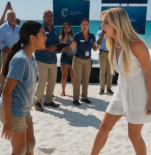
PART 4 — BRIELLE’S CRACKED CROWN
Brielle grabbed her father’s arm.
“Tell me he’s lying,” she begged.
Malcolm’s eyes stayed fixed on Dane.
“Get our attorneys,” he told one assistant.
Brielle recoiled like his words had slapped her.
He had not denied it.
That was the moment her crown cracked.
I had disliked Brielle for years. Everyone at school knew her as the girl who arrived in a chauffeured SUV, who laughed when scholarship students brought homemade lunches, who treated kindness like something poor people invented to feel important. She had humiliated me once for smelling like fish medicine after a morning rescue shift.
But standing there on the beach, watching her whole world tilt beneath her, I felt something unexpected.
Not forgiveness.
Not pity.
Something closer to recognition.
Because beneath all her glitter and cruelty, Brielle looked suddenly young. Lost. Like a girl who had spent her life believing she was standing on marble, only to discover it was thin glass.
She turned toward me.
For a moment, I thought she would apologize.
Instead, her eyes filled with panic.
“You ruined everything,” she whispered.
I shook my head. “No. Your father did.”
Her lips trembled.
Before she could answer, a police officer approached the stage with two officials from the Department of Land and Natural Resources. Their badges flashed in the sunlight.
“Mr. Beaumont,” one official said, “we need to ask you some questions regarding unauthorized activity in a protected reef zone.”
Malcolm’s expression became perfectly still.
“I will cooperate through counsel.”
He turned to leave, but reporters swarmed him, shouting questions about illegal barriers, endangered species violations, bribery, and the hidden report.
Brielle stood abandoned in the middle of the sand.
No assistants rushed to comfort her.
No friends stepped forward.
The cameras that she had wanted so badly were now capturing every crack in her perfect life.
Then Hoku shifted inside the carrier.
The small sound brought me back.
This ceremony had never been about Brielle.
It had never been about Malcolm.
It had never been about cameras.
It was about returning a living creature to the ocean.
Dr. Kealoha looked at me gently. “Are you ready?”
My hands shook.
“My knee hurts,” I admitted.
Ms. Alana knelt beside me. “We can have someone else release Hoku.”
I looked at the turtle.
I remembered the first time Hoku ate again after refusing food for days. I remembered cleaning wounds with careful hands. I remembered whispering, “Don’t give up,” when I was really saying it to both of us.
“No,” I said. “I can do it.”
Two volunteers helped me stand. My leg screamed with pain, but I held the carrier close.
The crowd parted.
The ocean waited.
And then, just as I reached the wet sand, Brielle spoke behind me.
“Wait.”
The entire beach turned.
She walked toward me slowly, barefoot now, her expensive sandals forgotten somewhere in the chaos. Her makeup had streaked beneath her eyes.
I stiffened.
She stopped several feet away.
“I don’t deserve to touch it,” she said, voice breaking. “I know that.”
Then she looked at Hoku.
“But I need to say I’m sorry.”
The words trembled out of her like they had cut her throat on the way.
“I’m sorry for kicking you. I’m sorry for trying to take something you earned. I’m sorry I thought money meant ownership.”
I did not answer immediately.
The waves curled around my ankles.
Finally, I said, “Don’t apologize because cameras are watching.”
Her face crumpled.
“I’m not.”
I searched her eyes, looking for performance.
For once, I found none.
PART 5 — THE RELEASE THAT CHANGED EVERYTHING
I lowered the carrier carefully onto the wet sand.
Hoku blinked toward the sea.
The crowd held its breath.
“This is your home,” I whispered. “Go find it.”
For a moment, Hoku did not move.
Then one flipper pressed into the sand.
Then another.
Slowly, bravely, the little turtle began crawling toward the water.
The entire beach watched in silence.
No one clapped. No one shouted.
Even the reporters lowered their microphones.
There are moments too sacred for noise.
Hoku reached the first thin wash of foam. The water slid beneath its shell, then pulled away. It pushed forward again. Another wave came, stronger this time, lifting it gently.
My eyes blurred.
“Go,” I whispered.
The next wave carried Hoku into the blue.
A cheer rose behind me, enormous and bright. Volunteers hugged one another. My mother cried openly. Dr. Kealoha wiped his eyes with the back of his wrist and pretended he had sunscreen in them.
I laughed through tears.
For months, Hoku had fought for this.
For months, I had dreamed of seeing that little shell disappear into freedom.
And now it had.
But as the turtle swam beyond the foam, the tracking dashboard on the giant screen updated in real time.
A tiny moving signal appeared offshore.
The crowd cheered again.
Then something strange happened.
The signal stopped.
Dr. Kealoha’s smile faded.
He looked down at the tablet, tapped once, then twice.
“What is it?” Ms. Alana asked.
The tiny dot on the map pulsed near the outer reef.
Another signal appeared beside it.
Then another.
Then five more.
Dr. Kealoha went very still.
He connected the tablet audio to the stage speaker.
A warning tone sounded.
MULTIPLE DISTRESS TRANSMITTERS DETECTED.
The beach went silent again.
“What does that mean?” I asked.
Dr. Kealoha’s face had gone pale.
“It means Hoku just swam near other tagged turtles.”
“That’s good, right?”
He did not answer.
On the screen, the signals clustered near North Reef — the same reef beside Beaumont’s development zone.
Then the environmental exposure readings loaded.
Chemical spikes.
Low oxygen.
Abnormal temperature.
Movement restriction.
Dr. Kealoha whispered, “Oh no.”
The joy vanished from the beach.
One official stepped closer. “Doctor?”
Dr. Kealoha turned toward the ocean.
“There are more turtles trapped out there.”
Malcolm Beaumont had been halfway through pushing past reporters when he froze.
Dane stared at the screen, horrified.
Brielle covered her mouth.
Dr. Kealoha’s voice shook with anger. “The barriers were never fully removed.”
The words landed like thunder.
Hoku had not merely returned home.
Hoku had found the evidence everyone else had missed.
PART 6 — INTO THE REEF
Everything happened at once.
Rescue teams sprinted toward boats. Volunteers hauled emergency gear across the sand. Officials radioed marine patrol. Reporters followed from a distance, broadcasting every second.
I tried to follow, but Ms. Alana caught my arm.
“You’re injured.”
“I can help.”
“You already have.”
I looked toward the ocean, where Hoku’s signal blinked beside the others.
“No,” I said. “Hoku is still out there.”
Dr. Kealoha heard me. He hesitated, then handed me a headset.
“Stay onshore. Monitor the dashboard. Tell us if any signal moves or drops.”
It was not the rescue boat, but it was something.
I sat beneath the stage canopy with my knee wrapped in ice, eyes locked on the screen. Brielle stood several feet away, arms crossed tightly over herself.
For once, she looked afraid to speak.
The rescue boat cut across the water toward North Reef. Through the live drone feed, we saw the truth rising beneath the glittering surface.
Pieces of construction netting had tangled around coral heads. Temporary underwater barriers sagged across a channel where turtles surfaced and fed. Floating debris twisted with seaweed.
And there — trapped near the reef — were three turtles.
One struggled weakly against mesh.
Another floated too still.
The third circled in distress.
I pressed the headset closer. “Two meters east of the big coral formation,” I said, voice shaking. “There’s another signal under the barrier.”
Dr. Kealoha’s voice crackled back. “Copy.”
Brielle stepped closer to the screen. “That’s from our resort?”
I did not look at her. “Your family’s development.”
She flinched.
A rescue diver entered the water. Then another.
Minutes stretched like hours.
One turtle was freed.
Then the second.
The third did not move.
My chest tightened so sharply I could hardly breathe.
“Come on,” I whispered. “Please.”
The diver lifted the still turtle carefully. On the feed, I saw its flipper twitch.
The whole beach exhaled.
Alive.
Barely, but alive.
Brielle made a small sound beside me. When I glanced over, she was crying silently.
“I didn’t know,” she said.
I wanted to say that not knowing was not enough.
I wanted to tell her ignorance did not erase damage.
But her face was turned toward the reef, and for the first time, she looked not embarrassed, not defensive, not worried about herself.
She looked ashamed.
“Then help,” I said.
She stared at me.
“How?”
“Start by telling the truth.”
Her lips parted.
Across the beach, Malcolm Beaumont was speaking rapidly to his attorneys. Even now, even with trapped turtles being pulled from his construction debris, he looked more angry about being exposed than sorry for what had happened.
Brielle followed my gaze.
Something inside her changed.
It was visible.
A decision.
She walked away from me and straight toward the nearest live camera.
The reporter blinked in surprise as Brielle stopped in front of her.
“My name is Brielle Beaumont,” she said, voice trembling but clear. “And I need to make a statement.”
PART 7 — THE HEIRESS WHO BROKE THE EMPIRE
Malcolm saw her too late.
“Brielle,” he barked. “Do not say another word.”
She turned toward him.
All her life, that voice had probably ended every argument.
Not this time.
She faced the camera again.
“My family’s company knew there were problems at North Reef,” Brielle said. “I heard arguments at home. I heard my father say inspections could be delayed. I heard him say bad press would be worse than a dead turtle.”
The beach went dead quiet.
Malcolm’s face turned purple. “She’s a minor. She’s emotional. Turn that camera off.”
The reporter did not.
Brielle kept speaking.
“I didn’t understand everything. Maybe I didn’t want to. I liked being important. I liked being praised for conservation projects I never worked on. But today I saw who actually cared.”
Her eyes found mine.
“Not me.”
Her voice cracked.
“Her.”
Every camera turned briefly toward me, but I barely noticed. I was watching the rescue feed. The divers were cutting more netting. The turtles were being lifted into emergency tanks.
Brielle wiped her cheeks with shaking fingers.
“And I know where the internal files are.”
Malcolm lunged forward, but officials blocked him.
Brielle’s voice grew stronger.
“There’s a private server at the Beaumont Marine Operations office. It has inspection schedules, payment records, and messages about hiding reef damage. My father made my brother back them up last Christmas because he didn’t trust anyone.”
A stunned murmur rolled through the crowd.
Malcolm stared at his daughter as if she had become a stranger.
But Brielle was not done.
“And there’s one more thing,” she said.
Her hands shook violently now.
“My father didn’t come here today to support conservation. He came because he knew this turtle had a tracking chip. He was afraid the release data would show contamination near the resort.”
The shock that followed was almost physical.
Even Dr. Kealoha’s voice went silent over the headset.
Brielle looked straight into the camera.
“So investigate him. Investigate us. Investigate all of it.”
Then she turned away, and for the first time since I had known her, Brielle Beaumont looked free.
Not happy.
Not forgiven.
But free from a lie that had dressed itself in silk and diamonds.
Officials moved quickly after that. Malcolm was escorted from the ceremony area, still shouting about lawyers and stolen data. His assistants scattered. Reporters chased the story in every direction.
Meanwhile, the rescued turtles arrived onshore.
One was strong enough to lift its head.
One needed oxygen.
The smallest one had a cracked shell and a fishing line wrapped deep around its flipper.
I forgot Brielle. I forgot cameras. I forgot my knee.
I reached for gloves.
Ms. Alana gave me a look. “You’re supposed to rest.”
“I can prep saline.”
She sighed, but her mouth softened. “Sit while you do it.”
So I sat beside the emergency table, hands steady despite everything, preparing supplies while the team worked.
Brielle approached slowly.
No one welcomed her. No one stopped her.
She stood beside the supply crates.
“What can I do?” she asked.
A volunteer looked ready to snap at her.
I handed Brielle a stack of clean towels.
“Fold those. Don’t touch anything sterile.”
She nodded quickly.
And she did it.
No complaint.
No drama.
No camera smile.
Just a girl folding towels on a beach while her empire burned behind her.
PART 8 — THE END — HOKU’S FINAL SECRET
Three months later, North Reef looked different.
The Beaumont construction site was closed by court order. Environmental investigators had uncovered enough violations to fill boxes. Malcolm Beaumont resigned from the company before the board could remove him, though everyone knew it was not really a resignation. It was a collapse.
Several executives were charged. Fines were issued. Restoration orders followed.
But the biggest surprise came from Brielle.
She did not return to school in designer sunglasses pretending nothing had happened. She did not post tearful apologies for sympathy. She disappeared for two weeks, then came to the rescue center wearing plain shorts, old sneakers, and no makeup.
“I know nobody trusts me,” she told Ms. Alana. “They shouldn’t. But I want to work.”
Ms. Alana looked at me.
I shrugged. “The algae tanks need scrubbing.”
Brielle scrubbed algae tanks for four hours.
Badly at first.
Then better.
Week after week, she came back. Some volunteers ignored her. Some glared. A few forgave her slowly. I did neither for a long time.
Forgiveness, I learned, is not a door you throw open because someone knocks once.
Sometimes it is a window you unlock inch by inch, only after watching what someone does when no one is applauding.
Brielle learned to clean filters. She learned not to wear perfume near recovery pools. She learned how to prepare turtle greens and record feeding behavior. She gagged the first time she handled fish medication, and I laughed before I could stop myself.
She laughed too.
That was the first normal sound between us.
One afternoon, while we cleaned a pool together, she said, “I was jealous of you.”
I snorted. “Of my stained volunteer shirts?”
“Of knowing who you were,” she said quietly.
I stopped scrubbing.
Brielle stared into the water. “I thought being admired meant being loved. But when everything happened, most people around me vanished. You had people who stood beside you even when you were covered in sand and crying over a turtle.”
I looked away.
“My dad used to say people only respect power,” she continued. “But Hoku followed you because you were patient. Dane told the truth because he wanted his son to respect him. The rescue team saved those turtles because nobody cared who got credit.”
Her voice softened.
“I think my father was wrong about everything.”
I did not know what to say.
So I handed her the scrub brush.
“Then clean the corners. You missed a spot.”
She smiled.
It was not the smile she used to wear at ceremonies.
This one was smaller.
Real.
The North Reef restoration took months. Divers removed debris. Scientists replanted coral fragments. Volunteers documented wildlife returning to the area. The resort project was permanently canceled, and the land was transferred into a protected coastal trust after a public campaign exploded across the islands.
Brielle testified against her father.
Dane did too.
And I kept volunteering after school, though now reporters sometimes called asking for interviews. I refused most of them. I had not saved Hoku for attention. I had saved Hoku because a living creature had needed someone stubborn enough to believe survival was possible.
Then, on the day North Reef officially reopened as a protected marine sanctuary, Dr. Kealoha called me to the rescue center.
He looked strangely nervous.
“There’s something you need to see,” he said.
Ms. Alana was there. So was my mother. Brielle stood near the doorway, twisting her hands.
“What’s going on?” I asked.
Dr. Kealoha turned on the monitor.
A tracking map appeared.
My heart jumped.
“Hoku?”
He smiled. “Hoku.”
The signal had traveled hundreds of miles over the past months, looping through feeding grounds, drifting through deep blue channels, then returning toward the islands.
But now, Hoku’s signal was stationary near a quiet stretch of protected beach.
“Is Hoku okay?” I asked quickly.
“Yes,” Dr. Kealoha said. “More than okay.”
He clicked to a new image from a remote shoreline camera.
At first, I only saw moonlit sand.
Then I saw tracks.
Small flipper marks leading from the ocean.
A rounded shape near the dune.
My hands flew to my mouth.
Dr. Kealoha’s eyes shone.
“Hoku came back,” he said. “She nested.”
The room blurred.
“She?” I whispered.
He laughed softly. “Yes. We confirmed it from the footage. Hoku is female.”
The camera image changed again.
There, under the silver moon, was Hoku — larger, stronger, alive — covering her nest with slow, careful movements before turning back toward the sea.
I cried so hard my mother wrapped both arms around me.
After everything — the injury, the hidden report, the scandal, the rescue, the reef — Hoku had returned not as a victim, but as a beginning.
Brielle wiped her face. “She made it.”
I nodded through tears. “She made it.”
Dr. Kealoha cleared his throat, but his voice still trembled.
“The sanctuary board voted yesterday. The restored North Reef nesting protection program needs a name.”
He glanced at Ms. Alana.
She smiled.
“We’re calling it the Hoku Volunteer Marine Fund,” she said. “It will support young conservation volunteers across the islands.”
I stared at them, speechless.
“And,” Dr. Kealoha added, “its first scholarship has already been funded anonymously.”
Brielle suddenly became very interested in the floor.
I turned toward her.
She shrugged, cheeks red. “It wasn’t anonymous enough, apparently.”
I laughed, crying harder.
“You did that?”
She swallowed. “With money from selling my car.”
I blinked. “Your car?”
“It was too shiny,” she said. “And I’m taking the bus now.”
For some reason, that made all of us laugh until we cried again.
Months later, when Hoku’s hatchlings finally emerged, we stood together under a sky crowded with stars. Tiny turtles pushed through the sand, fragile and determined, moving toward the moonlit ocean.
No cameras were allowed close.
No sponsors stood on stages.
No one shouted for attention.
Brielle stood beside me in an old rescue center shirt, holding a red flashlight pointed low to protect the hatchlings’ path.
One tiny turtle paused near my foot.
Then it kept going.
Toward the waves.
Toward the unknown.
Toward life.
Brielle whispered, “Do you think they’ll come back?”
I watched the hatchlings disappear into the silver foam.
“Some of them,” I said. “The stubborn ones.”
She smiled.
And somewhere beyond the reef, where the dark ocean breathed beneath the stars, Hoku’s tracking signal blinked steadily on the monitor behind us.
Not as evidence.
Not as accusation.
But as proof.
Proof that the truth can be buried, but not forever.
Proof that one small life can expose an empire.
Proof that even people who begin in cruelty can choose to change.
And proof that sometimes, the creature everyone thinks you saved…
comes back to save you too.
