PART 2 — THE NAME IN THE SAFETY REPORT
Victoria’s face lost all color when she realized the person credited with protecting the team was me.
Not her.
Not one of the celebrated athletes.
Not one of the powerful families whose logos covered the banners along the Seattle waterfront.
Me.
The girl with worn shoes, a faded jacket, and calluses from repairing handles nobody else bothered to check.
For a moment, the only sound was the wind pushing against the festival flags. The giant event screen froze on the official safety report, enlarged so everyone in the grandstands could read it.
PRIMARY SAFETY INTERVENTION: MAYA BENNETT.
My name sat there in black letters, impossible to ignore.
The head coach, Coach Ramirez, turned toward the crowd. His voice carried through the speakers.
“Three weeks ago, during a harbor training session, Maya Bennett identified structural failures in multiple paddles before launch. Her inspection prevented a crew from entering rough water with unsafe equipment. Had those paddles failed mid-race, the result could have included capsizing, collision, or serious injury.”
A murmur rippled through the spectators.
Parents turned to one another with wide eyes. Athletes whispered my name. Reporters swung their cameras away from Victoria and toward me.
I wanted to disappear.
My palms stung from hitting the deck. My knee throbbed. The ceremonial drumsticks still lay several feet away, one resting near the edge of the platform like it might roll into the water.
Victoria stared at the screen, her mouth open.
“That’s not true,” she said.
Coach Ramirez looked at her calmly. “It is documented, reviewed, and confirmed.”
Victoria’s hands curled into fists. “She fixes equipment. That’s her job.”
A cold silence followed.
Coach Ramirez’s expression sharpened. “No, Victoria. Her job was to sweep storage rooms and help with inventory after school. She chose to learn repair standards. She chose to inspect every paddle before practice. She chose to speak up when adults were rushing.”
My throat tightened.
Nobody had ever said it like that before.
I had not thought of myself as brave. I had only seen a crack, imagined it snapping in someone’s hands, and refused to stay quiet.
Victoria stepped closer to the microphone. “My family built half the junior racing programs in this region. I have trained since I was eight. I should have been chosen for the drum.”
Coach Ramirez glanced at the giant drum beside us. Its painted dragon scales shimmered red and gold beneath the gray Seattle sky.
“The opening drum is not awarded for fame,” he said. “It is awarded for service to the sport.”
The words landed hard.
Victoria flinched as though he had slapped her.
Then her father, Marcus Kensington, pushed through the crowd near the sponsor tent. He wore a navy suit and the kind of expression adults use when they expect doors to open before they touch them.
“Coach Ramirez,” he called, climbing onto the platform, “this is inappropriate. My daughter made a mistake in a heated moment. There is no need to humiliate her publicly.”
The crowd stirred.
Coach Ramirez looked from Marcus to Victoria. “She shoved a student volunteer in front of hundreds of people.”
Marcus lowered his voice, but the microphone caught every word. “And you chose to provoke her with this display.”
“Sir,” Coach Ramirez said, “the display was prepared before she touched Maya. This ceremony was meant to honor Maya’s contribution.”
Victoria looked horrified. “You were going to show that anyway?”
“Yes,” the coach said. “Before you decided to prove exactly why you were not chosen.”
A gasp passed through the athletes gathered near the docks.
My cheeks burned.
Marcus Kensington’s jaw tightened. “Do you understand who funds this festival?”
Coach Ramirez did not blink. “I understand exactly who funds it. I also understand who keeps young athletes safe when nobody famous is watching.”
For the first time, Marcus had no immediate answer.
Then Victoria turned on me.
Her eyes blazed, wet with fury.
“You planned this,” she hissed.
I stared at her. “I planned to hit a drum.”
“You wanted everyone to worship you.”
“No,” I said quietly. “You wanted that.”
The microphone picked up my words.
The entire waterfront heard them.
Victoria’s expression cracked. Not with regret. With rage.
She lunged toward me again.
This time, two athletes caught her before she reached me.
And that was when the giant screen changed.
The training footage resumed without anyone touching the tablet.
The video jumped to a different angle.
A hidden dock camera.
A timestamp from earlier that same morning.
The screen showed someone entering the equipment tent before sunrise.
A girl in a white racing jacket.
Victoria.
PART 3 — THE SECOND VIDEO
Nobody breathed.
On the giant screen, Victoria moved through the equipment tent with a flashlight in one hand. Her ponytail was tucked beneath a cap, but everyone knew it was her. The white jacket carried the Kensington Racing crest across the back.
She stopped beside the rack of ceremonial paddles.
Coach Ramirez turned slowly toward her.
“Victoria,” he said, voice dangerously low, “what is this?”
Victoria shook her head violently. “That’s not me.”
Her father snapped, “This is absurd. That footage is unclear.”
But it was not unclear.
The camera angle shifted when she stepped closer. Her face appeared in profile as she pulled one paddle from the rack and examined it. Then she looked over her shoulder, reached into her pocket, and took out a small tool.
A sharp cry came from the crowd.
One of the junior athletes whispered, “She tampered with it.”
“No,” Victoria said. “No, I didn’t.”
The footage showed her scraping along the edge of a paddle shaft, then placing it back on the rack.
My stomach dropped.
Those ceremonial paddles were not for display. They were to be used later by the youngest demonstration crew—children between ten and twelve years old who would paddle a short course for the opening broadcast.
Coach Ramirez’s face went pale.
He grabbed the radio clipped to his belt. “Stop the junior demonstration launch immediately. Inspect every ceremonial paddle. Nobody touches the water.”
Down at the dock, coaches began moving at once. Children in bright life jackets looked confused as adults pulled them back from their boats.
Victoria stared at the chaos she had caused.
Her lips trembled. “I only scratched one.”
The words left her mouth before she could stop them.
The whole crowd heard.
Her father closed his eyes.
I felt sick.
“You scratched one?” Coach Ramirez repeated.
Victoria’s voice became tiny. “I wasn’t going to hurt anyone. I just wanted them to delay the ceremony. I thought if something went wrong, they’d need another representative, and my dad would—”
She stopped.
Marcus Kensington grabbed her arm. “Victoria.”
She looked at him, terrified.
That look told me everything.
This was not just jealousy.
There was something else beneath it. Something larger. Darker. Older.
Coach Ramirez saw it too.
“Mr. Kensington,” he said, “what did your daughter think you would do?”
Marcus released Victoria’s arm.
“I have no idea,” he said smoothly. Too smoothly.
But Victoria was shaking now, and the rage had drained from her face, leaving a frightened girl behind.
My knee still hurt. My hands still burned. Yet when I looked at her, I did not feel triumph.
I felt dread.
Because Victoria Kensington, who had shoved me in front of the entire festival, looked like someone who had been pushed long before she pushed me.
A whistle sounded from the dock.
One of the assistant coaches lifted the damaged ceremonial paddle high. Even from the stage, I could see the scraped groove along the shaft.
The crowd erupted.
Parents shouted.
Reporters spoke rapidly into cameras.
A woman near the front yelled, “My son was supposed to be in that boat!”
Victoria covered her ears.
Coach Ramirez raised both hands. “Everyone remain calm. The paddle was found before launch. The crew is safe.”
Safe.
The word hit me with such force that I nearly sat down.
Again. Unsafe equipment. Again, children seconds away from danger. Again, the difference between disaster and prevention came down to someone checking the details.
Only this time, someone had created the danger on purpose.
Coach Ramirez turned to security. “Escort Victoria and Mr. Kensington to the operations tent.”
Marcus snapped, “You cannot detain us.”
“No,” Coach Ramirez said. “But I can remove you from this festival and contact the authorities.”
Victoria whispered, “Dad, please.”
He glared at her. “Not another word.”
Something inside me tightened.
That was not a father protecting his daughter.
That was a man controlling a witness.
Before security could lead them away, a small boy in a green life jacket broke from the junior crew and ran toward the stage.
“Wait!” he cried.
His coach tried to stop him, but the boy dodged around him.
He climbed halfway up the platform steps and pointed at Marcus Kensington.
“I saw him too!”
The crowd went silent again.
Marcus turned slowly.
The boy’s voice shook, but he kept pointing.
“I saw him in the equipment tent last week. He was arguing with someone. He said the festival needed a failure before people would listen.”
Marcus’s face darkened.
The boy’s mother rushed forward, pulling him close.
Coach Ramirez crouched near the edge of the platform. “What is your name?”
“Leo,” the boy said.
“Leo, are you sure?”
Leo nodded fiercely. “He knocked over a box when he left. I was hiding because I didn’t want to run warm-ups.”
A nervous laugh moved through the crowd, but it died quickly.
Coach Ramirez stood.
Marcus Kensington looked at every camera pointed at him. For the first time, his confidence slipped.
Then the festival’s main broadcast producer ran onto the stage holding a headset.
“Coach,” she said breathlessly, “you need to see what our crew recorded during sound check.”
PART 4 — THE MAN BEHIND THE PERFECT FAMILY
The broadcast producer connected her headset feed to the event system.
The giant screen flickered.
For the third time that morning, the waterfront became a theater of secrets.
The video showed the sponsor tent from an hour before the ceremony. The camera must have been accidentally recording while technicians tested angles for the opening broadcast.
Marcus Kensington stood near the back of the tent, speaking to a man in a gray raincoat. Victoria was beside him, arms crossed, looking miserable.
Marcus’s voice came through faintly at first, then clearer.
“The federation has ignored us for years,” he said. “They take our money, our name, our boats, and then hand the spotlight to some repair girl.”
My skin prickled.
The man in the raincoat asked, “You want the demonstration delayed?”
“I want embarrassment,” Marcus replied. “Nothing serious. A broken paddle. A panic. A moment that proves the organizers are incompetent without Kensington oversight.”
Victoria’s recorded voice said, “Dad, what if someone gets hurt?”
Marcus turned sharply toward her.
“Do you want leadership or not?”
The real Victoria standing onstage began to cry silently.
On screen, she looked down.
Marcus continued, “After the delay, you step in. You calm everyone. You lead the junior crew with Kensington equipment. By tonight, every outlet calls you the future of the sport.”
The man in the raincoat shifted. “And the existing safety report?”
Marcus’s mouth tightened. “Maya Bennett made that complicated. The federation planned to honor her.”
The screen showed Victoria looking startled. “Maya?”
Marcus waved a hand. “The girl from the repair shed. She spotted the defective batch before we could use it as evidence.”
Before we could use it.
A horrible silence fell.
The first damaged paddles—the ones from the Harbor Training Incident—had not been an accident either.
Coach Ramirez whispered, “My God.”
Marcus Kensington lunged toward the cable connected to the screen.
Mr. Hayes, the festival’s dock safety officer, stepped in front of him. He was a broad, quiet man who had spent the morning checking life vests and weather patterns. Until that moment, nobody had paid him much attention.
“Step back,” Mr. Hayes said.
Marcus sneered. “Do you know who I am?”
Mr. Hayes did not move. “A man being recorded.”
The crowd erupted into applause, angry and sharp.
Victoria sank to her knees on the stage.
“I didn’t know about the first paddles,” she sobbed. “I swear I didn’t know.”
Coach Ramirez looked at her with pain in his eyes. “But you knew about today.”
She nodded, crying harder. “He said it would only delay things. He said nobody would launch. He said if I refused, he’d pull funding from my team.”
Her father spun toward her. “Victoria!”
She flinched so violently that the crowd saw it.
And suddenly, the girl who had seemed arrogant and untouchable looked very young.
I remembered her fury when people congratulated me. I remembered her shouting that the spotlight belonged to her. But now her words sounded different.
Maybe the spotlight had never belonged to her.
Maybe it had been a cage her father built around her.
Security moved in.
Marcus tried one final smile, the polished sponsor smile printed in festival programs and donor brochures.
“This is being misunderstood,” he said. “Everything I did was to protect the reputation of the sport.”
“No,” I said.
I had not meant to speak, but the word came out clear.
Every camera turned toward me.
Marcus looked down at me as though I were dirt on his shoe. “Excuse me?”
I stepped forward, my knee aching, my hands trembling.
“You didn’t protect the sport,” I said. “You endangered children to control it.”
The waterfront went silent.
My voice shook, but I kept going.
“You treated athletes like props, volunteers like obstacles, and your own daughter like a trophy you could polish until she reflected you.”
Victoria looked up at me through tears.
Marcus’s face turned red. “You know nothing about my family.”
“I know what cracked equipment looks like,” I said. “Sometimes it looks fine from far away. But pressure reveals the damage.”
The words seemed to strike Victoria harder than anyone.
Her shoulders folded inward.
Coach Ramirez nodded to security.
This time, when they escorted Marcus Kensington away, the crowd did not gasp.
They booed.
PART 5 — THE GIRL WHO FELL AND STOOD BACK UP
After Marcus was removed from the waterfront, the festival seemed suspended between disaster and decision.
The junior demonstration was canceled. The opening broadcast was delayed. Officials huddled near the operations tent. Parents demanded answers. Reporters chased every whisper.
And I stood beside the giant drum with dirt on my dress and pain pulsing through my knee.
A medic finally reached me.
“You need to sit,” she said.
“I’m fine.”
“You fell hard.”
“I said I’m fine.”
But the moment I took a step, my leg buckled.
Victoria moved before anyone else did.
She caught my arm.
The crowd noticed. Cameras noticed. I noticed too.
For one long second, we stared at each other.
Her hand was shaking.
“I’m sorry,” she whispered.
I pulled my arm back, not cruelly, but firmly. “You shoved me.”
“I know.”
“You tampered with a paddle.”
Her face crumpled. “I know.”
“That apology has to be bigger than two words.”
She nodded, tears falling freely now. “It will be.”
The medic guided me into a chair near the stage. She cleaned the scrape on my palm and checked my knee while festival officials continued arguing about whether the ceremony could continue.
Part of me wanted them to cancel everything.
Another part of me looked toward the athletes waiting by the docks. Teams had traveled from Oregon, California, Vancouver, and across Washington. Kids in bright jerseys sat with paddles across their laps, faces tense. They had trained for months. They had woken before sunrise. They had believed this day would be about teamwork, rhythm, and racing together across cold water.
Instead, they had watched adults fail them.
Coach Ramirez climbed back onto the platform.
His voice was heavy when he addressed the crowd.
“We have confirmed that all active race equipment will be re-inspected before any event proceeds. We will cooperate fully with investigators. The safety of every athlete comes first.”
Someone shouted, “Cancel the festival!”
Another voice shouted, “Let them race!”
The grandstands divided into noise.
Then Victoria walked to the microphone.
A hush spread—not because people respected her now, but because they wanted to hear what a fallen princess would say.
She looked smaller without her father beside her.
“My name is Victoria Kensington,” she began. Her voice trembled. “And I owe everyone here the truth.”
Her mother, who had been standing near the sponsor tent with a pale, devastated face, covered her mouth.
Victoria continued.
“I was angry when Maya was chosen to beat the opening drum. I thought recognition was something you inherited, not something you earned. I thought my name made me more deserving than her work.”
She looked at me.
“I shoved her because I was jealous.”
My chest tightened.
“And I damaged a ceremonial paddle because my father convinced me it would only delay the ceremony. But I knew it was wrong. I knew there was a risk. I did it anyway because I was afraid of disappointing him.”
She turned toward the junior crew.
“I am sorry. Not because I was caught. Because I could have hurt you.”
A mother in the front row began crying.
Victoria took a breath.
“I’m withdrawing from today’s competition. I’m also stepping down from the Kensington Junior Leadership Council. I don’t deserve to lead anyone until I learn what responsibility actually means.”
Her voice cracked, but she did not stop.
“And I think the festival should continue if the athletes and parents agree. Not for sponsors. Not for cameras. For the teams who came here to race.”
No applause came at first.
Only silence.
Then Leo, the little boy in the green life jacket, stood on his bench.
“I still want to race,” he said.
A few people laughed softly through tears.
Then one team captain rose. “We want to race too.”
Another followed.
Then another.
Soon athletes across the waterfront were standing, raising paddles, tapping them against the ground in a slow, thunderous rhythm.
Tap.
Tap.
Tap.
Like a heartbeat returning.
Coach Ramirez looked at me.
“Maya,” he said gently, “the opening drum is still yours if you want it.”
I looked at the giant drum.
My knee hurt. My palms stung. My heart was pounding so hard I could barely hear.
Then I stood.
Victoria stepped aside.
This time, she did not reach for the spotlight.
She cleared the path.
PART 6 — THE DRUMBEAT THAT CHANGED THE FESTIVAL
When I picked up the ceremonial drumsticks, the waterfront went still.
The sticks felt heavier than before. Smooth lacquer beneath my fingers. Red ribbons tied near the ends fluttered in the breeze.
I climbed onto the drum platform slowly, every step sending pain through my knee. But I kept going.
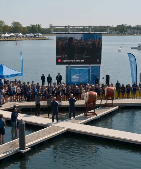
Below me, teams lined the docks. Paddlers sat tall in their boats, life jackets bright against the steel-blue water. Coaches stood with clipboards. Parents leaned forward in the grandstands. Reporters held cameras steady.
The festival had begun as a celebration of teamwork.
Then it became an exposure.
Now, somehow, it was becoming something else.
A promise.
Coach Ramirez stood beside me, his hand resting near the microphone.
“Today’s opening drum honors service,” he said. “It honors vigilance. It honors the people who protect others without expecting applause. Maya Bennett reminded us that safety is not a detail. It is the foundation of trust.”
My throat burned.
All my life, I had been the girl behind the shed. The girl with grease on her sleeves. The girl who stayed late sanding rough handles because blisters could ruin a race. The girl who labeled damaged equipment while others posed for team photos.
I had never thought those things made me important.
But as I looked out at hundreds of faces, I realized importance did not always arrive wearing medals.
Sometimes it wore worn shoes.
Sometimes it carried duct tape.
Sometimes it noticed a crack.
I raised the drumsticks.
The first strike boomed across the waterfront.
BOOM.
The sound rolled over the water, deep and ancient, as if the harbor itself had answered.
The second strike came stronger.
BOOM.
Teams lifted their paddles.
The third strike echoed against the glass towers of Seattle.
BOOM.
And then the crowd erupted.
Not polite applause.
Not sponsor applause.
Real applause.
The kind that rises from relief, gratitude, shame, and hope all at once.
I stepped down from the platform, breathless.
Coach Ramirez smiled at me. “You earned that.”
Before I could answer, a woman approached from the broadcast crew. Her eyes were bright.
“Maya, we’re running a feature segment later today. People should know what happened before the cameras turned on.”
I glanced at Victoria, standing alone near the edge of the stage.
She heard it too.
For a second, I saw old pain flash across her face—the instinctive wound of being overlooked. But then she did something that surprised me.
She nodded.
“Tell them,” she said. “Tell them all of it.”
“All of it?” I asked.
Her voice was quiet. “Especially the parts that make me look bad.”
That was the first moment I believed she might actually change.
The races began after every paddle, drum, life vest, and boat was inspected twice.
The first heat launched under a sky that had begun to clear. Sunlight broke through the clouds and scattered across the water like shattered glass. The boats surged forward, paddles rising and falling in perfect rhythm.
“Hut! Hut! Hut!”
The callers shouted cadence.
Drummers beat time.
Water sprayed.
The crowd roared.
And for a while, the scandal faded behind the beauty of motion: twenty paddlers moving as one body, one breath, one heartbeat.
I sat near the medic station with an ice pack on my knee, watching.
Victoria stood several feet away, alone.
No friends surrounded her. No cameras begged for her smile. No father arranged her posture.
She looked lost.
Then Leo walked up to her holding a small cracked paddle handle.
“You know how to fix this?” he asked.
Victoria blinked. “No.”
Leo pointed at me. “She does.”
Victoria looked at me uncertainly.
I sighed. “Bring it here.”
They both came over.
I examined the handle. “This one should be retired, not repaired. See this split near the grip? Water got under the seal.”
Leo nodded seriously, as if I had revealed a state secret.
Victoria crouched beside us.
“Can you teach me?” she asked.
I looked at her.
Her face reddened. “Not for cameras. I just… I don’t know how anything works. I only know how it looks when it’s finished.”
That honesty disarmed me.
So I handed her the paddle.
“Then start by learning where things break.”
PART 7 — THE SECRET INSIDE THE REPAIR SHED
By late afternoon, the festival had survived the impossible.
The races continued safely. The crowd stayed. Donations began pouring into a new independent equipment safety fund established on the spot by the federation. Marcus Kensington’s organization was suspended from all event control pending investigation.
Victoria’s world collapsed in public.
Mine changed in public.
And yet the most shocking discovery of the day happened away from the cameras, inside the old repair shed behind the boathouse.
Coach Ramirez asked me to check archived equipment logs for investigators. Victoria followed after asking permission so quietly I barely recognized her voice.
The shed smelled like varnish, rope, rainwater, and old wood. This was my kingdom, though nobody had ever called it that. Shelves of spare parts lined the walls. Paddles hung from hooks. A cracked practice drum sat in the corner.
I unlocked the metal cabinet where we kept repair records.
Victoria stood behind me, arms wrapped around herself.
“I used to hate this place,” she said.
I raised an eyebrow. “You came here?”
“Once. My father said it was where invisible people did invisible work.”
I paused.
The anger came hot and fast.
“Your father was wrong.”
“I know,” she whispered.
I pulled out three binders and set them on the workbench. “Look for entries from the defective paddle batch.”
We worked in silence.
Outside, cheers rose from the waterfront.
Inside, pages turned.
Then Victoria stopped.
“Maya.”
Something in her tone made me look up.
She held a yellowed maintenance form from nearly ten years earlier.
At the bottom was a signature.
ELENA KENSINGTON.
Victoria’s mother.
“What is that?” I asked.
Victoria scanned the page, her face tightening.
“It says my mother flagged a shipment of unsafe youth paddles years ago. She recommended canceling a regional event until replacements arrived.”
I moved closer.
The form had been marked: OVERRIDDEN BY EXECUTIVE ORDER.
Below that was Marcus Kensington’s signature.
Victoria’s hands began to shake.
“She knew,” Victoria whispered. “My mom tried to stop him.”
More pages revealed the same pattern. Elena Kensington had repeatedly raised concerns about equipment quality, sponsor pressure, and unsafe shortcuts. Each warning had been dismissed, buried, or overruled.
Then we found a sealed envelope tucked behind the oldest binder.
On the front, written in faded ink, were four words:
FOR VICTORIA, WHEN READY.
Victoria stared at it like it might explode.
“That’s my mom’s handwriting.”
“Open it,” I said gently.
She did.
Inside was a letter.
Her eyes moved across the page, and with every line, her face broke a little more.
Finally, she handed it to me.
I read silently.
Elena had written the letter five years earlier, after Marcus pushed her out of leadership and reduced her to a ceremonial role in the organization she helped build.
She wrote that dragon boat racing was never meant to be about famous names. It was born from rhythm, unity, trust, and collective strength. She wrote that Marcus had become obsessed with legacy and control. She wrote that she feared Victoria would confuse pressure with love.
The final lines made my throat close.
My daughter, if you ever feel you must hurt someone to earn your place, then the place being offered to you is not worth having. Find the people who teach you how to repair what breaks. They are the ones who understand strength.
Victoria covered her mouth.
For a long time, she did not cry loudly. She just folded over the letter, silent tears falling onto the paper.
Then the shed door opened.
Elena Kensington stood there.
She had removed her expensive festival blazer. Her hair was windblown. Her face was pale, but her eyes were steady.
“I wondered when you would find that,” she said.
Victoria looked up. “You left it here?”
Elena nodded. “This shed was the last place in the organization your father never cared enough to search.”
Victoria ran to her mother.
Elena held her tightly, and the sound Victoria made was not the sob of a spoiled girl losing status.
It was the sob of a daughter realizing someone had been trying to save her all along.
Coach Ramirez appeared behind Elena with two investigators.
He looked at the forms on the table.
“These records prove the safety concerns go back years,” he said.
Elena nodded. “I will testify.”
Victoria pulled back, stunned. “Against Dad?”
Elena’s eyes filled.
“For you,” she said. “And for every child he treated as acceptable risk.”
That was when I understood the real hero of the footage was not only me.
It was every person who had noticed danger and refused, in whatever way they could, to let it stay hidden.
PART 8 — THE END: THE RACE NO ONE EXPECTED
The final race of the day almost did not happen.
It was meant to be ceremonial: a mixed boat of youth paddlers from different teams, chosen to represent unity across the festival. With Victoria suspended and several Kensington athletes shaken, Coach Ramirez considered canceling it.
Then Leo raised his hand.
“What if Maya drums for us?” he asked.
Everyone turned.
I nearly dropped the repair log I was holding.
“I’m not a drummer,” I said.
Leo shrugged. “You already started the festival.”
A few athletes laughed.
Then one by one, paddlers began asking for the same thing.
“Let Maya drum.”
“She kept us safe.”
“She knows the rhythm.”
Victoria stood beside her mother, eyes still red from crying. For a second, I thought this would hurt her. This had been her world. Her water. Her expected glory.
Then she stepped forward.
“I’ll paddle,” she said.
The group went silent.
Coach Ramirez studied her. “Victoria, you withdrew.”
“I know,” she said. “Not for a medal. Put me in the back. Put me wherever nobody sees me. I just want to do it right once.”
A coach muttered, “The parents may object.”
Leo’s mother, the same woman who had cried earlier, looked at Victoria for a long time.
Then she said, “She can paddle behind my son.”
Victoria’s lips parted in shock.
“But,” Leo’s mother added, “if she so much as looks at a paddle wrong, I’m jumping in the boat myself.”
For the first time all day, real laughter swept across the waterfront.
And so, near sunset, the strangest crew in festival history carried a dragon boat to the dock.
Paddlers from rival teams sat side by side. Leo took the front-left bench, proud as a captain. Victoria sat near the back, not hidden exactly, but no longer centered. I sat at the drum, facing them all.
The water glowed orange beneath the sinking sun.
The city skyline rose behind us.
Spectators packed the railings, quieter now, as if they sensed they were about to witness something that would be remembered differently from a normal race.
Coach Ramirez leaned close before launch.
“Set the rhythm they can trust,” he said.
The boat pushed away from the dock.
For a moment, we drifted.
I looked at the paddlers.
Some were nervous. Some excited. Some still angry. Victoria stared down at her paddle, then lifted her eyes to mine.
“I’m ready,” she said.
Not loudly.
Not dramatically.
But honestly.
I raised the drumstick.
The first beat struck.
BOOM.
Paddles entered the water together.
Another beat.
BOOM.
Pull.
Another.
BOOM.
Pull.
The boat surged forward.
Wind rushed against my face. Water sprayed my shoes. The paddlers moved with growing confidence, their separate jerseys blurring into one bright body of motion.
“Hut!” Leo shouted.
The team answered with power.
Victoria paddled hard, but not wildly. She watched the person in front of her. She matched the rhythm. She did not try to outshine anyone.
For the first time, Victoria Kensington was not performing leadership.
She was practicing trust.
Halfway through the course, another boat pulled beside us. The crowd roared. My arms burned as I kept the drumbeat steady.
BOOM. BOOM. BOOM.
The finish buoys approached.
The two boats were nearly even.
I thought of the repair shed. The cracked paddles. Elena’s letter. Coach Ramirez’s faith. Leo’s courage. Victoria’s trembling apology. My own fall on the wooden deck.
I thought of how people break.
And how sometimes, with enough honesty, they can be repaired stronger than before.
The final beats thundered from my hands.
BOOM. BOOM. BOOM.
Our boat crossed the line.
Nobody knew who won.
For several seconds, nobody cared.
The paddlers erupted, laughing, crying, splashing water. Leo shouted so loudly his voice cracked. Victoria lowered her paddle and covered her face, shoulders shaking.
When we returned to the dock, the official results came in.
We had placed second.
Leo groaned. “No!”
But then Coach Ramirez announced something else.
“The Unity Crew receives no medal for placement,” he said over the speakers. “Today, they receive the first Harbor Courage Award.”
He turned toward me.
“Maya Bennett, for preventing disaster before anyone applauded.”
Then toward Leo.
“Leo Tan, for telling the truth when powerful adults hoped a child would stay quiet.”
Then toward Elena.
“Elena Kensington, for preserving records that will protect future athletes.”
Finally, he looked at Victoria.
The waterfront held its breath.
“And Victoria Kensington,” he said, “not for what she did wrong, but for choosing, after disgrace, to tell the truth, accept consequence, and paddle in service of a crew instead of herself.”
Victoria began crying again.
The applause started slowly.
Then grew.
Then thundered.
Not everyone clapped for her. Some people were not ready. Maybe some never would be. Consequences did not vanish because of one good choice.
But some clapped.
And that was enough for a beginning.
Months later, the investigation revealed that Marcus Kensington had manipulated equipment contracts for years, choosing cheaper materials while charging premium sponsor rates. His organization lost control of youth racing programs. A new safety board was formed, led by coaches, parents, athletes, and repair specialists.
Somehow, I became one of them.
At first, I said no. I was sixteen. I still had homework. I still had to help my mom with groceries. I still wore the same worn shoes.
Coach Ramirez only smiled.
“Good,” he said. “People who remember real life make better decisions.”
Victoria changed schools for a semester while the scandal settled. When she came back, she did not return as queen of anything. She came to the repair shed every Thursday.
The first time she sanded a paddle grip, she ruined it.
The second time, she got a blister.
The third time, she brought Leo snacks and asked him to explain how junior crews chose seating.
He told her, “You listen first.”
She wrote that down.
By spring, she could identify stress fractures better than most athletes. By summer, she was teaching younger paddlers how to inspect their own equipment.
One afternoon, she found me at the dock after practice.
“I used to think being seen meant being loved,” she said.
I watched gulls wheel above the harbor. “What do you think now?”
She looked toward the repair shed, where Leo was loudly accusing another kid of storing paddles wrong.
“I think being trusted is better.”
I smiled.
She handed me a small wooden charm shaped like a dragon scale. On one side, she had carved a drum. On the other side were four words:
NOTICE WHAT OTHERS MISS.
I kept it on my keychain.
Years later, when people talked about that festival, they often remembered the dramatic parts first—the shove, the giant screen, the exposed footage, Marcus Kensington being escorted away while cameras rolled.
But that was not the part I remembered most.
I remembered the first safe launch after everything almost fell apart.
I remembered the sound of paddles entering water together.
I remembered Victoria sitting in the back of the boat, finally learning that a crew moves fastest when nobody tries to rise alone.
And I remembered standing at the drum, hands aching, heart blazing, realizing that heroes are not always the people at the center of the photograph.
Sometimes the real hero is the girl in the repair shed.
The one who checks the cracks.
The one who speaks before disaster.
The one who gets shoved down in front of everyone and still stands back up.
Because on that day, the training footage did more than expose the truth.
It proved that the strongest rhythm on the water is not fame, power, or pride.
It is courage.
THE END
