PART 2 — THE DOCUMENT NOBODY EXPECTED
The giant screen glowed over the silent training grounds.
Every eye was fixed on the document.
The chief fire investigator adjusted his glasses and slowly read the final line aloud.
“Initial volunteer safety concern dismissed by company liaison Audrey Sinclair pending internal review.”
For a moment, nobody moved.
Nobody breathed.
Then the meaning hit the crowd.
A wave of shocked whispers spread across the field.
Audrey’s face drained of color.
“No,” she stammered. “That isn’t the whole story.”
The investigator remained calm.
“It is exactly the whole story.”
The screen zoomed in.
There was Audrey’s signature.
There was the date.
And there was the recommendation she had made.
Delay repairs.
Delay further investigation.
Delay emergency shutdown procedures.
The audience erupted.
Firefighters exchanged stunned looks.
Reporters immediately began typing.
Television cameras swung toward Audrey.
Her confidence collapsed.
“This is ridiculous!” she shouted.
But her voice no longer carried authority.
Only panic.
I stood frozen.
For two years I had never known who originally dismissed my warning.
I had submitted the report.
I had followed up repeatedly.
I had begged adults to take the malfunction seriously.
But the identity of the person blocking action had remained confidential.
Until now.
The truth stood exposed before everyone.
And the entire country was watching.
PART 3 — A HERO’S STORY FINALLY REVEALED
The investigator raised another binder.
“This young volunteer did far more than identify one malfunction.”
The giant screen changed.
New records appeared.
Different schools.
Different dates.
Different hazards.
My name appeared again.
And again.
And again.
A murmur swept through the audience.
Many of the firefighters looked genuinely surprised.
The investigator continued.
“Over the past five years, this volunteer submitted more than one hundred documented safety reports.”
Another slide appeared.
Blocked exits.
Expired extinguishers.
Broken emergency lighting.
Damaged sprinkler systems.
Electrical hazards.
The list seemed endless.
The investigator’s voice grew stronger.
“Thirty-seven major corrections were completed because of these reports.”
Applause broke out.
Then it became thunderous.
People stood.
Some firefighters whistled.
Others cheered.
My chest tightened.
I had never wanted recognition.
I volunteered because I cared.
Because safety mattered.
Because disasters never announce themselves beforehand.
But seeing those records displayed before thousands of people felt overwhelming.
The director of the training center stepped beside me.
“You changed lives,” he said quietly.
I shook my head.
“I just filled out reports.”
“No,” he replied.
“You paid attention when others didn’t.”
Those words hit harder than the applause.
Because they were true.
Most people only notice danger after something terrible happens.
I noticed it before.
And sometimes that makes all the difference.
PART 4 — AUDREY’S LAST ATTEMPT
The reporters surrounded Audrey.
Questions flew from every direction.
“Did you ignore the warning?”
“Did your company delay repairs?”
“Were students placed at risk?”
Audrey backed away.
Then something unexpected happened.
She grabbed a microphone.
“I made a mistake,” she said.
The crowd quieted.
For a second it seemed she might finally accept responsibility.
But then her eyes locked onto me.
And the anger returned.
“This never would’ve happened if that report hadn’t exaggerated the problem.”
Gasps echoed through the audience.
The investigator immediately stepped forward.
“That’s false.”
He opened another file.
Engineering assessments appeared on the screen.
Experts.
Independent inspectors.
Emergency technicians.
Every report reached the same conclusion.
The danger had been real.
Very real.
The automatic notification system could have failed during an evacuation.
The consequences could have been catastrophic.
Audrey’s defense crumbled instantly.
The reporters noticed.
So did the cameras.
For the first time in her life, she couldn’t talk her way out.
The truth was stronger than influence.
Stronger than money.
Stronger than family reputation.
And everyone could see it.
Tears suddenly formed in her eyes.
Not from guilt.
From humiliation.
The difference mattered.
PART 5 — THE ALARM LEVER
The training center director returned to the podium.
He looked at the crowd.
Then at me.
“We nearly forgot why we’re here.”
Laughter rippled through the audience.
The tension eased slightly.
The director smiled.
“Today marks fifty years of training firefighters, rescuers, and safety professionals.”
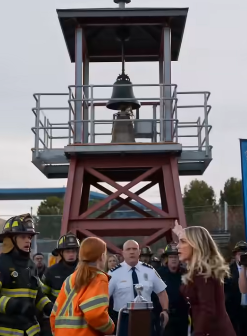
He pointed toward the historic alarm tower.
“And today we honor the values that built this institution.”
The crowd applauded.
Then he turned to me.
“Would you still like to pull the ceremonial alarm?”
My throat tightened.
Thousands of eyes watched.
Television cameras focused.
For a moment I considered refusing.
The entire day had become chaos.
But then I noticed something.
A firefighter standing near the front.
He gave me a small nod.
Then another.
Soon several others did the same.
One by one.
Across the crowd.
A silent message.
You earned this.
My hands trembled as I stepped toward the lever.
The antique brass handle gleamed beneath the sunlight.
Fifty years of history.
Fifty years of service.
Fifty years of protecting communities.
I wrapped my fingers around it.
The director began counting.
“Three.”
The crowd joined in.
“Two.”
My heartbeat thundered.
“One.”
I pulled.
The lever slammed downward.
A powerful bell exploded across the training grounds.
CLANG!
CLANG!
CLANG!
The sound echoed through the mountains.
Fire engines immediately activated their ceremonial lights.
Sirens briefly sounded.
The crowd erupted.
Cheers filled the air.
People jumped to their feet.
Some firefighters actually wiped tears from their eyes.
And standing there beneath the ringing alarm, I finally understood something.
Recognition wasn’t about glory.
It was about proving that ordinary people can make extraordinary differences.
PART 6 — THE SHOCKING DISCOVERY
The ceremony should have ended there.
But fate wasn’t finished.
A firefighter suddenly rushed toward the chief investigator.
He whispered urgently into his ear.
The investigator’s expression changed.
Immediately.
Something was wrong.
Very wrong.
He turned toward the audience.
“We’ve just received information regarding an archived warehouse owned by Sinclair Fire Systems.”
Confused murmurs spread.
Audrey looked terrified.
The investigator continued.
“An anonymous source contacted authorities this morning.”
Reporters instantly became alert.
“According to the report, older safety testing records may have been concealed inside the warehouse.”
The audience fell silent again.
Audrey whispered, “No…”
The investigator looked directly at her.
“Authorities are obtaining a search warrant.”
The training grounds erupted into chaos.
Questions flew everywhere.
What records?
What warehouse?
Why hide them?
Then something nobody expected happened.
Audrey suddenly burst into tears.
Real tears.
Not anger.
Not embarrassment.
Fear.
Pure fear.
“I didn’t know,” she whispered.
The words barely reached the microphone.
The investigator frowned.
“What didn’t you know?”
Audrey looked completely shattered.
“My father…”
She struggled to continue.
“My father told me the company always put safety first.”
The crowd listened carefully.
“I believed him.”
Silence.
Then she said the sentence that changed everything.
“I think he lied to me too.”
PART 7 — THE TRUTH BEHIND THE SINCLAIR EMPIRE
Three weeks later, the investigation made national headlines.
The warehouse had contained thousands of documents.
Years of records.
Internal communications.
Safety evaluations.
Testing results.
Some revealed shocking misconduct by senior executives.
Not defective equipment.
Not intentional sabotage.
Something subtler.
Warnings.
Repeated warnings.
Warnings that had been ignored whenever fixing problems became expensive.
Several executives resigned.
Government investigations expanded.
Audrey’s father stepped down as company chairman.
The story dominated news networks for weeks.
Yet the biggest surprise wasn’t the scandal.
It was Audrey.
She disappeared from public view.
No interviews.
No statements.
No social media.
Nothing.
Then one afternoon, nearly two months later, I received a letter.
No return address.
Just my name.
Inside was a handwritten note.
I recognized the signature immediately.
Audrey Sinclair.
The letter read:
“I spent most of my life believing recognition belonged to people because of their last names.”
“Watching that ceremony forced me to realize something painful.”
“You earned respect. I inherited attention.”
“Those aren’t the same thing.”
“I’m sorry for what I did.”
“You deserved better.”
I stared at the letter for a long time.
Part of me remained angry.
Another part understood how difficult those words must have been to write.
At the bottom was one final sentence.
“I’m volunteering at community safety programs now. Maybe it’s time I learn what real service looks like.”
For the first time since the ceremony, I smiled.
People can change.
Not everyone does.
But some do.
And when they do, the results can be remarkable.
PART 8 — THE END
Six months later, the Colorado Fire Training Center hosted another event.
Far smaller.
Far less public.
No national media.
No television crews.
Just volunteers.
Students.
Firefighters.
Community leaders.
And one special announcement.
The director invited me onto the stage once more.
This time I wasn’t nervous.
I had learned something important.
The spotlight isn’t something you chase.
It’s something that occasionally finds you while you’re focused on helping others.
The director handed me a framed certificate.
Then another item.
A small brass plaque.
The audience looked curious.
The director smiled.
“This plaque will be installed beside the historic alarm tower.”
I blinked.
“What for?”
He pointed toward the inscription.
My eyes widened.
The plaque read:
IN HONOR OF THOSE WHO CHOOSE RESPONSIBILITY OVER RECOGNITION.
DEDICATED TO THE VOLUNTEERS WHO SEE DANGERS BEFORE DISASTERS OCCUR.
INSPIRED BY A YOUNG SAFETY INSPECTOR WHO PROVED THAT ONE PERSON’S ATTENTION CAN PROTECT THOUSANDS.
The room erupted into applause.
I could barely speak.
Then I noticed someone standing near the back.
Audrey.
No designer clothes.
No security entourage.
No cameras.
Just a volunteer badge clipped to her shirt.
When our eyes met, she offered a small smile.
I returned it.
Not because everything had been forgotten.
But because forgiveness is sometimes the final step toward healing.
As the audience continued applauding, the chief investigator approached the microphone.
“There is one final statistic I’d like everyone to know.”
The room quieted.
He opened a folder.
“Since the school alarm hazard was corrected, more than four thousand students have attended classes in that building.”
He paused.
“Every one of them was protected because somebody refused to ignore a warning sign.”
The audience stood.
Every single person.
The applause seemed endless.
And at that moment, surrounded by firefighters, volunteers, and people dedicated to protecting others, I finally understood the greatest lesson of all.
Heroes are rarely the loudest people in the room.
They aren’t always wealthy.
They aren’t always powerful.
Most of the time, they’re ordinary individuals doing small acts of responsibility day after day.
Checking a fire extinguisher.
Testing an alarm.
Inspecting an emergency exit.
Filling out a report nobody else wants to write.
The world changes because of those people.
Not because they seek recognition.
But because they care.
As the sun set behind the training grounds, the historic alarm tower glowed orange in the evening light.
The bell remained silent.
No emergency.
No danger.
Just peace.
And standing there beneath the tower, I realized the most surprising truth of all:
The slap that was meant to humiliate me had accidentally exposed years of hidden corruption, protected thousands of future students, transformed an entire company, and changed two young lives forever.
Mine.
And Audrey’s.
Sometimes the worst moment of your life becomes the beginning of something extraordinary.
And sometimes, the person nobody notices becomes the one who saves everyone.
THE END
