The church doors burst open so violently that the brass handles struck the stone walls like gunshots.
Every head turned.
The organist’s fingers froze above the keys. The priest stopped mid-breath. Somewhere behind me, my aunt let out a small, frightened sound as if she had just seen a ghost wearing a face she recognized.
A woman stood at the back of the church, framed by late afternoon sunlight pouring through the open doorway. Her dark hair had loosened from a hurried bun, and her cream blouse was wrinkled as though she had dressed in panic. In one hand, she clutched a folded stack of papers. In the other, she held the hand of a little boy in a tiny gray suit.
He could not have been more than five.
His cheeks were wet with tears.
He looked heartbreakingly out of place among the flowers, silk dresses, polished shoes, and gold-edged hymnals. His bow tie sat crooked under his chin. One of his shirt cuffs was buttoned wrong. He held a stuffed brown dog against his chest like it was the only thing keeping him upright.
The entire church seemed to inhale at once.
I felt James’s hand stiffen around mine.
Then, slowly, his fingers slipped away.
That was the first moment I knew.
Not because the woman had arrived. Not because of the boy. Not even because my wedding had been interrupted seconds before becoming official.
I knew because James did not look confused.
He looked caught.
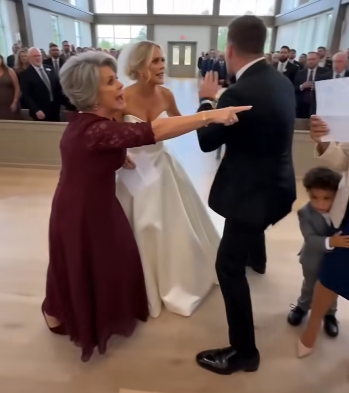
The woman started down the aisle.
Her heels struck the marble floor with sharp, steady clicks. Guests leaned back as she passed, parting for her the way people part for bad news. My father rose halfway from his pew, his face gone gray. My maid of honor, Clara, whispered my name, but I barely heard her.
The woman stopped at the altar.
For one suspended second, the only sound was the little boy sniffling into the ear of his stuffed dog.
Then the woman looked straight at James.
“Ask him,” she said, her voice trembling but clear, “why his son is not invited.”
A gasp rolled through the church.
James’s mother, Evelyn, shot to her feet in the front pew.
“This is a sick joke!” she snapped. “How dare you come here and humiliate my son?”
The woman did not even look at her.
Instead, she turned to me.
“I’m sorry,” she whispered.
Then she placed the folded papers into my hands.
My fingers were numb beneath my lace gloves. I unfolded the first page slowly, stupidly, as if taking more time might change what was written there.
It was a birth certificate.
The child’s name was listed as Oliver.
Mother: Natalie Brooks.
Father: James Alexander Whitmore.
My vision blurred.
The bouquet in my left hand suddenly felt too heavy, as if every white rose had turned to stone.
I looked at James.
“Is this real?”
His mouth opened. Closed. Opened again.
“I can explain.”
The little boy looked up at him then. His small voice cracked the silence more cruelly than any accusation could have.
“Dad, you said you were going to marry Mommy.”
The church erupted.
Whispers became murmurs. Murmurs became voices. People twisted in their seats, staring at James, then at me, then at the little boy as if truth itself had walked into the room wearing a crooked bow tie.
Clara grabbed my arm.
“Emma,” she whispered, “breathe.”
But I pulled away.
James reached toward me. “Emma, please.”
I stepped back.
That single movement seemed to frighten him more than anything Natalie had said.
His mother lunged toward me, one hand outstretched.
“Give me that paper.”
Before she could touch it, Father Michael stepped between us.
“Nobody moves.”
His voice, usually gentle, rang through the sanctuary with such authority that even Evelyn froze.
The birth certificate shook in my hands.
I looked down again, searching for something. A mistake. A wrong date. A wrong middle name. Some clerical error that would let me wake up from this nightmare.
Then I saw Oliver’s birthday.
My stomach turned cold.
The date was exactly five years and eight months earlier.
The same weekend James had proposed to me.
Not close. Not almost. Exact.
He had asked me to marry him on a balcony overlooking the sea, under a sky full of lanterns. He had cried when he opened the velvet box. He had told me he had never been more certain of anything in his life.
That same weekend, somewhere else, Natalie had been giving birth to his son.
The memories rearranged themselves in my mind like shards of broken glass.
His sudden phone calls outside.
His unexplained two-day delay before returning home.
His mother’s strange insistence that we never speak about “that messy summer.”
My breath came shallow and fast.
“James,” I said, barely recognizing my own voice, “what did you do?”
He looked toward his mother.
It was quick.
Almost nothing.
But I saw it.
And so did Natalie.
Her expression hardened.
“That is not all,” she said.
She reached into her purse and pulled out a second document.
For some reason, that frightened me more than the first.
She handed it to me without a word.
I unfolded it.
The title at the top read: Petition for Voluntary Transfer of Custodial Rights and Financial Settlement Agreement.
My eyes skimmed the page, not understanding at first.
Then I saw it.
At the bottom.
My signature.
Emma Rose Bennett.
It was unmistakable.
My name. My handwriting. My looping E. My slanted B. My signature, placed on a legal document I had never seen before in my life.
The air left my lungs.
“What is this?” I whispered.
Natalie’s eyes filled with tears. “That document was delivered to my lawyer three weeks ago. It says you acknowledged Oliver’s existence, accepted James’s prior obligations, and agreed that after the wedding, James would have no further contact with him except through a trust.”
“No,” I said.
The word came out too small.
Clara was suddenly beside me again. “Emma didn’t sign that.”
James whispered, “Emma—”
I turned on him.
“Did you forge my signature?”
He flinched.
That flinch broke something inside me.
Evelyn shouted, “This is absurd! My son would never—”
“Enough,” Father Michael said.
His voice was low now, almost dangerous.
Evelyn turned on him. “This is family business.”
“No,” he replied. “This is a church. And a child is standing here crying.”
Oliver hid behind Natalie’s skirt.
That small movement quieted everyone more than the priest’s command had.
The child looked terrified. Not triumphant. Not rehearsed. Not like a pawn in some revenge plot.
Just terrified.
I crouched slowly, ignoring the tight pull of my wedding dress.
“Oliver?” I said softly.
His wet eyes found mine.
“I’m Emma.”
“I know,” he whispered.
“You do?”
He nodded and held his stuffed dog tighter. “I saw your picture. Daddy said you were nice.”
A sound left me that was almost a laugh and almost a sob.
Behind him, James covered his face with one hand.
Natalie closed her eyes.
Then Oliver said, “He said after today he could come home.”
Every whisper died.
I looked up at James.
“What does that mean?”
James looked ruined now. Not guilty in the polished, controlled way of a man caught in a lie, but ruined in the way of someone who had been living under a collapsing ceiling and finally heard it crack.
“My mother told him that,” Natalie said.
Evelyn’s face hardened. “I told that woman nothing.”
Natalie turned toward her. “You told me James would marry Emma, secure the merger, and then divorce her quietly after the trust transferred. You told me I would receive enough money to disappear, and Oliver would be ‘handled.’”
My father stepped into the aisle.
“What merger?”
The question struck the room like a match.
James’s family owned Whitmore Properties. My father owned Bennett Land & Development. Our wedding had always been romantic, yes, but it also made business sense. Everyone said so. Two old families. Two companies. One future.
I had hated when people called it convenient.
James had hated it too.
Or so I had thought.
My father’s voice shook with contained fury. “Evelyn, what merger?”
Evelyn smiled thinly.
It was the wrong expression.
Too calm. Too practiced.
“The children are upset,” she said. “We should move this discussion somewhere private.”
“No,” I said.
Every face turned to me.
I stood, still holding both documents.
“No more private rooms. No more explanations in hallways. No more people deciding what I should know after the fact.” I looked at James. “Tell me the truth. Right now.”
James stared at the floor.
His silence was unbearable.
Natalie touched Oliver’s shoulder. “James.”
His head lifted at the sound of his name.
The way he looked at her hurt. Not because there was love there exactly, but because there was history. Regret. Familiarity. A thousand things I had been locked outside of.
“I didn’t know about him at first,” James said.
Evelyn snapped, “James, stop talking.”
He turned toward her. “No.”
One word.
His mother went pale.
James swallowed hard. “Natalie and I were together before I met you, Emma. It ended badly. I left for London. She tried to contact me after she found out she was pregnant, but I never got the messages.”
Natalie’s face tightened. “Because your mother intercepted them.”
Evelyn laughed once. “That is ridiculous.”
James looked at her. “I found the emails last year.”
A murmur spread.
Last year.
My mind caught on that.
“You found out last year?” I whispered.
His eyes came back to mine.
“Yes.”
“And you didn’t tell me?”
“I wanted to.”
I laughed then.
Not because anything was funny, but because my heart had reached for anger and found only disbelief.
“You wanted to?”
“I was scared.”
“Of me?”
“No,” he said quickly. “Of her.”
He looked at his mother.
For the first time in all the years I had known Evelyn Whitmore, I saw something crack beneath her perfect surface.
James continued, voice trembling. “When I found out Oliver existed, I went to Natalie. I met him. I wanted to be part of his life. But my mother said if I told you before the wedding, she would destroy Natalie in court and bury your father’s company in the merger negotiations. She had documents, debts, old contracts. She said everyone would lose everything.”
My father’s jaw tightened.
“She threatened my company?”
Evelyn said nothing.
That was answer enough.
Clara snatched the second document from my hand and scanned it. “Emma, this is notarized.”
“I never signed it.”
“I know.” Clara looked toward Evelyn. “But someone wanted it to look like you did.”
My father moved closer. “Let me see.”
He took the paper, and when his eyes reached the signature, his face changed.
Not with shock.
With recognition.
He looked at me.
“Emma,” he said quietly, “where is the letter your mother wrote you?”
The question was so unexpected that for a moment, I could not speak.
“My mother?”
My mother had died when I was sixteen. She had left me a box of letters, one for every major day she guessed she might miss. My eighteenth birthday. College graduation. My first real heartbreak. My wedding day.
That morning, before the ceremony, I had opened the wedding letter.
Inside, she had written about choosing love without losing myself.
At the bottom, she had signed her name.
And beneath that, almost as a joke, she had written mine the way I used to sign it as a child when I practiced “being grown-up.”
Emma Rose Bennett.
The same looping E.
The same slanted B.
My blood turned cold.
“The letter,” I whispered, “was in the bridal room.”
Clara’s eyes widened. “It’s still there?”
“I left it on the vanity.”
Evelyn’s gaze flicked toward the side door.
This time, everyone saw.
Father Michael turned to one of the ushers. “Lock the church office. No one leaves with anything.”
Evelyn’s composure broke. “This is insane.”
My father pointed at the document. “That signature was copied from my late wife’s letter, wasn’t it?”
“No,” Evelyn said.
Too fast.
James took a step away from her.
“Mother?”
Evelyn looked at him then, and for one terrible second, all her polish disappeared.
What remained was not love.
It was possession.
“You were going to throw away everything,” she hissed. “For a woman who trapped you and a child who should never have existed.”
Natalie covered Oliver’s ears.
But he heard enough.
His little face crumpled.
That was the moment James finally became a father.
Not by blood. Not by a certificate.
By choice.
He crossed the altar, knelt in front of Oliver, and pulled him gently into his arms.
“I’m sorry,” James whispered. “I am so sorry.”
Oliver resisted at first, stiff with hurt. Then his small hands gripped James’s jacket, and he sobbed into his shoulder.
The sound devastated the room.
I watched them through tears that would not fall.
I had imagined James crying at our wedding. I had imagined him taking my hands, promising forever, kissing me beneath the stained glass while everyone applauded.
I had not imagined him on his knees, holding the son he had hidden from me.
And yet the strangest thing happened.
My heart broke.
But not cleanly.
There was rage there. Betrayal. Humiliation. Grief.
There was also, buried beneath all of it, the memory of the man who once stopped traffic to rescue an injured dog. The man who cried when my father recovered from surgery. The man who kept every silly note I had ever written him in a wooden box beside his bed.
Had he lied?
Yes.
Had he been cowardly?
Yes.
Had his mother manipulated everyone around him like pieces on a chessboard?
Also yes.
But the boy in his arms was real.
And none of this was his fault.
I turned to Natalie.
“Why today?”
She wiped her face. “Because yesterday Evelyn’s attorney sent me a final agreement. It said if I accepted the settlement, James would never see Oliver again. If I refused, they would argue I had tried to extort the family. Then this morning, I received a copy with your signature on it.” She looked at me helplessly. “I thought you knew. I thought you had agreed.”
I shook my head.
“I didn’t.”
“I’m sorry,” she said again. “I didn’t know what else to do.”
I believed her.
That surprised me too.
Evelyn tried to move toward the side aisle, but my father stepped into her path.
“You are not going anywhere.”
She straightened, recovering some of her old iciness. “You cannot hold me here.”
“No,” Father Michael said. “But the police can ask questions about forgery, coercion, and fraud.”
Several guests pulled out phones.
Evelyn’s eyes scanned the room, searching for allies.
She found none.
Not even her husband, Arthur Whitmore, who had sat silent through everything with his hands folded over his cane. Now he rose slowly from the front pew.
He was a quiet man, often overshadowed by his wife. I had once thought him gentle. Then, later, weak.
But when he spoke, his voice carried.
“Evelyn,” he said, “what have you done?”
She stared at him as if he had slapped her.
“I protected this family.”
“No,” Arthur said. “You protected your control of it.”
Something passed between them then, something old and exhausted.
He looked at James.
“I knew she kept things from you,” he said quietly. “I did not know about the child.”
James’s face twisted. “Dad.”
Arthur’s eyes filled. “Bring him here.”
James hesitated.
Natalie did too.
Arthur held out one shaking hand. “Please.”
Oliver peeked at him.
James whispered, “That’s your grandfather.”
Oliver studied the old man for a long second.
Then, still clutching his stuffed dog, he walked slowly toward him.
Arthur knelt with difficulty.
“Hello, Oliver,” he said. “I am very sorry I am late.”
Oliver sniffed. “Do you like dogs?”
Arthur blinked.
Then he laughed through tears.
“Yes,” he said. “Very much.”
Oliver held up the stuffed animal. “This is Biscuit.”
Arthur bowed his head solemnly. “It is an honor to meet Biscuit.”
The room softened.
Even in the wreckage, something human survived.
Police arrived twenty minutes later.
By then, my wedding veil had been removed, my bouquet lay forgotten on a pew, and Evelyn Whitmore sat rigidly in the front row while two officers reviewed the documents. Clara retrieved my mother’s letter from the bridal room. On the vanity, beside the empty envelope, she found something else.
A thin sheet of tracing paper.
My copied signature.
Evelyn said nothing when they showed it to her.
But her silence had lost its power.
As officers escorted her outside, she passed James.
For one moment, I thought she might apologize.
Instead, she whispered, “You will regret choosing them.”
James looked at Oliver, then at Natalie, then finally at me.
“No,” he said. “I regret not choosing the truth sooner.”
The church doors closed behind her.
No one moved.
The wedding was over, though no one had said it aloud.
Father Michael approached me gently. “Emma, would you like me to clear the church?”
I looked around.
At guests who had come expecting vows and witnessed a trial.
At my father, still holding the forged agreement as if it were a weapon.
At Natalie, pale and exhausted, one hand resting protectively on Oliver’s shoulder.
At James.
My almost-husband.
My betrayer.
The man who had just lost the version of himself his mother had built.
“I need to speak to James,” I said.
Clara gripped my hand. “Alone?”
“No,” I said. “Not alone.”
We moved into the small garden behind the church, where ivy climbed the stone walls and white petals from the wedding arrangements drifted across the path. Natalie stayed near the door with Oliver, close enough to hear if she needed to, far enough to give us space.
James stood before me with red eyes and trembling hands.
“I know I don’t deserve forgiveness,” he said.
“You don’t,” I replied.
He nodded as if the words physically struck him.
“I was going to tell you after the wedding.”
“That makes it worse.”
“I know.”
“Do you?” My voice rose. “Because you let me stand in there like a fool. You let me wear my mother’s pearls. You let me open her letter this morning and believe she would have been proud to see me marry you.”
His face crumpled.
“I’m sorry.”
“Sorry is too small.”
“I know.”
The garden fell quiet except for distant traffic and Oliver’s faint voice asking Natalie if weddings always had police.
I almost laughed again.
Instead, I cried.
Not beautifully. Not delicately.
I cried the way grief demands to be seen.
James reached for me, then stopped himself.
Good, I thought.
At least he had learned that much.
When I could speak again, I said, “Do you love Natalie?”
He looked toward the door.
Natalie’s face tightened, but she did not look away.
“No,” James said. “Not like that. I cared about her. I hurt her. I owe her honesty and support. But no.”
Natalie nodded slowly, as if hearing something painful but necessary.
I swallowed.
“Do you love me?”
“Yes.”
The answer came instantly.
That hurt too.
“Then why didn’t you trust me?”
He had no quick answer for that.
The silence stretched.
Finally, he said, “Because trusting you meant becoming someone brave. And I kept choosing to be obedient instead.”
That was the truest thing he had said all day.
I looked at him for a long time.
“I can’t marry you.”
He closed his eyes.
“I understand.”
“Not today. Maybe not ever.”
“I understand.”
“But Oliver deserves better than adults whispering over his head. Natalie deserves safety. And you…” I breathed in shakily. “You deserve the chance to become the man you should have been before today.”
His eyes opened.
Hope flickered there, but I raised one hand.
“Do not mistake that for a promise.”
“I won’t.”
“Good.”
I turned toward Natalie.
“I’m sorry too,” I said.
She looked startled. “You have nothing to apologize for.”
“I judged you for half a second when you walked in. I thought you were destroying my life.”
Her mouth trembled. “I thought you had helped destroy mine.”
We stood there, two women in the ruins of a lie neither of us had built.
Then Oliver walked over, dragging Biscuit by one floppy paw.
“Are you still getting married?” he asked.
The question was so innocent that all three adults froze.
I knelt in front of him.
“No, sweetheart. Not today.”
He looked worried. “Because of me?”
My heart split.
“No,” I said firmly. “Because grown-ups made mistakes. Not you.”
He stared at me. “Are you mad at Dad?”
“Yes.”
James winced.
Oliver considered this. “When I’m mad, Mommy says I should use words and not throw cereal.”
Despite everything, Natalie snorted.
I smiled through tears. “Your mommy is very wise.”
Oliver leaned closer and whispered, “He did cry when he missed my birthday.”
James covered his mouth.
Natalie looked away.
And there it was, the tiny hidden mercy in the wreckage.
James had been weak.
But not heartless.
Six months passed before I saw him again without lawyers present.
In that time, Evelyn Whitmore was charged with forgery and fraud. Arthur separated from her and cooperated with the investigation. My father withdrew from the merger and saved his company by exposing several clauses Evelyn had hidden deep in the agreement. Natalie received proper child support without signing away a single right. Oliver started spending weekends with James, slowly at first, with a family therapist and clear boundaries.
And I learned how to wake up without checking my phone for apologies.
James sent letters.
I did not answer the first seven.
The eighth was different.
It did not ask for forgiveness. It did not explain. It did not defend.
It simply said:
Oliver lost his first tooth today. He wanted to call you because you told him brave people can cry and still be brave. I told him that was your wisdom to give, not mine to borrow.
I cried over that letter longer than I wanted to admit.
By spring, the scandal had faded from headlines, replaced by newer disasters. But in our town, people still spoke of the wedding where the bride discovered a child at the altar and the groom’s mother left in handcuffs.
They always lowered their voices when I passed.
I let them.
Then one Saturday, Clara dragged me to the community garden fundraiser.
“You need sunlight,” she said.
“I have windows.”
“You need sunlight with witnesses.”
I reluctantly went.
There, among tomato plants, folding tables, and children painting flowerpots, I saw Oliver.
He was kneeling in the dirt beside an elderly man, carefully planting marigolds. Arthur Whitmore wore gardening gloves and a straw hat. Biscuit sat nearby, propped against a watering can like a supervisor.
Oliver saw me and shouted my name.
Before I could prepare myself, he ran into my arms.
“You came!”
“I did.”
“Dad’s here too,” he said, then looked suddenly guilty. “Is that okay?”
I looked up.
James stood near the tool shed, holding a tray of seedlings.
He looked different.
Thinner. Less polished. More tired.
But lighter somehow.
He did not approach until I nodded.
“Hi, Emma,” he said.
“Hi.”
Oliver looked between us. “Use words.”
I laughed.
So did James.
It was the first easy sound between us in nearly a year.
We did use words.
Not romantic ones. Not dramatic ones.
Careful ones.
Honest ones.
Weeks became months. James did not rush me. That mattered. Natalie and I, improbably, became something like friends, bonded first by court dates and then by Oliver’s school plays, where he insisted every adult he loved sit in the same row.
One evening, after Oliver performed as a tree in a kindergarten production about seasons, Natalie sat beside me and whispered, “You know, he loves you.”
I watched Oliver wave both hands from the stage, nearly knocking over a cardboard squirrel.
“I love him too,” I admitted.
“I meant James.”
I said nothing.
Natalie smiled faintly. “That man made a disaster of many things. But he looks at you like someone who knows exactly what he lost.”
Forgiveness did not arrive like lightning.
It came like dawn.
Slow. Uneven. Uncertain.
It came when James told the truth even when lying would have been easier. It came when he showed up for Oliver without needing praise. It came when he apologized to Natalie in front of their son, not with excuses but with accountability. It came when he visited my mother’s grave with me and stood silently while I cried.
Two years after the ruined wedding, James asked me to meet him at the church garden.
I almost refused.
But curiosity, that dangerous little match, brought me there.
The ivy was thicker now. The stone path had been repaired. Marigolds bloomed along the wall, bright as small suns.
James was waiting beside the bench where I had told him I could not marry him.
Oliver stood beside him, taller now, still holding Biscuit though he pretended he was too old for that.
Natalie was there too.
So were Clara, my father, Arthur, and Father Michael.
My heart began to pound.
James stepped forward, empty-handed.
No ring.
No velvet box.
Good.
“I’m not here to ask you anything,” he said. “Not yet. Maybe not ever. I asked everyone to come because this place holds the worst thing I ever did to you. I wanted it to hold the truth too.”
He turned to Oliver.
Oliver unfolded a piece of paper and cleared his throat with theatrical seriousness.
“This is a family promise,” he read. “No secrets that hurt people. No papers without reading them. No grandmas doing crimes.”
Arthur coughed.
Clara made a strangled sound.
Natalie covered her smile.
Oliver continued. “No making kids feel like mistakes. No marrying someone unless everybody knows the truth. And always invite Biscuit.”
He lowered the paper.
James looked at me with tears in his eyes. “I signed it. Natalie signed it. My father signed it. Oliver signed it with a dinosaur stamp.”
Oliver held up his thumb proudly, stained green.
James’s voice softened. “I don’t deserve the life I wanted with you. But I am trying to build a life that could deserve your trust, whether or not you ever give it to me again.”
I looked at the paper.
At the signatures.
At the ridiculous dinosaur stamp.
Then at the people standing there.
Not a perfect family.
A truthful one.
And suddenly, I remembered my mother’s wedding letter. Not the signature Evelyn had stolen, but the line above it.
Love is not proven by the absence of mistakes, my mother had written. It is proven by what people do when the truth costs them everything.
I took the paper from Oliver.
“Do I get to sign?”
James stared at me.
Oliver gasped. “Really?”
I smiled. “Someone has to make sure Biscuit is protected legally.”
Laughter broke through the garden.
Father Michael handed me a pen.
My hand did not tremble this time.
I signed my name beneath the others.
Emma Rose Bennett.
My real signature.
My choice.
One year later, I walked down the aisle of the same church again.
There were no business partners in the pews. No reporters outside. No merger contracts waiting in office drawers.
Natalie sat in the front row with her new husband, smiling through tears. Arthur held Biscuit, who wore a tiny bow tie. Clara stood beside me, threatening to ruin her makeup if I made her cry again.
Oliver walked ahead of me, scattering petals with great seriousness.
Halfway down the aisle, he turned and whispered loudly, “Don’t worry. I checked the doors.”
The church burst into laughter.
At the altar, James waited.
Not perfect.
Not innocent.
But honest.
When I reached him, he took my hands carefully, as if still grateful they were offered at all.
Father Michael smiled.
“Are we ready?”
I looked at Oliver.
He gave me a thumbs-up.
I looked at Natalie.
She nodded.
I looked at my father, who touched my mother’s pearls at my throat and mouthed, She’d be proud.
Then I looked at James.
This time, when his fingers tightened around mine, they did not slip away.
“Yes,” I said.
And at last, in a church that had once held the sound of betrayal, we made room for something stronger.
Not the love story everyone expected.
The one truth had almost destroyed.
The one truth had saved.
