PART 2 – THE FILE NOBODY WAS SUPPOSED TO FIND
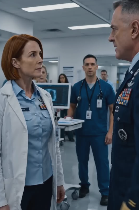
The conference room was completely silent.
A few moments earlier, everyone had been focused on Colonel Derek Stone kicking my chair.
Now nobody was looking at me.
They were staring at the screen.
The medical records specialist, Karen, slowly enlarged the file.
I stood up and walked closer.
The document was old.
Very old.
The date in the corner showed it had been created almost eight years earlier.
My stomach tightened.
The pilot’s name appeared at the top.
The same pilot whose flight status I had suspended that morning.
The room remained motionless.
Karen opened the attached records.
Lab reports.
Cardiology notes.
Specialist recommendations.
Then the key finding appeared.
A cardiac rhythm abnormality.
Not a minor one.
Not something that could simply be ignored.
A condition requiring ongoing monitoring.
A condition that could potentially cause sudden incapacitation.
Exactly the concern that had triggered my decision earlier that morning.
One physician beside me whispered:
“That’s impossible.”
But it wasn’t.
The records were right there.
The pilot’s condition had been identified years ago.
Yet somehow he had remained on flight status.
The room grew colder.
Then someone noticed something else.
The case wasn’t marked unresolved.
It was marked:
“Administrative review completed.”
Nobody understood.
Karen opened the approval section.
A signature appeared.
The room collectively inhaled.
Colonel Derek Stone.
Nobody spoke.
Derek’s face lost color.
The senior administrator quietly asked:
“Colonel, why is your signature on a medical disposition?”
Military regulations were clear.
Commanders could make operational decisions.
They could not overrule medical determinations.
Especially not without proper review.
Derek immediately straightened.
“There must be some mistake.”
But nobody sounded convinced.
The timestamp was valid.
The authorization code was valid.
And the digital audit trail confirmed the document was authentic.
For the first time all morning, Derek had no argument.
PART 3 – THE AUDIT TRAIL
The meeting ended immediately.
Not because anyone wanted it to.
Because it had to.
The discovery triggered mandatory reporting procedures.
Within an hour, inspectors from regional medical command were notified.
Within three hours, an investigation team was assembled.
By afternoon, they arrived at the facility.
The investigators weren’t interested in opinions.
They wanted records.
Every record.
I spent most of the day answering questions.
What had I found?
When had I found it?
What testing had been performed?
What regulations applied?
Everything was documented.
Everything matched.
By evening, the investigators began reviewing historical files.
That was when the second surprise appeared.
The pilot wasn’t the only case.
Another file surfaced.
Then another.
Then another.
All involved flight personnel.
All involved medical concerns requiring additional review.
And every file shared one thing in common.
The same approval signature.
Derek Stone.
The room became increasingly uncomfortable.
One investigator rubbed his forehead.
Another requested additional archives.
By midnight, they had identified seven separate cases.
Seven.
Too many to dismiss as an accident.
Too many to explain away.
And then they found something even worse.
Several physicians had originally recommended temporary grounding.
Those recommendations had disappeared from the final versions of the records.
Someone had altered the administrative routing process.
Someone with access.
Someone with authority.
Someone like Derek.
PART 4 – THE PILOT’S CONFESSION
Three days later, the grounded pilot requested a meeting.
His name was Major Evan Mercer.
A respected aviator.
Decorated.
Experienced.
Trusted.
He looked exhausted when he entered my office.
Older than he had appeared during the physical.
The strain showed in his eyes.
For a moment neither of us spoke.
Then he sat down.
“I need to tell you something.”
His voice was barely above a whisper.
I listened.
Evan stared at the floor.
“I knew.”
The words hit like a hammer.
He knew.
Not recently.
Not for a few months.
For years.
The room felt smaller.
Evan rubbed his face.
“I reported symptoms eight years ago.”
He paused.
“The doctors wanted more testing.”
I nodded.
That matched the records.
“But Derek told me not to worry.”
My pulse quickened.
Evan continued.
“He said we’d handle it internally.”
I already knew where this was heading.
And I hated it.
“He told me grounding me would hurt my career.”
Silence filled the office.
Evan’s voice cracked.
“I believed him.”
For years he had convinced himself everything was fine.
For years he flew missions.
For years he ignored warning signs.
Not because he wanted to endanger anyone.
Because he trusted someone who should have protected him.
The realization haunted both of us.
PART 5 – THE FLIGHT THAT ALMOST ENDED IN DISASTER
The investigation uncovered another hidden report.
This one was classified.
It described an incident from five years earlier.
An incident nobody in the room had ever heard about.
A transport aircraft flying through severe weather.
Nothing unusual.
Until halfway through the flight.
According to the report, the pilot experienced sudden dizziness.
Temporary visual disturbances.
Loss of situational awareness.
The co-pilot took control.
The crew recovered.
The aircraft landed safely.
The event was attributed to fatigue.
Case closed.
Or so everyone believed.
But investigators found medical notes attached to the original report.
Notes suggesting the symptoms might have been linked to the exact condition now under investigation.
The report had never reached flight medicine.
Someone stopped it.
Someone buried it.
When the investigators connected the dates, they discovered who had approved the final review.
Again.
Derek Stone.
The room went silent.
Because now this wasn’t merely paperwork.
This wasn’t merely policy violations.
People could have died.
Entire crews.
Entire aircraft.
For years.
PART 6 – THE HEARING
The formal hearing took place six weeks later.
The room was packed.
Command staff.
Medical officers.
Investigators.
Legal advisors.
Everyone wanted answers.
Derek entered wearing his uniform.
But the confidence was gone.
The evidence was overwhelming.
Digital records.
Witness testimony.
Medical files.
Audit logs.
Emails.
Years of decisions.
Years of shortcuts.
Years of ignored warnings.
One by one the witnesses testified.
Then my turn came.
I explained the examination.
The findings.
The regulations.
The suspension.
Everything.
No drama.
No exaggeration.
Just facts.
When I finished, the lead investigator asked a final question.
“Dr. Brooks, why did you refuse to reverse your determination?”
The room became still.
I looked directly at the panel.
“Because airplanes don’t care about rank.”
Nobody moved.
I continued.
“Medical standards exist because gravity treats everyone equally.”
Several people lowered their eyes.
The statement spread through the hearing room like a wave.
And for the first time, nobody argued.
PART 7 – THE SECRET INSIDE THE LETTER
A week after the hearing, I received an envelope.
No return address.
No official markings.
Inside was a handwritten letter.
From Derek Stone.
I stared at it for several minutes before opening it.
The first sentence surprised me.
“You were right.”
I kept reading.
The letter wasn’t defensive.
It wasn’t angry.
It wasn’t an attempt to justify anything.
Instead, it contained a confession.
Years earlier, Derek’s younger brother had lost his military career because of a medical disqualification.
The experience devastated him.
Their family never recovered.
Derek carried that resentment for years.
When pilots under his command faced medical problems, he viewed regulations as obstacles rather than safeguards.
He convinced himself he was protecting careers.
Protecting families.
Protecting futures.
Instead, he had created risk.
The final paragraph stopped me cold.
“I forgot that protecting lives must always come first.”
I folded the letter slowly.
For the first time, I understood how everything had happened.
Not because Derek was evil.
Because he allowed emotion to replace judgment.
And in aviation, that can be just as dangerous.
PART 8 – THE END
Three months later, winter settled across Alaska.
Snow covered the runways.
Aircraft continued launching into the frozen sky.
The mission continued.
The work continued.
But some things had changed.
The investigation resulted in major reforms.
Medical review procedures were strengthened.
Independent oversight increased.
Historical records were audited.
Dozens of cases were reexamined.
Most importantly, pilots began reporting medical concerns more openly.
The culture shifted.
Slowly.
But noticeably.
Major Evan Mercer completed treatment.
After extensive evaluation, he transitioned into a training and safety role.
He no longer flew operational missions.
Yet he became one of the strongest advocates for aviation safety in the command.
As for Derek Stone, his career ended quietly.
No dramatic headlines.
No public spectacle.
Just accountability.
The system finally corrected itself.
One morning, several months later, I stood near the flight line watching a transport aircraft climb into a bright Arctic sky.
The engines roared.
The aircraft disappeared into the clouds.
A young flight medic beside me asked a question.
“Do you ever regret grounding people?”
I thought about it.
The arguments.
The pressure.
The threats.
The chair crashing backward.
The investigation.
The lives that might have been lost.
Then I shook my head.
“No.”
The medic smiled.
I looked toward the horizon.
Toward the aircraft now invisible against the winter sunlight.
Medicine wasn’t about protecting careers.
It wasn’t about protecting reputations.
It wasn’t even about avoiding conflict.
It was about protecting people.
Sometimes that meant delivering news nobody wanted to hear.
Sometimes it meant standing alone in a room full of opposition.
And sometimes it meant refusing to bend when everyone else wanted you to.
The old file had exposed a secret hidden for nearly a decade.
It had uncovered mistakes.
Destroyed assumptions.
Ended careers.
But it had also prevented future tragedy.
And in aviation, there is no greater success than the accident that never happens.
Because the safest flight is often the one protected by a difficult decision made long before the aircraft ever leaves the ground.
