PART 2 — THE NAME IN THE FILE
The ballroom had become so silent that I could hear the faint hum of the stage lights.
The event coordinator stood frozen for a moment, staring at the final entry in the official record.
Then she slowly raised her eyes.
“Audrey Sinclair,” she said.
A murmur rippled through the room.
Audrey’s perfect posture cracked.
The coordinator swallowed.
“This entry shows that someone attempted to remove Mika Sato’s name from the Original Score archive at 8:14 this morning.”
Everyone stared.
The coordinator continued.
“The authorization request came from a Sinclair Foundation administrative account.”
The room exploded.
People began whispering.
Teachers exchanged shocked looks.
Sponsors shifted uncomfortably in their seats.
Phones rose higher.
For the first time all evening, Audrey looked afraid.
“No,” she snapped. “That’s impossible.”
The coordinator held up the document.
“The system recorded the request automatically.”
Audrey’s face drained of color.
Her father, seated in the front sponsor section, suddenly stood.
He looked far more alarmed than angry.
And that terrified me.
Because it meant he knew exactly how serious this was.
PART 3 — THE SCORE’S SECRET
The coordinator carefully turned another page.
A puzzled expression crossed her face.
Then she frowned.
“There’s something else.”
The room quieted again.
I watched her eyes scan the records.
Her expression changed from confusion to disbelief.
“What is it?” someone asked.
The coordinator looked toward the festival director.
“You need to see this.”
The director hurried over.
Together they studied the page.
Several seconds passed.
Then the director inhaled sharply.
“Oh my God.”
My stomach twisted.
Nobody knew what they had found.
Finally, the director faced the audience.
“The Original Score was never supposed to be part of tonight’s program.”
Confused whispers spread through the crowd.
He continued.
“It was discovered six months ago in storage beneath the old concert hall.”
That much I knew.
I had found it myself while organizing forgotten music archives.
But then he said something I didn’t know.
“The score is believed to have been written by a young composer whose work disappeared almost eighty years ago.”
The audience leaned forward.
“The composer was never identified.”
The room became silent.
Then the director looked directly at the Sinclair family.
“And according to these newly recovered records, the Sinclair Foundation knew that.”
Gasps erupted everywhere.
Audrey’s father looked like he had been punched.
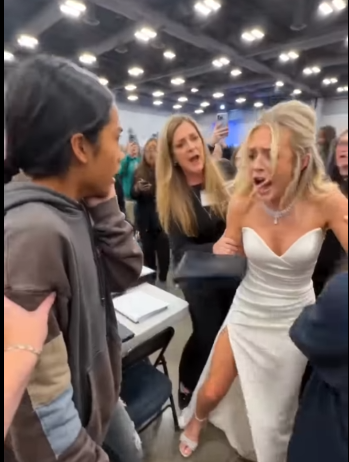
PART 4 — THE TRUTH HIDDEN FOR DECADES
The director continued reading.
The story emerging from the documents sounded impossible.
Eighty years earlier, a teenage immigrant musician named Kenji Sato had written a remarkable orchestral composition.
Before it could be performed publicly, the work vanished.
The young composer vanished from public records shortly afterward.
His music was forgotten.
Or so everyone believed.
The recovered documents revealed something different.
The original score had been quietly purchased decades ago by a wealthy benefactor.
That benefactor eventually became one of the founders of the Sinclair Foundation.
For years the organization possessed the score.
For years they knew who created it.
And for years they never acknowledged him.
The crowd stared at the Sinclair family.
The director’s voice trembled.
“The foundation was preparing to announce ownership of the discovery tonight.”
A collective gasp swept the ballroom.
Everyone suddenly understood.
The ceremony wasn’t just about recognition.
It was about money.
Prestige.
Media attention.
Control.
And I had accidentally become an obstacle.
Because I had found the records before they could disappear.
Then the director read the final line.
The entire room froze.
The composer, Kenji Sato…
…was my great-grandfather.
PART 5 — THE NIGHT EVERYTHING CHANGED
I couldn’t breathe.
My knees nearly gave out beneath me.
“What?”
The word escaped before I could stop it.
The director looked stunned.
“You didn’t know?”
I shook my head.
My grandmother had spoken very little about her father.
Only that he loved music.
Only that life had been unfair to him.
Nothing more.
The coordinator handed me the document.
There it was.
A photograph.
A signature.
A family registry.
Every piece matched.
Kenji Sato was family.
Tears blurred my vision.
Suddenly every hour I’d spent cataloging music felt different.
Every late afternoon in dusty archives.
Every weekend organizing forgotten boxes.
Every moment everyone ignored me.
It had somehow led here.
Across the room, Audrey looked completely lost.
For the first time, she wasn’t the center of attention.
For the first time, nobody cared about her designer gown.
Nobody cared about her family’s donations.
The room cared about the truth.
And the truth had finally arrived.
Then Audrey surprised everyone.
Including herself.
She began crying.
Real crying.
Not the polished tears of someone protecting an image.
The broken tears of someone watching her entire world collapse.
“My father told me it belonged to us,” she whispered.
Nobody answered.
Because suddenly the villain standing before us looked less powerful than trapped.
PART 6 — AUDREY’S CHOICE
The festival ended in chaos.
Reporters appeared.
Sponsors argued.
Board members held emergency meetings.
The Sinclair Foundation suspended several executives pending investigation.
By midnight, news of the discovery had spread across the city.
Yet the moment I remember most happened outside.
Alone.
Near the empty parking lot.
I sat on a bench clutching the copied records.
The cool night air felt unreal.
Footsteps approached.
I looked up.
Audrey.
For a moment neither of us spoke.
Then she sat down several feet away.
No cameras.
No audience.
No performance.
Just two exhausted teenagers.
“I’m sorry.”
The words were barely audible.
I stared at her.
She looked nothing like the confident girl from earlier.
She looked shattered.
“I thought everything belonged to us,” she admitted.
“I grew up hearing that.”
I remained silent.
Her eyes filled again.
“When I learned you were being honored tonight, I panicked.”
She laughed bitterly.
“That’s pathetic, isn’t it?”
I didn’t answer.
She looked down at her hands.
“My whole life was built around being important.”
The confession hung between us.
Then she whispered the sentence that changed everything.
“I don’t think I know who I am without that.”
For the first time, I saw something deeper than arrogance.
Fear.
Loneliness.
Pressure.
Generations of expectations.
It didn’t excuse what she had done.
But it explained it.
And sometimes understanding changes everything.
PART 7 — THE PERFORMANCE
Three months later, Salt Lake City gathered again.
This time for a different event.
A public performance of Kenji Sato’s restored composition.
The concert hall sold out.
Musicians traveled from across the state.
Historians attended.
Students filled entire balconies.
Backstage, my hands shook.
The conductor smiled.
“Nervous?”
“A little.”
“You should be proud.”
I glanced toward the audience.
My grandmother sat in the front row.
Tears already shining in her eyes.
Beside her was an empty seat reserved for the composer’s family.
For decades nobody knew who belonged there.
Now we did.
The lights dimmed.
Silence fell.
The conductor raised the baton.
Then the music began.
The opening notes floated through the hall like a voice returning after eighty years of silence.
Beautiful.
Powerful.
Alive.
My chest tightened.
Around me people listened without moving.
The melody grew.
Strings soared.
Brass answered.
The composition felt less like music and more like a message carried across generations.
A forgotten young composer speaking at last.
When the final note faded, nobody moved.
For one long heartbeat the hall remained silent.
Then the audience rose as one.
The standing ovation seemed endless.
My grandmother buried her face in her hands and cried.
And so did I.
PART 8 — THE END
Six months later, another surprise arrived.
A letter.
Not from a lawyer.
Not from a reporter.
From Audrey.
Inside was a handwritten note.
No public statement.
No publicity campaign.
Just honesty.
She wrote that she had spent months learning the truth about her family’s history.
She wrote that she had resigned from several ceremonial positions she never truly wanted.
She wrote that she had begun volunteering at community music programs.
Then she wrote something unexpected.
“Thank you for not becoming what I became.”
I read that sentence several times.
Because I understood what she meant.
Bitterness would have been easy.
Hatred would have been easy.
Revenge would have been easy.
But none of those things would have honored Kenji Sato.
Months later, the city unveiled a permanent exhibit dedicated to forgotten young artists.
At its center stood the restored Original Score.
Beneath it was a plaque.
Not with the Sinclair name.
Not with a sponsor logo.
But with the name of the young composer who had finally been remembered.
And beside it was another inscription.
A smaller one.
It honored the student who had discovered the truth.
The first time I saw it, I laughed through tears.
Because for years I had wanted one simple thing.
One clean moment.
One moment where my name was spoken without pity.
Now it stood there permanently.
Not because someone powerful gave it to me.
Not because someone felt sorry for me.
But because I earned it.
As visitors walked through the exhibit, they learned about Kenji Sato.
They learned about perseverance.
They learned about truth.
And every so often, I would watch strangers stop in front of the plaque and quietly read my name.
Mika Sato.
No whispers.
No doubt.
No humiliation.
Only respect.
The slap that was meant to erase me had done the opposite.
It had uncovered a buried history, exposed a powerful lie, reunited a family with its lost legacy, and given a forgotten composer the audience he deserved.
And in the most unexpected twist of all…
it gave two girls a chance to become better than the stories they had inherited.
The score survived.
The truth survived.
And so did we.
