PART 2 — THE NAME IN THE FILE
The entire auditorium seemed to stop breathing.
The coordinator’s hand trembled slightly as she held up the document.
Everyone could see it.
Everyone.
The record clearly showed my name beside every field entry, every sound sample, every late-night report I had uploaded during the project.
But it was the final page that changed everything.
The coordinator slowly read it aloud.
“Administrative modification request submitted at 8:14 a.m.”
A murmur spread through the room.
Then she continued.
“Request: Remove contributor Rafaela Souza from official recognition materials.”
The silence became heavier.
I stared at Serena.
For the first time all evening, her confidence cracked.
The coordinator swallowed.
“Requested by…” she paused.
Every camera pointed toward the stage.
“…Blackwood Foundation Representative.”
Gasps erupted.
Several teachers exchanged stunned looks.
A sponsor nearly dropped his phone.
Serena’s face turned white.
“No,” she said quickly. “That doesn’t prove anything.”
The coordinator looked again.
“It includes a digital authorization code.”
Serena shook her head.
“My family has dozens of employees.”
But nobody seemed convinced.
Because beneath the request was another detail.
The authorization had been submitted using a private sponsor terminal accessible only to three people.
One of them was Serena Blackwood.
The room exploded with whispers.
For years, people had treated the Blackwoods like royalty.
Now everyone was seeing something they had never expected.
Fear.
Fear on Serena’s face.
And it terrified her.
PART 3 — THE RECORDINGS
Principal Harris stepped onto the stage.
“Everyone calm down.”
But calm was impossible.
The project had become the biggest educational initiative in Portland that year.
Sponsors had invested thousands.
Local news stations were present.
And now allegations of sabotage were unfolding live.
Serena straightened her shoulders.
“You all believe her?” she snapped.
Her voice cut through the noise.
“She’s acting like she built everything herself.”
My hands shook.
For months I had stayed silent.
For months I had accepted being ignored.
But something inside me finally broke.
“No,” I said.
The room quieted.
“I never said I built everything.”
People turned toward me.
“I said I did my part.”
My voice grew stronger.
“I spent six months collecting data before sunrise.”
I pointed toward the display.
“I walked through rainstorms recording sound pollution.”
Another breath.
“I skipped weekends.”
Another.
“I missed birthday parties.”
Another.
“And every report I submitted is right there.”
Nobody interrupted.
Because they knew it was true.
The records existed.
The timestamps existed.
The evidence existed.
Then one of the science teachers stepped forward.
Mrs. Ortega.
She looked furious.
“Actually,” she said, “Rafaela is being modest.”
I blinked.
Mrs. Ortega continued.
“The sound chart everyone is discussing?”
She pointed toward the display.
“That chart wouldn’t exist without her.”
More whispers.
Serena looked horrified.
“What?”
Mrs. Ortega nodded.
“The mapping algorithm failed repeatedly.”
She turned toward the audience.
“Rafaela redesigned the categorization system herself.”
Now people were openly staring.
Several sponsors began flipping through project documents.
Serena looked trapped.
Then she made a mistake.
A terrible mistake.
She laughed.
A sharp, ugly laugh.
And in that moment everyone saw exactly who she was.
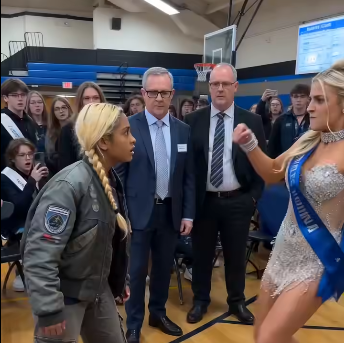
PART 4 — THE SECRET EVERYONE MISSED
“I don’t care,” Serena said.
The words echoed through the auditorium.
A collective gasp followed.
Even her own family’s representatives looked uncomfortable.
Then Serena crossed her arms.
“My family paid for this project.”
There it was.
The truth.
Not evidence.
Not merit.
Ownership.
She believed money created achievement.
She believed sponsorship erased effort.
She believed wealth entitled her to recognition.
The cameras captured every second.
Then something unexpected happened.
A man stood from the sponsor section.
I recognized him instantly.
Victor Blackwood.
Serena’s father.
The head of the Blackwood Foundation.
One of the wealthiest men in the state.
He looked furious.
But not at me.
At Serena.
The entire room watched as he walked toward the stage.
Serena suddenly looked nervous.
“Dad—”
“Stop.”
One word.
Ice cold.
She froze.
Victor looked at the coordinator.
“Show me the records.”
The documents were handed over.
He read silently.
Then read again.
Then a third time.
His expression darkened.
Finally he lifted his eyes.
“Did you do this?”
Serena’s voice cracked.
“Dad, I was protecting our reputation.”
The answer was enough.
The color drained from his face.
Because she had effectively confessed.
The cameras caught everything.
Every second.
Every word.
Every expression.
The damage was already irreversible.
But nobody realized the biggest revelation was still coming.
PART 5 — THE BOX UNDER THE TABLE
As chaos spread across the auditorium, one of the student volunteers approached the stage.
She carried a cardboard archive box.
“Excuse me,” she said quietly.
Everyone turned.
The volunteer looked nervous.
“I found this in the storage room.”
The coordinator frowned.
“What is it?”
“It was labeled for disposal.”
Something about those words made my stomach tighten.
The box was placed on the table.
Inside were dozens of printed reports.
Folders.
Field notes.
Audio logs.
My audio logs.
The coordinator opened one.
Then another.
Then another.
Every document belonged to me.
Months of work.
Months of evidence.
Months of contributions.
All marked for destruction.
The audience erupted again.
Someone had not merely tried to remove my name.
Someone had tried to erase proof I had ever participated.
The realization sent chills through the room.
Victor Blackwood looked stunned.
“Who authorized this?”
Nobody answered.
Then the volunteer pointed.
“There was a signature.”
The coordinator found the page.
Her eyes widened.
The signature belonged to a foundation employee.
One directly assigned to Serena.
A journalist near the front row immediately raised her camera.
Flash.
Flash.
Flash.
The story had just become national-news material.
And Serena knew it.
She looked around desperately.
For the first time, there was nowhere left to hide.
PART 6 — THE TRUTH ABOUT THE DISCOVERY
The evening should have ended there.
But fate had one more surprise waiting.
Mrs. Ortega requested permission to play an audio file.
The principal agreed.
The lights dimmed.
A speaker crackled.
At first it sounded ordinary.
Birdsong.
Wind.
Distant traffic.
Then a strange rhythmic pattern emerged.
The audience leaned forward.
That sound had become the centerpiece of the entire project.
The sound nobody could identify.
The sound that led to the quiet-zone initiative.
The sound that revealed hidden environmental interference across several neighborhoods.
The discovery that made the project famous.
Mrs. Ortega smiled gently.
“Most people know the result.”
She looked at me.
“Few know how it happened.”
A screen illuminated behind us.
Photographs appeared.
Image after image.
Me standing alone at dawn.
Me carrying recording equipment.
Me taking measurements.
Me entering data.
Me repairing damaged sensors.
The room watched in silence.
Mrs. Ortega continued.
“Rafaela recorded this sound after noticing an anomaly everyone else ignored.”
More photographs appeared.
“The discovery happened because she refused to stop asking questions.”
I felt tears burning behind my eyes.
Nobody had ever said those things publicly.
Nobody.
For years I had been invisible.
Now hundreds of people were hearing the truth.
And they were hearing it from someone who had witnessed every step.
When the presentation ended, the auditorium stood.
Not some people.
All of them.
The applause hit me like a wave.
A standing ovation.
For me.
For the first time in my life.
I nearly cried.
PART 7 — THE FALL OF A DYNASTY
The next morning everything exploded.
Videos spread across social media.
News stations replayed Serena’s confrontation.
Commentators discussed favoritism and privilege.
Interviews appeared online.
Articles multiplied by the hour.
The Blackwood Foundation released a statement.
Then another.
Then a third.
Each one attempting damage control.
But the evidence was overwhelming.
Within days the employee responsible for the deletion request was terminated.
An internal investigation began.
Several board members demanded accountability.
And Serena vanished from public view.
Rumors spread everywhere.
Some claimed she had been expelled.
Others claimed she had transferred schools.
Most stories were false.
The truth was simpler.
She had finally encountered consequences.
Meanwhile, my life changed in ways I never expected.
Teachers who barely knew my name suddenly stopped me in the hall.
Students congratulated me.
Researchers contacted the school.
Environmental organizations requested copies of the data.
Then came the email.
The one that changed everything.
I opened it three times because I thought it was fake.
A university research program had reviewed my work.
Not because of the scandal.
Because of the data.
Because of the discovery.
Because of the methodology.
Because the work itself was impressive.
I stared at the screen for nearly an hour.
Then I cried.
Not from sadness.
Not from relief.
From disbelief.
For years I had wondered whether hard work mattered.
Now I was finally seeing an answer.
PART 8 — THE END
Three months later, I returned to the same auditorium.
The room looked different.
Or maybe I did.
My jacket was still old.
My sneakers were still worn.
My braid was the same.
I hadn’t magically become wealthy.
I hadn’t become famous.
But something fundamental had changed.
I no longer felt invisible.
The ceremony that day was smaller.
Quieter.
No sponsors dominating the stage.
No extravagant displays.
Just students.
Teachers.
Families.
And honest recognition.
Principal Harris approached the podium.
“We have one final announcement.”
I felt a strange nervousness.
The audience waited.
He smiled.
“Due to her contributions to environmental acoustic research, exceptional academic achievement, and leadership under extraordinary circumstances…”
My heart began pounding.
“…Rafaela Souza has been awarded the Northwest Innovation Scholarship.”
For a second I couldn’t move.
Then applause filled the room.
My mother burst into tears.
I heard her before I saw her.
She was standing in the third row, crying and laughing at the same time.
The sight nearly broke me.
Because she had sacrificed everything.
Long work hours.
Missed sleep.
Endless worry.
And now she was watching her daughter receive something neither of us had dared imagine.
I walked to the stage.
This time nobody blocked my path.
Nobody shoved me.
Nobody questioned whether I belonged.
When I accepted the award, I looked out across the audience.
Hundreds of faces stared back.
Then I noticed someone near the rear exit.
A familiar figure.
Serena.
She stood quietly in the shadows.
No cameras surrounded her.
No attention followed her.
For a moment our eyes met.
I expected anger.
Bitterness.
Resentment.
Instead I saw something surprising.
Regret.
Real regret.
She hesitated.
Then gave a small nod.
Not a friendly one.
Not an apology.
Just an acknowledgment.
A recognition of reality.
The spotlight had never belonged to her.
It had never belonged to her family.
It belonged to the truth.
A second later she turned and left.
I never saw her again.
Years later, people would remember the scandal.
They would remember the videos.
They would remember the confrontation.
But that wasn’t the moment that stayed with me.
The moment I remembered most happened afterward.
Long after the cameras disappeared.
Long after the headlines faded.
Long after everyone stopped talking.
I kept the original sound chart.
The first version.
The one covered in notes, corrections, coffee stains, and muddy fingerprints.
Whenever life became difficult, I looked at it.
Not because it proved I was right.
Not because it proved someone else was wrong.
Because it reminded me of something far more important.
The truth can be delayed.
The truth can be buried.
The truth can be ignored.
But when evidence stands beside integrity, the truth eventually finds its voice.
And sometimes…
the quietest person in the room becomes the one nobody can silence.
