PART 2 — THE NAME IN THE FILE
The room did not breathe.
Not the teachers. Not the sponsors. Not the students holding phones above their heads like witnesses at a trial. Not even Audrey Sinclair, who only seconds earlier had looked powerful enough to bend the whole ceremony around her.
The event coordinator, Mrs. Lillian Rowe, held the file in both hands as if it had suddenly become heavier than paper.
Her eyes moved over the entry once.
Then again.
Then she looked up.
“The attempted removal request was made at 7:42 this morning,” she said, her voice sharp enough to cut through the marble lobby.
Audrey’s father, Charles Sinclair, stepped forward immediately. He was tall, silver-haired, wearing a black suit that probably cost more than my mother’s car. His expression was calm, but his jaw was tight.
“Lillian,” he said, “this is not the proper place.”
Mrs. Rowe did not lower the file.
That was when I understood something terrifying.
The name in that file mattered more than Audrey’s slap.
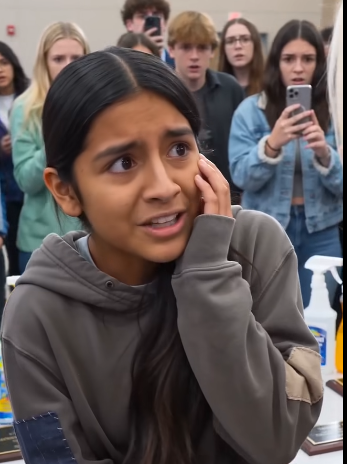
My cheek still burned. I could feel the outline of her hand across my skin, hot and humiliating, but the pain had become distant. Everyone had seen her hit me. Everyone had heard her lie. But this—this was something planned before the ceremony, before the cameras, before she leaned into my ear and told me I did not belong.
Someone had tried to erase me before I even arrived.
Mrs. Rowe turned the file slightly, as if she wanted the front row to see without handing over the record.
“The request came from an authorized administrative terminal,” she said.
Principal Harrow, who had been standing near the podium with a frozen smile, suddenly looked ill.
Audrey’s eyes darted to him.
It was fast. Too fast for most people to catch.
But I saw it.
So did Mrs. Rowe.
“Principal Harrow?” she asked.
He cleared his throat. “There must be a misunderstanding.”
Audrey found her voice again, but it trembled now. “This is ridiculous. You are all embarrassing my family because of some janitor girl’s mistake.”
Janitor girl.
The words hit harder than the slap.
A sound moved through the crowd—not laughter this time, but discomfort. Some students lowered their phones. Others lifted them higher. I saw my art teacher, Mr. Bell, staring at Audrey as if she had become a stranger in front of him.
I wanted to speak. I wanted to say I was not a janitor, that cleaning the stones had been part of the restoration process, that someone had to remove the chemical residue before the engraving could be inspected. I wanted to explain every evening I stayed late, every name I polished until my fingers cracked, every old record I matched by hand when the system failed.
But my throat was still locked.
Mrs. Rowe spoke for me.
“Marisol Vega was not hired to clean floors,” she said. “She volunteered more than one hundred and forty hours to restore, verify, and document the memorial stones.”
One hundred and forty hours.
I had not known anyone counted.
My eyes stung.
Audrey’s face twisted. “My family funded this entire event.”
“And Marisol saved it,” Mrs. Rowe replied.
That sentence changed the room.
I felt it happen.
The sponsors looked at me differently. The teachers straightened. The students stopped whispering like I was entertainment and began watching like something important was unfolding.
Principal Harrow took one step toward Mrs. Rowe. “Lillian, close the folder.”
“No,” she said.
The word rang like a bell.
Charles Sinclair’s polite mask slipped. “You are making a mistake.”
Mrs. Rowe looked at him, then at Audrey, then at me.
“No,” she said again. “The mistake was thinking this child had no one watching the records.”
A chill ran down my spine.
Because she had said child with a tenderness that almost broke me.
I had spent the whole year trying to be invisible enough not to be mocked, useful enough not to be dismissed, grateful enough not to be called bitter. I had swallowed comments about my shoes, my lunch, my mother’s accent, my scholarship, my old hoodie, my patched sleeves.
I had learned how to make myself smaller.
But standing there under chandelier light, with my cheek burning and my name inside that file, I suddenly understood the truth.
They had not hated me because I was small.
They had hated me because I had refused to disappear.
PART 3 — THE STONE THAT SHOULD NOT EXIST
Mrs. Rowe placed the test engraving on the display table.
It was a flat gray stone, no bigger than a notebook, with practice cuts across its surface. At first glance, it looked ordinary. To anyone else, maybe even ugly.
But to me, it was the beginning.
Three months earlier, I had found it behind stacked boxes in the old maintenance room, covered in dust and old tape. It had not been part of the new memorial design. It had been a practice stone from the first campus memorial, decades ago, used to test depth, spacing, and tool pressure.
Across its face were fragments of names.
Not full names.
Just beginnings.
“ALV—”
“ROSA—”
“M. VE—”
The last one had made my heart stop.
M. VE.
My last name began with those letters.
At first I thought it was coincidence.
Then I found the old handwritten ledger.
That was how everything started.
Mrs. Rowe tapped the stone gently. “This test engraving led Marisol to a missing entry in the historical memorial list.”
The crowd shifted.
Audrey looked confused now, not just afraid.
Principal Harrow looked worse.
I finally forced air into my lungs.
“There was a student missing,” I said.
My voice came out small, but the microphone near the podium caught it.
Mrs. Rowe turned toward me. “Go on, Marisol.”
I swallowed. My cheek throbbed. My hands shook. But the room was listening now, and something inside me knew that if I did not speak at this moment, someone else would steal even my silence.
“There were thirty-two names on the original memorial,” I said. “But the student newspaper archive said thirty-three students were honored after the accident.”
Mr. Bell stepped closer, his eyes wide. “You found another name?”
I nodded.
Audrey laughed suddenly. It was a sharp, desperate sound. “This is absurd. She is making herself part of some dramatic mystery now?”
I looked at her.
For the first time that night, I did not look away.
“No,” I said. “I found a student named Rosa Elena Vega.”
The room seemed to tilt.
My mother’s name was Elena.
My grandmother’s name had been Rosa.
And Vega was ours.
Charles Sinclair went very still.
Principal Harrow whispered, “Don’t.”
But it was too late.
Mrs. Rowe opened the second folder, the one I had never seen before. She removed a yellowed copy of an old school newspaper and held it up.
“Rosa Elena Vega,” she read, “seventeen years old, scholarship student, member of the campus design program, remembered for her work on the original memorial garden.”
My heartbeat became thunder.
I had found Rosa’s name, but I had not known all of that.
Scholarship student.
Seventeen.
Design program.
Like me.
Mrs. Rowe looked at me with eyes full of something I could not name. “Marisol, your grandmother was not only supposed to be honored by the memorial. She helped design it.”
The lobby blurred.
“My grandmother?” I whispered.
I had known my abuela only through stories. She died before I was born. My mother rarely spoke about her school years, only that Abuela Rosa had been brilliant, stubborn, and “too proud for people who wanted her humble.”
No one had ever told me she was connected to this campus.
No one had ever told me her name had been removed.
Audrey’s voice dropped low. “That is impossible.”
Mrs. Rowe faced her. “Why?”
Audrey’s lips parted.
She had no answer.
Then Charles Sinclair said the sentence that made every camera turn toward him.
“Because that name was removed for a reason.”
Gasps broke across the room.
Mrs. Rowe’s face hardened. “And what reason would that be, Mr. Sinclair?”
Charles looked around and realized too late what he had admitted.
Principal Harrow closed his eyes.
Audrey whispered, “Dad.”
But he was already trapped by his own arrogance.
“My grandfather chaired the original memorial board,” Charles said carefully. “There were disputes. Old disputes. Families agreed to certain changes.”
“My family did not agree,” I said.
I did not know how I knew it, but I did.
My mother would have told me if our family agreed to erase Abuela Rosa. Someone would have carried that shame differently. Instead, there had always been a hole in our stories, a place where adults stopped talking.
Charles looked at me the way rich men look at locked doors that should have opened for them.
“You do not understand history,” he said.
I stepped closer to the test engraving.
“No,” I said. “I understand erasure.”
PART 4 — MY MOTHER ARRIVES
The lobby doors opened with a burst of cold Utah evening air.
Everyone turned.
My mother stood at the entrance in her nurse scrubs, her dark curls pulled into a tired bun, her work badge still clipped to her pocket. She must have run from the parking lot, because she was breathing hard.
“Marisol?”
Her voice cracked on my name.
The moment I saw her, I stopped being brave.
I was seventeen again. Hurt. Shaking. Humiliated in front of everyone. My cheek red from Audrey’s hand.
“Mamá,” I whispered.
She crossed the lobby so fast that people stepped aside without thinking. When she reached me, her hands went to my face. Her thumb hovered near the mark on my cheek.
“Who did this?”
No one answered.
My mother turned slowly.
Audrey flinched before my mother even looked at her.
“You hit my daughter?” my mother asked.
Audrey lifted her chin, but the confidence was gone. “She caused a scene.”
My mother laughed once, cold and disbelieving. “No. You caused a scene. My daughter survived it.”
Then my mother saw the test engraving.
Her entire body changed.
She stared at the stone like it was a ghost.
“Where did you find that?” she asked.
“In the maintenance room,” I said.
Her eyes filled with tears.
Mrs. Rowe stepped closer. “Elena, did you know Rosa Vega worked on the original memorial?”
My mother pressed a hand to her mouth.
For a moment, she looked like she might deny it. Not because it was false, but because saying it aloud hurt too much.
“My mother loved this school,” she said quietly. “She won a design scholarship here. She made sketches for the first memorial garden after the bus accident. But after she reported missing funds from the project, everything changed.”
Charles Sinclair’s face turned gray.
Principal Harrow lowered his head.
The crowd was no longer a crowd. It was a jury.
My mother continued, her voice trembling but clear. “Rosa said the sponsor board had taken money meant for student materials. She had copies. Then suddenly, her scholarship was revoked. Her design credit vanished. Her name was removed from the memorial records.”
Mrs. Rowe looked at Charles. “Your grandfather chaired that board.”
“My grandfather is dead,” Charles snapped.
“But the foundation still carries his name,” my mother said. “And your family still benefits from pretending he was honorable.”
A silence followed so deep I could hear someone crying near the back.
Audrey looked at her father with horror. I think it was the first time she had ever seen the family name as something other than armor.
Then my mother turned to Principal Harrow.
“And you,” she said.
He stiffened.
“You knew,” she said. “When Marisol was admitted on scholarship, you knew exactly who she was.”
Principal Harrow did not deny it.
My stomach dropped.
“You knew?” I asked.
He looked at me, and for one terrible second, I saw not cruelty, but shame. Weak shame. Cowardly shame.
“The Sinclair Foundation is one of our largest donors,” he said.
My mother’s voice went deadly quiet. “So you let my daughter restore a memorial that erased her own grandmother?”
He could not meet her eyes.
Mrs. Rowe lifted the record again. “And this morning, someone used an administrative login to remove Marisol’s name from the unveiling file.”
Principal Harrow’s mouth trembled.
Charles Sinclair said, “Be careful.”
The principal looked at him.
Something passed between them—fear, history, dependency.
Then Principal Harrow broke.
“The request came from my office,” he said.
The room erupted.
Audrey whispered, “No.”
But Principal Harrow was staring at the floor now, defeated by truth.
“I was told the Sinclair family would withdraw funding if Marisol Vega’s connection to the memorial became public.”
My mother gripped my hand so tightly it hurt.
Charles shouted, “That is a lie.”
But the phones were still recording.
Every word.
Every face.
Every collapse of the perfect Sinclair image.
For the first time all night, Audrey Sinclair looked small.
PART 5 — AUDREY’S SECOND LIE
Security moved closer, but Mrs. Rowe lifted a hand.
“No one leaves,” she said.
Audrey’s eyes flashed. “You cannot keep us here.”
“No,” Mrs. Rowe replied. “But the truth can.”
Audrey looked around wildly, searching for rescue in faces that had always opened for her. Sponsors. Teachers. Students. Her father. The principal.
No one stepped forward.
So she did what desperate people do when the first lie burns down.
She built another one from the ashes.
“I did it for the school,” Audrey said suddenly.
Everyone stared.
She touched her diamond necklace, fingers trembling. “You all act like I’m some monster, but this ceremony mattered. My family made it possible. We brought donors, press, opportunities. And then she—” Audrey pointed at me, “—she was going to turn it into some personal sob story about her grandmother.”
I felt my mother stiffen beside me.
Audrey’s voice rose. “I was protecting the event.”
“You slapped me,” I said.
Her eyes snapped to mine.
I do not know what she saw in me then. Maybe not fear. Maybe that was what frightened her most.
“You were going to ruin everything,” she said.
“No,” I replied. “I was going to unveil a plaque.”
That simple sentence seemed to hum through the room.
Audrey’s face crumpled, but only for a second. Then anger hardened it again.
“You have no idea what pressure is,” she said. “Everyone expects me to be perfect. Everyone expects my family to lead. Do you know what it feels like to have your whole name judged?”
I looked at her gown, her diamonds, the reporters who had come because her family invited them, the principal who had risked his career for her father, the sponsors who had treated her like royalty.
Then I looked down at my patched sleeves.
“Yes,” I said softly. “I do.”
Audrey had no reply.
Mrs. Rowe closed the folder. “The ceremony will continue.”
Charles Sinclair barked a laugh. “You cannot be serious.”
“I am completely serious,” she said. “This memorial belongs to the students. Not to donors. Not to family reputations. Not to old lies.”
She turned to me.
“Marisol, will you still unveil it?”
My whole body went cold.
I wanted to say no.
I wanted to go home. To sit at our kitchen table while my mother pressed ice to my cheek. To hide under blankets and pretend strangers had not watched me be slapped, insulted, exposed, and dragged into a buried scandal.
But then I looked at the test engraving.
M. VE.
A broken beginning.
A name nearly lost.
My grandmother had once stood where I stood, young and brown and brilliant, believing work could speak for itself. Then powerful people had stolen her credit, buried her name, and waited for time to make the theft look like history.
I thought of all the evenings I had stayed after school, rubbing dust from engraved letters while my classmates went to coffee shops and parties. I thought I had been cleaning stone.
But maybe I had been listening.
Maybe the names had been waiting for someone with hands patient enough to find them.
I squeezed my mother’s hand.
“Yes,” I said.
My mother began to cry.
Mrs. Rowe nodded toward the covered plaque.
The original silk cloth still hung over it, gold and blue under the lights. I walked toward it slowly. Every step felt impossible. My cheek burned. My knees shook. Phones followed me. Cameras clicked.
Audrey stood frozen near the front, her father behind her like a crumbling statue.
At the plaque, I reached for the cloth.
Then Mrs. Rowe stopped me.
“Before you unveil it,” she said, “there is one correction.”
She opened a small velvet case.
Inside was a narrow brass strip.
My breath caught.
Freshly engraved across it were the words:
ROSA ELENA VEGA — STUDENT DESIGNER, SCHOLAR, AND RESTORED HONOREE
My mother made a sound like her heart had cracked open.
Mrs. Rowe looked at me. “We verified the archives this afternoon. I had hoped to tell you privately after the ceremony. But perhaps public truth is exactly what this moment needs.”
I touched the brass strip with shaking fingers.
It was real.
After decades of silence, my grandmother’s name had weight again.
PART 6 — THE UNVEILING
I lifted the cloth.
The plaque shone beneath the lights, dark bronze and newly polished, engraved with rows of student names. The lobby lights reflected across the letters like water.
For a second, no one clapped.
Everyone simply looked.
Then my mother stepped forward and pressed the brass strip into its place at the bottom of the memorial.
It clicked softly.
Such a small sound.
Yet it felt louder than Audrey’s slap.
Rosa Elena Vega had returned.
The applause began in the back.
One student. Then another. Then Mr. Bell. Then the teachers. Soon the entire lobby filled with thunder.
My mother hugged me so tightly I could barely breathe. I buried my face in her shoulder, smelling hospital soap and winter air, and I cried in front of everyone. Not graceful tears. Not movie tears. Real ones. The kind that shake loose everything you tried to survive quietly.
“I’m sorry,” she whispered into my hair.
“For what?” I sobbed.
“For not telling you.”
I pulled back. “Why didn’t you?”
She wiped my face with her thumbs. “Because I thought silence would protect you. I thought if we stayed away from the past, it couldn’t hurt us again.”
I looked at Audrey.
She was crying too, but no one was comforting her.
My mother followed my gaze. “Silence never protects the people who were harmed,” she said. “It only protects the people who harmed them.”
Mrs. Rowe approached us. Her professional calm had cracked; her eyes were wet.
“Marisol,” she said, “there is something else.”
I almost laughed through my tears. “More?”
“A good more,” she said.
The sponsors shifted nervously. Charles Sinclair looked ready to explode.
Mrs. Rowe faced the room. “The state arts council representative is here tonight.”
A woman in a navy suit raised her hand slightly from the second row.
Mrs. Rowe continued, “After reviewing Marisol’s restoration documentation, archival research, and engraving work, the council has decided to offer her a summer fellowship in historical preservation.”
I stared at her.
“What?”
Mr. Bell grinned. “You earned it.”
The woman in navy stepped forward. “Your work showed unusual patience, technical skill, and historical instinct. We would be honored to have you.”
Honored.
The word seemed impossible.
All year, I had been treated like someone lucky to be allowed near beautiful things. Now someone was saying my hands had made something beautiful enough to matter.
Audrey suddenly stepped toward me.
Security moved, but she stopped several feet away. Her mascara had streaked down her cheeks. Without her perfect expression, she looked younger. Still proud. Still wounded. But frightened too.
“I didn’t know about your grandmother,” she said.
I said nothing.
“I didn’t,” she repeated, as if that erased anything.
My mother’s hand rested on my shoulder.
Audrey swallowed. “But I knew about the file.”
The applause died.
Her father turned on her. “Audrey.”
She flinched, but kept looking at me.
“I asked Principal Harrow to remove your name,” she said. “I told him my father wanted it done.”
Charles grabbed her arm. “Stop speaking.”
She pulled away from him.
For the first time that night, Audrey Sinclair disobeyed the person who had taught her power.
“I thought if my name was attached to the unveiling, people would finally see me as more than my family’s daughter,” she said. “But then they chose you, and I hated you for it.”
Her voice broke.
“Because you had nothing, and somehow you still had something I didn’t.”
I looked at her diamond necklace.
“What?”
Audrey whispered, “A reason.”
The room was silent again, but different now. Less hungry. More human.
I wanted to hate her completely. Part of me did. Part of me always would remember her hand across my face, her voice calling me a pity choice, her attempt to erase my name.
But another part of me saw the cage behind her diamonds.
That did not excuse her.
It only explained why cruelty sometimes wears expensive shoes.
PART 7 — THE OFFER THAT CHANGED EVERYTHING
The next week was chaos.
The video spread through the school first, then through local news, then farther than any of us expected. People called it “The Memorial Slap.” Others called it “The Vega File.”
I hated both names.
I was not a slap. I was not a file.
I was a person.
The Sinclair Foundation announced a “temporary review of historical giving practices,” which sounded to me like rich people trying to say sorry without bending their knees. Principal Harrow resigned three days after the ceremony. Mrs. Rowe was appointed interim head of student affairs.
Audrey disappeared from school.
Some students said she had transferred. Others said her father sent her away. I did not ask.
For a while, I enjoyed the quiet.
Then a letter arrived.
Not an email.
A real letter on thick cream paper, addressed to me in careful handwriting.
I opened it at our kitchen table while my mother made coffee.
Marisol,
I do not expect forgiveness.
I am writing because my mother found boxes in our storage room after the ceremony. They belonged to my great-grandfather. Inside were documents about the original memorial. There are sketches signed by Rosa Elena Vega.
There are also letters.
One is addressed to Elena Vega.
My mother says my father knew about the boxes.
I am leaving them with Mrs. Rowe.
Audrey
My hands began to shake.
My mother read over my shoulder and dropped into the chair beside me.
“Letters?” she whispered.
We went to campus that afternoon.
Mrs. Rowe met us in the archive room. On the table sat three brown boxes, dusty and tied with old string. My mother stood frozen in the doorway.
“You do not have to open them today,” Mrs. Rowe said gently.
My mother shook her head. “Yes, I do.”
Inside were sketches.
Beautiful sketches.
The original memorial garden had not been designed as the cold stone courtyard it became. Rosa had imagined curved paths, wildflowers, benches under trees, and engraved stones placed low enough for children to touch.
In the corner of one drawing, she had written:
A memorial should not make grief stand at attention. It should give grief somewhere to sit.
My mother covered her mouth.
Then we found the letter.
It was yellowed, sealed, and addressed in my grandmother’s handwriting.
To my Elena, when you are old enough to ask why.
My mother’s hands trembled so badly that I opened it for her.
The letter was not long.
Rosa wrote that she had been threatened after reporting the missing funds. She wrote that she was afraid the school would destroy her records. She wrote that if her name disappeared, she wanted her daughter to know one thing:
“They can remove letters from stone, mi amor, but they cannot remove truth from blood.”
My mother broke.
She pressed the letter to her chest and sobbed like a child who had finally heard her mother call her name after years in the dark.
I held her.
Mrs. Rowe cried quietly by the shelves.
That should have been the ending.
But life rarely ends at the moment that feels most poetic.
Two days later, I received another message.
This one was from Audrey.
Please meet me at the memorial garden. Alone. I found something else.
My mother said absolutely not.
Mrs. Rowe said she would come with me and stay nearby.
I agreed because curiosity is sometimes stronger than fear.
Audrey was waiting near the newly restored plaque, wearing jeans and a plain sweater. Without the gown, without diamonds, without her entourage, she looked like someone trying to learn how to stand without a pedestal.
On the bench beside her was a small metal box.
“My great-grandfather kept this locked,” she said. “My father didn’t know I had the key.”
I did not move closer.
“What is it?”
Audrey opened the box.
Inside was an old medal, tarnished but intact. A student design award.
Engraved on the back:
ROSA ELENA VEGA — FIRST PLACE, MEMORIAL DESIGN COMPETITION
I stopped breathing.
Audrey’s eyes filled. “Your grandmother didn’t just help design it.”
She placed the medal in my palm.
“She won.”
PART 8 — THE END: THE GARDEN THAT FINALLY BLOOMED
One year later, the memorial garden looked nothing like the place where Audrey Sinclair slapped me.
That lobby still existed. The bronze plaque still hung there. But beyond it, through the glass doors and down the stone steps, Rosa Elena Vega’s true design had finally been built.
Curved paths. Wildflowers. Benches beneath young trees. Low stones engraved with names children could touch.
At the center stood a new marker, not tall or cold, but wide and welcoming.
It read:
DESIGNED BY ROSA ELENA VEGA, STUDENT ARTIST AND SCHOLAR. RESTORED THROUGH THE WORK OF MARISOL VEGA.
The first time I saw those words, I cried so hard Mr. Bell pretended to be very interested in a nearby bush.
The school held a second ceremony that spring.
This time, I wore a blue dress my mother and I found at a thrift store and altered together at the kitchen table. My shoes were still canvas, but clean. My hair was loose down my back. My cheek carried no mark.
My mother sat in the front row holding Rosa’s letter.
Mrs. Rowe stood at the podium as the new director of campus programs. The state arts council had helped fund the restoration. The Sinclair Foundation had been legally restructured after an investigation revealed decades of manipulated donor records and buried complaints. Charles Sinclair stepped down from every board he controlled.
And Audrey?
Audrey came.
No cameras followed her. No diamond necklace flashed at her throat. She sat in the last row beside her mother, quiet and pale.
I did not know she would speak until Mrs. Rowe called her name.
Audrey walked to the podium with shaking hands.
A murmur moved through the crowd. I felt my body tense, old fear waking up like a bruise pressed too hard.
Audrey unfolded a paper.
“I spent most of my life believing a name could make me important,” she said. “Then I tried to take someone else’s name away.”
She looked at me.
“I assaulted Marisol Vega. I lied about her work. I tried to steal a moment she earned. I did those things because I was jealous, cruel, and afraid of being ordinary.”
The crowd was silent.
“I cannot undo what I did,” Audrey continued. “But I asked to speak today because the Sinclair family owes more than money. We owe public truth.”
She turned toward the garden.
“Rosa Elena Vega won the original memorial design competition. My great-grandfather erased her because she exposed theft. My family protected his reputation for generations.”
Her voice broke.
“I am sorry, Marisol. I am sorry, Mrs. Vega. And I am sorry, Rosa.”
She stepped back from the podium.
No one clapped.
That felt right.
Some apologies are not performances. They are stones placed at the beginning of a long road.
After the ceremony, Audrey approached me near the wildflowers.
“I’m not asking for forgiveness,” she said.
“I know.”
She nodded. “I’m applying to volunteer with the archive project.”
I studied her face, searching for arrogance, for performance, for the old Audrey hiding under softer clothes.
Maybe she was still there.
Maybe people do not change all at once.
But gardens do not bloom all at once either.
“They will make you clean dust from boxes,” I said.
A tiny, embarrassed smile crossed her face. “I probably deserve worse.”
“You do.”
She accepted that.
Then she said, “Your grandmother’s sketches are beautiful.”
I looked toward the center marker.
“Yes,” I said. “They are.”
Audrey left without asking for anything else.
That was the beginning of my strange peace with her—not friendship, not forgiveness exactly, but something quieter. A recognition that she had broken something and was finally willing to spend time among the pieces.
That summer, I began my fellowship.
My first assignment was cataloging student work nearly forgotten in storage rooms across Utah. I found names written in pencil, carved in wood, painted behind frames, hidden in margins. Names of students who had believed their work mattered.
Some had been remembered.
Some had not.
I began keeping a notebook titled:
NO NAME LEFT BEHIND
On the first page, I wrote Rosa Elena Vega.
On the second, I wrote Marisol Vega.
Not because I had been erased.
Because I had almost let shame convince me I deserved to be.
Months later, Mrs. Rowe called me into her office with a smile she was terrible at hiding.
“There is someone here to see you,” she said.
Inside sat an elderly woman with silver curls and bright brown eyes. She held one of Rosa’s old sketches in her lap.
“My name is Carmen Alvarez,” she said. “I was Rosa’s roommate.”
My mother and I visited her that weekend.
Carmen told us stories no document ever could. She told us Rosa sang while she drew. Rosa put cinnamon in bad cafeteria coffee. Rosa once marched into a board meeting wearing muddy shoes because someone said scholarship girls should use the side entrance.
My mother laughed and cried at the same time.
Then Carmen took my hand.
“Your grandmother knew they might erase her,” she said. “But she also said something I never forgot.”
“What?”
Carmen smiled.
“She said, ‘One day, a girl with my eyes will come back and finish the garden.’”
My mother gasped.
I looked toward the window, where sunlight spilled across the floor like gold.
For so long, I thought the test engraving had exposed Audrey’s lie.
But that was only the surface.
The test engraving had exposed a wound older than me.
It had returned my grandmother to her daughter.
It had turned a slap into testimony, humiliation into inheritance, and a forgotten stone into a doorway.
On the final day of summer, I went alone to the memorial garden.
The wildflowers had grown high. Bees drifted lazily between purple blossoms. Students sat on Rosa’s benches eating lunch, laughing, reading, existing comfortably inside the space she had imagined.
I knelt by the low stone where her name was engraved.
ROSA ELENA VEGA.
I traced each letter.
Then I took out the medal Audrey had returned and placed it briefly against the stone.
“You won,” I whispered.
The wind moved through the trees.
For one impossible second, I imagined my grandmother beside me—seventeen, brilliant, stubborn, smiling like she had known all along that truth could sleep for decades and still wake up stronger than shame.
Behind me, my mother called my name.
“Marisol.”
I turned.
She stood at the garden entrance, holding two cups of coffee. Bad coffee, probably. The kind Rosa used to fix with cinnamon.
My mother smiled through tears.
I stood and walked to her.
Together, we sat on the bench my grandmother had drawn before anyone believed she deserved to be remembered.
And as the sun lowered over the campus, painting every engraved name in warm light, I finally understood what belonging meant.
It was not being invited into someone else’s spotlight.
It was not wearing the right dress, having the right last name, or being approved by people who confused money with worth.
Belonging was leaving proof that you were here.
Belonging was refusing to let love be edited out of history.
Belonging was a garden where grief could sit, truth could bloom, and every stolen name could finally come home.
THE END
