PART 2 — THE FOLDER EVERYONE FEARED
The silence inside the hall felt heavier than stone.
Every camera pointed toward the event director.
Every sponsor froze.
Every student stopped breathing.
I stood there with curry sauce drying on my jacket while Giselle Norwood’s confident smile slowly began to crack.
The director adjusted his glasses and lifted a single document from the folder.
His voice echoed through the speakers.
“Three months ago, our handmade chalk initiative faced cancellation.”
Murmurs spread across the room.
Many people hadn’t known that.
The director continued.
“The chalk samples repeatedly failed color consistency tests. We were losing funding.”
A giant screen behind the stage lit up.
Rows of charts appeared.
Color measurements.
Testing dates.
Student logs.
Signatures.
And one name.
TENZIN CHO.
A ripple moved through the audience.
I saw reporters immediately start taking notes.
The director pointed to the screen.
“These records show that Tenzin personally redesigned the sharpening process.”
Giselle’s face paled.
The director wasn’t finished.
“She stayed after school for seventy-two separate sessions.”
The room gasped.
“She created the color preservation method currently used in every sample displayed today.”
People turned toward me.
Not with pity.
With surprise.
With respect.
And then came the page Giselle feared most.
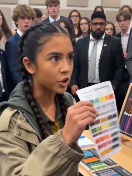
The color test sample.
The original sample.
The first successful result.
At the bottom was my handwriting.
My notes.
My calculations.
My signature.
The evidence was undeniable.
Then the director said something nobody expected.
“There’s another issue.”
The room became silent again.
His expression hardened.
“We discovered someone attempted to remove Tenzin’s name from the project records.”
A collective gasp exploded through the hall.
Giselle stopped breathing.
I could actually see it.
For the first time all day, she looked afraid.
Very afraid.
Because she knew exactly who had done it.
PART 3 — THE RECORDING
“Show them.”
The voice came from the back of the room.
Everyone turned.
An older woman stepped forward.
She was the school’s technology coordinator.
Mrs. Alvarez.
In her hands was a tablet.
“I think everyone should see this.”
The event director nodded.
A video appeared on the giant screen.
The timestamp showed two weeks earlier.
Late evening.
Nearly midnight.
The records office.
A figure entered the room.
The audience leaned forward.
The figure approached a computer.
Opened project files.
Scrolled through student names.
And then deleted one.
Mine.
The camera zoomed.
The entire room erupted.
The person in the video was unmistakable.
Giselle Norwood.
Several reporters stood up instantly.
Cameras swung toward her.
Flash after flash exploded across the room.
“No!” Giselle shouted.
“That’s not what happened!”
But the footage kept playing.
Everyone watched her replace my name with another.
Her own.
The evidence was overwhelming.
A sponsor dropped his coffee.
Someone in the audience whispered,
“My God.”
Another reporter said,
“Keep recording.”
The director slowly closed the folder.
“Would you like to explain this, Giselle?”
For a moment, she looked trapped.
Cornered.
Exposed.
Then her eyes hardened.
And she made a terrible decision.
Instead of apologizing—
She doubled down.
“None of this matters.”
The room froze.
She pointed directly at me.
“She’s still not good enough.”
The cruelty of those words hit harder than the curry.
People visibly recoiled.
Even some of Giselle’s own friends stepped away from her.
But she wasn’t done.
She laughed.
Actually laughed.
And said,
“She’s just a poor scholarship student.”
The silence afterward was horrifying.
Because everyone knew she had gone too far.
PART 4 — THE SECRET NOBODY KNEW
What happened next shocked me more than anything Giselle had done.
A voice rose from the audience.
Strong.
Clear.
Angry.
“Enough.”
A man stood up.
Gray-haired.
Distinguished.
Wearing a dark suit.
I recognized him immediately.
He was one of the largest donors at the event.
People respected him.
Feared him.
Listened to him.
His name was Arthur Bennett.
And he was staring directly at Giselle.
“I know who Tenzin Cho is.”
The room fell silent.
I blinked.
I had never met him.
Arthur walked onto the stage.
Then he looked at me.
A strange sadness filled his eyes.
“Your father once saved my life.”
I couldn’t move.
My heart stopped.
“What?”
The word escaped before I could stop it.
Arthur nodded.
“Fourteen years ago.”
The room listened carefully.
“I was trapped during a climbing accident in Colorado.”
Suddenly tears filled my eyes.
Because my father had been a mountain guide.
He had died when I was very young.
Arthur continued.
“Your father carried me down the mountain after I broke my leg.”
Nobody spoke.
“He refused payment.”
Arthur’s voice cracked.
“He said helping people was worth more than money.”
The room was completely silent.
Then Arthur smiled.
“And today I learned his daughter is exactly the same.”
I couldn’t stop the tears anymore.
Not because I was sad.
Because for the first time in years, someone remembered him.
Someone remembered the man who had taught me kindness.
The audience erupted into applause.
A standing ovation followed.
And I realized something.
For the first time that day—
Nobody was looking at Giselle anymore.
They were looking at me.
PART 5 — THE FALL OF A PERFECT IMAGE
Giselle’s world was collapsing.
And she knew it.
Reporters surrounded her.
Sponsors began whispering.
Phones buzzed across the room.
The video had already started spreading online.
Thousands of views.
Then tens of thousands.
Then more.
The image she had spent years creating was cracking apart in real time.
Her father arrived moments later.
A powerful businessman.
A man whose influence usually fixed everything.
But even he looked horrified.
“What have you done?” he whispered.
Giselle stared at him.
For the first time, there was no arrogance.
Only panic.
“You said our reputation mattered.”
Her father closed his eyes.
“No.”
His voice trembled.
“I said integrity mattered.”
The words hit her like a slap.
The room watched.
Nobody interrupted.
Because something deeper than a scandal was unfolding.
A family was confronting the truth.
Years of entitlement.
Years of excuses.
Years of believing wealth could erase consequences.
And suddenly it couldn’t.
The sponsors gathered.
After a brief discussion, they announced a decision.
The Norwood family would lose its ceremonial role in future events.
Several partnerships were suspended pending review.
Gasps echoed everywhere.
Giselle looked devastated.
But then something unexpected happened.
She looked at me.
Not with hatred.
Not with arrogance.
With confusion.
As if she genuinely couldn’t understand why things had turned out this way.
Because people like Giselle had spent their lives believing recognition belonged to them.
They never imagined someone else might earn it.
PART 6 — THE OFFER
The ceremony should have ended there.
Instead, it became something entirely different.
Arthur Bennett approached the microphone again.
“I have one more announcement.”
The crowd quieted.
Arthur smiled at me.
Then addressed everyone.
“Talent should never be limited by money.”
My stomach tightened.
I had no idea where this was going.
Arthur continued.
“For that reason, I am creating a new educational grant.”
Whispers spread instantly.
He raised a finger.
“The first recipient will be Tenzin Cho.”
The hall exploded.
People jumped to their feet.
Students cheered.
Teachers cried.
I stood frozen.
Unable to process what I was hearing.
Arthur looked directly at me.
“The grant covers advanced education, research opportunities, and future academic expenses.”
My knees nearly gave out.
This wasn’t a small scholarship.
This was life-changing.
Everything my mother worried about.
Every bill.
Every sacrifice.
Every late-night conversation about money.
Suddenly there was hope.
Real hope.
The kind that changes futures.
I covered my mouth.
Tears streamed down my face.
The audience applauded for nearly a full minute.
And then the director handed me the microphone.
My hands trembled.
I looked across the room.
At teachers.
Students.
Sponsors.
Reporters.
And finally at the giant screen displaying my name.
The same name someone had tried to erase.
I swallowed hard.
Then spoke.
“My father taught me something.”
The room listened.
“He said recognition comes and goes.”
I paused.
“But character stays.”
Silence.
Beautiful silence.
Then thunderous applause.
PART 7 — THE TRUTH BEHIND GISSELLE
The ceremony ended.
But the story didn’t.
Three days later, something surprising happened.
I received an email.
From Giselle.
I almost deleted it.
Instead, I opened it.
The message was short.
Can we talk?
I stared at the screen for a long time.
Part of me wanted to ignore her.
Another part wanted answers.
Eventually I agreed.
We met in a quiet Denver park.
She arrived alone.
No designer clothes.
No cameras.
No audience.
Just Giselle.
For several moments neither of us spoke.
Then she surprised me.
She apologized.
Not the kind people give when they get caught.
A real apology.
Messy.
Awkward.
Painful.
“I was awful to you.”
I nodded.
“Yes.”
She looked down.
“I know.”
The wind moved through the trees.
Children played nearby.
Life continued around us.
Then she told me something nobody else knew.
Since childhood, she had lived under enormous pressure.
Every achievement was expected.
Every mistake criticized.
Every success compared.
Nothing was ever enough.
Not grades.
Not awards.
Not attention.
Nothing.
She had spent years believing that being important was the only way to matter.
So when the ceremony spotlight landed on me instead of her—
She panicked.
Not because I had harmed her.
Because she couldn’t imagine value existing without recognition.
It didn’t excuse what she had done.
Not even close.
But it explained it.
And for the first time, I saw something unexpected.
She wasn’t powerful.
She was terrified.
Terrified of being invisible.
The same fear that had haunted me for years.
Only it had led us in different directions.
I thought about my father’s words.
Character stays.
Finally, I said,
“You hurt me.”
She nodded.
“I know.”
“But people can change.”
Tears filled her eyes.
And for the first time since we met—
She smiled.
A genuine smile.
Not a perfect one.
A human one.
PART 8 — THE END
Six months later, the world looked very different.
The chalk project became nationally recognized.
Schools across several states adopted the techniques I had developed.
The educational grant expanded.
More students received support.
More overlooked kids found opportunities.
And me?
I was invited to science programs, innovation workshops, and leadership events.
Not because of the scandal.
Because of the work.
The thing that mattered most.
One autumn afternoon, I returned to the school auditorium.
The same room.
The same stage.
The same display tables.
Only this time, things felt different.
A new ceremony was taking place.
New students.
New projects.
New dreams.
I sat quietly in the audience.
No spotlight.
No microphone.
No cameras.
And honestly?
I liked it that way.
As the event began, a nervous freshman walked onto the stage.
Her clothes were worn.
Her shoes old.
She looked exactly the way I had looked.
Scared.
Unsure.
Out of place.
The audience barely noticed her.
But I did.
Because I knew that feeling.
I knew what it meant to work hard in silence.
To be invisible.
To wonder if anyone saw you.
After the ceremony ended, I approached her.
“Good job.”
She looked shocked.
“Really?”
I smiled.
“Really.”
Then I handed her a small notebook.
The same kind I used for my color experiments.
Her eyes widened.
“Why are you giving me this?”
I thought about the folder.
The records.
The humiliation.
The applause.
The grant.
The impossible chain of events that had changed everything.
Then I answered.
“Because somebody should keep a record of your work.”
The girl’s smile lit up the room.
And in that moment, I finally understood the greatest lesson hidden inside the color test sample.
The sample had never simply proved who deserved credit.
It had revealed something far more important.
Truth survives.
People may ignore it.
Hide it.
Mock it.
Steal from it.
Erase names.
Rewrite records.
Or bury evidence.
But truth has a remarkable habit of finding daylight.
And when it does—
It changes everything.
As I walked out of the auditorium, the late afternoon sun painted the Denver sky gold.
I looked upward and imagined my father smiling somewhere beyond the mountains he had loved.
For years I thought being noticed would change my life.
I was wrong.
What changed my life was staying honest when nobody was watching.
Working when nobody applauded.
Believing in myself when nobody else did.
The color test sample exposed a lie.
But it also uncovered something beautiful.
A future.
A purpose.
A community.
And a truth stronger than power itself.
The girl they tried to erase became the one nobody would ever forget.
THE END
