Mara Ellis would remember, for the rest of her life, that the dog’s eyes were not wild.
Everything else about him looked terrible.
His yellow coat was clumped with mud. One ear drooped lower than the other. His ribs showed beneath his dirty fur, and his paws left wet prints across the pale tile floor of the ATM kiosk. He smelled like rainwater, old leaves, and the alley behind the bakery where trash bags split open after midnight.
But his eyes were steady.
Almost human.
Almost desperate.
Mara was too tired to notice.
She had worked twelve hours at St. Agnes Medical Center, smiling at patients whose families never came, answering phones with a voice that did not sound like hers, pretending she was not two months behind on rent. Her shoes hurt. Her back ached. Her little brother, Eli, had called three times asking when she would be home because the electricity had flickered again and he hated being alone in the dark.
“I’m coming,” she had promised him. “I just need to get cash first.”
Now she stood inside the glass ATM kiosk on Hartwell Street, jabbing her card into the machine with one hand and clutching her phone with the other.
The street outside was unusually quiet.
Usually, at six-thirty, Hartwell buzzed with buses, office workers, cyclists, and impatient drivers leaning on horns. But rain had swept through an hour earlier, leaving the sidewalks shining black and the air cold enough to empty the block. A coffee shop glowed across the street. A pharmacy sign blinked red, red, red.
Mara typed her PIN.
The machine hummed.
Behind her, the glass door sighed open.
She glanced over her shoulder, expecting another customer.
Instead, a muddy Labrador stepped inside.
“Oh, no,” Mara muttered. “No. Absolutely not.”
The dog looked straight at her.
Then he walked forward and grabbed her jacket sleeve in his mouth.
Mara gasped and yanked back. “Hey! Let go!”
The dog pulled.
Not playfully. Not gently.
Hard.
The sleeve stretched tight between his teeth and her arm. Mara stumbled sideways, nearly dropping her phone. Her irritation flared so fast it burned through her exhaustion.
“Stop it!”
She shook him off.
The Labrador released her sleeve, backed up one step, then immediately came forward again.
His teeth closed around the fabric.
He pulled harder.
Outside the kiosk, a man under the pharmacy awning laughed. A woman carrying groceries slowed to watch. Someone said, “Looks like he wants dinner.”
Mara’s face heated.
She hated being watched. Hated looking helpless. Hated anything that made people stare at her as if her life was some little sidewalk show.
“I don’t have food,” she snapped at the dog. “Go away.”
The ATM beeped.
PLEASE TAKE YOUR CASH.
The slot opened, revealing four hundred dollars in crisp bills. Rent money. Grocery money. The difference between keeping the apartment one more month and explaining to Eli why their things were packed in garbage bags again.
Mara snatched the cash.
The dog barked.
Sharp. Loud. Urgent.
Mara flinched.
“Seriously?”
He grabbed her sleeve a third time and pulled toward the door.
This time, anger broke through her fear.
All day, people had needed things from her. Patients. Doctors. Her landlord. Her brother. Her mother’s old debts. The whole world had been pulling at her sleeve for years, and now even a filthy stray would not leave her alone.
Mara shoved him.
Not brutally, but hard enough.
The Labrador lost his footing on the wet tile and stumbled backward onto the sidewalk. His paws slid. His shoulder bumped the glass door. A few bystanders laughed.
“Poor thing,” someone said, though not loudly enough to help.
Mara instantly felt guilty, which only made her angrier.
“Stay away from me,” she said, her voice shaking.
The Labrador got up.
For one second, he just stood there in the drizzle, mud dripping from his chin, eyes fixed on her face.
Then the glass door opened behind Mara again.
This time, the dog did not look at her.
He looked past her.
His whole body changed.
His tail went stiff. His head lowered. His lips lifted from his teeth, and a low growl rolled through the small kiosk.
Mara turned.
A man stood three feet behind her.
He wore a dark hoodie pulled low over his forehead. Rainwater dotted his sleeves. His face was mostly shadow, but she saw his eyes.
They were not looking at her face.
They were locked on the cash in her hand.
One of his hands was hidden inside his jacket pocket.
Mara’s throat closed.
The man took one slow step forward.
The Labrador moved first.
He slipped between Mara and the stranger like a door slamming shut. Muddy paws planted wide. Growl deepening. Body trembling, not with fear, but with warning.
The man froze.
“Move the dog,” he said.
Mara could not answer.
The Labrador barked once.
The sound cracked through the kiosk and bounced off the glass.
Outside, laughter died.
The man’s jaw tightened. For a terrifying moment, Mara thought he would lunge. Instead, his eyes flicked toward the witnesses gathering near the entrance.
Then he backed away.
One step.
Two.
He shoved through the door and ran.
The Labrador chased him only to the threshold, then stopped, as if he knew his job was not to catch the man.
His job was to stay with Mara.
She stood trembling, money crushed in her fist, breath coming in tiny broken pieces.
Someone shouted, “Call the police!”
“I already am!” another voice answered.
Mara sank onto the small metal bench beside the machine. Her knees had simply stopped believing in her. The Labrador turned around and padded back to her.
She stared at him.
A minute ago, she had shoved him.
Now he sat at her feet, wagging his tail softly.
As if he forgave her before she even knew how to ask.
“I’m sorry,” Mara whispered.
The dog tilted his muddy head.
She touched his ear with shaking fingers.
“Were you trying to save me?”
His tail thumped once against the tile.
By the time the police arrived, the crowd had grown. People spoke over one another, each trying to be the first witness to explain what had happened. Officers searched the alley behind the pharmacy and found something abandoned beneath a stack of damp cardboard.
Mara did not look closely when one officer carried it away in a clear evidence bag.
She had seen enough.
A tall police officer with silver at his temples approached her slowly. His badge read KLINE.
“You’re Mara Ellis?” he asked.
She nodded.
“You’re safe now.”
The words should have comforted her.
Instead, they made her eyes fill.
Officer Kline crouched beside the Labrador. “And who’s this hero?”
“No idea,” Mara said. “He just appeared.”
Kline smiled faintly and reached toward the dog’s neck. “Let’s see if he has a collar under all this mud.”
The Labrador allowed him to lift the matted fur beneath his throat.
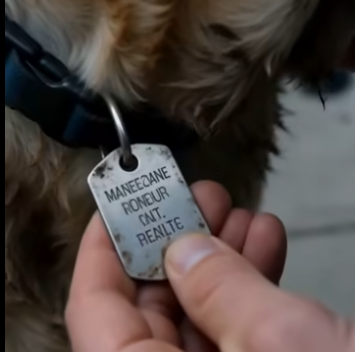
A weathered leather collar appeared, nearly hidden.
Something metallic dangled from it.
Kline wiped the tag with his thumb.
His smile vanished.
Mara noticed immediately.
“What is it?”
Kline did not answer.
He stared at the tag as if it had spoken.
Then he looked at the dog’s face.
His breath left him in a strange, broken sound.
“That’s impossible,” he whispered.
Mara’s skin prickled. “Officer?”
Kline turned the tag toward the kiosk light.
The engraving was scratched but readable.
BUDDY
K-9 ASSISTANCE PARTNER
CALL IF FOUND
Below that was a phone number.
And beneath the number, almost worn smooth, were three small words:
PROPERTY OF ELLIS.
Mara stared.
Her last name.
The air seemed to thin.
“What does that mean?” she asked.
Kline looked at her carefully. “Did your family ever have a service dog?”
“No.”
The answer came too quickly.
Then something stirred in the back of Mara’s memory.
A yellow blur.
Warm fur.
A child’s hand holding a red leash.
Her mother crying in a kitchen.
A man’s voice saying, “He knows the route. He’ll bring her home.”
Mara pressed her fingers to her temple.
“No,” she said again, but softer.
Kline watched her with a sadness that made her uneasy.
“How old are you, Mara?”
“Twenty-six.”
The officer swallowed.
“I knew your father.”
The world stopped moving.
Mara had not heard anyone say those words in years.
Her father, Daniel Ellis, had died when she was six. That was the official story. A rainy night. A robbery outside a check-cashing store. A brave man who tried to protect his wife and child. A tragedy too messy for her mother to discuss without leaving the room.
Mara remembered very little.
A siren.
Broken glass.
Her mother screaming.
A dog barking somewhere far away.
“My father?” Mara said.
Kline stood slowly. “Daniel worked with rescue animals after leaving the army. Buddy was his dog.”
Mara looked at the Labrador.
He wagged his tail.
“That’s not possible,” she whispered. “That was twenty years ago.”
“I know.”
Dogs did not live forever.
Everyone knew that.
And yet the tag was there. The name was there. The last name was there.
Kline took out his phone and called the number on the tag. Mara expected it to be disconnected.
Instead, somewhere nearby, a phone began ringing.
Not from the officer’s hand.
Not from Mara’s pocket.
The sound came from the Labrador’s collar.
Kline froze again.
He lifted the tag and found a small waterproof capsule attached behind it, packed so tightly with mud that no one would have noticed. Inside was a tiny tracking device, blinking with a weak blue light.
“That isn’t twenty years old,” Kline murmured.
Mara’s pulse hammered. “What is happening?”
Before Kline could answer, the Labrador suddenly stood.
His ears lifted.
He turned toward the alley where the man had run, but not toward the alley’s entrance. Toward the narrow side street beyond it.
Then he barked once and trotted away.
“Buddy!” Kline called.
The dog stopped, looked back at Mara, and barked again.
Not a warning this time.
An invitation.
Mara should have stayed with the officers. She knew that. She had given her statement. She had Eli waiting at home. She had no business following a muddy dog into a wet alley after nearly being robbed.
But the name on the tag pulled at something buried inside her.
Ellis.
Her father.
The missing pieces of a night no one would explain.
“I’m going with him,” she said.
Kline hesitated, then spoke into his radio. “I need two units on Hartwell, east alley. Possible connection to old Ellis case.”
Old Ellis case.
Not closed.
Old.
Mara heard the difference.
The Labrador led them past the pharmacy, through the alley, and behind a row of shuttered shops. He never ran too far ahead. Every few steps, he checked to make sure Mara followed.
Rain began again, thin and cold.
At the end of the alley stood an abandoned postal annex, boarded up for years. Mara knew the building. Everyone in the neighborhood did. Kids dared each other to touch the rusty back door. Adults complained it attracted trouble. City notices had been pasted and torn away so many times the walls looked diseased.
Buddy walked straight to the back entrance.
Then he sat.
Kline’s hand moved to his radio again. “We need entry authorization.”
But Buddy had already lowered his nose to a loose board near the bottom of the door.
He scratched once.
The board shifted.
Behind it was not darkness.
It was a small metal lockbox.
Kline pulled on gloves before touching it. The box was old but not ancient, sealed with a combination lock. On top, scratched into the metal with something sharp, were four numbers.
Mara saw them and stopped breathing.
June nineteenth.
Her birthday.
Kline looked at her.
“My dad used that for everything,” she said faintly.
The lock opened.
Inside was a plastic-wrapped envelope, a faded photograph, and a small cassette recorder so old Mara almost laughed from shock.
The photograph showed her father kneeling beside a yellow Labrador.
A much younger Labrador.
Buddy.
But another person stood partly visible at the edge of the frame. Only half his face appeared before the photo cut off, but Mara recognized him instantly from framed holiday pictures her mother still refused to take down.
Uncle Ray.
Her mother’s older brother.
The man who had handled Daniel Ellis’s funeral arrangements.
The man who had moved Mara and Eli into his rental apartment after their mother died.
The man who called every month to ask whether she had the rent.
Mara felt cold in a way rain could not explain.
Kline inserted the cassette into the recorder and pressed play.
Static hissed.
Then a man’s voice filled the alley.
Daniel Ellis.
Mara did not remember his voice clearly, but her body did. Her knees weakened as if the sound had reached through twenty years and touched the child she used to be.
“If this is found,” Daniel said, “then Ray lied. I’m recording this because I don’t know who I can trust anymore. Buddy’s trained to interrupt withdrawals when he senses a threat pattern. We built the exercise because Ray’s crew watches cash points. They choose people alone. People tired. People desperate.”
Mara covered her mouth.
Daniel continued, voice low and urgent.
“Ray isn’t just taking money. He’s using family names, accounts, addresses. If anything happens to me, the proof is hidden where Buddy knows to go. He knows Mara’s birthday. He knows the route. Trust the dog.”
The tape clicked.
Then a second voice spoke.
Not Daniel’s.
Ray’s.
“You should’ve minded your business, Danny.”
Mara flinched.
There was a crash on the recording. A shout. Buddy barking fiercely. Daniel yelling, “Run, Mara!”
Then static.
Kline stopped the tape before it became worse.
He looked shaken.
Mara stared at the lockbox.
“My uncle killed him,” she whispered.
Kline’s face tightened. “Your father’s death was ruled a robbery because key evidence disappeared. I was a rookie then. I never believed the story, but I couldn’t prove otherwise.”
Mara’s thoughts spun wildly. “But Buddy can’t be the same dog.”
“No,” Kline said quietly. “He can’t.”
Buddy pressed his wet nose into Mara’s hand.
Kline examined the tracking device again. “This was installed recently. Someone found your father’s old collar and put it on this dog.”
“Who?”
A voice answered from behind them.
“I did.”
Mara turned so fast she nearly slipped.
An old woman stood beneath a broken fire escape, holding an umbrella with one trembling hand. She wore a nurse’s coat under a rain jacket, and her white hair was pinned in a bun that had partly come loose.
Kline stared. “Mrs. Alvarez?”
The woman nodded.
Mara knew the name.
Rosa Alvarez had been her mother’s closest friend. She had vanished from their lives after the funeral, or so Mara had been told.
Rosa looked at Mara with tears already falling.
“You look like him,” she said. “Your father. Around the eyes.”
Mara could not speak.
Rosa stepped closer. “Daniel didn’t die immediately that night. He gave me the collar. He told me Ray would come for any proof. He told me to wait until Mara was old enough, safe enough, strong enough.”
“Safe enough?” Mara’s voice cracked. “I grew up with Ray controlling everything.”
Rosa lowered her head. “I know. And I am sorry every day.”
“Why didn’t you tell the police?”
“I tried,” Rosa said. “Ray had people everywhere then. One officer warned him before I could make a statement. My house was broken into that same night. I ran. Years later, when I came back, your mother was already gone, and Ray was watching you closely.”
Kline’s jaw tightened. “Rosa, why now?”
Rosa looked at Buddy.
“Because this dog found me.”
The Labrador wagged his tail as if proud.
“He was abandoned near the clinic where I volunteer,” Rosa said. “Same coloring. Same stubborn heart. When I put Daniel’s old collar on him, he started reacting to the ATM training whistle.”
Mara blinked. “Whistle?”
Rosa reached into her pocket and pulled out a tiny silver dog whistle.
“Daniel trained Buddy with one. I used it tonight.”
Mara stepped back. “You sent him to me?”
“To save you.”
“From that man?”
Rosa’s expression darkened. “Ray sent him.”
Mara’s stomach dropped.
Rosa nodded toward the envelope in the lockbox. “The accounts in there prove Ray has been running the same scheme for decades. Your father discovered it. Your mother discovered it later. That is why she was never the same.”
Mara thought of her mother’s fear. Her locked bedroom drawers. The way she had whispered, “Never trust easy kindness, Mara. It always sends a bill.”
All those years, Mara had thought grief had broken her mother.
Maybe it had been terror.
Kline’s radio crackled.
“Officer Kline, suspect from ATM has been detained two blocks east. He’s requesting Ray Calder.”
Mara closed her eyes.
Ray Calder.
Her uncle.
The landlord.
The family savior.
The man who had raised rent every time Mara got a raise.
The man who had smiled at Eli and called him “little soldier.”
Kline spoke into the radio. “Bring him in. And send units to Raymond Calder’s residence and office.”
Mara’s phone buzzed.
Eli.
Her hands shook as she answered. “Eli?”
“Mara?” His voice was small. “Uncle Ray is here.”
The alley seemed to tilt.
“What?”
“He said you asked him to pick me up. Did you?”
Mara’s blood turned to ice.
Buddy began growling before anyone else moved.
Mara put the phone on speaker. “Eli, listen to me. Go to your room and lock the door.”
There was a pause.
Then Ray’s voice came through the line, warm and familiar.
“Mara, honey. There’s no need for drama.”
Kline signaled sharply to nearby officers.
Mara forced herself to breathe. “Get away from my brother.”
Ray sighed. “You always were your father’s daughter. Stubborn at the worst possible time.”
Buddy barked so loudly Eli gasped through the phone.
Ray went silent.
Then he laughed.
“Is that a dog?”
Mara looked down at the muddy Labrador, at the old collar, at the tag that had dragged the truth back from the grave.
“Yes,” she said. “It is.”
Ray’s voice hardened. “Mara, whatever you think you found, you don’t understand it.”
“I understand enough.”
“No,” he said. “You understand nothing. Your father was going to destroy this family.”
“He was trying to stop you.”
“He was trying to make himself a hero.”
Mara’s fear sharpened into fury. “He was a hero.”
For a moment, only breathing filled the line.
Then Eli shouted, “Mara!”
The call cut off.
Mara moved before thinking, sprinting toward the street. Kline ran beside her, calling for units to her apartment. Buddy tore ahead through the rain like a streak of yellow light.
The drive to Mara’s building took four minutes.
It felt like four years.
When they arrived, two patrol cars were already outside. Mara burst from Kline’s car before it fully stopped.
Her apartment building was old brick, three floors, fire escapes rusted red. Her window glowed on the second floor.
Then the front door opened.
Ray came out holding Eli by the shoulder.
He was a handsome man in his late fifties, silver-haired, clean-shaven, dressed in a navy coat that probably cost more than Mara’s monthly rent. He looked less like a criminal than a school principal, or a senator, or the kind of man neighbors trusted with spare keys.
Eli looked terrified but unharmed.
Ray smiled when he saw the police.
“Thank goodness,” he called. “My niece is having some kind of episode. She’s been under a lot of stress.”
Mara almost believed him.
That was the worst part.
He sounded so calm. So reasonable. So hurt.
Buddy did not.
The Labrador stepped forward and growled.
Ray’s smile flickered.
Kline raised his voice. “Raymond Calder, let the boy go.”
Ray chuckled. “Officer Kline. Still chasing ghosts?”
“No,” Kline said. “Just caught one.”
Ray’s hand tightened on Eli’s shoulder.
Buddy barked.
Eli remembered something Mara had forgotten.
When they were little, their mother had taught them one emergency rule: if someone dangerous held you, drop your weight. Become impossible to carry.
Eli suddenly went limp.
Ray cursed and stumbled.
Buddy lunged—not at Ray’s throat, not with wild violence, but straight at his coat sleeve.
He clamped down and pulled with all his strength.
The same way he had pulled Mara from the ATM.
Ray lost his grip.
Eli scrambled away, and Mara caught him so hard they both nearly fell.
Officers rushed in.
Ray tried to run.
He made it three steps before Kline stopped him.
No one laughed this time.
No one called the dog a nuisance.
Buddy sat in the rain, panting, muddy, magnificent.
Ray looked at Mara as officers cuffed him.
“You think this ends happy?” he spat. “You have no idea what your father really left behind.”
Mara held Eli tighter.
Rosa stepped from the crowd, holding the plastic-wrapped envelope.
“Yes,” she said softly. “He does.”
Inside the envelope were bank records, names, dates, photographs, and one final letter addressed to Mara.
She read it two days later in Kline’s office, after Ray’s arrest made headlines, after more victims came forward, after the city learned the respected landlord and charity donor had built half his life on fear.
Mara unfolded the letter with trembling hands.
My brave girl,
If you are reading this, I am sorry I could not tell you myself. I wanted to watch you grow up. I wanted to teach you how to ride a bike without letting go too soon. I wanted to embarrass you at school concerts and burn pancakes on Saturdays.
But if I cannot be there, remember this.
Courage is not being unafraid.
Courage is listening when love pulls you away from danger.
Trust the ones who protect you, even when you do not understand them yet.
And always, always trust the dog.
Mara cried until she laughed.
Because Buddy, the new Buddy, had fallen asleep under the table with his muddy head on her shoe.
Three months later, Hartwell Street looked different.
The ATM kiosk had new lights. The alley behind the pharmacy had security cameras. Ray’s properties were under investigation, and Mara’s rent debt vanished when authorities uncovered illegal charges he had forced onto tenants for years.
Rosa moved into the apartment downstairs.
Officer Kline visited every Sunday with dog biscuits and terrible jokes.
Eli stopped sleeping with the lights on.
And Buddy became, officially and permanently, Mara’s dog.
On the first warm evening of spring, Mara walked him past the same ATM where everything had changed. She stopped outside the glass door and looked at her reflection.
She saw a tired woman, yes.
But not a helpless one.
Buddy nudged her hand.
Mara smiled. “You’re not pulling me away this time, are you?”
Buddy wagged his tail.
Across the street, Eli waved from the bakery, holding a paper bag of rolls. Rosa stood beside him, laughing at something Kline had said. The city lights blinked on one by one, not like warnings now, but like small promises.
Mara crouched and hugged Buddy around the neck.
His old tag rested against her palm.
BUDDY.
ELLIS.
Not the same dog from twenty years ago.
But somehow, exactly the dog her father had promised would find her when the truth was ready.
Buddy licked her cheek.
Mara laughed through sudden tears.
Then, for the first time in years, she walked home without looking over her shoulder.
