“You really think your husband is going to protect you from us?”
The words settled into the room like smoke.
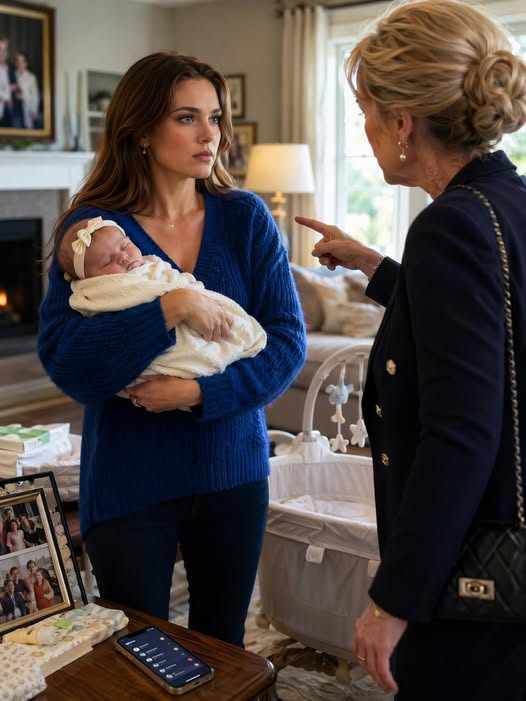
For a moment, all I could hear was Hazel’s uneven crying against my shoulder and the faint hum of the refrigerator in the kitchen. My mother stood three feet away from me, her chin raised, her eyes narrowed with the confidence of someone who had spent years mistaking obedience for love.
I looked at her, really looked at her.
Not as my mother.
Not as the woman who raised me.
Not as the person whose approval I had chased like a starving child chasing a meal.
I looked at her as someone standing in my home, frightening my newborn daughter, threatening the fragile peace I had fought too hard to build.
And suddenly, the fear that had lived in my chest for years went quiet.
“My husband doesn’t need to protect me from you,” I said. “I’m going to do that myself.”
My mother blinked.
For the first time in my life, Martha Kline had no immediate answer.
I shifted Hazel higher against my chest and walked to the front door. Every step hurt. My body was still sore, my knees weak, my head light from exhaustion, but I kept moving anyway. When I reached the door, I opened it and stood beside it.
“Leave.”
Her mouth parted in disbelief.
“You cannot throw me out.”
“Yes,” I said. “I can.”
“This is ridiculous,” she snapped. “You’re emotional. You just had a baby, and now you think you can talk to me like some stranger?”
“You walked into my house without knocking, demanded money, woke my child, and threatened me.” My voice stayed low. Steady. “You are a stranger right now.”
The color drained from her face, then rushed back in a furious red.
“You ungrateful little girl.”
That phrase would have broken me once.
It would have sent me scrambling to explain myself, to soften my tone, to prove I was still good, still loyal, still worthy of being loved. But Hazel was warm against my chest, tiny and trusting, and I realized something with a force that almost stole my breath.
My daughter would never learn love by watching me surrender to cruelty.
“Give me the key,” I said.
My mother laughed once, sharp and humorless. “Absolutely not.”
“Give me the key, or I call base security.”
That did it.
Her face changed.
She had never been afraid of me, but she was afraid of embarrassment. She was afraid of uniforms, records, reports, and witnesses. She was afraid of anything that dragged family business into daylight.
“You wouldn’t dare,” she said, but there was less certainty in it now.
I reached for my phone with one hand.
She dug into her purse so violently that lip balm and receipts spilled onto the floor. Then she pulled out the spare key and threw it. It hit the entryway wall before clattering onto the hardwood.
“There,” she spat. “Happy?”
I did not bend to pick it up.
“Leave.”
She stared at me for several seconds, breathing hard. Then she stepped toward the doorway, stopping just close enough that I could smell her perfume.
“You’ll regret this,” she whispered.
I looked down at Hazel’s face. Her crying had softened into hiccups.
“No,” I said. “I think I already regret waiting this long.”
My mother stepped outside.
I closed the door.
Then I locked it.
For several seconds, I stood there with my forehead against the cool wood, holding my baby, listening to my mother shout from the porch.
She called me selfish.
She called me brainwashed.
She said Penny’s children would remember this.
She said family didn’t abandon family.
Then her voice became muffled as she walked away, and finally the house went still.
That was when my legs gave out.
I sank carefully onto the floor, Hazel pressed safely against me, and for the first time since giving birth, I cried. Not loudly. Not dramatically. Just silent, shaking tears that seemed to come from somewhere older than pain.
I cried for the girl who had learned too early that love had invoices attached.
I cried for the soldier who had wired money from overseas while pretending she wasn’t lonely.
I cried for the woman who had given birth alone and still been expected to serve everyone else before herself.
And then I cried for Hazel, because she would not inherit that life.
Not if I could help it.
The next morning, I called a locksmith.
He arrived just after noon, a kind older man with silver eyebrows and a toolbox that looked older than I was. He changed the front lock, the back lock, and the garage door code while Hazel slept in her bassinet near the couch.
When he handed me the new keys, I stared at them in my palm like they were some kind of medal.
“New baby?” he asked gently, nodding toward the bassinet.
I smiled despite myself. “One week old.”
“She’s beautiful,” he said. “You got family helping?”
For a second, I almost lied.
It would have been easier.
Instead, I said, “Not anymore.”
He did not pry. He just gave a slow nod, the kind that carried more understanding than words.
“Then make sure you sleep when you can,” he said. “And don’t open the door unless you want to.”
It was such a simple sentence.
Don’t open the door unless you want to.
No one had ever said that to me before.
By evening, my phone had become a battlefield.
Penny sent twelve messages.
Mom said you humiliated her.
The kids are crying.
You always act like you’re better than us.
It must be nice having government money.
You owe this family more than you think.
Then came messages from relatives I barely heard from unless somebody needed something.
Aunt Linda said I should “cool down.”
Cousin Mark said childbirth made women “irrational sometimes.”
My grandmother sent only one sentence: Your mother has a hard life too.
I read that one twice.
Then I deleted it.
Caleb called at 2100, his face appearing on the screen under harsh barracks lighting. The moment he saw me, his expression changed.
“What happened?”
I had planned to be calm. I had planned to summarize it neatly.
Instead, I told him everything.
The hospital text. The ignored messages. My mother bursting through the door. Her threat. The key. The locksmith. All of it.
Caleb didn’t interrupt once.
When I finished, he sat very still, jaw tight, eyes dark with a quiet anger I had rarely seen.
“She threatened you?” he asked.
“She implied you couldn’t protect me from them.”
His voice dropped. “Mara.”
I hated how much I loved hearing my name like that. Like I mattered. Like my pain was not an inconvenience.
“I’m okay,” I said quickly.
“No,” he replied. “You survived it. That’s not the same thing.”
The words hit harder than I expected.
I looked over at Hazel sleeping in her bassinet, one tiny fist tucked under her chin.
“I changed the locks,” I whispered.
“Good.”
“I told her to leave.”
“Good.”
“I didn’t send the money.”
For the first time since the call began, Caleb smiled. It was small, but proud.
“Really good.”
My throat tightened.
“I keep waiting to feel guilty.”
“And do you?”
I thought about it.
“No,” I said slowly. “I feel scared. But not guilty.”
“Scared makes sense,” Caleb said. “You’ve never told them no and made it stick before.”
That was true.
I had said no plenty of times in my head. In the shower. In the car. While staring at my bank account after another transfer. But out loud, to their faces, I had always folded eventually.
This time, I didn’t.
And they knew it.
That was why they were panicking.
Three days later, Penny came.
Unlike our mother, she knocked.
I saw her through the peephole standing on my porch in an oversized cardigan, arms crossed, eyes red like she had been crying. My heart lurched, not because I wanted to open the door, but because the oldest part of me still responded to her distress automatically.
Penny was five years older than me. Growing up, she had been the storm and I had been the shelter. When she screamed at our mother, I cleaned the kitchen. When she failed classes, I helped write apology notes to teachers. When she got pregnant the first time at twenty-one and panicked, I emptied my savings to help with rent.
I had loved her children fiercely.
That was the hook they always used.
Children.
Innocent children.
As though Hazel was not one too.
Penny knocked again.
“Mara, I know you’re in there.”
I stood very still with Hazel asleep against my chest in her wrap.
“I just want to talk,” Penny called through the door. “Mom made everything worse, okay? I’m not here to fight.”
My hand moved toward the lock.
Then I stopped.
Don’t open the door unless you want to.
I did not want to.
So I spoke through the door.
“You can talk from there.”
A pause.
“That’s dramatic.”
“Then you can leave.”
Another pause. Longer this time.
When Penny spoke again, her voice was lower. “The kids really were excited about the phones.”
I closed my eyes.
There it was.
Not how are you. Not how is the baby. Not I’m sorry Mom scared Hazel.
Just the phones.
“They don’t need new phones,” I said.
“You don’t know that.”
“They’re eleven, nine, and seven.”
“That doesn’t mean they don’t feel left out.”
“Penny, I just had a baby.”
“I know that.”
“No,” I said, and my voice shook for the first time. “You know Hazel was born. That’s not the same as knowing what happened to me.”
Silence.
I waited.
Part of me hoped she would ask. Just once. I wanted my sister to surprise me. I wanted her to say, Were you scared? Did it hurt? Are you healing? Do you need food? Can I meet my niece?
Instead, she sighed.
“Look, I’m sorry your birth was hard, but everyone has hard things.”
Something in me closed.
Not shattered. Not exploded.
Closed.
Like a door locking from the inside.
“You need to go,” I said.
“Mara—”
“I won’t be sending money anymore.”
“That’s insane.”
“No. What’s insane is expecting me to fund your household while I’m recovering from birth and raising my own child.”
Her voice sharpened instantly. “You think you’re the only mother who struggles?”
“No,” I said. “I think I’m finally allowed to care that I struggle too.”
Penny scoffed.
“You know, Mom was right. You have changed.”
I looked down at Hazel.
“Yes,” I said. “I have.”
Penny stood outside another minute, then muttered something I couldn’t hear and walked away.
That night, I blocked her number.
Then my mother’s.
Then every relative who had messaged me about money before asking about Hazel.
I expected silence to feel lonely.
Instead, it felt like oxygen.
For four whole days, my house was quiet.
Hazel and I moved through a strange little world of feeding, sleeping, crying, changing, and staring at each other under the soft glow of night-lights. Caleb called whenever he could. Sometimes we talked. Sometimes he just stayed on video while I fed Hazel and tried not to fall asleep sitting up.
The peace was not perfect, but it was mine.
Then, on the fifth day, an email arrived from my bank.
Subject: New Access Request Denied.
I stared at the notification while Hazel slept beside me on the couch.
At first, I assumed it was spam. Then I opened it.
Someone had attempted to reset the online banking password connected to my checking account. The security question had been answered incorrectly twice, triggering a temporary lock.
My stomach turned cold.
Only three people knew enough personal details to attempt that reset.
Me.
Caleb.
And my mother.
I called the bank immediately. After forty-two minutes on hold, a fraud specialist confirmed the attempt had come from a device located in my hometown, not far from my mother’s house.
“Do you want us to add verbal authentication?” the woman asked.
“Yes.”
“Would you like to change your security questions?”
“Yes.”
“Would you like to restrict access unless you appear in person with identification?”
“Yes.”
My voice sounded calm, but my hands were trembling.
After I hung up, I sat there in the living room with the phone pressed against my palm, staring at nothing.
Threats were one thing.
Guilt was one thing.
But trying to break into my bank account?
That was different.
That was not family drama.
That was a crime wearing my mother’s perfume.
I sent Caleb a screenshot.
He called within two minutes.
“Mara,” he said, “you need to document everything.”
“I know.”
“I mean everything. Texts. Emails. Calls. The locksmith receipt. Dates. Times. What she said.”
“I know.”
But I hadn’t done it yet, because documentation made it real.
And once it was real, I could no longer pretend this was just a family argument.
That night, after Hazel finally fell asleep, I sat at the kitchen table with my laptop open and began building a folder.
I named it Boundary.
Then I changed it to Evidence.
I saved every screenshot. Every demand. Every insult. Every message implying I owed them money. I wrote down what my mother had said at the door as accurately as I could remember. I noted the date and time of Penny’s visit. I saved the bank email and the fraud specialist’s case number.
By the time I finished, the sun was beginning to rise.
Hazel stirred in her bassinet, making a soft squeaking sound.
I lifted her into my arms and whispered, “I’m sorry it took me so long.”
She yawned.
I decided to imagine that meant she forgave me.
Two weeks after Hazel was born, a white envelope appeared in my mailbox.
There was no return address.
Inside was a printed letter.
At first, I thought it was from my mother. The tone had her fingerprints all over it: wounded, formal, theatrical.
But then I reached the bottom.
It was signed by an attorney.
My mother and Penny had contacted a lawyer.
The letter claimed that I had made “verbal commitments of financial support” to Penny’s children over a period of years and that my abrupt refusal had created “financial hardship.” It suggested that unless I agreed to a private family repayment arrangement, they would consider pursuing civil remedies.
I laughed.
Not because it was funny.
Because if I didn’t laugh, I might have screamed.
They were trying to sue me for not buying birthday phones.
I took a picture of the letter and sent it to Caleb.
Then, on instinct, I called my commanding officer.
Major Ellison answered on the second ring.
“Kline,” she said. “Everything all right?”
I hesitated.
Major Ellison had already sent a congratulatory text after Hazel was born. She was professional, composed, and not someone I ever wanted to burden with personal chaos.
But I was learning, slowly, that asking for help was not the same as failing.
“No, ma’am,” I said. “I need advice.”
She listened.
Really listened.
When I finished explaining the bank attempt and the attorney letter, she did not sigh or minimize it.
“First,” she said, “you are not to respond directly to that letter. Second, contact legal assistance on base today. Third, keep documenting. Fourth, do not meet them alone.”
My eyes burned.
“Yes, ma’am.”
“And Kline?”
“Yes?”
“You did the right thing changing the locks.”
The words almost undid me.
I swallowed hard. “Thank you, ma’am.”
By the end of the week, I had met with a military legal assistance attorney named Captain Ruiz, a sharp-eyed woman who read the letter once and made a sound of pure disgust.
“This is nonsense,” she said.
I blinked. “It is?”
“Yes. Unless you signed something legally binding, which you did not, being generous in the past does not create an eternal obligation to fund your sister’s lifestyle.”
Relief moved through me so suddenly I felt dizzy.
Captain Ruiz leaned back in her chair.
“The bank issue is more serious. Keep that case number. Also, consider filing a police report, even if only for documentation.”
“My mother will tell everyone I’m destroying the family.”
Captain Ruiz’s expression softened by one careful inch.
“Sergeant, people who rely on your silence often call it destruction when you start telling the truth.”
I carried that sentence home with me.
For two days, I repeated it in my head like a prayer.
Then the social media post appeared.
My cousin Mark sent it to me from a number I hadn’t blocked yet.
Thought you should know.
It was from my mother’s account.
She had written a long public post about “a daughter who forgot where she came from,” accusing me of abandoning struggling children, disrespecting elders, and becoming cruel after marrying into “military arrogance.” She never used my full name, but she used enough details that everyone knew.
The comments were exactly what she wanted.
Some people offered sympathy.
Some called me heartless.
Some said success made people forget family.
Then one comment froze my blood.
Penny had written: Don’t worry. She’ll pay one way or another.
I screenshotted everything.
Then I did something I had never done before.
I wrote my own post.
Not emotional.
Not messy.
Not cruel.
Just facts.
I wrote that I had given birth alone while my husband was away on orders. I wrote that hours after delivery, my first message from my mother had been a demand for $2,000 for electronics. I wrote that when I did not respond, she entered my home without permission one week postpartum, yelled near my newborn, refused to return my key until I threatened to call security, and later someone attempted to access my bank account.
I did not insult them.
I did not beg people to believe me.
I attached screenshots.
Then I posted it.
For ten minutes, nothing happened.
Then everything happened.
My phone erupted.
Messages flooded in from people I hadn’t spoken to in years. Some apologized for believing my mother’s version. Some admitted they had also been pressured for money by her. One distant cousin wrote, I wondered when someone would finally say it.
Then came a message from someone unexpected.
Aunt Linda.
I almost deleted it without reading.
But something made me open it.
Mara, I owe you an apology. I didn’t know about the bank. I didn’t know she went to your house. Call me when you can. There is something you need to know about Penny.
I stared at that final sentence.
There is something you need to know about Penny.
My pulse slowed.
Then sped up.
I called her.
Aunt Linda answered quietly, as though someone might be listening.
“I’m sorry,” she said immediately. “I should have asked questions before messaging you.”
“What do I need to know?”
She exhaled.
“Your mother didn’t ask you for two thousand dollars because of phones.”
The kitchen seemed to tilt.
“What?”
“The phones were a lie,” Aunt Linda said. “Penny owes money. A lot more than two thousand. Your mother has been trying to cover pieces of it wherever she can.”
I sat down slowly.
“What kind of money?”
“I don’t know all of it,” she said. “Credit cards, payday loans, maybe worse. I heard your mother arguing with her last month. Penny said if she didn’t come up with something soon, someone was going to start calling people.”
My mouth went dry.
“Why didn’t anyone tell me?”
Aunt Linda was quiet.
Then she said, “Because everyone knew they would come to you first.”
The truth of it landed with a heavy, ugly thud.
They had not needed me because I was family.
They had targeted me because I was reliable.
Because I answered.
Because I paid.
Because I had mistaken being used for being needed.
I looked across the room at Hazel sleeping peacefully in her swing.
“What else?” I asked.
Aunt Linda hesitated.
“Mara…”
“What else?”
“Your mother told Penny not to worry because she still had your old banking information from when you sent money before.”
For a second, I could not breathe.
Old banking information.
Deployment transfers.
Shared accounts from years ago.
Routing numbers.
Screenshots.
Receipts.
Pieces of my life I had handed over carelessly because I thought trust was automatic inside a family.
My hand tightened around the phone.
“Thank you for telling me.”
“Mara, be careful,” Aunt Linda whispered. “Your mother is scared. Penny is desperate. That makes them reckless.”
After the call ended, I sat in silence for a long time.
Then I picked up Hazel and held her close.
Her tiny cheek rested against my collarbone. Her breath warmed my skin. She knew nothing of money, manipulation, guilt, or betrayal. Her whole world was milk, warmth, heartbeat, and safety.
I wanted to keep it that way for as long as possible.
The next morning, I filed the police report.
By afternoon, Captain Ruiz helped me draft a formal cease-and-desist letter.
By evening, Caleb called with news of his own.
“I spoke to my commander,” he said. “There’s a chance I can request emergency family leave based on harassment and postpartum safety concerns. No promises, but they’re reviewing it.”
Hope rose so fast it hurt.
“You might come home?”
“I’m trying.”
I pressed my lips together, refusing to cry.
Hazel made a small sound in my arms, and Caleb smiled through the screen.
“Tell my daughter I’m working on it.”
“She says hurry up.”
He laughed softly.
For one beautiful second, I let myself imagine him walking through the door, taking Hazel into his arms, making coffee in our kitchen, standing beside me when the next storm came.
Then the doorbell rang.
My entire body went cold.
Caleb noticed immediately. “Who is it?”
“I don’t know.”
“Don’t open it.”
“I won’t.”
Holding the phone in one hand and Hazel in the other, I walked carefully toward the front window and pulled the curtain aside just enough to see.
A man stood on the porch.
Not my mother.
Not Penny.
A man in a dark jacket holding a folder.
My stomach twisted.
“Someone’s here,” I whispered.
“What does he look like?”
Before I could answer, the man stepped back from the door and looked directly toward the window, as if he knew I was there.
Then he lifted a white envelope and pressed it against the glass.
Printed across the front in bold black letters were four words:
HAZEL KLINE — CUSTODY NOTICE
For one frozen second, I did not understand what I was seeing.
Then the man lowered the envelope, turned, and walked away.
My phone slipped from my hand and hit the floor, Caleb’s voice shouting my name through the speaker.
Hazel startled awake and began to cry.
I stood there staring at the envelope taped to my front door.
And for the first time since my mother had burst into my home, I felt real fear.
Not for my money.
Not for my reputation.
For my daughter.
Because somehow, my mother and Penny had found a new way to reach me.
And this time, they had put Hazel’s name on it.
…If you want to know what happened next, please type “YES” and like for more.
