The county fair in Des Moines smelled like funnel cake and barbecue smoke, but the crowd went dead quiet when Oliver grabbed my wrist near the ticket booth.
My name is Claire Bennett. I was seven months pregnant, tired, and carrying a lemonade I had barely touched because my hands were shaking.
Not from the baby.
From him.
Oliver had been charming everyone all night.
That was what he did best.
He moved through crowds like a man born under good lighting. Laughing with coworkers. Holding doors. Buying extra tickets for kids whose parents were short on cash. Calling me “sweetheart” loudly enough for people to hear. Resting one hand on my back every time someone looked our way, not to support me, but to display me.
His pregnant fiancée.
His proof of stability.
His little family story, polished clean for public use.
We were supposed to be there for his company’s summer night at the fair. His employer, a regional insurance firm, had rented a picnic area near the livestock barn and handed out wristbands, food vouchers, and little blue buttons that said Reed & Wallace Family Night.
Oliver loved events like that.
He loved places where people could admire him without knowing him.
He wore jeans, a white button-down shirt with the sleeves rolled, and that easy smile that made strangers forgive things they had not even noticed yet. His coworkers clapped him on the shoulder. Their wives told me how lucky I was. One woman from accounting looked at my belly and said:
“He’s going to be such a good dad. You can just tell.”
I smiled because I was tired.
Not because I agreed.
Under the picnic table, Hank rested his head on his paws and watched Oliver’s feet.
Hank was my Labrador. Big, dark yellow, patient with children, suspicious of fake laughter. He had been with me since before Oliver, before the pregnancy, before the lawyer, before I learned that love could sound gentle in public and cruel in the kitchen.
Oliver hated that dog.
Not openly.
Never openly.
In front of people, he called Hank “buddy” and gave him fries he knew I didn’t want Hank eating. But at home, when no one watched, he called him a shadow with fur.
“That dog looks at me like he’s taking notes,” Oliver once said.
“He probably is,” I answered.
He didn’t laugh.
That was the thing about Oliver. He enjoyed jokes only when he controlled them.
The first time I suspected the secret account, it was not because of a dramatic bank statement or a lipstick-stained receipt. It was because he got angry over six dollars.
I bought prenatal vitamins with my debit card, and he asked why I hadn’t used the joint account. I said because I was at the pharmacy and my card was already in my hand. He smiled too tightly and told me we were supposed to be transparent.
Transparent.
That word became a leash.
He wanted access to my spending, my schedule, my messages, my doctor appointments. He said it was because we were building a life. But when I asked why his paycheck seemed smaller than it should be, he kissed my forehead and said:
“Don’t worry your pregnant little head about money.”
So I worried.
Quietly.
I found transfers first. Small ones. Then larger ones. Money moving from his payroll account to a business account I had never heard of. Then payments to a woman named Mallory Trent. Then a credit card statement sent to an email address I didn’t recognize.
When I asked, he said Mallory was a vendor.
When I asked vendor for what, he said I was spiraling.
When I asked why a vendor was getting payments at 2:13 a.m., he stood so still I knew I had found the edge of something.
Two days later, I called a lawyer.
Her name was Dana Walsh.
She told me to collect documents, not confront him alone, and make sure someone trusted knew where I was.
That someone was Hank.
And my older sister, Mara, who had been telling me for months that “charming” was not the same as kind.
At the fair that night, I kept checking my phone because Dana had promised to send a draft of the financial disclosure request.
I should not have opened it near Oliver.
I know that now.
But pregnancy does strange things to fear. Sometimes you are careful for weeks, and then one second of exhaustion makes you human.
The text came while Oliver was laughing with his supervisor by the lemonade stand.
Dana Walsh: I found the account. Do not sign anything. Do not let him isolate you after tonight. Call me when safe.
My stomach dropped.
I stared at the screen too long.
Oliver saw.
His smile stayed on for his supervisor until the man turned away.
Then Oliver’s hand closed around my wrist.
Not tight enough to bruise immediately.
Tight enough to remind me who he was when the crowd wasn’t useful.
“What was that?” he asked.
“Let go.”
“Claire.”
“Let go of my wrist.”
He leaned in, still smiling for anyone who glanced over.
“What did you do?”
I tried to pull back.
He tightened his grip.
The ticket booth lights flashed behind him, red and yellow bulbs reflecting in his eyes. A carnival worker shouted for the next group. Somewhere nearby, a kid cried because he dropped cotton candy. The Ferris wheel moved slowly against the Iowa sky.
Everything looked normal.
That was the worst part.
“I talked to my lawyer,” I said.
His smile vanished.
For one second, the real Oliver stood in front of me.
Cold. Furious. Empty of charm.
Then he whispered:
“You should have stayed stupid.”
The words were worse than his hand.
Maybe because part of me had already known he thought that.
I looked at him, really looked, and something inside me steadied.
“Your secret account isn’t secret anymore.”
His face changed again.
Not rage this time.
Fear.
Then rage because of the fear.
He slapped me so fast my lemonade splashed across my shirt.
The cup hit the grass. Ice scattered near my sandals. Lemonade soaked the front of my maternity dress, cold and sticky against my skin.
Dozens of people stared.
Nobody moved.
The silence spread in a circle.
His coworkers. Their spouses. The teenage fair workers. Parents near the ticket booth. A man holding a stuffed dinosaur. A little girl with face paint shaped like butterfly wings.
Everyone saw.
And everyone froze.
I could feel my cheek swelling, but all I could see was Oliver’s face as he realized there were too many witnesses to rewrite the first second.
So he started rewriting the second.
“Claire,” he said loudly, voice smooth again, “you need to calm down.”
I almost laughed.
My mouth wouldn’t move.
“I didn’t—” he began.
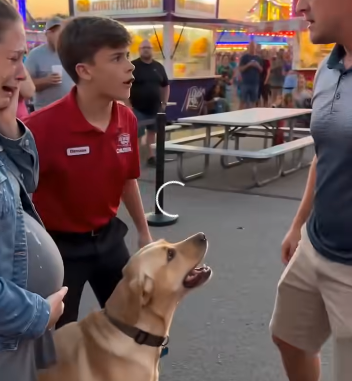
Hank moved.
He launched from under the picnic table before Oliver could finish the lie.
One bark.
Sharp.
Deep.
Like a warning shot.
Then Hank slammed his shoulder into Oliver’s knees.
Oliver stumbled backward into the ticket ropes, arms windmilling, suddenly not so brave with everyone filming. The red ropes tangled around his legs, and he grabbed the metal post to keep from falling.
People gasped.
A teenage fair worker in a neon vest shouted:
“Hey!”
Hank did not chase him.
He came back to me and stood in front of my legs, body stiff, eyes fixed on Oliver.
Oliver pointed at him.
“That dog attacked me!”
A woman from payroll whispered:
“You hit her.”
Oliver’s head snapped toward her.
“What?”
She shrank back.
But the words were out.
“You hit her,” said the teenage fair worker, louder this time.
His name tag said ETHAN.
He looked maybe seventeen, freckled, sweaty from working the ticket booth, and terrified of his own courage.
Oliver’s phone lay unlocked on the ground near the ropes.
It must have fallen from his pocket when Hank knocked him backward.
The screen lit up.
A notification slid down.
Venmo.
From Mallory Trent.
Ethan bent automatically to pick up the phone, probably just trying to return it. Then he froze.
His eyes moved across the screen.
Oliver saw his face.
“Give me that.”
Ethan did not move.
Oliver lunged forward.
Hank growled.
Low.
The kind of growl that makes people remember dogs are not furniture.
Oliver stopped.
“What does it say?” I asked.
My voice shook, but it carried.
Ethan looked at me.
Then at Oliver.
Then at the phone.
“I shouldn’t—”
Oliver snapped:
“It’s private business.”
Ethan swallowed.
“The memo line says, ‘For keeping her quiet until after the baby.’”
The fair seemed to drop away.
No music.
No carnival bells.
No laughter.
Just that sentence.
For keeping her quiet until after the baby.
My hand went to my belly.
Oliver laughed once, sharp and fake.
“It’s a joke. A stupid joke between colleagues.”
“Who is Mallory?” I asked.
He pointed at me.
“See? This is what I deal with. She’s been paranoid for months.”
A woman near the picnic table muttered:
“After watching that, I’d be paranoid too.”
Oliver heard, but he ignored her.
He reached for the phone again.
Ethan stepped back.
“I think security should see this.”
Oliver’s face darkened.
“You’re a ticket kid. Don’t get involved in adult business.”
Ethan’s jaw tightened.
“I just watched you hit a pregnant woman.”
The word pregnant changed the crowd.
Not because hitting a woman who was not pregnant would have been acceptable.
But because people who had been hiding inside uncertainty suddenly found an easier moral exit. They could be outraged now without naming all the other things they had ignored.
A man in a fair security shirt jogged over.
“What’s going on?”
Oliver spoke first.
“My fiancée is having a panic episode, and that dog attacked me.”
Hank barked once.
I almost smiled.
The security guard looked at my wet dress, my cheek, Ethan holding the phone, Oliver tangled in the ticket ropes, and the crowd with their phones raised.
Then he looked at me.
“Ma’am?”
That one word nearly undid me.
Because he asked me.
Not Oliver.
Not the loudest person.
Me.
“He grabbed my wrist,” I said. “He saw a text from my lawyer. He slapped me. Hank stopped him. His phone fell. There’s a Venmo notification.”
Oliver scoffed.
“She’s twisting everything.”
Ethan held up the phone, careful not to touch anything else.
“The notification is right here.”
The security guard leaned enough to read without taking it.
His expression changed.
“Sir, step away from her.”
Oliver tried to laugh.
“Come on.”
“Step away.”
Hank started pawing at the backpack under Oliver’s chair.
At first, nobody noticed except me.
The backpack was black, half-hidden under the picnic bench where Oliver had been sitting with his coworkers earlier. He had told me it held snacks, a jacket, and work papers.
Hank pawed once.
Then again.
The zipper was already half-open.
“Hank,” I whispered.
He looked at me, then back at the bag.
Oliver’s face went white.
“Don’t touch that.”
The security guard turned.
“What’s in the backpack?”
“Work documents.”
Hank hooked his paw under the fabric and dragged it forward.
Papers shifted inside.
Something heavy thumped against the ground.
Oliver moved too fast.
“Enough!”
Hank barked and blocked him.
The security guard stepped between them.
“Sir, back up.”
“That’s my property.”
“And you are not reaching over the dog or the pregnant woman right now.”
Ethan said quietly:
“The zipper was open already.”
The payroll woman stepped forward again, this time with more courage.
“I saw him put something in there earlier. After he came back from the parking lot.”
Oliver stared at her.
“Lena.”
She looked scared.
Then she looked at me.
“I’m sorry,” she said. “I didn’t know it mattered.”
The security guard radioed for another officer and asked if I wanted medical assistance.
I said no automatically.
Then Hank turned his head and nudged my thigh.
Right.
I was not fine just because I was standing.
“Yes,” I corrected. “I’m pregnant. I should be checked.”
Oliver rolled his eyes.
That did more to turn the crowd than anything else.
The second security officer arrived with a woman in a red fair staff polo. She said her name was Denise and that she was the event operations supervisor. She asked everyone to back up, then looked at me and said:
“Do you consent to us keeping him away from you until police arrive?”
“Yes.”
Oliver exploded.
“Police? Are you serious?”
Denise did not blink.
“Yes.”
My cheek burned.
My shirt was sticky.
My wrist ached where his fingers had been.
But for the first time in months, Oliver was the one being told no by strangers.
And he hated it.
The backpack sat between us like a sealed answer.
Hank would not stop staring at it.
Denise asked:
“Do you know if anything of yours is in that bag?”
I swallowed.
“Maybe.”
Oliver snapped:
“No, she doesn’t. She’s never seen inside it.”
“That’s not what I asked you,” Denise said.
I looked at the bag.
A corner of a manila envelope stuck out from the half-open zipper.
On the envelope, in black marker, was my name.
CLAIRE.
My legs weakened.
“My name is on that envelope.”
Denise’s expression hardened.
“Then we wait for police unless you want to retrieve only the item with your name.”
Oliver said:
“She’s not touching my bag.”
The security guard looked at him.
“You are being detained from approaching her. Stop talking over the victim.”
Victim.
I hated that word.
I needed it too.
The police arrived twelve minutes later.
Twelve minutes can feel like a lifetime when your whole life is lying half-open under a picnic table.
The officers were calm. One male, one female. Officer Brooks and Officer Hall. They separated us immediately. Took my statement. Took Ethan’s. Took Lena’s. Took three phone videos from people who had finally found movement after Hank did.
Oliver kept saying:
“She’s emotional.”
“She’s pregnant.”
“She’s confused.”
“That dog is aggressive.”
“It’s a misunderstanding.”
“It’s a private relationship issue.”
Officer Hall looked at him and said:
“Assault in public is not private.”
That sentence settled something in me.
Assault in public is not private.
Neither was fear.
Neither was the truth.
When Officer Brooks asked about the backpack, Oliver refused consent to search. Then Ethan pointed again at the envelope with my name visible through the open zipper.
Officer Hall looked at me.
“Do you recognize the envelope?”
“No. But that’s my name.”
“Do you believe it contains documents related to you?”
“Yes.”
Oliver shouted:
“She doesn’t know that.”
Officer Hall said:
“Sir, lower your voice.”
Denise, the fair supervisor, added:
“The bag was already unzipped when the dog began pawing at it. Multiple people saw the envelope.”
After a careful discussion I barely understood through my pounding pulse, the officers secured the backpack as evidence related to the assault and possible coercion. They did not dump it out dramatically on the grass, no matter how badly the crowd wanted a scene.
They handled it slowly.
Properly.
Still, one thing slid partway free when Officer Brooks lifted the bag into an evidence sleeve.
A folder.
Blue.
My prenatal clinic logo stamped on the corner.
My stomach turned.
“How does he have that?” I whispered.
Oliver looked away.
Officer Hall heard me.
“That’s your medical provider?”
“Yes.”
I kept staring.
“I didn’t give him that folder.”
Oliver said:
“We live together. It’s our baby.”
Officer Hall’s face went cold.
“Her medical records are not automatically yours.”
Oliver opened his mouth.
Closed it.
Good.
The paramedics checked me near the first-aid tent. My blood pressure was elevated, but the baby was moving. They recommended I go to the hospital for monitoring because of the stress and the hit. I agreed.
Before I left, Officer Hall came over.
“We’re going to ask if you have somewhere safe to go tonight.”
“My sister.”
“Good. Call her now.”
My hands shook too much.
Ethan, still nearby, quietly offered his phone because mine had dropped into the grass during everything. His screen was cracked, the case covered in fair stickers.
“Thank you,” I said.
He nodded awkwardly.
“I’m sorry I read the notification.”
“You did the right thing.”
His face changed, like nobody had ever told him that after he got involved in something messy.
Mara answered on the first ring.
“Claire?”
“I need you to come to the fair.”
“What happened?”
“Oliver hit me.”
Silence.
Then her voice became steel.
“Where are you?”
I told her.
“And Hank?”
“With me.”
“Good. Don’t let anyone take that dog.”
“I won’t.”
When Mara arrived, she did not ask me why. She did not ask whether I had upset him. She did not ask what led up to it.
She walked straight to me, put one hand on my shoulder, looked at my cheek, and said:
“I’m taking you home after the hospital.”
I cried then.
Not because I was safe yet.
Because someone finally acted like safety was the obvious next step.
At the hospital, they monitored the baby for two hours. Hank was not allowed in the room at first, but Mara argued so fiercely and produced his paperwork so fast that a nurse finally found a way to keep him nearby in the family waiting area until I was cleared.
The baby’s heartbeat was steady.
That sound broke me.
I lay there under fluorescent lights, lemonade drying stiff on my dress, cheek aching, wrist sore, and listened to my baby’s heartbeat gallop through the monitor.
Alive.
Unbothered by Venmo and secret accounts and grown men who thought control was love.
Mara sat beside me.
“Tell me everything.”
So I did.
The secret account.
Dana’s text.
Oliver’s grip.
The slap.
Hank.
The phone.
Mallory.
The memo.
The backpack.
The clinic folder.
Mara’s expression did not change much.
That was how I knew she was furious.
“Dana needs to know tonight,” she said.
“I know.”
“And you are not going home.”
“I know.”
“And Oliver does not get access to your phone, your email, your appointments, or the hospital.”
I closed my eyes.
“I know.”
She touched my hand.
“Say it like you believe it.”
I opened my eyes.
“Oliver does not get access.”
“Good.”
The next morning, Dana Walsh came to Mara’s apartment with coffee, a legal pad, and the face of a woman who had been expecting something bad but not this exact bad.
She had already spoken to the police.
The backpack had been inventoried.
Dana did not give me every detail immediately. She asked if I was ready. I said no. Then I said yes. Both were true.
Inside the backpack were documents.
Not random ones.
Organized ones.
A copy of my prenatal schedule.
A printed email between Oliver and Mallory Trent.
A cashier’s check made out to Mallory.
A second phone.
A draft agreement titled “Mutual Privacy and Financial Stabilization Statement.”
A typed letter addressed to me, unsigned, claiming that I agreed not to pursue financial separation until six months after the baby’s birth.
A hospital pre-registration form with Oliver listed as primary contact and my sister removed.
My mouth went dry.
“He removed Mara?”
Dana nodded.
“He attempted to submit a revised form online. It was not finalized because the hospital required confirmation from you.”
I pressed both hands over my belly.
“And Mallory?”
Dana took a breath.
“Mallory Trent appears to work for a document preparation service. Not an attorney. She was communicating with Oliver about delaying your legal filing, discouraging you from speaking to counsel, and preparing documents that would make it appear as though you voluntarily agreed to postpone any financial claims.”
“For keeping her quiet until after the baby,” Mara said.
Dana nodded.
“Exactly.”
I felt sick.
“Why after the baby?”
Dana’s face softened in that terrible way professionals soften when they know the answer will hurt.
“Because once the baby was born, he planned to argue you were financially dependent, emotionally unstable, and better off maintaining the household arrangement. There were notes suggesting he wanted time to move assets before any separation became formal.”
Mara swore under her breath.
I stared at the wall.
Oliver had not been hiding money because he was careless.
He had been building a cage quietly enough that I would not see the bars until the baby arrived.
Dana continued:
“The second phone contains messages. Some are with Mallory. Some are with someone saved as R.W.”
“R.W.?”
“His supervisor. Robert Wallace.”
I remembered Robert laughing at the lemonade stand.
Dana slid a printed page across the table.
One message was highlighted.
Oliver: Need her calm through fair night. If she causes scene, I can use that too.
R.W.: Just keep it clean. No company issue.
Oliver: She won’t do anything. She’s too embarrassed to make noise in public.
I stared at the last line.
Too embarrassed to make noise in public.
He had counted on that.
He had counted on the same thing everyone counts on when they hurt someone in front of a crowd: the shock, the shame, the silence, the way strangers freeze because moving would make it real.
He had not counted on Hank.
My dog, who did not care about embarrassment.
My dog, who saw a hand strike and moved.
Mara leaned back in her chair.
“I want to frame that dog’s paw print.”
Dana almost smiled.
“I wouldn’t object.”
Oliver was arrested later that day.
Not in a dramatic way. No screaming through a courthouse hallway. No movie ending. Just charges, statements, protective measures, and a man who finally learned charm does not erase video.
His coworkers began contacting me quietly.
Lena sent a message:
I’m sorry I froze. I saw him grab your wrist before he hit you. I’ll give a statement.
Ethan sent the Venmo screenshot through the officer, then a note written like a teenager trying to sound formal:
I hope you and the baby are okay. Your dog is awesome.
I cried at that one.
People online would later turn Hank into the story.
Dog saves pregnant woman at county fair.
Labrador knocks abusive fiancé into ticket ropes.
Hero dog exposes secret payment.
And yes, Hank deserved every treat in Iowa.
But the real story was uglier.
The real story was that dozens of people saw Oliver grab me and did not move.
That Oliver knew they might not.
That he had built his plan around my silence and their discomfort.
The real story was that the memo line, the backpack, the secret account, the hospital form, and the second phone were not sudden madness.
They were paperwork.
Control with headers and dates.
Abuse in folders.
A cage built with passwords, payments, and polite language.
Two weeks later, I went to the police station to collect copies of the evidence I was allowed to have for the civil case. Mara drove. Hank sat in the backseat, head between the front seats like a supervisor.
Officer Hall met us in the lobby.
“How are you feeling?”
“Better.”
She looked at me carefully.
“Really?”
I gave a small smile.
“Less afraid.”
“That counts.”
She handed me a sealed envelope.
Inside were printed stills from fair security footage. One showed Oliver grabbing my wrist. One showed the slap. One showed Hank mid-lunge, all muscle and fury, launching from under the picnic table. One showed Oliver tangled in the ticket ropes, his phone glowing on the ground.
Officer Hall hesitated.
“There’s one more.”
She slid it out.
It was taken seconds after everything stopped.
I was standing with one hand on my belly, lemonade across my shirt, Hank planted in front of me, and the entire crowd behind us frozen.
Only Hank was blurred.
Because only Hank was moving.
I looked at the photo for a long time.
Mara whispered:
“That’s the title.”
She was right.
Only my dog moved when the crowd froze.
Months passed.
The baby came early but healthy.
A little girl.
I named her Nora.
When they placed her on my chest, I thought I would feel only joy. I did feel joy. A terrifying, enormous kind. But I also felt grief for the version of myself who once thought keeping quiet could keep peace.
Hank met Nora two days later.
He sniffed her blanket, then lay down beside the bassinet and sighed like the county had assigned him permanent duty.
Mara took a photo.
In it, Nora is asleep, tiny fist near her mouth, and Hank is watching the doorway.
Always the doorway.
Dana helped me untangle the accounts. The secret money did not stay secret. The attempted documents did not hold. The hospital removed Oliver’s unauthorized changes. The protective order stayed in place. Oliver’s company quietly put Robert Wallace on leave after the messages surfaced.
Mallory Trent tried to claim she thought she was helping with “family mediation.”
Dana said:
“Family mediation does not come with Venmo memos about keeping pregnant women quiet.”
I liked that sentence very much.
One year after the fair, Mara took me back to Des Moines County Fair opening weekend.
I did not want to go at first.
Then I did.
Not to reclaim the place in some grand symbolic way.
I just wanted a lemonade.
A new one.
One I could actually drink.
Hank came with us. Nora rode against my chest in a carrier, wearing a yellow hat shaped like a duck because Mara has no taste and endless confidence.
The ticket booth looked the same.
The ropes were new.
Ethan was there again, taller, still freckled, wearing the same neon vest.
When he saw Hank, his face lit up.
“No way.”
Hank wagged his tail like he remembered exactly who had held the phone.
Ethan crouched.
“Hey, hero.”
I smiled.
“Hey, Ethan.”
He stood quickly.
“How’s the baby?”
I turned Nora slightly.
“This is Nora.”
His face went soft.
“Hi, Nora.”
Then, after a pause, he said:
“I’m glad he moved.”
He meant Hank.
But I heard more than that.
I looked around at the fair: kids laughing, smoke rising from grills, lights blinking above the rides, people walking past without knowing that a year earlier, my life had cracked open near that booth.
“I am too,” I said.
I bought a lemonade.
My hand did not shake this time.
Not much.
Mara noticed.
She didn’t comment.
Good sisters know when silence is support, not avoidance.
We sat at a picnic table, Hank underneath, Nora asleep against me. The air smelled like sugar and fried dough. Somewhere nearby, a band played a song badly and enthusiastically.
I looked down at Hank.
“You know,” I told him, “you ruined his whole plan.”
Hank thumped his tail.
Mara said:
“He improved it.”
I laughed.
For real.
And for the first time in a long time, the sound did not feel borrowed.
People think the moment that changes you is always the loudest one.
The slap.
The shout.
The dog’s bark.
The police sirens.
But sometimes the real change happens in the second after.
When you look around and realize who moved, who froze, who filmed, who lied, who helped, who stayed, and who counted on your shame to keep you quiet.
Oliver thought I would stay embarrassed.
He thought the crowd would stay frozen.
He thought his secret account, his second phone, his payments, and his little folder of control would stay zipped under a picnic bench until after the baby.
He thought wrong.
Because Hank heard the sound of a hand against my skin and did not wait for permission.
He moved.
And once he did, the truth started moving too.
