I fell asleep at a Seattle bus stop with pregnancy meds in my tote, and our Labrador chased the bus clawing at the door until the driver finally stopped.
That was the sentence everyone kept repeating later, like it sounded unbelievable enough to belong to someone else.
But it happened to me.
My name is Mara Bennett, I was thirty-four weeks pregnant, and that morning I had only been trying to make it home without fainting in public.
The bus stop was on Rainier Avenue, under a glass shelter streaked with old rain and fingerprints. Seattle was doing that thing where the sky looked permanently bruised, the kind of gray that made every building seem tired. Cars hissed through puddles. A man in a Seahawks hoodie smoked near the curb. Someone’s coffee had spilled under the bench and gone cold.
Oakley, my yellow Labrador, sat pressed against my knee.
He always did that when he knew I was pushing myself too far.
My doctor called him “a very attentive dog.”
My husband called him “our furry alarm system.”
I called him the only creature in our life who didn’t argue with my body.
I had just come from a prenatal appointment at Harborview, where the nurse reminded me again that I could not miss my medication. Not because she wanted to scare me, but because my pregnancy had become the sort where everyone spoke gently and wrote everything down twice.
Rest. Hydrate. Take the prescribed dose on schedule. Watch symptoms. Call if anything changes.
Simple instructions.
Hard life.
Because my husband, Nate, was working twelve-hour shifts. My mother lived three hours away in Yakima. And Nate’s family had decided my pregnancy was not a medical situation, but a character test.
His mother, Denise, said I was “fragile.”
His sister, Tessa, said I used doctor appointments to get attention.
And his brother-in-law, Aaron, who smiled too much and listened too closely, once said, “Some women like being treated like glass because then nobody expects anything from them.”
I had learned to keep my mouth shut around them.
That morning, I had failed.
The appointment had gone longer than expected. My phone battery was dying. My ankles hurt. My tote was heavy with my wallet, a sweater, a folder of forms, a bottle of water, and the small insulated medication bag the nurse had checked before I left.
Nate had wanted to pick me up, but his boss called him into a last-minute inventory audit. He hated it. I told him I’d be fine. The bus came straight from the clinic area to our neighborhood. Oakley knew the route. I had done it before.
What I hadn’t done before was fall asleep on a public bench.
I remember sitting down.
I remember setting the tote beside my hip, strap wrapped around my wrist.
I remember Oakley nudging my knee.
Then I remember waking up to the sound of barking.
Not normal barking.
Oakley did not bark for fun. He didn’t bark at squirrels, kids, bikes, delivery vans, or the neighbor’s ancient terrier who screamed at clouds.
This bark was sharp and desperate.
I opened my eyes and saw the bus already pulling away.
The route number glowed orange through the drizzle.
My tote sat beside me, half-zipped.
The strap was no longer wrapped around my wrist.
For one stupid second, my mind tried to make it simple.
Maybe I loosened it.
Maybe I moved in my sleep.
Maybe I was being dramatic.
Then I looked inside.
The medication bag was gone.
My whole body went cold.
“Oakley!”
He was already running.
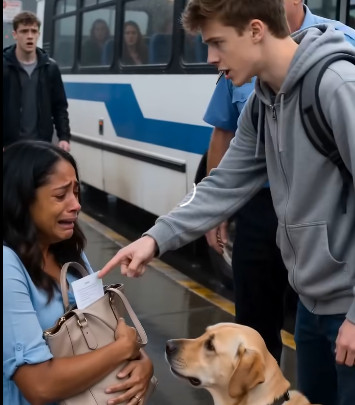
He sprinted alongside the bus, paws splashing through gutter water, barking and clawing at the folding door whenever the bus slowed near traffic. People inside turned their heads. Faces appeared behind fogged glass. Someone pointed. Someone laughed. Someone lifted a phone.
The driver kept going.
Oakley did not.
He ran harder.
His front paws scraped the lower edge of the door at the next red light, nails hitting metal in a frantic rhythm. The driver threw one hand up like he was cursing at us through the windshield.
I tried to stand and nearly fell.
“Stop!” I shouted.
My voice disappeared under the traffic.
The bus lurched forward again.
Oakley lunged beside it, barking so hard his whole body shook.
Then the driver finally slammed the brakes.
The sound cut through the street.
Passengers jolted in their seats. A horn blared behind the bus. The driver pulled over half a block ahead, opened the front door with a violent hiss, and leaned out with his face twisted in anger.
“Get your dog under control!”
I was already moving, one hand under my belly, the other gripping the shelter post until I could step off the curb.
“My medication is on that bus,” I said.
The driver frowned.
“What?”
“My medication bag. It was in my tote. It’s gone. My dog followed it.”
The driver looked at Oakley like he wanted to blame him for every delay in the city.
“Ma’am, you need to control the animal.”
“He doesn’t chase buses.”
“Well, he just did.”
“Because my bag is on there.”
The passengers stared through the windows like I was some viral public meltdown before the video even had a caption.
Pregnant woman loses it at bus driver.
Dog attacks public transit door.
Seattle morning chaos.
I could see the story forming in their eyes before the truth had a chance to breathe.
Oakley shoved past the driver the second the door opened wider.
“Hey!” the driver barked.
But Oakley didn’t jump on anyone. He didn’t growl. He didn’t sniff randomly.
He moved with purpose.
Straight down the aisle.
Past seat six.
Past seat nine.
Past a woman clutching a paper grocery bag.
Past a teenager holding his phone up, recording.
Oakley stopped at seat fourteen.
Then he dropped to his belly and shoved his head underneath.
My heart hammered so hard I could feel it in my throat.
“Seat fourteen,” someone whispered.
Oakley pulled once.
Nothing.
He braced his paws and pulled again.
A black insulated medication bag slid out from under the seat, wedged so far back I never would have found it by looking from the aisle.
The bus went silent.
Not quiet.
Silent.
The driver’s anger faded in pieces.
I stepped onto the bus, shaking.
“That’s mine.”
A woman in a blue raincoat stood up.
“I saw a tote,” she said. “I thought it belonged to the lady who got off.”
“What lady?” I asked.
She swallowed.
“Gray coat. Big sunglasses. Sat there for maybe two stops. She kept looking out the window.”
The driver turned toward her.
“Why didn’t you say something?”
“I thought she dropped something. I didn’t know.”
Oakley nudged the medication bag toward me with his nose.
I bent slowly, picked it up, and checked the zipper.
Closed.
Still cold.
Still there.
Relief hit so hard I almost sat down on the bus floor.
Then Oakley reached again.
This time he pulled at the side pocket of the bag.
“Oakley,” I whispered.
He hooked his teeth gently into the edge of something folded and tugged it free.
A note.
Small.
Creased.
Tucked deep into the pocket where no paper should have been.
The driver crossed his arms.
“Maybe you dropped it.”
I unfolded it.
The handwriting was blocky and rushed.
Miss one dose and she’ll never make it.
For a second, every sound in the city vanished.
No rain.
No engine.
No phones.
No breathing.
Just those words.
Miss one dose and she’ll never make it.
The driver stopped being mad when he realized the note was written on his transfer slip.
His face changed completely.
I know because I was staring at him when he saw the pale green paper, the printed route number, the timestamp, the tiny serial code at the bottom.
“That’s mine,” he said.
His voice was no longer angry.
It was frightened.
Passengers leaned closer.
Someone whispered, “Oh my God.”
I looked at the driver’s badge.
FRANK M.
He held out his hand, then stopped himself before touching the note.
“That paper comes from my pad,” he said. “Transfer slips. I keep them up here.”
He pointed near the fare box.
“Can anyone take them?” I asked.
“No. I mean… not supposed to. They’re right by my seat. I tear them off.”
The teenager with the phone slowly lowered it.
“Dude,” he said. “This is bad.”
Frank looked toward the front of the bus, then at me.
“Ma’am, I need you to sit down.”
“I don’t want to sit.”
“You’re shaking.”
“I’m pregnant and someone just stole medication from my bag.”
“Then sit.”
The woman in the blue raincoat guided me into the nearest seat. Oakley stayed pressed against my legs, eyes fixed on the aisle.
Frank shut the bus door.
People outside were honking. Cars tried to go around. Someone on the sidewalk lifted a phone.
Frank ignored them.
He picked up his radio.
“Dispatch, this is Route 7 southbound near Rainier and Massachusetts. I need a supervisor and possibly police. We have a passenger medical theft situation and evidence on board.”
A crackle.
Then a voice.
“Repeat medical theft?”
Frank looked at the note again without touching it.
“Affirmative. Pregnant passenger. Medication recovered under seat fourteen. Threatening note on a transfer slip from my pad.”
The word threatening made my stomach twist.
I pulled out my phone.
Two percent battery.
I called Nate.
It rang once.
Twice.
Three times.
Voicemail.
Of course.
I called again.
No answer.
I texted:
911 situation. Bus. Oakley found meds. Someone stole them. Call me.
The message sent.
My battery dropped to one percent.
Then the phone died.
I stared at the black screen.
The woman in the blue raincoat crouched in front of me.
“My name is Paula,” she said. “Do you want to use my phone?”
I nodded.
I tried Nate again from her phone.
This time he picked up.
“Hello?”
“Nate.”
“Mara? Whose phone is this? What happened?”
My voice cracked.
“Someone took my meds out of my tote while I was asleep at the bus stop. Oakley chased the bus. He found them under a seat.”
Silence.
Then Nate’s voice dropped.
“Are you safe?”
“I’m on the bus. The driver called dispatch.”
“Where?”
I told him.
“I’m coming.”
“There was a note.”
“What note?”
I closed my eyes.
“It said if I missed one dose, she’d never make it.”
Nate did not speak.
“Nate?”
“Don’t move. Don’t talk to anyone alone. Keep Oakley with you. I’m on my way.”
Then, quieter, like he was speaking to himself and forgot I could hear:
“No. No, no, no.”
My blood chilled for the second time.
“What do you mean no?”
He inhaled sharply.
“Mara, did the note say she?”
“Yes.”
Another pause.
“Last night, Tessa said something.”
My fingers tightened around Paula’s phone.
“What?”
“She said Mom was worried you were being careless with the baby. She said if something happened because you forgot your medicine, nobody could pretend they hadn’t seen it coming.”
I felt every passenger vanish again.
Only that sentence remained.
If something happened because you forgot your medicine.
“Nate,” I said slowly, “your sister knew about my medication schedule?”
“I didn’t tell her details.”
“That’s not what I asked.”
He didn’t answer fast enough.
“Nate.”
“Mom asked what the doctor said. I told her you had to be careful. That’s all.”
“That’s all?”
“I swear.”
But it was never “all” with his family.
It was a sentence passed from one person to another until it became a weapon.
Frank stepped closer.
“Ma’am, police are on the way. Transit supervisor too.”
I handed Paula’s phone back.
“Thank you.”
She touched my shoulder lightly.
“I’ll stay until they come.”
The teenager raised his hand like he was in class.
“I got video of the dog scratching the door,” he said. “And when he went to the seat.”
Frank looked at him.
“Did you record the woman in the gray coat?”
The boy shook his head.
“Not at first. But I might have her in the background when she got off. I was recording my friend being stupid.”
A man near the middle spoke up.
“I remember her. She wore those big sunglasses even inside the bus. Had a red umbrella. She got on two stops before the pregnant lady woke up.”
“I wasn’t on the bus,” I said.
Everyone looked at me.
I swallowed.
“I was asleep at the stop. She must have taken it from my tote before boarding.”
The blue raincoat woman pressed her lips together.
“Then she carried it onto the bus, hid it under seat fourteen, and got off.”
Frank looked toward the front security mirror.
“Why?”
Nobody answered.
Because the answer was too ugly to say out loud.
To make me miss the dose.
To make it look like I lost it.
To make me look careless.
To put the blame in my hands.
Oakley leaned harder into me.
He had known.
Somehow, through diesel, wet pavement, coffee, passengers, and city rain, he had known the bag that mattered was leaving without me.
The transit supervisor arrived first.
Her name was Lorraine Chao, and she came wearing a dark rain jacket, carrying a clipboard and the face of someone who had seen every version of public chaos except maybe this one.
Frank explained.
I explained.
Passengers interrupted with details.
Lorraine listened to all of it without touching the note.
Then she took photos of the transfer slip, the bag, the seat, the floor, and Oakley, who looked offended that nobody had offered him proper recognition.
“This bus has cameras?” I asked.
Lorraine nodded.
“Forward, rear, and door area. We’ll preserve footage.”
Frank rubbed both hands over his face.
“She used my transfer slip.”
Lorraine looked at him.
“When did you last issue one?”
Frank glanced at the pad.
“I gave one to a man with a blue duffel at the stop before Jackson. Then… wait.”
He froze.
“What?” Lorraine asked.
“There was a woman at the front. Gray coat. She asked if this bus went toward Columbia City. I said yes. She said she needed a transfer because her ORCA card wasn’t working. I told her transfers are only after fare.”
“Did you give her one?”
“No. She got irritated. Then some guy behind her asked about the fare reader, and I turned for maybe two seconds.”
Lorraine’s expression sharpened.
“You think she took one?”
Frank pointed at the pad.
“I don’t know. Maybe.”
I stared at the green slip in my hand, now sealed in a plastic evidence sleeve Lorraine had taken from her kit.
A transfer slip from the bus.
A note written before or after the theft.
A woman in a gray coat.
A red umbrella.
A plan.
The police arrived next.
Officer Grant and Officer Ellis. Calm voices. Not enough surprise on their faces, which somehow made it worse.
They asked if I needed medical attention.
I said I needed to take my medication first, under instruction from my doctor. They stepped aside while I did, after confirming with me that I felt able to follow my own medical plan.
Nobody rushed me.
Nobody rolled their eyes.
Nobody told me I was dramatic.
I wanted to cry from that alone.
Then they began taking statements.
“Who knew you had the medication with you?” Officer Grant asked.
“My husband. My doctor. The nurse.”
“Family?”
I hesitated.
“My husband’s family knew I had medication. I don’t know how much.”
“Any conflict?”
I laughed once.
It came out flat and ugly.
“How much time do you have?”
Officer Grant did not smile.
“Start with the most relevant.”
So I told him about Denise.
Denise Bennett, my mother-in-law, who had offered to move into our apartment after the baby came, then cried when I said no. Denise, who called my boundaries “walls.” Denise, who told Nate that I was isolating him. Denise, who told me she had raised three children without “all this modern panic.”
Then I told him about Tessa.
Tessa Bennett-Rowe, Nate’s older sister, who had two children and considered herself the final authority on motherhood. Tessa, who once told me that needing medication during pregnancy “proved my body wasn’t cooperating.” Tessa, who had asked twice what would happen if I forgot a dose, then claimed she was just curious.
Then I told him about Aaron.
Tessa’s husband. Quiet. Observant. Always in the doorway when people argued. He worked part time doing security installs. He knew cameras, routes, schedules. He had once joked that “everybody leaves a trail if you know what to watch.”
Officer Ellis wrote that down.
“Any of them know you’d be at this bus stop today?”
I opened my mouth.
Closed it.
My appointment time had been in a group chat.
Not because I wanted it there.
Because Denise had asked Nate what time my appointment was, and Nate had answered in the family chat before I could stop him.
I had been furious.
He had said, “They’re just checking in.”
I looked at the officer.
“Yes.”
“Names?”
“All three.”
Nate arrived before I finished the statement.
He came running through the rain in his work boots, hair wet, face pale, jacket half-zipped. He looked at me first, then Oakley, then the bus, then the police.
For one second, I saw guilt hit him before fear covered it.
“Mara.”
I stood too fast.
He caught my elbow.
“Don’t.”
“I’m fine.”
“You’re not fine.”
“No, Nate. I’m not.”
He flinched.
Oakley wagged his tail once, then sat between us like he had opinions.
Officer Grant asked Nate for his statement. Nate answered everything. Appointment time. Family group chat. Medication. Recent conflict. His mother’s comments. Tessa’s comments.
Then Officer Ellis asked:
“Do you know anyone who uses a red umbrella?”
Nate’s face went blank.
I knew that look.
It was the look he got when his mind reached a door he did not want to open.
“Nate,” I said.
He swallowed.
“My mother.”
The rain against the bus windows suddenly sounded louder.
“She has a red umbrella?” Officer Ellis asked.
“Yes. But lots of people—”
“Nate,” I said again.
He stopped.
His eyes lowered.
“She bought it in Vancouver. Red with a black handle. She uses it all the time.”
Officer Grant wrote it down.
Then Paula, the woman in the blue raincoat, spoke up from the bus doorway.
“The woman I saw had a red umbrella with a black handle.”
Nate turned toward her slowly.
“Are you sure?”
Paula looked sorry for him.
“Yes.”
No one said Denise’s name out loud for several seconds.
Then Oakley did something strange.
He walked to my tote.
The half-zipped tote sat on the bench where Lorraine had placed it after photographing it. Oakley sniffed the front pocket, then nudged it with his nose.
“Oakley?” I whispered.
He nudged again.
Officer Ellis crouched.
“Is there something else in there?”
My hands went cold.
“I don’t know.”
“May I look with you?”
I nodded.
She opened the front pocket.
Inside was a folded transit map.
I never carried paper transit maps.
Officer Ellis unfolded it on the bench.
A route was circled in black ink.
My clinic.
The bus stop.
The stop where the gray-coated woman got off.
A coffee shop two blocks away.
On the back, someone had written:
She sleeps after appointments. Don’t confront. Just move the bag.
Nate made a sound like someone had punched him.
I stared at the words until they blurred.
She sleeps after appointments.
That was not public information.
That was not something Denise could guess from a group chat.
Only someone who had watched me after appointments would know that sometimes, when the stress dropped and the exhaustion hit, I fell asleep suddenly. In the car. On the couch. Once in the clinic waiting room.
Nate knew.
My mother knew.
And Tessa knew, because she had mocked me for it at brunch two Sundays earlier.
“She just shuts down like a toddler after appointments,” Tessa had said.
Everyone laughed except me.
Nate had squeezed my knee under the table.
But he hadn’t told her to stop.
The officers exchanged a look.
Nate took out his phone with shaking hands.
“I’m calling my mother.”
Officer Grant stopped him.
“Not yet.”
“She might—”
“Not yet,” the officer repeated. “Let us handle contact.”
Nate looked at me.
“I didn’t know.”
The words were too small for what had happened.
“I know,” I said.
And I did.
That was the terrible part.
I did not think Nate had wanted this. I did not think he had imagined anyone would steal my medication or write a note about our baby like she was a threat in someone else’s story.
But he had given them access.
Appointment times.
Medical worries.
My habits.
My exhaustion.
My private life, translated into family concern.
He had not lit the match.
But he had kept handing them dry paper.
Lorraine came back from the front of the bus with a tablet.
“I just got preliminary stills from dispatch,” she said.
Officer Grant stepped closer.
Lorraine turned the screen.
The bus camera showed the front door.
A woman in a gray coat boarded two stops before the stop where I woke up.
Big sunglasses.
Red umbrella with black handle.
Her face was partly turned away.
But Nate whispered, “Mom.”
I didn’t need him to say it.
I knew the shape of her.
The careful hair.
The stiff shoulders.
The purse held close.
The way she moved like every public space owed her room.
Then the next still.
Denise walking down the aisle.
The black medication bag in her hand.
I felt my knees loosen.
Nate grabbed me before I fell.
Oakley pressed against my other side.
“Mara,” Nate said.
I pulled away from him.
Not hard.
Just enough.
Lorraine showed the next still.
Denise sitting in seat fourteen.
Denise leaning down.
Denise pushing the bag under the seat with her foot.
Then, a final still: Denise exiting through the rear door, red umbrella opening before she stepped into the rain.
Officer Ellis asked quietly, “Do you recognize this person?”
I looked at the photo.
My mother-in-law had worn pearls to my baby shower and told everyone she only wanted what was best for me.
She had cried when I said she couldn’t be in the delivery room.
She had called me daughter once, in front of church friends, with her hand on my shoulder like a claim.
Now she was frozen on a transit camera, hiding my medication under a public bus seat.
“Yes,” I said. “That’s Denise Bennett.”
Nate covered his mouth.
For a moment, he looked ten years younger.
“She wouldn’t,” he whispered.
But the image was right there.
She did.
My phone was dead, but Nate’s started ringing.
He looked at the screen.
Tessa.
Nobody moved.
Officer Grant held out his hand.
“May I?”
Nate stared at him.
“You can choose to answer on speaker, or not answer. But do not warn her.”
Nate answered.
His voice was almost unrecognizable.
“Hello?”
Tessa’s voice came sharp through the speaker.
“Where are you? Mom’s freaking out. She said some bus driver made a scene and Mara’s probably blaming her already.”
Officer Grant’s eyes sharpened.
Nate looked at me.
I nodded once.
He said, “Why would Mara blame Mom?”
Tessa scoffed.
“Because that’s what she does. She turns everything into proof we hate her.”
“Did Mom take Mara’s medication bag?”
Silence.
A long one.
Then Tessa said, too quickly, “What? No.”
“Tessa.”
“Don’t use that tone.”
“The bus camera shows Mom.”
Another silence.
This one had fear in it.
Then Tessa hissed, “You don’t understand. We were trying to protect you.”
I closed my eyes.
There it was.
The family motto.
Protection.
A soft word wrapped around a knife.
Nate’s face crumpled.
“Protect me from what?”
“From waking up one day with a baby you never get to see because Mara has everyone convinced you’re unsafe. Mom said if people saw how careless she was—”
Officer Grant lifted one finger, signaling Nate to keep her talking.
Nate swallowed.
“Careless how?”
“She lost the bag, didn’t she?”
“She didn’t lose it.”
“She fell asleep in public while pregnant. That’s not normal.”
I opened my eyes.
Oakley had started to growl.
Low.
Controlled.
Nate looked like he might be sick.
“So you planned this?”
“I didn’t plan anything.”
“Then who wrote the note?”
“What note?”
Nate’s voice broke.
“The one that said miss one dose and she’ll never make it.”
Tessa inhaled.
That tiny sound answered before words did.
“I told Mom not to write anything.”
The bus went silent again.
Officer Ellis wrote quickly.
Nate looked at the phone like it had turned poisonous in his hand.
“Tessa,” he whispered.
“You don’t get it. Mom said without proof, no one would believe Mara was unstable. We needed something before the baby came. You were going to be trapped.”
“By my wife?”
“By her drama.”
“She’s carrying my daughter.”
“She’s using that baby to control you.”
I stood up.
Nate looked at me, panicked.
I took the phone from his hand.
“Mara,” he whispered.
I spoke into the speaker.
“Tessa.”
Silence.
Then she said my name like it tasted bad.
“You’re enjoying this, aren’t you?”
“No.”
“Oh, please.”
“I’m standing on a bus with police, transit footage, your mother hiding my medication, and your voice admitting you knew enough to tell her not to write a note.”
Tessa said nothing.
“I am not enjoying it,” I said. “I am finally awake.”
Then Officer Grant took the phone.
“Tessa Bennett-Rowe, this is Officer Grant with Seattle Police. Do not contact Mara Bennett again today. Officers will be reaching out for a statement.”
Tessa hung up.
Nate stood there in the aisle, soaked from rain, holding nothing.
No defense.
No excuse.
No family version.
Just the ugly truth, dripping in front of strangers.
Frank, the driver, spoke for the first time in a while.
“I’m sorry,” he said.
I turned to him.
He looked miserable.
“I thought your dog was just… I don’t know. I thought this was going to be one of those mornings.”
“It was one of those mornings,” Paula said softly. “Just not the kind you thought.”
Frank nodded.
“Oakley saved her.”
Oakley heard his name and wagged his tail.
The teenager with the phone said, “That dog’s a legend.”
For the first time since waking up, I almost smiled.
Almost.
The police arranged for another unit to go to Denise’s house. Lorraine preserved all footage. Frank gave a formal statement about the missing transfer slip. The passengers who had seen Denise stayed long enough to provide names and numbers.
And me?
I sat on that bus seat with Oakley’s head in my lap and finally understood that fear does not always arrive screaming.
Sometimes it arrives with pearls and a red umbrella.
Sometimes it says it is worried.
Sometimes it asks for your appointment time.
Sometimes it calls control protection.
Sometimes it waits until you are asleep.
Nate drove me to the hospital afterward, because the officers and my doctor agreed I should be checked. I sat in the passenger seat with Oakley in the back, my tote on my lap, both hands wrapped around it like someone might still try to take it through the window.
Nate did not turn on the radio.
He did not ask me to forgive him.
Smart man.
At the hospital, the nurse checked me carefully. My daughter’s heartbeat filled the room, fast and steady and real.
I cried then.
Not loudly.
Just enough that the nurse handed me tissues and pretended not to notice until I could breathe again.
Nate stood by the door.
Not beside the bed.
By the door.
Waiting for permission he no longer assumed he had.
When the nurse stepped out, he said, “I failed you.”
I watched the monitor.
The little peaks of my daughter’s heartbeat rose and fell.
“Yes.”
He flinched, but he nodded.
“I thought ignoring them was keeping peace.”
“No. It was keeping me alone.”
He pressed his lips together.
“I know.”
“You told them things about me.”
“I didn’t think—”
“You didn’t think they’d use them like weapons?”
He looked down.
“No.”
“But they did.”
“Yes.”
“And they did because you kept giving them pieces of me.”
His eyes filled.
“I’m sorry.”
I believed that he was.
But sorry was not a door lock. Sorry was not a changed phone password. Sorry was not a boundary held in front of Denise when she cried. Sorry was not standing between me and Tessa before the police had to.
“I need you to listen carefully,” I said.
He nodded.
“They do not get my medical information. They do not get appointment times. They do not get hospital access. They do not get to visit after the birth unless I decide I feel safe. Your mother does not come near me. Tessa does not come near me. Aaron does not come near me. If you argue, you can leave with them.”
He swallowed hard.
“I won’t argue.”
“I am changing my emergency contacts.”
“I understand.”
“My mother is coming.”
“Good.”
“And Oakley stays with me.”
For the first time, Nate looked at Oakley, who was lying under the chair like a golden bodyguard.
“He’s better at this than I am,” Nate said.
“Yes,” I said. “He is.”
That hurt him.
It needed to.
Denise denied everything at first.
Of course she did.
She said she found the bag abandoned and meant to bring it back.
Then police asked why she put it under seat fourteen.
She said she panicked.
They asked why she left the bus without telling the driver.
She said she was confused.
They showed her the note.
She said she had never seen it.
They showed her the transfer slip.
She said anybody could have used one.
Then they played Tessa’s call.
After that, Denise stopped talking.
Tessa tried to say she had only been venting.
Aaron claimed he knew nothing, but officers found searches on his tablet for bus routes near my clinic and posts about transit camera blind spots. That part made Nate leave the room when he heard it, because the truth had become too big to absorb while standing.
I did not leave.
I listened.
Every detail mattered now.
Every small thing I had been told to ignore was part of a larger map.
The family chat messages.
The comments about my memory.
The jokes about me sleeping after appointments.
The questions about medication.
Denise asking if Oakley always came with me.
Aaron asking which bus stop was “closest to the clinic, just in case we ever needed to pick you up.”
Tessa saying, “A mother who can’t keep track of her own body needs supervision.”
Supervision.
That was what they wanted.
Not help.
Supervision.
They wanted me documented as careless before my daughter was born. They wanted a story ready. Mara forgot her medication. Mara fell asleep in public. Mara endangered the baby. Mara is unstable. Mara needs family oversight. Mara should not be the only one making decisions.
And if Oakley had not chased that bus?
If Frank had kept driving?
If my medication bag had stayed under seat fourteen until the route ended, swept into lost and found hours later, or taken by someone else?
The note would never have mattered.
The transfer slip would never have been seen.
The story would have been mine to carry and theirs to shape.
She lost it.
She forgot.
She exaggerated.
She blamed us.
Oakley ruined that story by scratching a bus door open.
Three days later, Frank asked through Lorraine if he could check on us.
He came to the hospital lobby during my follow-up, holding a paper bag from a bakery and looking embarrassed.
“I brought muffins,” he said. “I didn’t know what pregnant people can eat, so there are three kinds.”
I laughed for real that time.
“Thank you.”
He crouched to Oakley’s level.
“And for you, hero, I asked first.”
He pulled out a sealed dog treat with the label still on.
Oakley took it gently, like a king receiving tribute.
Frank shook his head.
“I keep thinking about how mad I was.”
“You didn’t know.”
“No. But I thought I did.”
That sentence stayed with me.
I thought I did.
So many people had thought they knew.
They thought they knew I was dramatic.
They thought they knew Oakley was misbehaving.
They thought they knew Denise was just a worried mother.
They thought they knew Nate’s family was overbearing but harmless.
They thought they knew a sleeping pregnant woman at a bus stop had simply lost something.
The truth had been under seat fourteen.
Weeks passed.
My mother came from Yakima and took over the couch like a small, determined general. She cooked, cleaned, drove me to appointments, and told Nate he could help by following instructions without applause.
Nate did.
Quietly.
He changed passwords.
He left the family chat.
He sent one message to Denise and Tessa, written in front of me.
Do not contact Mara. Do not come to the hospital. Do not come to our home. Any information about the baby will come when Mara decides it is safe. What happened was not concern. It was harm.
Denise replied with a paragraph about betrayal.
Tessa replied with thirteen angry texts.
Aaron sent nothing.
Nate blocked them all.
That did not fix everything.
But it was the first thing he did that did not require me to beg.
Our daughter was born two weeks early on a rainy Thursday morning.
We named her June.
Not after anyone.
Not as a peace offering.
Not to honor a family that had mistaken control for love.
Just June, because she arrived like a break in weather.
When the nurse placed her on my chest, tiny and warm and furious at the world, Oakley was not in the delivery room, of course. But my mother had him waiting at home with a ridiculous yellow bow on his collar.
The first time we brought June into the apartment, Oakley approached slowly.
He sniffed her blanket.
Then he lay down beside the car seat and sighed like his job had become more serious.
Nate cried.
I cried too.
But my tears felt different now.
Not helpless.
Clean.
A month later, Lorraine mailed a printed still from the bus footage because Frank had asked if it could be released to us. Not the image of Denise. Not the theft. Not the ugly parts.
The still showed Oakley standing inside the bus aisle, head lowered toward seat fourteen, every passenger turned toward him.
On the back, Frank had written:
He knew before we did.
I framed it.
People ask me sometimes if I am angry that a dog had to be the one to save me.
I am.
A little.
I am angry that my husband did not see the danger sooner.
I am angry that kindness was used as camouflage.
I am angry that people heard a pregnant woman say she was uncomfortable and decided the real problem was her tone.
I am angry that my private medical needs became family gossip.
I am angry that Denise had time to buy a red umbrella, plan a route, take a transfer slip, hide a bag, write a note, and still believe she was the victim.
But mostly, when I look at Oakley sleeping beside June’s crib, I feel something stronger than anger.
I feel proof.
Proof that my fear had not been foolish.
Proof that my body had been worth protecting.
Proof that the quiet things matter: a half-zipped tote, a missing bag, a dog refusing to stop, a transfer slip with the wrong handwriting.
Proof that love does not always sound like comfort.
Sometimes love sounds like claws on a bus door.
Sometimes it barks until strangers stare.
Sometimes it makes a driver slam the brakes.
Sometimes it drags the truth out from under seat fourteen while everyone is still deciding whether to believe you.
And every time I pass a Seattle bus now, Oakley watches the doors.
Not because he is afraid.
Because he remembers.
So do I.
