Outside the Fort Liberty visitor gate in North Carolina, the morning looked normal until my mother-in-law walked through the line like she was coming to bury me too.
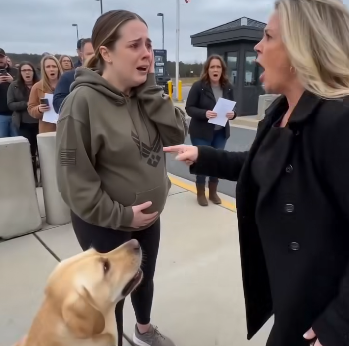
My name is Emily Miller. I was seven months pregnant, holding a paper cup of Dunkin’ coffee in one hand and my husband’s old Army hoodie against my belly with the other.
The hoodie still smelled faintly like him.
Not enough for anyone else to notice. Just enough to destroy me if I pressed my face into the collar for too long.
My service Labrador, Ranger, sat at my left knee because he always knew when my breathing got too fast. He was a broad yellow Lab with a white scar across one ear, calm eyes, and a stubborn kind of loyalty that made strangers smile until he decided they were a problem.
That morning, he had not smiled at anyone.
Not at the military police officer checking IDs.
Not at the young wife crying quietly into her sleeve.
Not at the retired sergeant pacing near the fence.
Not at the reporters trying to look respectful while still hoping something happened.
Everyone around us was waiting for IDs, passes, and bad news.
That was the strange thing about a military gate during a crisis. People still did normal things. They sipped coffee. Checked phones. Dug for licenses. Adjusted stroller blankets. Asked children to stop kicking the curb. But beneath all of it was the same terrible question.
Who made it home?
My husband, Staff Sergeant Caleb Miller, had been listed missing for nine days after a transport convoy incident overseas.
Missing.
That word had become the entire shape of my life.
The casualty officer said it carefully.
The command said it carefully.
The chaplain said it carefully.
My doctor said it carefully when she checked my blood pressure and told me stress could become its own emergency.
Missing did not mean dead.
Missing did not mean safe.
Missing meant the world had stopped between two doors, and nobody knew which one would open.
But Caleb’s mother, Patricia, refused to say missing.
She kept saying dead, like she wanted the word to make her the owner of his whole life.
“My dead son would not want this,” she told the casualty officer when I asked for another update.
“My dead son’s belongings should come to his mother,” she told Caleb’s friend Marcus over the phone.
“My dead son’s baby deserves to be raised with real family,” she told me three nights earlier, standing on my porch in a black cardigan, her eyes dry and sharp.
I shut the door on her.
My hands shook afterward for twenty minutes.
Ranger sat against my legs until I could breathe again.
That morning at Fort Liberty, I had been told to come to the visitor gate because there might be an update. Not a final confirmation. Not a ceremony. Not a folded flag. Just an update.
Those words had kept me awake all night.
Might be.
Could be.
Maybe.
Caleb’s old hoodie was the only thing I could hold without falling apart.
Ranger leaned against me as we stood in line. His vest brushed my knee. Every time my breathing hitched, he nudged my wrist.
“I’m okay,” I whispered.
He did not believe me.
Neither did I.
Then Patricia arrived.
I saw the line react before I fully saw her.
People shifted aside. Not because she asked. Because she moved like someone who expected the sidewalk to clear.
She wore a black dress, black flats, and a black coat even though the North Carolina morning was already warm. Her eyes were red, but not soft. Not broken. Red in the way eyes get after a person has worked hard to look devastated.
A leather purse was pressed tight under her arm.
Too tight.
Ranger saw that before I did.
His head lifted.
His ears changed.
His body went still.
Patricia came straight at me.
Not to the gate.
Not to the officer.
To me.
“Emily.”
She said my name like an accusation.
I kept one hand on the hoodie.
“Patricia.”
Her eyes moved to my belly.
Then to Ranger.
Then back to my face.
“You have no right standing at this gate wearing his last name.”
The words hit me so hard that for a second I could not answer.
A woman behind me gasped. Someone else murmured something low. The MP at the gate looked up.
I swallowed.
“The casualty officer has not confirmed anything,” I said. “Caleb’s baby and I are not leaving until we know the truth.”
Her face changed.
It was small. A tightening around the mouth. A flash in the eyes. Not grief.
Anger.
She leaned close, close enough that I could smell mint gum and expensive perfume.
“If you really loved him,” she whispered, “you would stop embarrassing the family.”
My coffee cup trembled.
“Embarrassing?”
“You standing here like some widow-in-waiting, using that belly for attention.”
The baby moved.
I pressed Caleb’s hoodie harder against me.
“I am his wife.”
“You were his mistake.”
The slap came so fast I barely saw her hand.
My coffee hit the concrete.
Hot liquid splashed across the sidewalk, brown and steaming, missing my feet by inches. The cup bounced once and rolled under the rope barrier.
For one second, the whole gate went silent.
I grabbed my cheek.
Ranger jumped between us with his hackles up.
Not barking wildly.
Not out of control.
He made one deep warning sound that rolled through the line like thunder.
Patricia lifted her hand again.
Ranger lunged forward and clamped onto her coat sleeve.
Not her skin.
Just fabric.
Just enough to drag her arm down before she could swing again.
A military police officer shouted:
“Everyone step back!”
The line scattered. People grabbed children, bags, phones. A man in uniform moved toward us. The MP came fast from the gate booth, one hand out, not reaching for Ranger, but controlling the space.
“Ma’am, step back from the dog.”
Patricia screamed.
“That animal is dangerous!”
Ranger held her sleeve one second longer, then released it when I said his name.
“Ranger.”
He backed into position in front of me, body angled sideways, still watching Patricia.
She was the one twisting away like she had something to hide.
Her purse slipped from under her arm.
She grabbed at it too quickly.
Ranger saw the movement.
He lowered his head, stepped forward, and hooked one paw against the strap.
“Ranger, wait,” I whispered.
But he had already pulled once.
The purse snapped open.
Lipstick, tissues, a phone charger, a folded black scarf, and a small cloth patch spilled onto the sidewalk.
Black and dusty.
With Caleb’s unit number stitched across it.
My body went cold.
Not metaphorically.
Cold.
Every inch of me.
I knew that patch.
I had sewn one loose corner myself the night before Caleb deployed. He sat at the kitchen table eating cereal from a mug because all the bowls were in the dishwasher, laughing while I stabbed myself twice with the needle.
“You know the Army has people for that,” he told me.
“I am people,” I said.
He kissed my forehead.
That same uneven stitch was still visible in the corner.
My stitch.
My husband’s patch.
On the sidewalk outside Fort Liberty.
From Patricia’s purse.
She dropped to her knees and tried to shove it back into her bag.
The MP saw it first.
“Ma’am, don’t touch that.”
Patricia froze.
The officer stepped closer.
His name tape read HARRIS.
He looked at the patch.
Then at me.
Then at Patricia.
“Why do you have evidence from an active missing-soldier case?”
Patricia started crying.
But not like a grieving mother.
She cried like a woman who had just been caught.
“I don’t know how that got there,” she said.
Her voice was too high.
Ranger growled again.
Officer Harris looked toward the gate booth.
“Secure the area.”
Another MP moved in. Someone asked people to stop recording. Nobody stopped completely. Phones stayed half-raised, low, hidden near chests and handbags.
I could not take my eyes off the patch.
“That’s Caleb’s,” I said.
My voice sounded like it came from someone else.
Officer Harris looked at me.
“Ma’am, you recognize it?”
“I sewed that corner. The night before he deployed.”
Patricia sobbed harder.
“Emily is confused. She’s pregnant. She’s under stress.”
I turned toward her.
The rage that hit me was so clean it almost steadied me.
“Do not use my pregnancy to erase what I know.”
Officer Harris stepped between us.
“Mrs. Miller, please stay back.”
Mrs. Miller.
He said it to me.
Not her.
Patricia heard that too.
Her face twisted.
Then the gate radio crackled.
A voice came through, sharp and clipped.
“Gate post, this is Casualty Liaison. Confirm presence of Mrs. Emily Miller, spouse of Staff Sergeant Caleb Miller.”
Officer Harris turned toward me.
His expression changed in a way that made my whole body go cold again.
He lifted the radio.
“Confirmed. Mrs. Miller is present.”
The radio crackled.
“Hold her at gate. Do not release family update to anyone except spouse. Repeat, spouse only.”
Patricia screamed.
“Don’t let her hear it!”
The whole line turned.
There are screams of grief.
And there are screams of control.
Hers was the second.
Before anyone could react, Ranger lowered his head again and nudged Patricia’s open purse.
Something white showed beneath the black scarf.
Folded paper.
Tucked deep into an inside pocket.
Ranger caught the edge gently between his teeth and pulled it out.
Not tearing it.
Not chewing.
Just uncovering it.
Officer Harris moved fast.
“Leave it.”
Ranger released the paper at his boot.
Patricia lunged.
Another MP blocked her.
“Ma’am, stand back.”
“No,” Patricia sobbed. “No, you don’t understand. That’s private.”
Officer Harris picked up the folded message with gloved fingers.
It was dirty at the edges, creased, and marked with a smear of black dust.
On the front, written in block letters, were three words:
FOR MY WIFE.
Not mother.
Not family.
Wife.
My knees almost failed.
Ranger pressed hard against my legs.
Officer Harris did not open it immediately. He looked toward the gate booth, then toward the other MP.
“Contact liaison. Now.”
Patricia was shaking her head.
“She doesn’t need to see that.”
I stared at her.
“What is it?”
She would not look at me.
“What is it, Patricia?”
Her mouth opened.
Nothing came out.
The radio crackled again.
“Gate post, be advised. Recovery team received personal effects tagged from Miller convoy. Message believed intended for spouse was not processed through official channel. CID notified. Do you have an item?”
Officer Harris looked down at the paper.
“Affirmative. We have a patch and folded message in possession, recovered from Patricia Miller’s purse after public altercation.”
A pause.
Then:
“Secure items. Spouse update pending. Keep Patricia Miller separated.”
Patricia’s face collapsed.
Not because she was sad.
Because the wall she had built had just cracked in front of witnesses.
I could barely breathe.
“Is he alive?” I asked.
Officer Harris looked at me, and I saw the answer had not fully arrived yet. Not cleanly. Not safely. Not in a way he could give on a sidewalk.
But something had changed.
He did not say no.
He did not look away like people do when they already know the worst.
He said:
“Mrs. Miller, I need you to come with me.”
Patricia screamed again.
“She’s not stable. She can’t handle it. I’m his mother.”
Officer Harris turned toward her.
“She is his spouse.”
The words stopped her like a door closing.
A woman in line whispered, “Oh my God.”
Another person said, “That patch was in her bag.”
The MP guided me toward a small office beside the visitor gate. Ranger stayed pressed to my left side, calm but alert. My hands had gone numb. Caleb’s hoodie was still clenched against my belly. The baby moved once, slow and firm, as if reminding me to stay upright.
Inside the office, the air was too cold.
A flag stood in the corner. A desk fan hummed. There were two chairs, a computer, a wall clock, and a box of tissues that made my stomach twist because tissues in official rooms are never just tissues.
Officer Harris asked if I needed medical assistance.
“I need to know if my husband is alive.”
His face softened.
“I understand. A casualty liaison officer is coming here now. I cannot give incomplete information before they arrive.”
“But the radio—”
“I know.”
“Patricia had his patch.”
“Yes.”
“She had a message for me.”
“Yes.”
“Why?”
He did not answer.
Because he did not know yet.
Or because he knew enough to be careful.
Through the glass window, I saw Patricia outside with another MP. She had stopped crying. Her face was pale and furious. She kept looking toward the office, toward me, toward the paper in Officer Harris’s evidence sleeve.
Ranger stood between me and the window.
“Good boy,” I whispered.
His tail moved once.
Officer Harris placed the folded message in a clear bag, but he did not seal it yet. He looked at me.
“I’m going to wait for the liaison officer before this is opened.”
I nodded, but my eyes would not leave the words.
FOR MY WIFE.
The door opened eight minutes later.
Captain Morales entered with a chaplain and a woman in civilian clothes I later learned was from CID.
Captain Morales was the casualty liaison officer assigned to Caleb’s case. I had spoken to him four times in nine days. He was careful, respectful, and always tired in the eyes.
When he saw me, his face changed.
Not into grief.
Into urgency.
“Mrs. Miller.”
I stood too fast.
Ranger braced against my leg.
“Tell me.”
Captain Morales glanced at Officer Harris.
“We have received new information.”
“Is Caleb alive?”
He took one breath.
“Yes.”
The room tilted.
The sound I made did not feel human.
Not a scream.
Not a sob.
Something between pain and air.
Ranger pushed against me hard, and Officer Harris caught my elbow before I sank completely.
Captain Morales stepped closer.
“Emily, listen to me. He is alive. He was recovered by allied forces after being separated from the convoy. He is injured, but he is alive and receiving care.”
Injured.
Alive.
Receiving care.
The words came in pieces.
I grabbed the edge of the desk.
“Where is he?”
“We cannot share full movement details yet, but he is in military medical custody. He has asked for you.”
My hands flew to my mouth.
“He asked for me?”
Captain Morales nodded.
“He was able to identify himself and request that his spouse be notified directly.”
The baby kicked.
Hard.
I laughed and cried at the same time.
“Caleb,” I whispered.
For nine days, every breath had been a negotiation.
Now the air came too fast.
The chaplain moved a chair behind me.
“Sit, Mrs. Miller.”
I sat.
Ranger put his head in my lap.
Captain Morales looked at the evidence bag.
“May I?”
Officer Harris handed him the folded message.
The CID woman photographed it before anything else. Then Captain Morales opened it carefully on the desk.
The paper was thin. Torn from something larger. The writing was uneven but unmistakable.
Caleb’s handwriting.
Messy, slanted, too much pressure on the downstrokes.
My vision blurred before I could read it.
Captain Morales looked at me.
“Would you like me to read it, or would you like to?”
“I want to.”
He slid it toward me.
My hands shook so hard that the chaplain placed one palm gently on the table near mine, not touching, just offering steadiness.
I read.
Emily,
I’m alive. Don’t let Mom make decisions for me. Tell our girl I kept my promise. I’m coming home if I can. The patch is so you know it’s me.
Caleb
Below that, smaller:
Ranger knows.
The room disappeared.
Ranger knows.
I pressed the paper to my chest and broke.
Not beautifully.
Not quietly.
I cried like a woman whose body had been holding nine days of terror and suddenly had nowhere to put it.
Captain Morales turned away slightly, giving me privacy. The chaplain stayed near. Officer Harris stood at the door like he was guarding something sacred.
The CID woman’s voice was soft when she spoke.
“Mrs. Miller, I know this is overwhelming. We need to ask about Patricia Miller’s access to your husband’s personal effects.”
I looked up slowly.
“My husband wrote, don’t let Mom make decisions for me.”
“Yes.”
“She knew he was alive?”
“We are trying to determine what she knew and when she knew it.”
A coldness settled under my ribs.
“Ask her.”
“We will.”
But I already knew part of it.
Patricia had not been grieving like a mother waiting for news.
She had been moving like someone trying to control the news before it reached me.
The CID woman, Special Agent Brooks, sat across from me.
“Did Patricia have access to your home, mail, phone, or official contacts?”
“She had access before we changed the locks two months ago. Not after. She still knew people in Caleb’s old unit through family readiness groups. She kept calling everyone. She demanded updates.”
Captain Morales added carefully:
“She was repeatedly informed that primary notification and decision-making authority rested with you as spouse.”
I closed my eyes.
That had been the beginning of her hatred.
Not Caleb missing.
Not the deployment.
Me.
My name on the paperwork.
My number on the notification sheet.
My signature required where she wanted hers.
My belly carrying the grandchild she called “our blood” when she wanted access and “your burden” when she wanted to hurt me.
“What decisions?” I asked.
Captain Morales hesitated.
I looked at him.
“What decisions did she try to make?”
Special Agent Brooks answered.
“She contacted multiple offices attempting to claim authority over personal effects and medical updates. She also submitted a statement asserting that you were emotionally unstable and should not receive direct notification without family supervision.”
I almost laughed.
It came out broken.
“She slapped me at the gate.”
Brooks nodded.
“We have witnesses.”
“She had the message.”
“We need to establish how.”
Officer Harris spoke from the door.
“She also tried to recover the patch before I secured it.”
Brooks wrote that down.
The door opened again, and another MP stepped in.
“Agent Brooks, Patricia Miller is requesting to speak to Captain Morales. She says she has rights as next of kin.”
Brooks glanced at me.
Captain Morales said:
“Mrs. Miller is next of kin for notification purposes.”
The MP nodded and stepped out.
Through the window, Patricia saw me holding the paper.
She knew.
She knew I had read it.
Her face twisted into something I will never forget.
Not sorrow.
Not relief that her son was alive.
Rage.
Because he had written to me.
Because even separated, hurt, and half a world away, Caleb had protected the boundary she spent years trying to break.
My phone buzzed.
I looked down.
Unknown number.
Then another.
Then a message.
Patricia: You don’t understand what I had to do.
I stared at the screen.
Another message came.
Patricia: He is my son before he is your husband.
Then:
Patricia: I was going to tell you when the family was ready.
The family.
Not when Caleb’s wife was ready.
Not when the Army notified me.
Not when the truth arrived.
When the family was ready.
I showed the phone to Agent Brooks.
She photographed the messages.
“Do not respond,” she said.
“I won’t.”
But I wanted to.
I wanted to write: He is alive, and the first thing he did was warn me about you.
I didn’t.
The evidence could speak.
It already had.
They moved Patricia away from the gate office. I did not see where. I only heard her voice once through the hallway.
“She is turning my son against me!”
Captain Morales closed the door.
For the first time, anger crossed his face.
Not professional concern.
Anger.
“Your husband’s message suggests he anticipated interference.”
“Because she’s done it before,” I said.
The room went quiet.
I had not meant to say it aloud.
But once I did, the words kept coming.
Patricia showing up at our apartment when Caleb was gone.
Patricia asking for spare keys “in case something happened.”
Patricia calling my doctor’s office pretending to be helping with appointments.
Patricia trying to add herself to hospital visitor lists.
Patricia telling Caleb I was isolating him.
Patricia telling me Army marriages fail because wives get selfish.
Patricia calling the baby “my second chance” in front of guests.
Captain Morales listened.
Agent Brooks wrote.
The chaplain looked like he had heard too many versions of families using crisis as a leash.
“And when Caleb was listed missing?” Brooks asked.
“She started calling herself his voice.”
The sentence hung there.
His voice.
That was what Patricia wanted.
Not just his belongings.
Not just his baby.
Not just his name.
His voice.
She wanted to decide what he would have wanted while he was unable to contradict her.
But Caleb had contradicted her.
In a folded message.
With a dirty patch.
With my uneven stitch in the corner.
Ranger knows.
An hour later, they let me make a call in a private room.
Not to Caleb. Not yet. He was being moved and treated, and communication would come through official channels when possible.
But I called my sister, Naomi.
She answered on the first ring.
“Emily?”
“He’s alive.”
The sound she made almost broke me again.
“He’s alive,” I repeated.
“Oh my God. Oh my God. Emily.”
“He’s injured, but alive. He wrote me a message.”
Naomi cried openly.
Then she stopped suddenly.
“Why do you sound like there’s more?”
I looked at Ranger, who was lying across the office doorway.
“Patricia had it.”
Silence.
“What?”
“She had his patch. She had the message. In her purse.”
Naomi said something under her breath I won’t repeat.
“Where is she?”
“With MPs.”
“Good.”
“I don’t know what happens now.”
“What happens now is you protect yourself and that baby.”
“I’m so tired.”
“I know. But you’re not alone.”
I looked at the message on the table.
For my wife.
“No,” I said. “I’m not.”
By late afternoon, the update had become official enough to be given properly.
Staff Sergeant Caleb Miller was alive.
He had been separated after the convoy incident, sheltered for days by allied personnel, and transferred to U.S. medical care. His condition was serious but stable. He had been conscious long enough to identify himself and insist that his wife be notified.
His wife.
Me.
Not Patricia.
Me.
I was told I would be contacted when a secure call could be arranged. I was told not to share details publicly. I was told to rest.
Rest.
That word almost made me laugh.
I walked out of the gate office with Ranger at my side and Caleb’s hoodie in my arms. My coffee stain still marked the sidewalk near the line.
People looked at me differently now.
Some had heard. Some guessed. Some only saw Patricia being escorted away earlier and built their own story from the pieces.
The woman who had stood behind me in line touched her chest.
“Is he…?”
I nodded once.
“He’s alive.”
She covered her mouth.
A stranger started crying.
The MP at the gate gave Ranger the smallest nod.
Ranger accepted it like a medal.
Outside the fence, Patricia’s black scarf lay near the curb where it must have fallen. Nobody picked it up.
Naomi drove down from Raleigh and met me at my house that night. She brought soup, clean sheets, and the kind of rage sisters carry carefully because they know you are too tired to hold it yourself.
She changed the locks again even though I told her it was unnecessary.
“It’s necessary for my blood pressure,” she said.
I let her.
Ranger watched the door the entire time.
The next day, Patricia’s relatives began calling.
Some cried.
Some demanded.
Some said she was “not herself.”
Some said a mother in grief does desperate things.
Some asked me not to press charges.
Some asked whether I really wanted to destroy the family when Caleb was fighting to come home.
I listened to one aunt say, “You have to understand, Patricia thought she was losing her son.”
Then I replied:
“She knew he was alive before I did.”
The aunt went silent.
That was the line.
It cut through every excuse.
Patricia had not stolen a memory from a dead son.
She had hidden a message from a living one.
Three days later, I received a secure video call.
Caleb looked thinner.
Paler.
There were medical lines and a blanket pulled to his chest. His voice was rough. His smile was slow.
But it was him.
My Caleb.
“Em,” he whispered.
I pressed both hands to my mouth.
For a few seconds neither of us could speak.
Then he said:
“You got the patch.”
I cried so hard the nurse on his end gently adjusted the screen and pretended not to notice.
“Ranger found it,” I said.
His eyes shifted.
“Ranger?”
“He pulled it out of your mother’s purse.”
Something changed in his face.
Not surprise.
Confirmation.
“She got it.”
“Yes.”
He closed his eyes.
“I tried to give it to a liaison. Things were chaotic. I told them wife only. I knew she’d try.”
“How did you know?”
His eyes opened again.
“Because before I deployed, she asked me to change my paperwork.”
My breath stopped.
“What?”
“She wanted to be added for emergency decisions. I said no. She said you were too emotional. That pregnancy made you unreliable.”
I pressed one hand to my belly.
He saw it.
His face tightened.
“I should’ve told you.”
“Yes,” I said.
He flinched.
But I was done protecting people from the truth just because they were already hurt.
“You should have told me.”
“I know.”
“She slapped me.”
His eyes darkened.
“What?”
“At the gate. Ranger stopped her from hitting me again.”
Caleb tried to move, then winced.
The nurse touched his shoulder.
“Staff Sergeant, easy.”
He stared at the screen.
“Emily.”
“I’m okay.”
“No, you’re saying that voice.”
“What voice?”
“The one where you’re not okay but you don’t want me to panic.”
That broke me.
Because even from a hospital bed, half a world away, Caleb still knew the difference.
“I was scared,” I said.
“I know.”
“She kept saying you were dead.”
His jaw tightened.
“I’m not.”
“No.”
“I’m coming home.”
“You better.”
His smile shook.
“Tell the baby I kept my promise.”
I looked down at my belly.
“She heard.”
Ranger, hearing Caleb’s voice, stood from the floor and pushed his head into the camera frame.
Caleb laughed.
It hurt him, but he laughed.
“Hey, buddy.”
Ranger whined once.
Caleb’s eyes filled.
“Ranger knows,” he said.
I touched Ranger’s head.
“Yes. He does.”
When Caleb came home weeks later, it was not cinematic.
There was no slow-motion airport run. No perfect uniform. No crowd cheering around us. There were medical escorts, a wheelchair he hated, a tired smile, and my enormous belly making it impossible to hug him the way I wanted.
So I bent carefully, and he reached for me with one arm, and we held each other badly and perfectly in the middle of a hospital transfer area.
Ranger pressed himself against Caleb’s leg and refused to move.
Caleb put his hand on the dog’s head.
“Good boy,” he whispered.
Ranger closed his eyes.
Patricia was not there.
She tried to come.
She called. She wrote. She cried to relatives. She said she deserved to see her son. She said I was cruel. She said stress had made her confused. She said she only hid the message because she wanted to process it first.
Caleb listened to one voicemail.
Just one.
Then he deleted it.
“She doesn’t get to call theft grief,” he said.
I did not speak.
He reached for my hand.
“I’m sorry I left you to fight her alone for so long.”
“You were deployed.”
“Before that.”
I looked at him.
He looked back.
No excuses.
Just truth.
“I knew she pushed,” he said. “I thought ignoring it made it smaller.”
“It made me smaller.”
His eyes filled.
“I know.”
That was the beginning of repair.
Not forgiveness.
Not a neat ending.
Repair.
The baby came two months later.
A girl.
Caleb cried when he held her.
So did Ranger, in his own Labrador way, whining softly from beside the bed until the nurse finally let him sniff the blanket.
We named her Hope.
Not because everything was easy.
Because she arrived after nine days of missing, one stolen message, one dirty patch, one gate radio crackle, and a dog who refused to let a woman’s purse stay closed.
When Hope was three weeks old, I took Caleb’s patch out of the evidence envelope after it was released back to us. The corner I had sewn was still loose again.
I sat at the kitchen table with a needle and black thread.
Caleb watched from his chair, Hope asleep against his chest.
“You don’t have to fix it,” he said.
“Yes, I do.”
He smiled faintly.
“Army has people for that.”
I looked at him.
“I am people.”
His eyes softened.
Ranger lay under the table, his head on my foot.
I stitched the corner slowly.
Not perfectly.
Just enough to hold.
Sometimes people ask me about the patch.
They expect a war story.
A dramatic story.
A story about survival overseas.
And that is Caleb’s to tell, not mine.
Mine is about a gate.
A paper cup of coffee on concrete.
A mother-in-law in black.
A slap in front of strangers.
A Labrador who knew the purse mattered.
A folded message that said wife.
Mine is about the danger of people who use grief to grab power.
About how “family” can become a weapon when consent gets in the way.
About how missing is not the same as gone.
About how a woman can stand at a military gate, pregnant and terrified, and still know the truth better than everyone trying to bury it.
Patricia kept saying dead because dead men cannot correct their mothers.
Dead men cannot say wife only.
Dead men cannot write messages.
Dead men cannot come home and hold their daughters.
But Caleb was alive.
And the proof fell out of her purse onto the sidewalk, black and dusty, with my uneven stitch still holding one corner like a promise.
Ranger found it.
The MP saw it.
The radio confirmed it.
And Patricia’s scream told everyone what I already knew:
She had not come to bury her son.
She had come to bury my place in his life.
She failed.
Because the patch proved he was alive.
And the message proved he was still mine.
