The Newport Beach yacht cruise looked rich and harmless, until I saw every orange life jacket locked behind a clear cabinet like decoration.
My name is Emily Carter, I was thirty-two weeks pregnant, and that afternoon I was barefoot on polished teak, trying not to slip while children ran past the rail with juice boxes in their hands.
The yacht was called The Caroline Rose.
Of course it was.
Caroline Whitmore named everything after herself. Her skincare line. Her charity luncheon. Her guest room. Her yacht. Even the white towels stacked in perfect rolls beside the deck chairs had little gold initials embroidered into the corners.
CW.
As if the ocean itself had been invited to admire her branding.
The cruise was supposed to be a harmless Sunday thing. A “small family-and-friends harbor celebration,” according to the invitation. My husband, Luke, worked with Caroline’s husband, Grant, at a real estate investment firm, and saying no to a Whitmore invitation was treated like declining oxygen.
Luke had wanted us to skip it.
“You’ve been tired all week,” he said that morning, standing in our kitchen with one hand on his coffee and the other on Scout’s head. “And Caroline’s idea of relaxing is making everyone feel underdressed.”
I should have listened.
But I was tired of being the pregnant woman who stayed home.
Tired of people lowering their voices around me. Tired of invitations arriving with a silent question mark. Tired of Luke’s coworkers asking him, not me, whether I was “up for things.” So I put on a loose blue sundress, packed my water bottle, my nausea crackers, my prenatal folder, and Scout’s collapsible bowl, and told Luke I wanted one normal afternoon.
Scout was our Labrador, broad-headed, honey-colored, and usually so calm that people assumed he was half asleep. He had been with me through two scares already: one dizzy spell at a grocery store and one night when my blood pressure climbed high enough to send us to the hospital. He wasn’t a service dog in the formal public-access sense, but he was trained, steady, and deeply tuned to me.
He knew when I was about to overdo it before I did.
He also knew when people were lying.
At least, that was what I told myself later.
The yacht sat in Newport Harbor like a floating wedding cake. White hull. Chrome rails. Cream cushions. Glass doors polished so clean they reflected the water like mirrors. Guests stood around holding champagne flutes and pretending the deck wasn’t rocking under them.
Caroline Whitmore greeted us at the gangway wearing linen the color of fresh milk, gold sandals, and sunglasses too large for a face that already looked designed to intimidate.
“Emily,” she said, air-kissing near my cheek without touching me. “You came.”
Not “I’m glad you came.”
Just you came.
As if I had wandered onto her yacht by accident.
“Thank you for inviting us,” I said.
Her eyes dipped to my belly.
“Brave.”
Luke’s jaw tightened.
Scout leaned gently against my leg.
Caroline looked down at him.
“And the dog.”
“Scout stays with me,” I said.
She smiled.
“Of course. As long as he doesn’t scratch anything. This teak is custom.”
Luke’s hand moved to my back.
“We’ll stay out of the way.”
That was our first mistake.
People like Caroline love it when you volunteer to shrink.
The cruise began with tiny appetizers, loud laughter, and a captain who looked like he wanted to be anywhere else. His name was Daryl, according to the faded patch on his shirt. He had sun-browned skin, gray hair under a navy cap, and the tense posture of a man who had been told not to speak unless spoken to.
I noticed that before I noticed the life jackets.
The children were everywhere.
Caroline’s nephews chased each other near the rail. A little girl in a pink swimsuit climbed onto a bench to look over the side. Two boys argued over a toy boat beside the aft steps. Adults laughed and said things like, “Careful, sweetheart,” without moving.
The deck was damp in patches from shoes, spilled drinks, and the fine spray drifting in from the harbor. I had taken off my sandals because the soles were slick, but barefoot wasn’t much better. Every time the yacht shifted, my center of gravity reminded me I was carrying an entire person inside me.
Scout stayed close.
At one point he nudged my wrist, and I took a sip of water.
“Good boy,” I whispered.
Then I saw the cabinet.
It was built into the wall near the stairs leading to the lower deck. Clear front. Chrome edges. Soft interior lighting, as if it contained art. Inside were rows of bright orange life jackets folded neatly, straps tucked, labels facing forward.
Locked.
A small silver lock hung from the side.
I stared at it.
The longer I looked, the stranger it felt.
Safety gear should not look like a museum display.
A boy ran past me, bumped my hip, and almost slipped. I grabbed the rail with one hand and steadied him with the other.
“Careful,” I said.
He laughed and ran away.
My eyes went back to the cabinet.
“Luke,” I murmured.
He followed my gaze.
His expression changed.
“Is that locked?”
“I think so.”
Caroline appeared as if the word locked had summoned her.
“Everything all right?”
I pointed carefully.
“Are those the life jackets?”
“Yes.”
“They’re locked.”
Her smile didn’t move.
“They’re visible.”
“That’s not the same as accessible.”
A woman nearby turned her head.
Caroline stepped closer, lowering her voice.
“Please don’t touch anything. Safety gear ruins the luxury look if people start pulling it out.”
I thought I had misheard her.
“The ocean does not care about your aesthetic,” I said.
Her smile dropped so fast I knew I had hit a nerve.
For half a second, the polished hostess disappeared, and what looked back at me was pure irritation. Not embarrassment. Not concern. Irritation that I had spoken a practical truth in front of guests.
“Emily,” Luke said softly.
Not warning me.
Warning himself not to step in too late.
Caroline tilted her head.
“You’re very tense today.”
“I’m pregnant on a moving deck with kids running around and the life jackets locked behind glass.”
“They are not behind glass. It’s clear acrylic.”
“That makes no difference.”
A man in sunglasses chuckled awkwardly. Someone behind us whispered, “She’s not wrong.”
Caroline heard it.
Her nostrils flared.
“This is a private yacht,” she said. “Not a ferry. We don’t need everyone pawing through emergency equipment because one guest got anxious.”
“One pregnant guest asked why children can’t reach life jackets.”
“They don’t need to reach them.”
“How would they reach them if they did?”
Her face hardened.
“You’re lucky you were even invited.”
The words landed harder than I expected.
Not because I cared about her invitation.
Because the whole deck heard it.
Luke moved beside me.
“Caroline, enough.”
But Caroline’s hand was already rising.
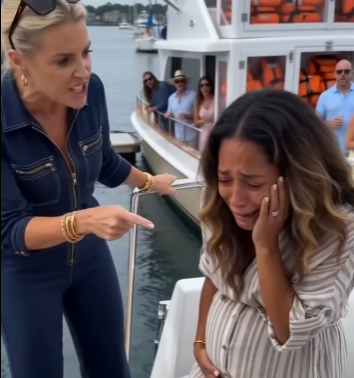
The slap cracked across my cheek in front of the guests.
It wasn’t dramatic like in movies. My head didn’t snap wildly. I didn’t collapse. There was no blood, no scream, no overturned table.
It was worse because it was so quick.
So casual.
As if my body were just another surface she had the right to correct.
My knees bent. My hand flew to my cheek, and tears came before I could stop them.
The deck froze.
A champagne flute tapped against a metal rail.
Someone gasped.
A child said, “Mom?”
Scout had been sleeping near the stairs.
He exploded up the deck with a deep warning bark.
Not a playful bark. Not panic. A low, chest-deep sound that seemed to roll over the white cushions and polished chrome and perfect little trays of food.
Caroline flinched.
“Get that dog away from me.”
Luke stepped between us.
“Don’t touch her again.”
Caroline, either too furious or too used to getting her way, reached past him toward my arm.
Scout moved.
He did not bite her.
He did not attack like some wild animal.
He rammed his shoulder into her side with one hard, sudden shove, the way he had been trained to block someone from crowding me.
Caroline stumbled backward on the damp teak.
Her gold sandal slid.
Her arms windmilled once.
Then she dropped over the low side opening beside the marina steps and splashed into the water.
For one breath, nobody moved.
Then the yacht erupted.
“Oh my God!”
“Caroline!”
“Throw something!”
“Get her!”
Grant Whitmore shouted her name from the upper deck. Someone grabbed towels. A guest reached for a decorative throw pillow like that would help. Daryl, the captain, moved faster than anyone, yanking open a side gate and tossing a floating ring with practiced precision.
Not from the locked cabinet.
From a storage bin under the captain’s bench.
Caroline surfaced, sputtering, hair plastered to her face, sunglasses gone.
“I’m fine!” she snapped, which was such a Caroline thing to say that under different circumstances I might have laughed.
Scout stood in front of me, trembling with contained energy, his body angled between Caroline and my knees.
Luke gripped my shoulders.
“Emily. Look at me. Are you hurt?”
I touched my cheek.
“No. I mean… I don’t know.”
“Sit down.”
“I’m okay.”
“You’re shaking.”
“I’m pregnant and your boss’s wife just hit me on a yacht with locked life jackets.”
He stared at me for a second.
Then said, very quietly, “Sit down.”
This time I did.
A woman named Natalie brought me water. Another guest crouched in front of me and asked if I wanted a doctor. I shook my head because I could still feel the baby moving, a strange rolling motion under my ribs, and that was the only thing keeping me from breaking down completely.
On the dock side, Daryl and another man helped Caroline toward the swim ladder.
She was furious even in the water.
“Get that dog off my boat!”
Luke turned.
“That dog just stopped you from putting hands on my pregnant wife again.”
Caroline grabbed the ladder.
“He knocked me into the marina!”
“You reached for her after hitting her.”
“I did not hit her.”
The deck seemed to inhale.
People looked at one another.
One teenager near the snack table lifted his phone slightly.
Natalie said, “Caroline, we all saw it.”
Caroline’s face changed.
For the first time, she realized the problem was not that she was wet.
It was that she was witnessed.
She climbed halfway up, dripping, mascara streaking faintly under one eye.
“Turn off your phones,” she snapped. “This is private property.”
Nobody moved.
Then her designer tote tipped over.
It had been sitting on a narrow bench beside the rail, heavy leather, cream-colored, probably worth more than our monthly rent. When she slipped, she must have kicked it. Now it sagged open, contents spilling onto the deck.
Lipstick. Sunglasses case. Gold compact. A key fob. Receipts. A folded cream cardigan.
And a yellow paper that slid across the damp teak until it stopped near my bare foot.
Scout lowered his nose.
I picked it up before anyone else could.
At the top was a seal.
United States Coast Guard.
My pulse slowed in a terrible way.
NOTICE OF DEFICIENCY.
I read only pieces at first.
Required personal flotation devices inaccessible.
Emergency equipment obstructed or secured against immediate use.
Correction required prior to passenger operations.
Inspection conducted: two days earlier.
Two days.
I looked at the locked cabinet.
Then at Caroline, still on the ladder, water dripping from her chin.
She saw the paper in my hand.
Her face drained.
“Give me that.”
Luke stepped in front of me.
“No.”
Grant Whitmore came rushing down from the upper deck.
“What the hell is going on?”
Caroline pointed at me from the ladder.
“She stole from my bag.”
I stood slowly.
“I picked up the Coast Guard notice that fell out of it.”
That phrase changed everything.
Not because everyone knew what it meant.
Because everyone understood Caroline did.
Grant froze.
“Caroline?”
She reached for the deck edge.
“Grant, get me out first.”
Before he could answer, a man in a Coast Guard jacket stepped from the dock.
He had been standing near a mooring post, half-hidden behind a stack of dock carts, holding a clipboard. I hadn’t noticed him before. Nobody had.
He looked at Caroline in the water.
Then at the locked cabinet.
Then at the yellow notice in my hand.
“Ma’am,” he said, voice calm and sharp enough to cut rope, “we need to talk right now.”
Caroline stopped climbing.
For the first time all afternoon, she had nothing to say.
The man stepped closer to the yacht.
“Petty Officer Daniel Ruiz, Coast Guard Sector Los Angeles-Long Beach. Captain Daryl, please secure the vessel and keep all passengers aboard for the moment.”
Daryl closed his eyes as if he had been expecting the end of the world and it had finally arrived on schedule.
“Yes, sir.”
Grant looked from Ruiz to Daryl.
“Daryl?”
The captain did not meet Caroline’s eyes.
“I told her we shouldn’t leave the dock.”
Caroline snapped, “Daryl.”
He turned toward her then, and something in his face had gone tired enough to become brave.
“I told you twice. After the inspection. This morning. Again before boarding.”
Grant’s mouth opened.
No words came out.
A child started crying near the stairs.
Natalie gathered the kids toward the shaded bench.
Petty Officer Ruiz stepped onto the yacht.
Scout growled once, low.
“It’s okay,” I whispered.
Ruiz glanced at him.
“That the dog that alerted?”
Luke answered.
“He stopped her from grabbing my wife again.”
Caroline finally climbed onto the deck, soaked and furious, wrapping a towel around herself like a queen receiving a damaged robe.
“That dog assaulted me.”
Ruiz looked at me.
“Ma’am, are you injured?”
“My cheek hurts. I’m pregnant. I’m mostly scared.”
“Do you need medical assistance?”
Luke said, “Yes.”
I started to protest.
He looked at me.
“Emily.”
I stopped.
“Yes,” I said quietly. “I should be checked.”
Caroline rolled her eyes.
Ruiz saw it.
He wrote something down.
Then he looked at the cabinet.
“Who has the key?”
No one answered.
Caroline tightened the towel around her shoulders.
“These are decorative storage cabinets. There are flotation devices elsewhere.”
Daryl pointed under the captain’s bench.
“There are six throwables and four adult vests in that bench. Not enough for this passenger count. The rest are in the locked cabinet.”
“How many souls aboard?” Ruiz asked.
Daryl answered immediately.
“Twenty-two adults, six minors, one dog.”
Ruiz looked at Caroline.
“And the key?”
Grant turned to her.
“Caroline, where is the key?”
Her lips pressed together.
“In my wet bag.”
Nobody moved.
Then everyone looked at the marina water.
Something small and metallic floated briefly near the hull before sinking out of sight.
Caroline’s face gave her away.
Ruiz did not need more.
“Captain, this vessel will not continue operating today.”
Guests started murmuring.
“What does that mean?”
“We’re going back?”
“We haven’t even left the harbor.”
“Wait, was this illegal?”
Caroline snapped, “Nobody is in danger.”
Ruiz turned toward the children gathered by Natalie.
“Locked life jackets on a passenger vessel are a danger.”
A man in a navy polo said, “But we’re just in the harbor.”
Ruiz looked at him.
“Most accidents don’t wait for deep water.”
The man shut his mouth.
I sat back down, suddenly too aware of my body. The baby shifted again, a firm roll, and I pressed my palm over the movement.
Luke crouched beside me.
“Stay with me.”
“I’m here.”
“Your cheek.”
“I know.”
“I should’ve moved faster.”
“You moved.”
“Not fast enough.”
I looked at Scout, standing alert beside my knee, wet paw prints darkening the deck around him.
“Scout did.”
Luke lowered his head.
For a moment, I thought he might cry.
Grant approached Caroline slowly.
“What inspection?”
She clutched the towel.
“It was routine.”
“What inspection, Caroline?”
“It wasn’t final.”
Ruiz stepped in.
“The notice was issued two days ago. Required corrections before carrying invited passengers beyond dockside activity.”
Grant stared at her.
“You said the paperwork was handled.”
“It was.”
“No, it clearly wasn’t.”
Caroline’s voice sharpened.
“Don’t do this in front of everyone.”
Grant laughed once, not with humor.
“In front of everyone? You slapped a pregnant woman in front of everyone.”
“She was humiliating me on my boat.”
“She asked about life jackets.”
“She was making a scene.”
“No,” Natalie said from near the children. “She asked why safety gear was locked.”
Caroline turned on her.
“Stay out of it.”
Natalie’s face hardened.
“My kids are on this yacht.”
That was when the guests fully shifted.
Before, some had been uncomfortable but quiet. Some wanted to preserve the afternoon. Some still hoped this could be reduced to rich-people awkwardness, a damp hostess and a pregnant guest overreacting.
But children change the weight of silence.
A father reached for his son’s shoulder.
A grandmother pulled a little girl closer.
A guest looked at the locked orange vests with a new expression, not annoyance anymore, but fear.
Ruiz asked Daryl for the passenger manifest.
Caroline said, “There is no manifest. This is private.”
Daryl reached into a drawer and handed over a clipboard.
Caroline looked betrayed.
“You kept one?”
Daryl met her eyes.
“I like staying licensed.”
That was the first time I almost smiled.
Almost.
Ruiz reviewed the names.
Then paused.
“Mrs. Whitmore, why is this listed as a dockside event?”
Caroline said nothing.
Grant leaned over.
“What?”
Ruiz turned the clipboard slightly.
“The filed plan indicates private dockside reception. No harbor cruise.”
Grant looked at Daryl.
Daryl sighed.
“She told me guests didn’t need to know. Said we’d do a short loop, no big deal.”
Caroline snapped, “Because it is no big deal.”
Ruiz looked at the locked cabinet again.
“It became one when you boarded passengers, minors included, with required safety equipment inaccessible.”
Caroline’s wet hair clung to her neck. Without the sunglasses, without the height of her perfect sandals, without the polished hostess voice, she looked smaller. Not sorry. Just exposed.
Then Scout moved.
He walked toward her tote.
“Scout,” I said.
He sniffed the spilled contents, nudged the cream cardigan aside, and pawed gently at a zippered inner pouch.
Caroline lunged.
“Don’t let that dog touch my things!”
Luke stood.
“Don’t move toward him.”
Ruiz raised a hand.
“Ma’am, step back.”
Caroline froze.
Scout looked at me.
I knew that look.
He had found something.
I looked at Ruiz.
“He alerts when something is wrong. May I?”
Ruiz considered for one second.
“Do not disturb anything beyond opening the pouch. I’ll observe.”
Caroline’s voice went high.
“You cannot search my purse because a dog sniffed it.”
Ruiz said evenly, “You may refuse. But given the notice already in plain view, the passenger statements, and the safety violation, we can preserve the bag and proceed formally.”
Grant turned to Caroline.
“What else is in there?”
She said nothing.
That was answer enough.
Ruiz put on gloves and opened the pouch himself.
Inside was a small brass key on a white ribbon.
Not in the water.
Not lost.
Right there.
Beside it was a folded piece of paper with printed text and handwritten notes.
Ruiz opened it.
His expression changed slightly.
“What is it?” Grant asked.
Ruiz read aloud only the top line.
“Guest experience notes.”
Caroline closed her eyes.
Grant reached for it.
Ruiz moved it away.
“I’ll keep this preserved.”
But I had already seen part of the page.
A seating diagram.
Names.
Arrows.
Comments.
Keep safety cabinet locked. Visual clutter.
Tell Daryl not to mention inspection.
Move Emily away from cabinet if she asks questions.
Dog may be a problem.
No orange vests in photos.
Dog may be a problem.
I looked at Scout.
My good, inconvenient, problem dog.
Luke’s face had gone white.
“You planned to keep her from asking?”
Caroline’s voice came out cold.
“I planned to keep the event elegant.”
“With locked life jackets and kids onboard?” Natalie asked.
Caroline snapped, “This is not a public ferry full of tourists in plastic ponchos. It is my yacht.”
Ruiz’s pen stopped.
“Mrs. Whitmore, do you understand that safety requirements don’t disappear because the vessel is expensive?”
The simplicity of that sentence seemed to embarrass her more than any insult could.
Grant rubbed his forehead.
“Caroline, what did you do?”
She rounded on him.
“What did I do? I hosted the event your partners expected. I kept the yacht beautiful. I made sure the photos looked right. Do you know what people say when they see orange life jackets all over a luxury deck? They think something is wrong.”
“Something was wrong,” I said.
She turned toward me.
“You.”
Scout growled.
She stopped.
“You were wrong,” I said quietly. “Before I said anything.”
Her face twisted.
“You were invited because Grant insisted Luke mattered at work. Not because anyone wanted a pregnant woman and a dog ruining the atmosphere.”
Luke took one step forward.
Grant spoke first.
“Enough.”
Caroline looked at her husband like he had slapped her.
Grant’s voice trembled, but he held it.
“Enough, Caroline. You hit her. You lied about the inspection. You locked safety gear. You put children on this yacht.”
“I put children on a yacht in a marina, not in a storm.”
Ruiz said, “That is not a defense.”
The paramedics arrived at the dock ten minutes later.
By then the yacht had been secured. Guests were being moved off in small groups, names checked against the manifest. Children first. Then older guests. Then anyone who had given statements.
I didn’t want to be carried off dramatically. I walked with Luke on one side and Scout on the other, one hand on the rail, the other under my belly.
As I stepped onto the dock, I looked back.
The locked cabinet still glowed softly, orange life jackets lit like boutique merchandise.
It made me sick.
A paramedic named Alicia checked my blood pressure while I sat on a dock bench wrapped in a blanket I hadn’t asked for but needed. My cheek was warm, my hands were cold, and the baby kept moving like she was annoyed at the whole afternoon.
“Baby’s active?” Alicia asked.
“Yes.”
“Good. We still recommend evaluation, given the stress and the fall risk.”
“I didn’t fall.”
“No, ma’am. But stress counts.”
I liked how she said that.
Stress counts.
So many people spend years telling women that stress only counts when it becomes visible enough to inconvenience someone else.
Luke stood nearby, answering Officer Ruiz’s questions. Scout lay under the bench, his chin on my foot.
Grant came over after giving his statement.
He looked older than he had an hour earlier.
“Emily,” he said.
Luke stepped closer.
Grant lifted both hands slightly.
“I’m not here to defend her.”
I didn’t respond.
He swallowed.
“I’m sorry. Deeply. I didn’t know about the failed inspection.”
I believed that part.
Not because Grant was innocent in all things. Men like Grant often benefited from women like Caroline making ugly things look effortless. But his shock had looked real.
“I should have paid attention,” he said. “It’s my yacht too.”
“Yes,” I said.
He took that like he deserved it.
“I’ll cover any medical costs. Anything you need.”
Luke’s jaw tightened.
“We don’t need hush money.”
Grant flinched.
“That’s not what I meant.”
“Good,” Luke said.
Grant looked at me.
“I’ll give the Coast Guard everything. The event notes. Messages. Whatever she sent.”
That mattered.
So I nodded once.
Caroline was still on the yacht, now wrapped in a white robe, giving a statement that looked more like a performance than cooperation. Every few seconds, she glanced toward us, her eyes sharp with blame.
Even wet, exposed, and caught, she still seemed to believe the real offense was that we had made her look bad.
Ruiz eventually came to me.
“Mrs. Carter, I need to ask about the contact before the incident.”
“Okay.”
“She struck you after you questioned the cabinet?”
“Yes.”
“Did you touch her first?”
“No.”
“Did your dog bite her?”
“No. He moved between us. She was reaching for my arm again. He bumped her away.”
Ruiz looked down at Scout.
“He trained?”
“Basic response training. He blocks when people crowd me. He alerts when I’m dizzy. He stays with me.”
“He did his job.”
Scout thumped his tail once.
Luke said, “He saved her from being grabbed.”
Ruiz nodded.
“I’ll document passenger statements. There’s also vessel footage, according to the captain.”
Caroline’s voice carried across the dock.
“That dog is dangerous!”
Natalie, standing with her children, shouted back, “Your locked cabinet was dangerous!”
A few guests clapped once, awkwardly, then stopped because the situation was too serious for applause.
But the point had landed.
Caroline was no longer controlling the room.
Or the dock.
Or the story.
At the hospital, they monitored me for two hours.
The baby was fine.
I said it three times out loud before I believed it.
The baby was fine.
Luke sat beside me, one hand wrapped around mine.
“I’m sorry,” he said.
“You already said that.”
“I’m saying it again.”
“For what?”
“For almost telling you to let it go.”
I turned to him.
He looked ashamed.
“When Caroline said not to touch anything, I almost did that thing,” he said. “The keep-the-peace thing. The it’s-her-boat thing. I didn’t say it, but I thought it for half a second.”
I appreciated that he admitted it.
I hated that it was true.
“I’m glad you didn’t.”
“I’m glad you didn’t either.”
Scout lifted his head from the corner where he had been allowed to stay after Luke explained the situation to the nurse and the nurse, apparently a Labrador person, decided he was cleaner than half the humans she saw.
“He knew,” Luke said.
“Yes.”
“Dog may be a problem,” Luke murmured.
I looked at him.
He shook his head.
“That line. In Caroline’s notes.”
My chest tightened.
“She knew Scout might stop her from controlling the scene.”
“She knew you’d notice the cabinet.”
That was the part I kept returning to.
Caroline had not been shocked that I saw the life jackets.
She had expected it.
Move Emily away from cabinet if she asks questions.
That meant my concern wasn’t random to her. It was a risk she had planned for. Not the risk of people drowning. Not the risk of children running across damp teak with life jackets locked away.
The risk of being called out.
The next morning, my phone was full of messages.
Some from guests.
Some from numbers I didn’t know.
Natalie wrote:
You were right. I keep thinking about my kids next to that rail. Thank you for saying something.
The woman whose son had nearly slipped wrote:
I’m ashamed I didn’t speak up when she hit you. I will give a statement.
Daryl, the captain, sent a message through Grant:
Tell Scout I owe him a steak.
I smiled at that one.
Then came the messages from Caroline’s friends.
Not apologies.
Warnings disguised as concern.
This has gotten blown out of proportion.
Caroline is devastated.
You know how social media twists things.
Maybe don’t ruin a woman’s life over a stressful moment.
She fell in the water too, remember.
She fell in the water too.
As if the marina had slapped her.
As if the water had locked the cabinet.
As if the ocean itself had forged the Coast Guard notice and hidden the key in her tote.
Luke read one message and said, “Block them.”
So I did.
Caroline tried a different route by evening.
A formal email arrived from an attorney.
It referred to the incident as “a misunderstanding involving an emotional guest and an unrestrained animal.”
Luke read that sentence aloud and stopped halfway because his voice changed.
I took the phone from him and read it myself.
Emotional guest.
Unrestrained animal.
Luxury property damage.
Reputational harm.
No mention of the slap.
No mention of the locked life jackets.
No mention of children.
No mention of the Coast Guard notice.
No mention of her own notes saying to keep the safety cabinet locked because orange vests ruined photos.
I forwarded it to the attorney Grant had recommended, then to Ruiz, then to myself.
The truth had to be stored in more than one place.
I had learned that much.
Two days later, Grant called Luke.
Luke put him on speaker after asking me.
Grant sounded exhausted.
“She’s trying to say Emily staged it.”
I laughed before I could stop myself.
Scout opened one eye.
“Of course she is,” I said.
Grant exhaled.
“I gave Ruiz the security footage.”
I sat up.
“And?”
“It shows the slap. It shows her reaching again. It shows Scout blocking. It shows her falling.”
“And the cabinet?”
“Yes. Daryl also gave them footage from before boarding. Caroline instructing staff not to unlock it unless the Coast Guard came back.”
Luke’s face darkened.
Grant continued.
“There are messages too. She told the event planner that safety equipment had to stay hidden because the yacht looked ‘cheap’ with compliance gear out.”
I closed my eyes.
Compliance gear.
Another clean phrase for the thing that keeps people alive.
Grant’s voice softened.
“I’m sorry, Emily. I know that doesn’t fix it.”
“No,” I said. “But giving them the footage helps.”
“She’s angry I did.”
“I imagine.”
“She says I chose your side.”
Luke said, “There shouldn’t have been sides.”
Grant was quiet.
Then he said, “I know.”
The investigation did what investigations do: slowly turned a humiliating public moment into documents, statements, timelines, and facts nobody could slap away.
The Coast Guard confirmed the yacht had failed the inspection two days earlier.
Life jackets were inaccessible.
The cabinet lock did not have an emergency release.
Passenger count exceeded readily available flotation devices.
The event had been represented as dockside.
Caroline had proceeded with a harbor cruise plan anyway.
Children had boarded.
Alcohol had been served.
The captain had objected.
Caroline had overruled him until the moment a pregnant woman said, out loud, what everyone should have cared about.
The ocean does not care about your aesthetic.
That line spread among the guests.
Someone must have said it to someone, who said it to someone else. By the end of the week, I heard from Natalie that it had become the sentence people repeated when explaining why they gave statements.
Not because it was clever.
Because it was true.
Caroline’s social circle tried to protect her at first.
Then the inspection notice became known.
Then the notes.
Then the footage.
Support turned into silence, and silence turned into distance.
The charity committee removed her from an upcoming gala “pending review.” Her skincare brand postponed a launch. The yacht stopped appearing in her posts. For once, the luxury look could not cover the locked cabinet behind it.
As for me, I had no interest in becoming part of her scandal.
I wanted quiet.
I wanted the baby to keep kicking.
I wanted Scout’s head on my lap, Luke beside me, and no more rich women telling me safety was ugly.
But quiet does not always mean disappearing.
So when Ruiz asked if I would give a full statement, I did.
I described the deck.
The children.
The damp teak.
The cabinet.
The lock.
Caroline’s words.
The slap.
Scout’s warning bark.
Her hand reaching for me again.
The fall.
The tote.
The notice.
The key.
The notes.
I did not exaggerate.
I didn’t need to.
The truth was bad enough.
A month later, our daughter was born.
We named her Nora.
She arrived on a foggy morning, small and loud and furious at being cold. Luke cried harder than she did. I was too tired to laugh, but I remember thinking that her first sound had more authority than Caroline Whitmore on her best day.
Scout met her two days later at home.
He sniffed her blanket, then lay down in front of the bassinet like he had been assigned to guard a queen.
“You already saved her once,” Luke whispered.
Scout sighed.
Weeks passed before I could think about the yacht without my cheek remembering the slap.
That was the strange part. The mark faded quickly. The humiliation did not.
Sometimes I would be brushing my teeth or folding tiny onesies and suddenly I’d be back on the deck: the white cushions, the orange vests locked like decoration, Caroline saying safety gear ruined the luxury look, everyone watching to see if I would make things uncomfortable by caring.
That, more than the slap, stayed with me.
The moment before.
The moment when a room full of adults could have said, She’s right. Unlock the cabinet. Move the children. Stop being ridiculous.
But people waited.
People often wait until proof arrives loudly enough to save them from courage.
In my case, proof had four paws and no patience.
Three months after Nora was born, a package arrived.
No return name.
Inside was a framed photograph.
Not from Caroline’s glossy event photographer. This was a still from someone’s phone, slightly blurry, taken seconds after the truth came out.
In the photo, I was sitting on the deck bench with one hand on my belly and one on Scout’s collar. Luke was crouched beside me. Scout stood tall, still staring toward Caroline. Behind us, the clear cabinet of life jackets glowed orange.
On the back, someone had written:
He saw the danger before the rich people did.
I never found out who sent it.
I hung it in the hallway.
Not because I wanted to remember being slapped.
Because I wanted my daughter to grow up in a house where safety was not considered ugly.
Where asking a question did not make her rude.
Where a locked life jacket was not treated as decoration.
Where a woman’s body was not touched because someone richer felt embarrassed.
Where luxury never outranked common sense.
Where “don’t make a scene” never meant “ignore the danger.”
Sometimes visitors ask about the photo.
I tell them the short version.
A woman locked the life jackets on her yacht because she thought orange ruined the pictures.
Scout disagreed.
They usually laugh at first.
Then they look again.
At the cabinet.
At my face.
At Scout’s stance.
At the little curve of Nora still inside me.
And they stop laughing.
Good.
Some stories should not stay pretty.
The Newport Beach cruise looked rich and harmless from the dock. White yacht, gold lettering, polished railings, music floating over calm water.
But danger does not always look dramatic.
Sometimes it looks expensive.
Sometimes it wears linen.
Sometimes it smiles and says, Don’t touch that.
Sometimes it locks the thing that could save you behind a clear cabinet and calls it design.
And sometimes the only one willing to ruin the luxury look is a Labrador who understands that safety was never meant to be decoration.
