The first seed packet hit the ground before Isabelle Carrington shoved me.
It slipped from the folder pressed against my chest, fluttered once in the warm South Carolina air, and landed faceup in the dark soil beside my gray sneaker.
The expiration date was visible.
MARCH 2023.
For one silent second, Isabelle stared at it.
Then she drove both hands into my shoulders.
I stumbled backward into the wooden edge of a raised garden bed. Pain shot through my hip, and my light puffer jacket snagged on a protruding screw. The folder flew open. Photographs scattered across the mulch like oversized playing cards.
Around us, students gasped.
Then the phones came up.
That was how quickly a school garden became a courtroom.
Nobody asked why Isabelle had shoved me.
Nobody looked at the dates printed on the seed packets.
Nobody noticed the photographs showing her glossy mini bag beside an open storage cabinet.
They saw Isabelle Carrington standing over me in an expensive cropped cardigan and cream silk trousers that somehow remained spotless even during after-school planting.
Then they saw me.
Nola Phillips.
Seventeen years old, Irish American, dressed in black track pants, a practical puffer jacket, and gray sneakers stained with red clay.
Isabelle looked like someone who belonged in front of cameras.
I looked like someone who should carry the soil behind them.
She knew the difference mattered.
“You went through my things,” she said loudly.
Her voice trembled with just enough emotion to sound injured rather than frightened.
I pushed myself away from the garden bed.
“I never touched your things.”
“You photographed my bag.”
“I photographed the supply station.”
“You’ve been following me all morning.”
“That isn’t true.”
A student near the greenhouse whispered, “She does seem obsessed.”
Someone else replied, “Isabelle raised almost all the money for this garden.”
I crouched to gather the photographs, but Isabelle planted one cream-colored loafer on the corner of the nearest image.
“Leave them,” she said.
The photograph beneath her shoe showed a cardboard box filled with seed packets.
Half the packets had green labels.
The other half had faded yellow labels.
The yellow ones were expired.
My hands shook, but I kept my voice steady.
“Move your foot.”
She looked down at me with a faint smile.
“Or what?”
Before I could answer, Mr. Hanley, the environmental science teacher, hurried across the garden.
“What is going on?”
Isabelle stepped back immediately.
The transformation was almost impressive.
Her shoulders lowered. Her eyes filled. Her voice softened.
“Nola attacked me.”
I stared at her.
“You shoved me.”
“She grabbed my bag.”
“I never touched it.”
“She has been accusing me of sabotaging the garden.”
Mr. Hanley looked between us.
Twenty students surrounded the raised beds. Several were filming. A group from the student council had been painting signs near the fence. Two members of the gardening club stood beside trays of tomato seedlings.
There were enough witnesses to create a school-wide scandal.
There were not enough who had seen how it began.
Mr. Hanley looked at the photographs on the ground.
“What are those?”
“Nothing,” Isabelle said.
“Evidence,” I said at the same time.
Her head snapped toward me.
That was the first time the crowd saw real fear on her face.
It vanished almost instantly.
“Nola has been trying to embarrass me since the garden project started.”
“I’ve been checking the seed inventory.”
“You’re not the inventory manager.”
“I was assigned to record germination results.”
“That means counting sprouts, not spying on people.”
Mr. Hanley raised one hand.
“Everyone stop.”
The phones did not lower.
He looked at me.
“Nola, start from the beginning.”
I picked up the expired packet.
“The winter vegetable seeds were switched.”
Isabelle laughed.
It was not a happy sound.
“They failed to grow. That happens.”
“Not to almost every tray.”
“The weather changed.”
“The trays were kept in the greenhouse.”
“You watered them wrong.”
“I used the schedule you approved.”
“You probably misread it.”
That was Isabelle’s favorite kind of accusation.
Small enough to sound believable.
Vague enough to be difficult to disprove.
For three weeks, our school garden project had been failing.
The garden was supposed to be the pride of Briarwood Academy’s spring community program. Students had raised money to grow vegetables for two local food banks. The project had received a city youth-service grant and a large private donation from the Carrington Family Foundation.
Isabelle stood at the center of it.
She chaired the student service council.
Her mother ran the foundation.
Her photograph appeared in the school newsletter holding a watering can beside a row of perfect lettuce seedlings that had been purchased from a nursery ten minutes before the picture was taken.
Behind the polished images, the real planting beds were nearly empty.
Carrot trays produced weak, yellow shoots.
Bean seeds turned soft beneath the soil.
Tomato seeds never broke open.
At first, everyone blamed the weather.
Then they blamed the soil.
Then Isabelle began blaming me.
I had been responsible for recording germination rates, which meant I was the first person to notice the pattern.
Every failed tray came from seed packets distributed after February tenth.
Packets opened before that date grew normally.
The difference did not make sense until I found an expired packet in the recycling bin.
Then I checked the storage cabinet.
The current seeds were gone.
In their place were boxes of old packets donated years earlier and marked for disposal.
Mr. Hanley took the packet from me.
His eyebrows drew together.
“This expired last year.”
“Two years ago,” I corrected.
He turned it over.
Isabelle folded her arms.
“That could have come from anywhere.”
“It came from tray seven.”
“You cannot prove that.”
I held up one of the photographs.
“I photographed the packet before I removed it.”
“After you put it there.”
A few students murmured.
Isabelle heard them and became bolder.
“She has been trying to take over the project. She hated that I was selected to present it at the city service awards.”
I felt the old, familiar pressure behind my eyes.
The urge to disappear.
It was one thing to know someone was lying.
It was another to stand in front of a crowd while the lie turned your quiet work into jealousy.
“I never wanted your award,” I said.
“That’s convenient.”
“I wanted the vegetables to grow.”
Her smile became pitying.
“Of course you did.”
The crowd shifted.
That small sentence changed the story.
Now I was not a student protecting a garden project.
I was a bitter girl making excuses for her own failure.
Isabelle reached for the folder.
I pulled it against my chest.
“Give it to Mr. Hanley,” she said.
“I will.”
“Then do it.”
“When everyone sees the photographs.”
Her face hardened.
“You don’t get to publicly display pictures of me.”
“If they are irrelevant, why are you afraid of them?”
Her cheeks flushed.
“I am not afraid of anything you have.”
Mr. Hanley stepped between us.
“Nola, give me the folder.”
I hesitated.
He had taught me for two years. He was kind, but his program depended on foundation funding. The Carrington name appeared on the greenhouse plaque, the tool shed, and the new irrigation system.
Good adults could still become cautious when money entered the room.
“Please,” he said.
I handed him the folder.
Isabelle relaxed.
Too quickly.
Mr. Hanley examined the photographs.
The first showed the seed cabinet at 3:47 p.m. the previous Friday.
Inside were twelve boxes of current seeds purchased from Palmetto Agricultural Supply.
The lot numbers were visible.
The second photograph showed the cabinet at 4:12 p.m.
The current boxes were gone.
Expired yellow-labeled packets had replaced them.
The third photograph showed Isabelle standing beside the cabinet.
Her glossy black mini bag rested on the potting table.
The cabinet door was open behind her.
Mr. Hanley looked up.
“Isabelle?”
“I was organizing supplies.”
“The current seeds were present before you arrived and missing afterward.”
“That does not prove I moved them.”
The fourth photograph showed the cardboard disposal box sitting beside her bag.
The fifth showed the same box inside the cabinet.
The sixth showed a corner of a green seed packet protruding from Isabelle’s bag.
Students leaned closer.
Isabelle’s voice sharpened.
“Those images have been manipulated.”
“They came from my phone,” I said.
“That means nothing.”
“The original files include timestamps.”
“You could have changed them.”
“Not the cloud backup.”
For the first time, she stopped answering immediately.
Mr. Hanley turned to me.
“What cloud backup?”
“My phone uploads every photograph automatically to the school garden account. You gave me access for the germination records.”
He remembered.
I saw it in his face.
Isabelle saw it too.
She reached toward the folder.
“I want to see the originals.”
“So does everyone else,” I said.
Her hand shot forward.
She grabbed the photographs.
I held on.
The folder tore between us.
Images spilled across the soil again.
Then a quiet voice came from behind the crowd.
“Open the garden account.”
Everyone turned.
A freshman named Eli Navarro stood near the fence holding a watering hose.
Eli barely spoke during club meetings. He had joined because his grandmother ran one of the food banks that was supposed to receive the vegetables.
He looked at Mr. Hanley.
“The originals should still be there.”
Mr. Hanley removed his phone.
Isabelle stepped toward him.
“Wait.”
He looked at her.
“If the photographs were manipulated, the originals will clear that up.”
“That account contains private student information.”
“No, it contains plant records.”
“My image is private.”
“You were photographed in a shared school workspace.”
Her mother’s influence had taught her how to sound authoritative even when she was cornered.
But the crowd had begun to change.
Phones were no longer pointed only at me.
They were pointed at Isabelle.
Mr. Hanley opened the account.
He signed in.
For several seconds, nothing happened.
Then he frowned.
“The folder is empty.”
Isabelle exhaled.
It was barely audible.
I heard it.
“So Nola deleted the originals,” she said.
“I didn’t.”
“You just claimed the account protected them.”
“I uploaded them this morning.”
“Well, they aren’t there.”
The crowd turned toward me again.
That was how fragile truth could be.
One empty folder, and everything I had shown became suspicious.
Mr. Hanley looked disappointed.
Not angry.
Disappointed was worse.
“Nola, did you access the folder after uploading the images?”
“Yes, but I didn’t delete anything.”
“Who else has the password?”
“You, me, Isabelle, and the service council media team.”
Isabelle spread her hands.
“So at least eight people.”
“Only you were photographed switching the seeds.”
“I was photographed near a cabinet.”
She bent to pick up the image showing the green packet in her bag.
“This is a reflection.”
“It isn’t.”
“It could be anything.”
“It has the same lot stripe as the new packets.”
She tore the photograph in half.
The sound was small.
The reaction was not.
Several students gasped.
Mr. Hanley stared at her.
“Why did you do that?”
Isabelle looked at the torn pieces in her hands as though she had only just realized what she had done.
“It was a picture of me taken without permission.”
“That was evidence.”
“Evidence of nothing.”
She tore it again.
Then she dropped the pieces into the soil.
I stared at them.
My hands stopped shaking.
Until that moment, some part of me had still wondered whether I was wrong.
Maybe I had misunderstood the sequence.
Maybe someone else had moved the seeds.
Maybe Isabelle’s bag had been open for another reason.
But innocent people did not destroy the one image that could settle the question.
“She deleted the online folder,” I said.
Isabelle laughed.
“You cannot prove that either.”
“I don’t need to.”
Her expression flickered.
I reached into the inner pocket of my puffer jacket.
Inside was a small blue memory card.
“I made a second backup.”
The garden erupted.
Isabelle lunged toward me.
Mr. Hanley caught her arm.
“Stop.”
“Give me that card!”
Her voice cracked across the garden.
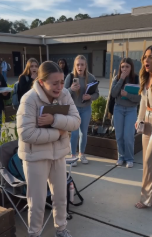
Not polished.
Not controlled.
Terrified.
Mr. Hanley stared at her.
“Why?”
Isabelle looked around.
Everyone had heard her.
She tried to recover.
“Because she stole private photographs.”
“You said they were fake,” Eli called from the fence.
A few students murmured in agreement.
Isabelle turned toward him.
“Stay out of this.”
“My grandmother was promised vegetables,” he replied. “You gave her dead seeds.”
The words struck harder than any accusation I had made.
Isabelle’s face went white.
Mr. Hanley held out his hand.
“Nola, the card.”
I gave it to him.
He walked toward the greenhouse office where an old desktop computer sat beside the planting records.
The crowd followed.
Isabelle did not.
She stood beside the raised bed, staring at the torn photograph in the soil.
I remained a few feet away.
“You could have explained,” I said quietly.
She looked at me.
“You think you understand everything because you took a few pictures?”
“I understand you replaced the seeds.”
“You understand nothing.”
“Then tell me.”
Her eyes filled with sudden fury.
“You don’t get to stand there in your cheap jacket and act morally superior.”
The insult should have hurt.
Instead, it revealed something.
“You keep talking about my clothes.”
“Because you want everyone to think being ordinary makes you honest.”
“I never said that.”
“You enjoy looking like the victim.”
“You shoved me.”
“Because you were destroying something bigger than you.”
“What?”
She glanced toward the greenhouse.
For a moment, I thought she might answer.
Then a black SUV stopped beside the garden gate.
The rear door opened.
Vivian Carrington stepped out.
Isabelle’s mother moved through the garden like a person arriving at a board meeting rather than a school conflict. She wore a camel coat, narrow sunglasses, and heels that sank slightly into the mulch.
Principal Carmichael followed her.
The speed of their arrival told me Isabelle had already sent a message.
Vivian looked at her daughter first.
Then at me.
“What has she done?”
Not what happened.
What has she done?
Isabelle did not answer.
Principal Carmichael approached Mr. Hanley at the greenhouse door.
“I understand a student accessed unauthorized records.”
“Nola documented an inventory problem,” Mr. Hanley said.
Vivian removed her sunglasses.
“She photographed my daughter and distributed the images.”
“She showed them to the supervising teacher.”
“In front of dozens of students.”
“After Isabelle shoved her.”
Vivian turned slowly toward me.
“Did you touch my daughter?”
“No.”
“Did you photograph her without her knowledge?”
“I photographed the seed cabinet.”
“She appears in the images.”
“Because she was standing in front of it.”
Vivian’s smile contained no warmth.
“You seem very certain of your rights.”
“I’m certain the new seeds were switched for expired ones.”
Her gaze dropped to my shoes.
It lasted less than a second.
But I saw where Isabelle had learned it.
Principal Carmichael cleared his throat.
“We should discuss this inside.”
“Not before we see the card,” Mr. Hanley said.
Vivian looked at him.
“What card?”
“The backup photographs.”
Isabelle stepped toward her mother.
“Mom.”
One word.
One warning.
Vivian’s expression did not change.
“Give it to me.”
Mr. Hanley hesitated.
“It is school project material.”
“It contains images of a minor.”
“So does every school event photograph.”
“My daughter did not consent.”
Eli spoke again.
“Did the food bank consent to expired seeds?”
The crowd went silent.
Vivian turned toward him.
“What is your name?”
“Eli Navarro.”
“I suggest you be careful about repeating accusations you cannot support.”
“My grandmother opened a greenhouse space for this project. She spent money preparing shelves for vegetables that never came.”
“That is unfortunate.”
“Not unfortunate,” he said. “Planned.”
The word hung in the air.
Vivian’s face tightened.
Principal Carmichael ordered the students to return to planting.
Nobody moved.
Too many phones were recording now.
The scene could no longer be controlled quietly.
Mr. Hanley inserted the memory card into the office computer.
The first six photographs appeared.
Exactly as I had described.
Then more images loaded.
Photographs I had not printed.
My stomach tightened.
There were forty-three files on the card.
I had taken only sixteen.
Mr. Hanley clicked the next image.
It showed the garden at night.
The timestamp read 11:38 p.m.
A figure stood beside the storage cabinet wearing a dark coat.
Vivian Carrington.
Isabelle gasped.
Her mother’s head snapped toward her.
“I didn’t take that,” I said.
Mr. Hanley opened another.
Vivian carried a box from the greenhouse to the SUV.
Another image showed Isabelle standing beside the vehicle.
Another showed the box open inside the trunk.
Green-labeled seed packets filled it.
The current seeds.
The crowd began whispering.
Vivian’s calm cracked.
“Those photographs are illegal.”
Principal Carmichael stared at the screen.
“Who took them?”
I examined the angle.
The images had been captured from above the tool shed.
Not from my phone.
Mr. Hanley looked at the file information.
“These came from a trail camera.”
We all turned toward the far corner of the garden.
A small wildlife camera was strapped to an oak tree overlooking the greenhouse.
It had been installed months earlier to identify the animal digging under the fence.
I had forgotten it existed.
So had Isabelle.
Mr. Hanley checked the card again.
The trail camera files had been copied onto my backup card.
Someone had added them.
“Who accessed this card?” Principal Carmichael asked.
“Only I did,” I said.
“That’s not true,” Eli said.
Everyone looked at him.
His face turned pale, but he continued.
“I saw it fall from Nola’s folder this morning. I picked it up.”
My heart sank.
“Eli?”
“I checked whether it still worked.”
“You added the trail camera photographs?”
He nodded.
“My grandmother asked me to check the camera because something kept digging near the greenhouse. When I saw Mrs. Carrington taking the seed boxes, I copied the files.”
Vivian stepped toward him.
“You had no authority to access those images.”
He took a step back.
“No one gave you authority to take the seeds.”
Vivian turned to Principal Carmichael.
“This has become absurd. I will not allow children to make defamatory claims based on incomplete images.”
Mr. Hanley opened the next photograph.
Vivian stood at the school dumpster with the empty boxes.
The next image showed Isabelle replacing them with expired packets.
The next showed Vivian photographing Isabelle beside the newly organized cabinet.
Principal Carmichael looked sick.
“Why?”
Vivian did not answer.
Isabelle stared at the ground.
“Tell them,” she whispered.
Her mother remained silent.
Isabelle looked up.
“You said it wouldn’t matter.”
Vivian’s jaw tightened.
“Do not speak without understanding the consequences.”
“You said the seeds were already useless.”
“Isabelle.”
“You said the garden had to fail.”
The crowd erupted.
Vivian grabbed her daughter’s wrist.
“Stop.”
Isabelle pulled away.
“You told me the food bank partnership was ruining the foundation deal.”
Principal Carmichael frowned.
“What deal?”
Vivian’s face hardened.
“There is no deal.”
“Yes, there is,” Isabelle said. “The Carrington Foundation promised the land to GreenPeak Development.”
My breath caught.
The school garden occupied the only undeveloped corner of campus. It bordered a city-owned access lane and the greenhouse used by the local food banks.
If the garden became successful, the partnership agreement would make it difficult to remove.
If the project failed, the school could classify the area as unused.
Then the land could be leased.
Mr. Hanley shook his head.
“The foundation cannot sell school property.”
“No,” Isabelle said. “But it can withdraw the grant and recommend redevelopment.”
Vivian’s voice became icy.
“You have no idea what you are discussing.”
“I heard you and Mr. Carmichael.”
Every eye turned toward the principal.
He went pale.
“I was not involved in any seed removal.”
“But you knew about the proposal,” Isabelle said.
Principal Carmichael did not answer.
That silence told us enough.
Vivian had not switched the seeds merely to embarrass me or manipulate a student project.
She needed the garden to fail.
She needed low harvest numbers, disappointed food banks, and a record showing students had been unable to maintain the site.
Isabelle had helped because she believed the redevelopment would fund a new performing arts center bearing her family’s name.
It would also secure her mother’s promise to recommend her for a prestigious youth philanthropy award.
My photographs had not threatened only Isabelle’s reputation.
They threatened a development agreement worth millions.
Vivian pointed toward me.
“She has constructed an interpretation from random images.”
“The seed lot numbers match,” I said.
“Packets can be moved for many reasons.”
“Why did you take them off campus?”
“To verify a supplier complaint.”
“Why replace them with expired packets?”
“We did not.”
Mr. Hanley opened one final image.
The photograph was brighter and closer than the others.
Vivian stood beside the SUV holding a current packet in one hand and an expired packet in the other.
Isabelle held a handwritten list.
Across the top, in thick black marker, were the words:
SWAP BY BED NUMBER.
The garden went silent.
Quiet evidence did not shout.
It did not cry.
It did not have a famous family name.
It simply waited for someone to look.
Vivian stared at the screen.
Then she turned toward Isabelle.
“You took that photograph.”
Isabelle recoiled.
“What?”
“The angle is too low for the trail camera.”
She was right.
The image had been taken from inside the SUV.
Isabelle’s face crumpled.
“You told me to document the boxes.”
“For our records.”
“I thought you might blame me.”
Vivian’s expression became something colder than anger.
“You disloyal child.”
Isabelle flinched.
In that moment, I understood why she had tried so desperately to destroy my evidence.
She was not protecting only a setup.
She was protecting herself from the woman who had created it.
Vivian had taught her that reputation was survival.
That public embarrassment was more dangerous than dishonesty.
That love depended on usefulness.
When the photographs appeared, Isabelle had not seen a chance to tell the truth.
She had seen the moment her mother would decide she had failed.
Vivian reached for the memory card.
Principal Carmichael moved first.
“Do not touch the computer.”
She stared at him.
“You should think carefully about which side you choose.”
He looked at the students filming.
For once, influence could not operate in private.
“The school will contact the district,” he said.
“And the police,” Mr. Hanley added.
Vivian laughed.
“Over seeds?”
“Over fraud, destruction of grant-funded materials, and an apparent attempt to falsify project records.”
The word fraud changed the air.
Vivian stopped smiling.
Two weeks later, the district placed Principal Carmichael on administrative leave after emails showed he had discussed the redevelopment proposal with Vivian before the garden project began.
He had not participated in switching the seeds, but he had agreed to delay an independent inventory review.
The Carrington Foundation’s development agreement collapsed.
The city opened an investigation into the grant application.
Vivian resigned from three charitable boards.
The newspapers that once printed photographs of her at fundraising galas began printing questions about how much of her philanthropy had been designed to increase her control over public land.
Isabelle was suspended for shoving me and helping replace the seeds.
Because she cooperated with investigators, turned over messages from her mother, and admitted her role, she was allowed to return under a strict disciplinary plan.
The first time I saw her after the suspension, she stood outside the greenhouse in jeans and a plain sweatshirt.
No glossy bag.
No silk trousers.
No crowd around her.
She held a box of new seed packets.
I stopped several feet away.
“What are you doing?”
“Restoring the inventory.”
“Mr. Hanley asked you?”
“The disciplinary board did.”
She looked at the box.
“I have to complete two hundred hours of service.”
“That’s a lot of planting.”
“I hate dirt.”
“I know.”
She glanced at my face.
The bruise from the shove had faded.
“I’m sorry.”
I waited.
She swallowed.
“I’m sorry I pushed you. I’m sorry I lied. I’m sorry I made everyone think you were jealous.”
“You did more than make them think it.”
“I know.”
“You used the way people saw us.”
Her eyes filled.
“Yes.”
“You knew they would believe the girl in silk trousers over the girl in track pants.”
“Yes.”
The honesty hurt more than another excuse would have.
I looked at the seed box.
“Why did you help her?”
Isabelle sat on the edge of the raised bed.
For a moment, she seemed unsure how to answer without performing.
Then she spoke quietly.
“My mother said the garden was temporary. She said the development deal would create scholarships and a new theater. She said expired seeds often still grew, so nothing serious would happen.”
“You saw the packets.”
“I knew they were old.”
“You saw the food bank agreement.”
“Yes.”
“You still did it.”
“Yes.”
The word was almost a whisper.
“She told me this award would change my future. She said everyone in our family had sacrificed for me, and if I ruined the plan, I would prove I was selfish.”
I thought about Vivian calling her disloyal in front of the garden.
“That doesn’t excuse it.”
“I know.”
“It explains why you were scared.”
“Yes.”
“You still chose to make me the villain.”
Her eyes lowered.
“Yes.”
I sat on the opposite side of the bed.
“I’m not forgiving you today.”
“I didn’t expect you to.”
“Maybe not for a long time.”
“I understand.”
I picked up one of the new seed packets.
The expiration date was three years away.
“Start with bed seven,” I said.
She blinked.
“You’re letting me help?”
“No. I’m making sure you do it correctly.”
For the first time, Isabelle smiled without an audience.
It was small and embarrassed.
“I suppose I deserve that.”
“You deserve much worse.”
“That too.”
The garden recovered slowly.
We replanted the carrots first.
Then beans.
Then lettuce, radishes, and tomatoes.
Students who had once filmed the confrontation returned to work. Some apologized to me. Others avoided eye contact.
One boy deleted the video only after it had been viewed more than twenty thousand times.
By then, the truth had spread too.
Not as quickly.
Truth rarely moved as fast as humiliation.
But it stayed longer.
Eli’s grandmother, Rosa Navarro, visited the garden every Thursday. She knew more about soil than anyone at the school and refused to let people call her advice “traditional wisdom.”
“It is agricultural knowledge,” she said. “Wisdom makes it sound free.”
She taught us how to test moisture with our fingers and how to recognize weak seedlings before they collapsed.
Isabelle listened more than she spoke.
That was new.
One afternoon, Rosa handed her a tray of bean seedlings.
“You broke trust,” she said.
Isabelle’s face tightened.
“Yes, ma’am.”
“Trust grows slower than beans.”
“I know.”
“No, you don’t. But you will.”
Isabelle carried the tray without answering.
By late spring, the raised beds were green.
Not perfect.
Some plants failed.
Some were eaten by insects.
One row of lettuce wilted during an unexpected heat wave.
But the failures were honest.
That mattered.
The city youth-service committee returned to inspect the project. This time, there were no staged nursery plants or carefully cropped photographs.
They saw mud.
Uneven rows.
Students sweating beneath the sun.
They saw Eli recording actual harvest weights and Isabelle checking seed dates under Mr. Hanley’s supervision.
They saw me photographing the storage cabinet.
Every image uploaded automatically to three separate accounts.
The committee renewed the garden grant.
More importantly, the city placed the land under a ten-year educational and food-access protection agreement.
No development proposal could touch it.
At the final harvest, we filled thirty-seven crates with vegetables.
The number was smaller than the original project estimate.
It was also real.
Rosa’s food bank received the first delivery.
When we arrived, she made Isabelle carry the heaviest crate.
I carried the second.
“You planned that,” Isabelle muttered.
“Of course.”
Inside the food bank, volunteers arranged the vegetables on long tables.
A little girl picked up a carrot with soil still clinging to it.
“This came from school?” she asked.
“Our school,” Eli said proudly.
Isabelle watched her.
Something changed in her expression.
Not guilt exactly.
Something quieter.
Understanding.
The vegetables had never been numbers in a grant report.
They had always been food.
On the last day of school, Mr. Hanley called a gathering in the garden.
A new plaque had been fixed to the greenhouse wall.
I expected it to honor the city program.
Instead, it read:
THE NOLA PHILLIPS–ELI NAVARRO GARDEN RECORDS LAB
DEDICATED TO TRANSPARENCY, COMMUNITY, AND THE COURAGE TO CHECK WHAT OTHERS PREFER TO HIDE.
I stared at it.
“You named a records lab after me?”
Mr. Hanley smiled.
“It is a cabinet with a computer.”
“That is not a lab.”
“Let us have one impressive thing.”
Eli grinned.
Isabelle stood at the edge of the group holding something behind her back.
After the others left, she approached me.
“I have something for you.”
“If it’s another expired packet, I’m reporting you.”
“It isn’t.”
She handed me a small wooden frame.
Inside was the photograph she had torn during the confrontation.
The pieces had been carefully fitted together.
The image still showed the green packet protruding from her bag.
Across the bottom of the frame, she had written:
THE PHOTOGRAPH I TRIED TO DESTROY BECAUSE IT TOLD THE TRUTH BEFORE I WAS READY TO.
I looked at her.
“You repaired this?”
“Badly.”
“The tape is visible.”
“I said badly.”
“Why give it to me?”
“Because you held your ground when everyone thought you were wrong.”
I studied the repaired image.
“You were afraid of your mother.”
“Yes.”
“You were also protecting your award.”
“Yes.”
“You don’t get to turn yourself into a victim now.”
“I’m not trying to.”
Her answer came without defensiveness.
That was new too.
She looked toward the garden beds.
“My mother has entered a plea agreement.”
I had heard rumors but nothing official.
“She has to repay the grant money and perform community service,” Isabelle continued. “She is also barred from managing charitable funds for several years.”
“How do you feel?”
“I don’t know.”
“That’s probably honest.”
“She says I betrayed her.”
“You told the truth.”
“She thinks those are the same thing.”
I looked at the repaired photograph.
“Maybe someday she’ll learn the difference.”
“Maybe.”
The late afternoon sun turned the greenhouse windows gold.
Students crossed the distant parking lot carrying yearbooks and graduation decorations. A sprinkler clicked slowly through the carrot bed.
Isabelle held out her hand.
I looked at it.
“What is this?”
“A peace offering.”
“We are not at peace.”
“A temporary ceasefire?”
I almost smiled.
Then I shook her hand.
Not because the shove had been forgotten.
Not because trust had returned.
But because accountability had begun.
Sometimes a happy ending was not everyone becoming innocent.
Sometimes it was the guilty telling the truth before they were asked again.
Sometimes it was a garden protected from people who saw empty land instead of hungry families.
Sometimes it was a girl who had built her identity around being admired learning to work where no one applauded.
And sometimes it was a photograph torn into four pieces, repaired with visible tape, refusing to become less true because someone had tried to destroy it.
The public scene had been loud.
The shove, the gasps, the phones, and the rumors had filled the whole school.
But the evidence had remained quiet.
It waited inside timestamps.
It waited inside lot numbers.
It waited on a forgotten wildlife camera above the tool shed.
It waited until someone finally asked the only question Isabelle and her mother had spent weeks avoiding:
Where did the good seeds go?
Once that question was answered, their story collapsed.
The garden did not.
By summer, red tomatoes climbed the trellis beside the greenhouse.
The carrots returned.
The beans flowered.
And every packet in the cabinet faced forward with its expiration date clearly visible.
No labels hidden.
No boxes switched.
No truth buried beneath the soil.
THE END
