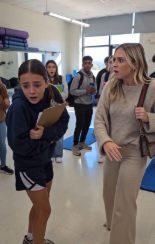
The slap came so fast that my brain registered the sound before it registered the pain.
One second, I was standing in the middle of the yoga room with a folded consent form pressed against my chest.
The next, Kinsley Barron’s palm cracked across my face.
The room fell silent.
Twenty students had been talking only moments earlier. Someone had been laughing near the mirrored wall. A portable speaker had been playing soft instrumental music. Yoga mats in shades of blue and purple covered the polished floor.
After Kinsley struck me, all of it stopped.
Then the phones appeared.
They rose almost together, as if the students had rehearsed the movement.
Nobody stepped between us.
Nobody asked why Kinsley had hit me.
Nobody looked at the paper in my hand.
They looked at my navy hoodie, my long athletic shorts, and the worn basketball shoes I had owned since middle school. Then they looked at Kinsley in her cream cashmere sweater, beige trousers, and expensive leather flats.
They decided what the scene meant before either of us spoke.
Kinsley knew they would.
That was why she had chosen the yoga room.
It was after school in Santa Monica, but the room was crowded because the wellness committee was preparing for Friday’s student mental-health showcase. Athletes, club leaders, student volunteers, and two faculty advisers had gathered to test lights and arrange demonstration stations.
There were enough witnesses to turn one accusation into a school-wide scandal.
Kinsley stood inches from me, breathing hard.
“Give me that,” she said.
My cheek burned.
I tightened my grip on the form.
“No.”
Her expression changed just enough for me to see the panic underneath her anger.
Then she raised her voice.
“Stop pretending you’re the victim, Maya.”
The students near the door whispered.
My name was Maya Brooks. I was seventeen years old, a junior, and one of the student assistants responsible for checking participation records for the showcase.
Until that afternoon, most people barely noticed me.
I was not invisible exactly.
I was simply useful in ways that did not attract attention.
I carried boxes. I checked forms. I replaced batteries in microphones. I stayed after meetings to make sure equipment had been returned. Teachers trusted me with keys because I never lost them. Students remembered my name only when they needed a charger, a schedule, or an answer.
Kinsley was the opposite.
People noticed her before she entered a room.
Her father sat on the school foundation board. Her mother owned a public-relations company that represented athletes, influencers, and several local politicians. Kinsley had perfect grades, perfect hair, and the effortless confidence of someone who had never been forced to explain why she belonged somewhere.
She also ran the student media committee.
That was where the trouble had begun.
Kinsley turned toward the crowd.
“Maya stole private files from the media office,” she announced. “She’s been following me and accusing me of recording students.”
A murmur rolled through the room.
I heard someone say, “That’s creepy.”
Another student asked, “Why would Maya do that?”
Kinsley pointed at the paper in my hand.
“She took documents she had no right to access.”
“This was in the wellness showcase folder,” I said.
“You searched my committee records.”
“I checked the forms because the camera list didn’t match the approved activities.”
“You are not in charge of media.”
“I’m in charge of verifying participation permissions.”
Kinsley laughed.
It was a polished laugh, practiced and dismissive.
“You hand out clipboards.”
The words landed almost as sharply as the slap.
A few students smiled nervously.
I wanted to disappear.
My face felt hot, not only from the strike but from the humiliation. Every phone in the room seemed pointed at me. By evening, a short video would be online showing Kinsley slapping a girl in old basketball shoes.
It would not show the week of questions that came before it.
It would not show the hidden camera I had found inside a meditation speaker.
It would not show the recordings.
Most importantly, it would not show the original consent form.
Kinsley stepped closer.
“Give it back before you make this worse.”
“For whom?”
Her eyes narrowed.
“You have no idea what you’re talking about.”
“I know the form was altered.”
The whispers stopped.
One of the faculty advisers, Ms. Ortega, finally moved toward us.
“What form?”
Kinsley answered before I could.
“A routine media release. Maya found an old draft and decided it proves some conspiracy.”
“It isn’t a media release,” I said. “It’s a consent form for private wellness interviews.”
Ms. Ortega frowned.
“There are no private interviews in the showcase.”
“That’s what I thought.”
Kinsley folded her arms.
“Because there aren’t.”
I opened the paper.
The top section contained the school logo and the title:
STUDENT WELLNESS PROJECT PARTICIPATION CONSENT.
Below it were spaces for a student’s name, signature, parent or guardian authorization, and a description of the activity being recorded.
The description had been covered with a white label.
Someone had typed new words over it:
GENERAL EVENT PHOTOGRAPHY AND PROMOTIONAL MEDIA.
I held the form toward Ms. Ortega.
“The label is newer than the paper.”
Kinsley scoffed.
“That proves nothing.”
“The student signature is dated September third. The replacement label uses the school’s new font, which wasn’t added to our templates until October.”
The room went quiet again.
I had noticed the difference because I spent hours looking at school forms. Most students would never have cared that the lowercase letter “a” had changed shape in the updated typeface.
Kinsley had counted on that.
Ms. Ortega reached for the document.
Kinsley stepped between us.
“It’s confidential.”
“If it is connected to the showcase, I need to see it,” Ms. Ortega said.
Kinsley lowered her voice.
“My mother’s company helped prepare those forms.”
“That does not make them exempt from school review.”
Kinsley glanced toward the mirrors.
It was a tiny movement.
Most people missed it.
I did not.
The yoga room had one full wall of mirrors. A narrow black shelf ran beneath them, holding candles, foam blocks, and portable speakers used during guided relaxation sessions.
The third speaker from the left was slightly crooked.
That was where I had found the camera.
I looked at Ms. Ortega.
“Ask her why the speaker was recording before today’s meeting began.”
Kinsley’s calm vanished.
“That’s a lie.”
“I saw the indicator light.”
“It’s a Bluetooth light.”
“It flashed red when motion started.”
“You don’t know anything about cameras.”
“My brother installs security systems.”
That part was true.
My older brother, Devon, had worked with an electrician during summer break. He had taught me how to distinguish status lights on common devices because he enjoyed turning every household problem into a technical lesson.
Kinsley moved toward the shelf.
I blocked her.
She shoved my shoulder.
This time, Ms. Ortega intervened.
“Enough.”
The other faculty adviser, Mr. Lang, pulled the speaker from the shelf.
At first, it looked ordinary.
Then he turned it over.
A pinhole lens was set into the side.
Several students gasped.
Kinsley recovered quickly.
“That belongs to the media committee.”
Mr. Lang stared at her.
“You placed a camera in a room where students stretch and change clothes?”
“They do not change here.”
“They remove jackets and athletic layers,” Ms. Ortega said. “And you did not have permission to record this meeting.”
Kinsley pointed at the form.
“We did have permission.”
“One student signed this.”
“It was a group template.”
“Consent does not work that way,” Ms. Ortega replied.
Kinsley’s voice sharpened.
“You are misunderstanding the project.”
“Then explain it.”
Kinsley looked at the phones around us.
For the first time, she seemed to realize they were no longer helping her.
“Turn those off,” she ordered.
Nobody moved.
Five minutes earlier, she had depended on the crowd.
Now she feared it.
I unfolded a second page.
“This is the camera equipment log.”
Kinsley’s face changed.
It happened so quickly that she almost hid it.
Almost.
Mr. Lang noticed.
“Where did you get that?” he asked.
“It was attached to the consent form.”
The equipment log listed four miniature cameras checked out under the student media committee’s account.
Only one had been approved for the showcase.
The locations written beside the others were vague:
WELLNESS CONTENT.
STUDENT REACTION FOOTAGE.
PRIVATE TESTIMONIAL PROJECT.
No room numbers.
No supervising teacher.
No return dates.
Mr. Lang read the page twice.
“Kinsley, where are the other cameras?”
“They’re not active.”
“That was not my question.”
“My committee has multiple projects.”
“Which projects?”
She hesitated.
I answered.
“One camera was in the yoga speaker. One was behind a fake plant in the peer-counseling room. One was attached beneath a shelf in the athletic recovery area.”
Students began talking at once.
A senior named Hallie pushed through the crowd.
“The recovery area?”
Her face had gone pale.
Students used that room after practices. They talked to trainers there. They discussed injuries, body image, eating concerns, and pressure from coaches.
Kinsley lifted her chin.
“The cameras were for a documentary.”
“About what?” Hallie demanded.
“Student stress.”
“You recorded us without telling us?”
“It was observational media.”
“That means secret,” Hallie said.
Kinsley’s voice became defensive.
“People behave differently when they know a camera is present.”
“That is why you need consent,” I said.
Her eyes snapped toward me.
“You always do this.”
“Do what?”
“Act like rules matter more than people.”
I stared at her.
“Rules about consent protect people.”
“You have no idea what I was trying to protect.”
The words came out before she could stop them.
Ms. Ortega caught them.
“Who were you protecting?”
Kinsley said nothing.
Mr. Lang examined the speaker.
“There should be a storage card in here.”
“There isn’t,” I said.
Everyone looked at me.
“I checked.”
Kinsley smiled coldly.
“So you admit you tampered with school equipment.”
“I opened the battery panel after I saw the lens. The storage slot was empty.”
“Then there is no recording.”
“There was a wireless transfer symbol on the display.”
Mr. Lang pressed a button.
A small screen lit up beneath the speaker grille.
A Wi-Fi icon appeared.
The room erupted again.
Kinsley grabbed her bag.
“I’m leaving.”
Ms. Ortega blocked the exit.
“No, you’re not.”
“You cannot detain me.”
“We are calling the principal.”
“My mother will call the superintendent.”
“Then they can speak to each other.”
Kinsley looked around the room.
Her control was slipping, and she knew it.
She pointed at me.
“This started because Maya is obsessed with me.”
My throat tightened.
The accusation sounded ridiculous, but it was personal enough to distract people.
Kinsley continued.
“She applied to the media committee and was rejected.”
“I never applied.”
“She followed me to the counseling wing.”
“I was delivering registration packets.”
“She went through my bag.”
“I found the form in the public event binder.”
“She has been telling people I’m dangerous.”
“I told one teacher there might be unauthorized recording devices.”
Kinsley’s eyes filled with tears.
They appeared so suddenly and so perfectly that several students shifted uncomfortably.
“She has been trying to ruin me for weeks.”
I saw what she was doing.
Facts were becoming emotions.
Equipment logs were becoming a feud.
Secret recordings were becoming jealousy.
It was the same strategy she had used when she slapped me.
Turn the crowd toward the most dramatic story and hope nobody checked the paper.
Then Hallie spoke.
“Maya warned me yesterday.”
Everyone looked at her.
Hallie crossed her arms.
“She asked whether I had signed a recording release for the recovery room.”
Kinsley stared at her.
Hallie continued.
“I thought she was being strange. I told her no.”
Another student raised his hand slightly.
“She asked me too.”
Then another voice came from the back.
“And me.”
One by one, students admitted that I had quietly asked about consent forms.
I had not accused Kinsley publicly.
I had not spread rumors.
I had been checking whether the process had been followed.
The crowd shifted away from her.
Kinsley saw it happen.
She reached for the consent form.
I pulled it back.
She seized my wrist.
“Give it to me.”
Ms. Ortega shouted her name.
Kinsley dug her nails into my skin.
“You don’t understand what’s on those recordings,” she whispered.
I met her eyes.
“Then tell us.”
Her grip loosened.
For a moment, she looked exhausted rather than angry.
Then Principal Warren entered with the campus safety officer.
He surveyed the room, the hidden camera, the phones, and my reddened cheek.
“What happened?”
Kinsley spoke first.
“Maya stole confidential documents and damaged media equipment.”
The principal looked at me.
I handed him the form.
“Please check the original before you believe either of us.”
That sentence changed everything.
Principal Warren took us to the administrative conference room while Ms. Ortega remained with the students.
Kinsley sat at one end of the table, her designer bag on her lap.
I sat opposite her.
The principal placed the consent form inside a clear evidence sleeve. The campus safety officer collected the speaker and the equipment log.
Kinsley’s mother arrived eleven minutes later.
Celeste Barron did not rush into the room shouting.
She entered calmly, wearing a charcoal suit and carrying a tablet. Her blond hair was pinned neatly at the back of her head. Her eyes moved first to Kinsley, then to the documents, then to me.
She did not ask why my cheek was red.
“My daughter will not answer questions until I understand the allegation,” she said.
Principal Warren explained.
Celeste listened without interrupting.
When he finished, she looked at the form.
“That document was created for an approved student documentary.”
“What documentary?” the principal asked.
“A youth mental-health awareness campaign.”
“Approved by whom?”
“My company consulted with the media committee.”
“That does not answer my question.”
Celeste’s expression cooled.
“The project was intended to help students.”
“Were students told they were being recorded?”
“They signed releases.”
“One student signed this form,” Principal Warren said. “The activity description appears to have been altered.”
Celeste looked at Kinsley.
Kinsley lowered her eyes.
It was the first sign that her mother might not know everything.
Principal Warren contacted the district records office and requested the original digital form.
While we waited, the safety officer connected the hidden speaker to an isolated school computer.
The device contained no storage card.
But it had been configured to upload files automatically to a private server.
The account name appeared on the screen.
WELLNESS_TRUTH_ARCHIVE.
Principal Warren looked at Kinsley.
“Is that yours?”
“No.”
Celeste spoke quickly.
“Do not answer.”
The officer opened the account activity log.
More than two hundred files had been uploaded over six weeks.
The filenames included dates, room abbreviations, and student initials.
Hallie’s initials appeared nine times.
Mine appeared twice.
My stomach dropped.
“You recorded me?”
Kinsley did not respond.
The officer clicked one of my files.
There was no video preview because the content was encrypted, but the metadata showed the location.
Peer-counseling hallway.
I remembered the day.
I had been sitting outside the counselor’s office with Devon.
He had come to school after our father missed another child-support payment. We had argued quietly about whether to tell our mother. I had cried. Devon had hugged me and promised we would figure it out.
Someone had recorded us.
My hands began to shake.
“Delete them.”
The officer shook his head gently.
“We need to preserve the files during the investigation.”
“I don’t want anyone watching that.”
“No one will access the content unless legally necessary.”
Kinsley finally looked at me.
Guilt flickered across her face.
Then the district records office sent the original consent form.
Principal Warren projected it onto the wall.
The paper version and the digital version looked almost identical.
The signatures matched.
The dates matched.
But the original activity description had not said general event photography.
It read:
PRIVATE RECORDED INTERVIEW REGARDING COACHING MISCONDUCT, STUDENT PRESSURE, AND RETALIATION.
The room went silent.
Below the description was the student’s name.
Evan Barron.
Kinsley’s older brother.
Celeste stood so abruptly that her chair struck the wall.
“Turn that off.”
Principal Warren did not.
“Evan attended this school four years ago.”
Kinsley’s face crumpled.
Her mother turned toward her.
“What did you do?”
Kinsley’s voice was barely audible.
“I found his recording.”
Celeste went pale.
“You were never supposed to see that.”
“Why?”
“Kinsley—”
“Why was I never supposed to see it?”
I looked from daughter to mother.
The secret recordings had not begun with a school project.
They had begun with Evan.
Four years earlier, Evan Barron had been captain of the school swim team. He was talented enough to attract college recruiters, but halfway through his senior year, he quit without explanation.
The public story was that he had lost interest.
The truth was inside the original interview.
Evan had reported that Coach Danner pressured injured swimmers to compete, encouraged dangerous weight-cutting practices, and threatened to destroy scholarship recommendations if athletes complained.
Evan had recorded a confidential testimony for a district investigation.
The investigation disappeared.
So did the interview.
Celeste Barron’s public-relations firm had represented the school foundation during the scandal.
Kinsley stared at her mother.
“You buried it.”
Celeste’s jaw tightened.
“I protected your brother.”
“He lost his scholarship.”
“He was emotionally unstable.”
“Because nobody believed him!”
“He asked us to stop the investigation.”
“After Coach Danner threatened him.”
Celeste closed her eyes.
Kinsley’s voice broke.
“Evan left California because he thought everyone saw him as a liar.”
Principal Warren leaned forward.
“How did you find the recording?”
“In my mother’s archive.”
Celeste turned on her.
“You accessed private company files?”
“I was looking for old footage for the anniversary video. I found Evan’s interview, emails from the foundation, and a settlement draft.”
Principal Warren looked at Celeste.
“Was the school informed?”
“This is not the appropriate setting.”
“That means no,” Kinsley said.
Tears ran down her face.
For the first time, there was nothing calculated about them.
“I wanted proof that Evan wasn’t the only one.”
“So you secretly recorded students?” I asked.
She looked at me.
“I heard people talking about Danner in the recovery room. I heard swimmers saying he still weighed them in front of the team. I heard a freshman crying in the counseling hallway because he threatened to bench her.”
“Then you should have reported it.”
“To whom?” Kinsley shouted. “The principal whose foundation accepted money from my family? The district that erased Evan’s statement? My mother?”
Celeste flinched.
Kinsley pointed at the screen.
“I needed recordings no one could deny.”
“You also needed consent,” I said.
“They would have stopped talking.”
“That did not give you the right to steal private moments.”
“I was trying to expose him.”
“You recorded me talking about my family.”
“I didn’t watch every file.”
“That does not make it better.”
Kinsley looked away.
Principal Warren asked, “Why alter Evan’s consent form?”
“Because I needed a form connected to the archive account. The cameras required documentation before the media server would activate.”
“You used your brother’s old authorization?”
“I copied the file and changed the activity description.”
“Why leave his name?”
“I thought the system only checked the signature fields.”
Celeste pressed her fingers against her forehead.
“You could have destroyed this family.”
Kinsley laughed bitterly.
“You already did that.”
The conference-room door opened.
A young man entered beside Ms. Ortega.
He was tall, thin, and wore a dark jacket over a faded college sweatshirt.
Kinsley stopped breathing.
“Evan?”
Her brother looked older than the photograph on the form, but his eyes were unmistakably hers.
Ms. Ortega had called him after finding his name in the district record.
Evan looked at the projected document.
Then at his mother.
“You kept it.”
Celeste stood.
“We should discuss this privately.”
“No.”
“Evan.”
“You told me the recording had been deleted.”
“I told you the investigation was closed.”
“You told me there was no proof.”
Celeste’s composure finally broke.
“I was trying to keep you from throwing away your future.”
“My future was already gone.”
“You could have gone back to swimming.”
“With him coaching?”
“You could have transferred.”
“You made me sign a settlement that protected him.”
“I was protecting you from public humiliation.”
Evan stared at her.
“No. You were protecting your company.”
Celeste did not answer.
That silence was the answer.
Kinsley rose from her chair.
“I was going to give you the recordings.”
Evan turned toward her.
“I know.”
“You know?”
“You called me three nights ago.”
“You didn’t answer.”
“I heard the voicemail.”
Kinsley began crying harder.
“I thought if I found enough students, they would reopen the investigation.”
Evan walked to her.
“You should have come to me.”
“I wanted to fix it.”
“You cannot fix what happened to me by doing the same thing to someone else.”
Kinsley looked at me.
The words struck her.
She had violated students’ privacy to expose someone who had abused power.
She had become so focused on proving the truth that she stopped caring whom she hurt while collecting it.
Evan faced Principal Warren.
“Coach Danner is still employed here?”
The principal nodded slowly.
“Then I want to make a new statement.”
Celeste stepped forward.
“Evan, think carefully.”
“I have been thinking carefully for four years.”
The hidden recordings were never used as public evidence.
That decision mattered.
Students whose private conversations had been captured were informed individually. Their files were sealed and later destroyed under supervision, except for a small number that students voluntarily chose to preserve and submit through proper legal channels.
Hallie chose to speak.
So did six swimmers.
Three former students came forward after Evan released his original statement.
Coach Danner was placed on leave and eventually dismissed after an independent investigation confirmed a long pattern of intimidation, unsafe training practices, and retaliation.
The district reopened Evan’s case.
Celeste Barron’s company lost its school contracts after emails showed that she had pressured administrators to minimize the original complaint.
She was not sent to prison, as some students predicted, but her reputation collapsed. For a woman who had built her life on controlling stories, losing control of her own was a punishment she understood.
Kinsley was suspended for the secret recordings and for striking me.
She was removed from the media committee and required to complete counseling, digital-privacy education, and a restorative accountability program.
The school gave me the option to participate in a meeting with her.
At first, I refused.
I was still angry.
For weeks, I imagined the camera watching me outside the counseling office. Even after I knew the file had been destroyed, I felt exposed whenever I passed a smoke detector, speaker, or dark computer screen.
Then Evan sent me a letter.
He did not ask me to forgive Kinsley.
He thanked me for noticing the altered form.
He wrote that people often believed evidence appeared in dramatic moments, but usually the truth survived because someone paid attention to a small inconsistency.
A font.
A date.
A sentence covered by a label.
At the bottom, he wrote:
You protected consent while Kinsley was trying to protect truth. Both matter, but truth without consent can become another kind of harm.
I agreed to the meeting.
Kinsley entered the counseling room wearing jeans, a gray sweatshirt, and ordinary sneakers. Without the cashmere and polished confidence, she looked younger.
She sat across from me.
A counselor remained near the door.
Kinsley folded and unfolded her hands.
“I’m sorry I slapped you.”
I waited.
“I’m sorry I accused you of stalking me. I knew it wasn’t true.”
I said nothing.
“I’m sorry I recorded you.”
“You recorded a lot of people.”
“I know.”
“You told yourself the reason made it acceptable.”
“Yes.”
“Do you still believe that?”
She looked down.
“No.”
I studied her face.
“Why did you slap me?”
“I saw Evan’s form in your hand. I thought you would expose everything before I had enough evidence.”
“So you tried to make me look unstable.”
“Yes.”
“You knew the crowd would believe you.”
Her eyes filled.
“Yes.”
“That might be the worst part.”
“I know.”
“No, you don’t.”
She looked at me.
“You knew your clothes, your name, and your family made people trust you. You used that before anyone could ask what was actually happening.”
Kinsley wiped her cheek.
“You’re right.”
The simple admission disarmed me more than an excuse would have.
I leaned back.
“I’m not forgiving you today.”
“I understand.”
“I might never trust you.”
“I understand that too.”
“But Evan was right about one thing.”
She waited.
“The truth still needed to come out.”
Kinsley nodded.
“Just not the way I did it.”
“Never the way you did it.”
The school changed after the investigation.
Not immediately.
Institutions did not transform as quickly as speeches claimed.
But new rules appeared.
Every recording device had to be registered.
Students received plain-language explanations of what they were agreeing to before signing media releases.
Wellness rooms became camera-free zones.
Confidential reporting systems were managed by an outside organization rather than the school foundation.
Most importantly, students who reported misconduct could request an independent advocate.
Principal Warren asked me to join the committee designing the new consent policy.
At the first meeting, one administrator referred to me as “the student who found the hidden camera.”
I corrected him.
“I’m the student who checked the form.”
The distinction mattered.
Finding a camera created a scandal.
Checking the form revealed the system that had allowed it.
By spring, the wellness showcase was rescheduled.
The school almost canceled it permanently, but the students voted to rebuild it around privacy, trust, and ethical storytelling.
Hallie led a discussion about pressure in school athletics.
Evan returned to speak about retaliation.
He did not describe himself as a victim.
He called himself a witness who had finally been heard.
I ran a small station titled CONSENT IS A CONTINUING CONVERSATION.
The title sounded boring.
More students visited than I expected.
Kinsley attended quietly with her counselor’s approval.
She did not speak onstage.
She helped place chairs, carried boxes, and checked that every camera had a visible notice beside it.
Near the end of the afternoon, she approached my table holding a clipboard.
“One of the photography forms is missing a withdrawal section,” she said.
I examined it.
She was right.
“You noticed.”
“I’ve been learning to check.”
I took the clipboard from her.
“That doesn’t erase what happened.”
“I know.”
“But it prevents something else.”
She nodded.
We added the missing section together.
A month before graduation, Evan received a letter from the university that had withdrawn its swimming scholarship years earlier.
The school could not restore the lost seasons, but it offered him funding to complete graduate studies in youth advocacy.
He accepted.
Not because it repaired the past.
Nothing could.
He accepted because he wanted to help other students speak before their lives were rearranged by silence.
Celeste entered professional mediation with both her children. Kinsley told me later that healing in their house was slow and ugly.
There were no dramatic hugs.
There were arguments, missed calls, and long stretches when Evan refused to visit.
But Celeste eventually released every remaining document connected to the old investigation.
It was the first honest thing she did without being forced.
On graduation day, I wore the same worn basketball shoes that had been visible in the slap video.
The video had circulated for several days before the full story emerged. At first, people captioned it with jokes about me being “put in my place.”
After the investigation, those captions disappeared.
Some students apologized.
Others simply pretended they had never shared it.
I learned that public shame traveled faster than correction, but correction lasted longer when records supported it.
As I stood beside the auditorium steps, Kinsley approached me.
She wore a simple blue dress beneath her graduation gown.
In her hands was a thin frame.
Inside it was a copy of the original consent form.
The altered label had been removed, revealing Evan’s testimony description beneath it.
Across the bottom, Kinsley had added a brass plaque:
THE DETAIL THAT DID NOT FIT SAVED THE TRUTH FROM THE STORY EVERYONE WANTED TO BELIEVE.
I looked at her.
“This belongs to Evan.”
“He has the original.”
“You framed evidence from your disciplinary case?”
“I’m trying to become less sentimental.”
I laughed despite myself.
She smiled carefully.
Then her expression became serious.
“Thank you.”
“I didn’t do it for you.”
“I know.”
“I did it because students were being recorded.”
“I know that too.”
She glanced toward the crowd where Evan stood beside Ms. Ortega.
“My brother says intention does not cancel impact.”
“He’s right.”
“He usually is. It’s irritating.”
“That might run in your family.”
Kinsley laughed softly.
A photographer called for graduates to gather near the steps.
Before she walked away, Kinsley turned back.
“Maya?”
“Yes?”
“I used to think power meant controlling what people saw.”
“And now?”
She looked toward the visible cameras, each marked with a bright consent notice.
“Now I think it means making sure they know they have a choice.”
She joined her class.
I remained beside the steps for another moment, holding the framed form.
The paper was ordinary.
Thin.
Creased.
Almost destroyed by a single white label.
Yet it had moved faster than Kinsley’s slap, faster than the rumors, and faster than every carefully managed lie surrounding her brother’s case.
Because attacks could control a room for a moment.
Crowds could be manipulated.
Videos could be cropped.
Stories could be polished until the guilty looked admirable and the careful looked suspicious.
But the original record waited.
It waited for someone willing to look beneath the alteration.
It waited for someone who understood that consent was not a signature to be borrowed, copied, or hidden.
It was a boundary.
It was a promise.
And when that promise was finally read aloud, it did more than expose Kinsley’s mistake.
It gave Evan his voice back.
It protected the students who came after him.
And it taught an entire school that the truth did not become honorable simply because someone claimed to be collecting it for a good reason.
Sometimes the person holding the camera believed they were the hero.
Sometimes the person in the old shoes holding a piece of paper was the only one protecting everyone else.
THE END
