The power died three seconds before our machine was supposed to save a life.
One moment, the Westbridge High gymnasium was glowing beneath rows of white exhibition lights, packed with students, parents, judges, and representatives from three universities. The next, our STEM booth went black.
The medical alert prototype on the table gave one weak electronic chirp and fell silent.
Beside me, a plastic model of a human heart stopped pulsing.
Across the gym, the other booths remained brightly lit.
A collective murmur moved through the crowd.
Then Peyton Cross screamed.
“Nadia, what did you do?”
Her voice cut through the room so sharply that everyone turned toward me before I could even understand what had happened.
I stood behind our booth with a screwdriver in one hand and a small camera module in the other. A bundle of red and blue wires hung from the open side panel of our prototype. To anyone who had not watched me work for the past six months, I probably looked exactly like someone who had been caught destroying it.
Peyton staggered backward, one hand pressed dramatically to her mouth.
“She was inside the power housing,” she said. “I told her not to touch it.”
“That isn’t true,” I replied.
My voice came out too quietly.
The judges were already approaching.
Phones lifted throughout the gym.
Some people filmed.
Some froze.
Almost nobody asked why Peyton looked terrified instead of confused.
Before anyone turned me into the problem, I had simply been Nadia Murphy, seventeen years old, senior lab assistant, scholarship applicant, and the person who did all the invisible work other students wanted to skip.
I labeled wires.
I tested batteries.
I cleaned solder from tables.
I stayed late to inventory equipment after the students with leadership titles had gone home.
Peyton Cross had the title of project captain.
I had the burn mark on my thumb from building the machine.
Our project was called PulseGuard, a portable emergency-monitoring system designed for schools, community centers, and rural clinics. It could detect an abnormal heart rhythm, alert nearby adults, and automatically send basic medical information to emergency responders.
It had begun as my idea.
Peyton had transformed it into her opportunity.
Her father owned Cross Biomedical Solutions, one of the companies sponsoring the statewide innovation competition. Peyton knew university recruiters by name. She wore a satin ivory shirt, an expensive navy pleated skirt, and a thin gold bracelet that flashed whenever she lifted her hand.
Even in panic, she looked polished.
I wore a faded Westbridge robotics sweatshirt and black jeans with a streak of soldering paste on one knee.
The contrast was useful to her.
“She sabotaged it,” Peyton announced.
“No,” I said. “Someone cut power to our booth.”
Mr. Halpern, the faculty adviser, pushed through the crowd.
His face had gone pale.
“Everyone step back,” he ordered. “Nadia, put down the tools.”
I lowered the screwdriver but held tightly to the camera module.
Peyton noticed.
Her eyes fixed on it for half a second.
That was the moment I knew the power failure had not been an accident.
Six months earlier, PulseGuard had belonged to both of us.
At least, that was what I had believed.
Peyton and I had met in sophomore physics. She had been quick, confident, and unusually kind to me during a year when my mother was working double shifts and I spent most afternoons caring for my younger brother, Eli.
Peyton had offered me rides home after lab meetings.
She had brought me coffee during finals.
When I designed the first PulseGuard circuit after Eli collapsed during soccer practice from an undiagnosed heart condition, Peyton was the first person who told me it could become something real.
“You could save people with this,” she had whispered, staring at the rough breadboard on my bedroom desk.
I had believed the wonder in her voice.
I had not understood that some people could admire your light and still decide it belonged to them.
By senior year, Peyton had become the public face of PulseGuard.
She gave interviews.
She spoke at assemblies.
She stood beside my machine in photographs while I remained behind the curtain fixing whatever had gone wrong.
At first, I told myself that it did not matter.
I was awkward in front of crowds. Peyton was not.
I wanted the project to succeed.
If she could explain it better, perhaps that helped both of us.
Then my name began disappearing.
First, it vanished from a presentation slide.
Then from the school newsletter.
Finally, from the preliminary patent application Mr. Cross’s legal team submitted on Peyton’s behalf.
When I confronted her, Peyton smiled as though I were being unreasonable.
“Your name will be added later.”
“Why wasn’t it included now?”
“Because the lawyers wanted a clean filing.”
“A clean filing?”
She sighed.
“Nadia, this is what I mean. You understand circuits, but you don’t understand business.”
The words stayed with me.
Not because they were cruel.
Because she spoke them gently.
As if erasing me were a favor she was trying to explain.
Three days before the STEM exhibition, I found something worse.
I had been alone in the lab checking the backup battery when I noticed a thin wireless relay connected beneath our booth’s primary power controller.
It did not belong there.
The relay could be activated remotely.
Someone could cut electricity to the booth without touching the visible switch.
I photographed it, then removed the casing to trace the wire.
The line ran not toward the prototype, but into the demonstration grid shared by four neighboring booths.
If activated during the exhibition, it would not merely shut down PulseGuard. It could overload the display network and destroy months of work belonging to other students.
I immediately showed Mr. Halpern.
He stared at the relay longer than I expected.
Then he closed his office door.
“You must not say anything about this yet.”
“Why?”
“Because we don’t know who installed it.”
“That’s why we need to investigate.”
“We will.”
“When?”
“After the competition.”
I looked at him.
“That makes no sense.”
His expression tightened.
“Nadia, Cross Biomedical funded half the equipment in this lab. If you make an accusation without proof, the entire program could lose its sponsorship.”
“I found a remote relay wired into our grid. That is proof something is wrong.”
“It is evidence,” he corrected. “Not proof of who did it.”
He took the relay from me and locked it inside his desk.
The next morning, it was gone.
Mr. Halpern claimed the custodian must have moved it while cleaning.
The custodian did not have a key to his desk.
That was when I installed the camera.
It was a tiny motion-activated module left over from a robotics project, no larger than two stacked postage stamps. I hid it inside the ventilation slot of our booth, angled toward the power housing.
I told no one.
Not even my mother.
Especially not Peyton.
Now, with the booth dark and half the school watching me, that little camera was the only reason I had not dropped to the floor.
“I said put it down,” Mr. Halpern repeated.
“This contains footage from the booth.”
The crowd quieted.
Peyton’s face changed.
Only slightly.
But I saw it.
The fear beneath her outrage.
“She was secretly recording us?” Peyton asked. “That’s insane.”
“I recorded the equipment.”
“You recorded me without permission.”
“Were you inside the power housing?”
Her mouth opened.
Before she could answer, a metal tray struck my arm.
I never saw who moved first.
Peyton had been standing beside the refreshment table. One moment, her hand was empty. The next, the tray of drinks tipped toward me.
Cold lemonade splashed across my sweatshirt.
Paper cups struck the floor.
The crowd gasped.
My hand slammed against the edge of the table, but I did not release the camera.
Peyton stared at me with wide, horrified eyes, performing shock at an accident she had caused.
“Oh my God,” she whispered. “I was trying to stop you from dropping it.”
“You hit me.”
“I barely touched you.”
“You knocked the tray into me.”
“She’s twisting everything!” Peyton cried.
The room reacted exactly as she needed it to.
People stopped thinking about the power failure.
Now they saw two girls fighting.
One of them was soaked, angry, and clutching a secret camera.
The other was trembling in designer clothes beneath the worried arm of a teacher.
The scene swallowed the reason behind it.
Principal Mercer arrived with the campus security officer.
“What is going on?”
“Nadia sabotaged the booth,” Peyton said immediately.
“I did not.”
“She’s been furious about the patent. She threatened to ruin the presentation.”
“I asked you to correct the patent.”
“You said you would make sure nobody could use PulseGuard without you.”
“Because I built it.”
A few students whispered.
Peyton’s eyes shone with tears.
“You see?” she said. “She admits it.”
There are moments when the truth sounds weak simply because a lie was spoken first.
I looked around the gym.
Students I had studied beside for years avoided my eyes.
A university judge frowned at me.
Mrs. Cross, Peyton’s mother, stood near the entrance with one hand over her pearl necklace as though I had attacked her daughter with a weapon.
My pulse thundered.
I thought about Eli lying unconscious on a soccer field.
I thought about the first PulseGuard alarm sounding in my bedroom.
I thought about Peyton’s face when I had shown her the design.
You could save people with this.
Principal Mercer held out his hand.
“Give me the camera.”
“No.”
His expression hardened.
“Nadia.”
“If I give it to you, will it be copied immediately?”
“We will follow school procedure.”
“That isn’t what I asked.”
Mr. Halpern stepped forward.
“You are making this worse.”
His voice contained a warning.
Not concern.
That frightened me more than Peyton did.
I closed my fist around the camera.
“My mother is on her way.”
“You called her?” Peyton asked.
“No. I scheduled a message to send if the booth lost power.”
For the first time, Peyton’s performance cracked completely.
Her lips parted.
Mr. Halpern looked at her.
Then at me.
“What message?”
“One explaining everything I found.”
That was not entirely true.
The message contained only three words:
Check Eli’s folder.
Two nights earlier, I had copied every photograph, wiring diagram, and project log onto a flash drive and hidden it inside my brother’s old medical records.
My mother had taught me to keep backups after a landlord once claimed we had never paid rent and she produced fourteen months of receipts from a shoebox.
“People lose their courage when paperwork appears,” she liked to say.
I had inherited her suspicion.
And perhaps, finally, her courage.
Principal Mercer ordered security to escort me to the conference room.
Peyton remained in the gym.
That told me everything.
If the school truly believed both of us were involved in a serious incident, both of us should have been removed.
Instead, the accused was isolated while the sponsor’s daughter stayed beside the judges.
The conference room smelled of dry-erase markers and old coffee. Rain tapped against the narrow window.
Principal Mercer sat across from me.
Mr. Halpern stood near the door.
The security officer placed a clear evidence bag on the table.
“Put the camera inside.”
“I want my mother present.”
“You are not under arrest,” Principal Mercer said.
“Then I’m free to keep it.”
“This is school property.”
“The camera belongs to me.”
“The footage was recorded on school grounds.”
“Of school equipment that someone tampered with.”
Mr. Halpern rubbed his forehead.
“Nadia, please. We can resolve this quietly.”
“Why does it need to be quiet?”
No one answered.
The door opened.
My mother walked in wearing blue hospital scrubs beneath a raincoat, her hair still covered by a disposable surgical cap. She had clearly left work without changing.
Behind her came Eli.
He was fourteen now, tall and thin, with a faint scar below his collarbone from the procedure that corrected his heart defect.
My mother’s gaze moved from my soaked sweatshirt to the bruise forming on my wrist.
Her face became still.
That stillness had frightened every dishonest landlord, billing office, and insurance representative she had ever encountered.
“What happened to my daughter?”
Principal Mercer began his polished explanation.
My mother let him finish.
Then she placed a thick folder on the table.
“I received Nadia’s message.”
Eli sat beside me.
His knee touched mine beneath the table.
A reminder that I was not alone.
My mother opened the folder and removed the flash drive.
“She documented the unauthorized relay three days ago,” she said. “She also documented its disappearance from Mr. Halpern’s locked desk.”
Principal Mercer turned toward him.
Mr. Halpern’s face reddened.
“I never said it was locked.”
“Yes, you did,” I replied. “In your email.”
My mother placed a printed copy on the table.
People lose their courage when paperwork appears.
Mr. Halpern stared at the page.
Principal Mercer reached for the flash drive.
My mother pulled it back.
“We will provide a copy.”
“This is a school investigation.”
“And Nadia is a minor accused of sabotage by the daughter of a corporate sponsor. We are preserving the original.”
For one second, pride warmed my chest despite everything.
Then Principal Mercer’s phone buzzed.
He read the screen.
His jaw tightened.
“The judges have suspended the competition.”
“Good,” I said.
He glared at me.
“Hundreds of students may lose opportunities because of this.”
“No. They may lose opportunities because someone planted a device in the power grid.”
Mr. Halpern suddenly stepped away from the door.
“This has gone too far.”
My mother looked at him.
“I agree.”
He swallowed.
“I need some air.”
The security officer blocked his path.
“Stay here.”
The room went silent.
Principal Mercer’s phone buzzed again.
This time, his face drained of color.
“What is it?” my mother asked.
He looked at me.
“The footage from the gym has been posted online.”
Peyton’s accusation had been filmed from at least twelve angles.
Within twenty minutes, a clip titled JEALOUS GIRL DESTROYS FRIEND’S STEM PROJECT had spread across student accounts.
The video began after the power failed.
It showed me holding the screwdriver.
It showed Peyton accusing me.
It showed the tray striking my arm.
It did not show what happened before.
The internet had received exactly the version Peyton wanted.
By the time we left the conference room, reporters were waiting outside the school.
My name was trending locally.
Strangers called me bitter, unstable, and dangerous.
One post claimed I had been obsessed with Peyton for years.
Another said my family wanted money from the Crosses.
Someone found my mother’s workplace and left comments demanding that the hospital fire her.
Eli read one message before I took his phone away.
It said his heart condition was probably fake too.
He went into his room and shut the door.
That hurt more than anything Peyton had done to me.
I stood in our kitchen, still wearing the stained sweatshirt, while my mother copied the camera footage onto her laptop.
The file would not open.
“Try again,” I said.
She did.
The screen displayed an error message.
Corrupted data.
My stomach dropped.
“No.”
I grabbed the camera.
The casing was damp from the lemonade, but the storage chip had been sealed inside.
“It should be protected.”
“Could the impact have damaged it?” my mother asked.
“No. These modules survive crashes.”
Eli appeared in the doorway.
His eyes were red.
“Maybe the file was already corrupted.”
“It records in ten-minute segments. At least some of them should work.”
He came closer.
“Can I see?”
Eli knew almost as much about electronics as I did. He had spent years watching me build devices and asking irritatingly precise questions.
He examined the camera beneath the kitchen light.
Then he frowned.
“Nadia, this isn’t your memory chip.”
I stared at him.
“What?”
He pointed to a tiny silver mark near the corner.
“You put blue nail polish on yours. Remember? So you could tell it apart from the robotics club chips.”
I had forgotten.
Months earlier, Eli had spilled a box of identical storage chips across my desk. I marked mine with a dot of blue polish so it would not happen again.
The chip inside the camera had no blue mark.
Someone had switched it.
My mind raced backward.
The gym.
The tray.
My hand striking the table.
Peyton saying she was trying to stop me from dropping it.
But she had never taken the camera.
Then I remembered Mr. Halpern placing the evidence bag on the conference table.
He had held it open.
The security officer had looked toward the door when my mother arrived.
For perhaps two seconds, nobody had watched his hands.
“He switched the chip,” I whispered.
My mother’s expression sharpened.
“Can you prove it?”
I looked down at the camera.
There was something else.
A thin scratch crossed one screw on the casing.
The screw had been opened recently.
“He must have had a replacement prepared,” I said. “Which means he knew the camera existed.”
“How?”
I thought of the hidden module behind the booth vent.
Only someone who had inspected the booth closely would have seen it.
Someone who had entered the power housing after I installed it.
Eli picked up the corrupted chip.
“Maybe this isn’t empty.”
“It won’t open.”
“That doesn’t mean the data is gone.”
For the next four hours, we worked at the kitchen table.
My mother made coffee.
Eli ran recovery software.
I checked the camera’s internal logs.
At 2:13 in the morning, a partial file appeared.
Sixteen seconds of sound.
No image.
Static crackled through the speakers.
Then Peyton’s voice emerged.
“You said she wouldn’t find it.”
Mr. Halpern answered.
“I said she wouldn’t find it before the demonstration.”
“You need to remove the camera.”
“I can’t. She’ll notice.”
“Then destroy the footage after the outage.”
The recording ended.
My mother covered her mouth.
Eli looked at me.
“That’s enough, right?”
It should have been.
But something felt wrong.
Peyton’s voice was frightened.
Mr. Halpern’s was irritated.
Neither sounded like the person in control.
I replayed the audio.
Again.
Again.
In the background, beneath the static, another voice spoke.
Too faint to understand.
I increased the volume.
A man said one sentence.
“Make sure Cross Biomedical sees the failure.”
My skin prickled.
“That isn’t Peyton’s father,” I said.
My mother leaned closer.
“Do you recognize him?”
I did.
But the answer made no sense.
It was Principal Mercer.
The next morning, we brought the recovered recording to the district superintendent.
We did not tell the school.
By noon, investigators arrived at Westbridge High.
Peyton was removed from class.
Mr. Halpern was suspended.
Principal Mercer locked himself in his office and refused to come out for nearly an hour.
Students crowded the hallways while district officials carried computers and boxes of documents from the administration wing.
The internet story began to change.
Now people posted side-by-side images of me building PulseGuard while Peyton posed beside it.
Former robotics students shared messages showing that I had written the original code.
The same strangers who had called me jealous began calling me brilliant.
Their sudden support felt almost as hollow as their cruelty.
At three o’clock, Peyton asked to speak with me.
The district investigator refused.
Peyton began crying.
“Please,” she said. “She needs to hear this from me.”
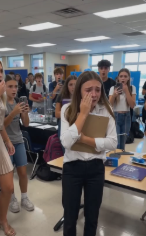
We met in the library conference room with my mother, the investigator, and a district lawyer present.
Peyton looked smaller without an audience.
Her satin shirt was wrinkled.
Her gold bracelet was gone.
For a long time, she could not look at me.
Finally, she whispered, “I knew about the relay.”
My mother’s hand tightened around mine.
“Did you install it?” the investigator asked.
“No.”
“Who did?”
“Mr. Halpern.”
“Why?”
Peyton glanced toward the door.
“Because my father’s company was going to buy PulseGuard.”
My heart stopped.
“What?”
“They weren’t going to steal it,” she said quickly. “Not exactly. They were going to license it after the competition.”
“My name wasn’t on the patent.”
“I know.”
“You told me it would be added.”
“I was trying to fix that.”
“You erased me.”
Tears rolled down her face.
“At first, I thought Dad’s lawyers were handling everything fairly. Then I saw the contract. The school would receive a donation. Mr. Halpern would get a consulting job. Principal Mercer would be appointed to the company’s education board.”
“And you?”
She looked down.
“I would be listed as the student inventor.”
The room seemed to tilt.
I had imagined hearing the truth for months.
I had expected satisfaction.
Instead, I felt grief.
Not for the patent.
For the girl who had sat on my bedroom floor beside Eli’s medical papers and told me I could save people.
“Why sabotage the demonstration?” I asked.
Peyton wiped her face.
“PulseGuard worked too well.”
No one spoke.
She continued.
“Cross Biomedical already sells an emergency-monitoring system. It costs almost twenty times more than yours. Dad thought PulseGuard could replace it in schools. But their current contracts still had three years left.”
“So they wanted my device to fail.”
“Publicly,” she said. “Just once. Then the company could claim it needed professional redesign before release. They would take control of the technology, delay it, and keep selling the expensive system.”
My mother’s voice was cold.
“How many schools use that expensive system?”
“Hundreds.”
The investigator wrote rapidly.
“Did your father order the sabotage?”
Peyton shook her head.
“That’s what I thought. But when I confronted him last night, he had no idea about the relay.”
“Then who planned it?”
“Principal Mercer. He wanted the company deal approved before Dad’s board meeting. Mr. Halpern installed the relay. They told me to blame Nadia if anything went wrong.”
“And you agreed,” I said.
Her face crumpled.
“Yes.”
The answer was barely audible.
“Why?”
“Because they showed me the messages you sent about the patent. They said you were planning to destroy the project and accuse me. They said if I didn’t control the situation, both of us would lose everything.”
“You knew I built PulseGuard.”
“I knew.”
“You knew I would never destroy it.”
“I knew that too.”
“Then why?”
She looked at me at last.
“Because part of me wanted to believe them.”
That was the most honest thing she had said.
Not fear.
Not pressure.
Not manipulation.
Ambition had opened the door, and the adults around her had walked through it.
The investigator leaned forward.
“Where is Nadia’s original memory chip?”
Peyton shook her head.
“I don’t know.”
“Mr. Halpern switched it.”
“He may not have it anymore.”
“What do you mean?”
Peyton hesitated.
Then she said, “The camera recorded more than the booth.”
A chill moved through me.
“What else?”
“Principal Mercer met with someone behind the display wall before the exhibition. Someone who was never supposed to be there.”
“Who?”
Peyton looked at my mother.
Then at me.
“Your father.”
For several seconds, I heard nothing.
My father had died when I was eight.
A construction accident.
A fall from scaffolding.
My mother had taken Eli and me to the funeral.
I remembered the closed casket.
I remembered rain against black umbrellas.
I remembered my mother gripping my shoulder so tightly it hurt.
“That’s impossible,” I said.
My mother released my hand.
Her face had turned gray.
“Mom?”
She stood too quickly, knocking her chair backward.
The district lawyer rose.
“Mrs. Murphy?”
My mother stared at Peyton.
“What did he look like?”
Peyton described a tall man with dark hair turning silver, a scar near his left eyebrow, and a slight limp.
My mother began to shake.
I had seen that scar in old photographs.
My father had not died in the construction accident.
He had caused it.
Years earlier, Daniel Murphy had been an electrical engineer working for a medical-device manufacturer. He discovered that the company had ignored safety failures in hospital monitoring systems.
He planned to expose them.
Before he could, an equipment fire destroyed part of the factory. A coworker died. Evidence was altered, and my father was blamed.
According to my mother, he had been given a choice by federal investigators: enter witness protection and help build a case, or risk the people responsible finding our family.
“He left to protect us,” she said through tears. “I was told to say he died. I hated him for agreeing. I hated myself for lying to you.”
I could barely breathe.
“All these years?”
“I was forbidden to contact him.”
“Did he contact you?”
“Once. After Eli’s surgery. Just a blank postcard from Arizona. I knew it was him because he drew a tiny circuit symbol in the corner.”
The room blurred.
Peyton whispered, “He was at the booth because he had been following Cross Biomedical.”
The investigator turned toward her.
“How do you know?”
“Because my father’s company purchased patents from the same manufacturer Daniel Murphy investigated.”
The sabotage was not merely about my school project.
PulseGuard contained a circuit architecture I had developed after studying old engineering notes stored in our garage.
Notes that had belonged to my father.
Without realizing it, I had recreated part of the safety system he had designed years ago—the same system powerful executives had buried after the factory fire.
My prototype proved his design had worked.
If PulseGuard succeeded publicly, it would prove that the earlier monitoring failures were preventable.
It could reopen the entire case.
Principal Mercer had not planted the power failure only to secure a corporate deal.
He had been paid to destroy evidence tied to a death.
My father had returned because he knew the demonstration would draw the people who had spent years hunting his work.
The original camera chip contained the meeting behind the display wall.
It showed Principal Mercer accepting instructions from a corporate attorney.
It showed Mr. Halpern testing the relay.
And it showed my father removing a second device hidden beneath the booth—a device designed not merely to shut down PulseGuard, but to cause the backup battery to overheat.
The planted power failure had been a distraction.
The real plan was a fire.
A fire that would destroy the prototype, the evidence, and perhaps anyone standing beside it.
Including me.
My father had disabled the dangerous device minutes before the exhibition. He could not remove the relay without alerting the conspirators, so he left the camera recording and tried to contact district security.
Mr. Halpern discovered the camera after the outage and switched the chip.
But he never escaped with it.
When he attempted to leave the conference room, the security officer blocked him.
During the struggle in the hallway, the chip slipped from his pocket.
A freshman volunteer found it beneath a vending machine that afternoon and turned it in, believing it was part of someone’s science display.
By evening, investigators had the entire recording.
Principal Mercer was arrested.
Mr. Halpern agreed to cooperate.
Three executives connected to the old factory case were indicted within weeks.
Cross Biomedical’s board removed Peyton’s father, not because he had ordered the sabotage, but because he had knowingly pursued ownership of a student invention through an unethical agreement.
The company surrendered all claims to PulseGuard.
The patent was filed again.
This time, the first name read NADIA MURPHY.
My father did not come home immediately.
Witness-protection rules and the reopened case made everything complicated.
But one month after the exhibition, my mother drove Eli and me to a quiet lakeside cabin two hours north of Providence.
A man stood on the porch.
He was older than every photograph I remembered.
His shoulders were narrower.
His hair was mostly gray.
But the scar near his eyebrow was the same.
He looked at me as though he had been waiting to breathe for nine years.
“I saw your circuit,” he said.
I stopped at the bottom of the steps.
There were a thousand things I wanted to ask.
Why did you leave?
Did you think about us?
Did you know I needed you?
Instead, I said, “You wired the failsafe backward in your original notes.”
His mouth trembled.
“I wondered if you would catch that.”
“I corrected it.”
“I know.”
He came down one step.
Then another.
“I’m sorry, Nadia.”
No explanation could replace the years.
No reunion could erase what had happened.
But happy endings are not always doors that return us to the life we lost.
Sometimes they are doors opening toward a life we never thought we could still build.
I crossed the distance first.
When my father wrapped his arms around me, Eli joined us. Then my mother did.
For a few moments, we stood together beneath the cold afternoon sunlight, imperfect and shaking, holding the broken pieces of a family that had somehow survived.
Three months later, the state STEM exhibition was held again.
This time, the PulseGuard booth stood in the center of the gym.
My name appeared above it in letters large enough to read from the entrance.
Eli operated the demonstration.
My mother sat in the front row.
My father watched through a secure video connection from another room.
Peyton attended too.
She had transferred schools and withdrawn from the competition, but she asked permission to sit in the audience.
When our eyes met, she did not smile.
Neither did I.
Forgiveness was not the same as forgetting.
But she had testified fully, returned every file she possessed, and admitted publicly that I had created PulseGuard.
That mattered.
The lead judge approached the microphone.
“Before announcing this year’s award, we would like to recognize a student whose work exposed failures far beyond a single exhibition.”
The gym grew quiet.
Months earlier, that silence had been used against me.
Now it felt different.
Not empty.
Listening.
I stepped onto the stage.
The judge handed me the innovation medal, but I looked beyond it toward our booth, where the plastic heart pulsed steadily beneath the lights.
Once.
Twice.
Again.
A machine built because my brother had collapsed.
A design born from my father’s unfinished work.
A truth my mother had protected in a folder.
A piece of evidence I had refused to release even when an entire crowd believed the worst of me.
The quietest object in the room had become the most dangerous one for everyone who depended on silence.
The judge asked whether I wanted to say anything.
I faced the students who had filmed me.
The teachers who had doubted me.
The parents who had believed a polished lie because it was easier than examining an uncomfortable truth.
Then I looked at Peyton.
She lowered her eyes.
“My project is designed to detect the moment a heart is in danger,” I said. “But danger does not always arrive with an alarm. Sometimes it looks respectable. Sometimes it has funding, authority, and a convincing story.”
Nobody moved.
“I learned that evidence matters. But evidence only protects people when someone is willing to hold on to it.”
Eli smiled from the booth.
My mother wiped her eyes.
On the video screen, my father placed one hand over his heart.
I raised the medal, not as a victory over Peyton, but as proof that the truth had survived every person who tried to shut it down.
Then the PulseGuard alarm sounded.
Clear.
Strong.
Impossible to ignore.
THE END
