The room went silent before I hit the floor.
It was the kind of silence that did not feel empty. It felt crowded—with shock, fear, and the knowledge that everyone had just seen something they would later be asked to describe differently.
Blair Pemberton’s shoulder drove into my chest first.
Then both of her hands struck my upper arms.
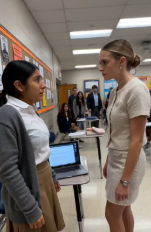
I stumbled backward into a desk, sending a stack of Spanish vocabulary cards sliding across the floor. My old Mary Jane shoes lost their grip on the polished tile, and I landed hard beside the teacher’s podium.
Somebody gasped.
A chair scraped.
Near the windows, a phone rose into the air.
But Blair did not look at the students recording us.
She looked at the laptop on Señora Morales’s desk.
More specifically, she looked at the small blue audio icon glowing on the screen.
That file was the reason she had shoved me.
And the fear in her eyes told me she knew exactly what it contained.
“Stay away from it,” Blair said.
My back ached where I had struck the desk, but I pushed myself upright.
“You’re the one who needs to stay away from it.”
Her face changed.
For one second, she no longer looked like the polished senior who chaired three clubs and greeted teachers by their first names at fundraising dinners. She looked like someone standing at the edge of a cliff.
Then the mask returned.
Blair adjusted the pearl-colored jacket of her skirt suit as though she had merely bumped into me by accident.
“She grabbed me,” she announced.
No one answered.
The Spanish classroom at Hayes Ridge High School had never felt so small.
Twenty-three students stood or sat frozen beneath strings of paper flags from Spanish-speaking countries. A poster of Machu Picchu hung behind me, its green mountains bright against the gray Birmingham sky beyond the windows.
My own family was from Peru.
My mother used to point at that poster during parent night and joke that it was the closest she had come to visiting home in fifteen years.
That morning, I had ironed my white blouse twice because the collar kept curling. My brown pleated skirt had belonged to my cousin before me. My wool cardigan was old enough that one cuff had been carefully repaired with thread almost the same shade.
Blair’s clothes looked as if they had never been folded.
Her silver watch gleamed beneath the classroom lights. Small diamonds flashed at her ears.
She was eighteen, wealthy, connected, and absolutely certain that the adults at Hayes Ridge would protect her.
I was Noemi Vasquez, seventeen years old, daughter of a hospital laundry worker and a city bus mechanic.
I stayed after school to organize classroom materials, helped teachers enter grades when they were overwhelmed, and avoided arguments whenever possible.
I did not want attention.
I wanted the truth recorded correctly.
That was all.
But at Hayes Ridge, the truth could become dangerous when it threatened the right family.
Señora Morales hurried around her desk.
“Noemi, are you hurt?”
“I’m okay.”
I was not okay.
My hands were shaking. My shoulder throbbed. Every face in the room seemed too sharp, every whisper too loud.
Blair folded her arms.
“She was trying to access a confidential school file.”
“It was my interview,” I said.
“It was a committee file.”
“It had my name on it.”
“That doesn’t make it yours.”
Señora Morales looked between us.
“Everyone sit down. Blair, move away from the desk.”
Blair did not obey immediately.
She stared at the laptop.
“Delete the recording.”
The command slipped out too quickly.
Several students reacted at once.
“Why?”
“What’s on it?”
“Did she just say delete it?”
Blair realized her mistake.
“I mean it was recorded without proper consent.”
“It was recorded during an official scholarship interview,” I said. “The consent form is in the folder.”
At the back of the room, Marcus Hill lowered his phone slightly.
“Then why are you so scared of it?”
Blair turned toward him.
“I’m not scared.”
Her voice cracked on the final word.
That was when Assistant Principal Denise Caldwell entered the room.
She had been called by a student before I hit the floor. Tall, composed, and known for speaking quietly when she was angriest, Ms. Caldwell stopped in the doorway and surveyed the scene.
Vocabulary cards on the floor.
Students filming.
Me beside the desk.
Blair standing over the laptop.
“What happened?”
Blair answered first.
“Noemi became aggressive when I asked her to stop interfering with a committee investigation.”
“She shoved Noemi,” Marcus said.
“So hard she fell,” another student added.
“I saw it,” said Elena Cruz.
Voices rose around the room.
Ms. Caldwell lifted one hand.
“Phones down. Nobody deletes anything. Nobody leaves.”
Her eyes moved to the screen.
“What committee investigation?”
Señora Morales exhaled shakily.
“The Alabama Youth Languages Fellowship.”
Ms. Caldwell frowned.
The fellowship was one of the most prestigious student programs in the state. Winners received a summer placement, a college scholarship, and the chance to work with local immigrant support organizations.
I had applied because the program focused on preserving oral histories.
My father said I had been collecting stories since I was old enough to ask why.
Blair had applied too.
Three days earlier, the school announced that she had been selected as Hayes Ridge’s official nominee.
I had been disqualified for allegedly falsifying part of my interview project.
According to the committee report, I had edited a Spanish-language interview with an elderly Peruvian woman to make the story more dramatic.
The report claimed that metadata from the original photograph and audio files proved I had altered both.
I knew that was impossible.
I had recorded the interview with Mrs. Lucía Ortega at the community center. She had spoken about arriving in Alabama as a young widow, working nights in a poultry plant, and raising two children while learning English.
I had not changed her words.
I had not edited the photograph.
Yet the digital file in the committee folder showed a different creation date and editing history.
At first, I believed there had been a technical error.
Then I requested the original school upload record.
The office refused.
Blair laughed when I asked again.
The next morning, an anonymous envelope appeared inside my locker.
It contained a printed screenshot of the school’s upload system.
The screenshot showed that my original project file had been submitted at 4:18 p.m. on February 12.
It also showed that another user opened the file at 7:42 p.m.
The username was partially hidden.
But the account privileges belonged to the student scholarship committee.
Blair served as student chair.
When I confronted her privately, she smiled.
“You’re confused,” she said.
Then she warned me not to embarrass myself by appealing the decision.
That warning was the reason I began checking everything.
The photo metadata.
The upload history.
The interview recording.
And now, in front of an entire class, Blair had shoved me to keep Ms. Caldwell from opening the original audio file.
The assistant principal stepped closer to the desk.
“Who placed this file on the computer?”
“I did,” I said.
Blair spoke over me.
“She copied it from a restricted folder.”
“No. Mrs. Ortega gave me her original copy this morning.”
That surprised Blair.
Her face lost color.
Mrs. Ortega had kept the interview because her grandson helped record it on his old digital recorder. The school had my submitted copy, but she still had the untouched original.
When she heard I had been accused of manipulation, she called my mother.
“She said something important after the official interview ended,” I continued. “Something that wasn’t included in my final project.”
Blair stepped toward me.
Ms. Caldwell moved between us.
“What did she say?”
“I don’t know yet. She told me to listen to the final seven minutes.”
The classroom seemed to shrink again.
Ms. Caldwell reached for the laptop.
Blair’s voice rose.
“You cannot play that without legal approval.”
“Why?”
“Because it may contain private information.”
“You said it was manipulated.”
“I said the project file was manipulated.”
“By Noemi?”
“Yes.”
“Then an untouched copy should prove your claim.”
Blair opened her mouth.
Nothing came out.
Ms. Caldwell clicked the audio icon.
Static filled the speakers.
Then came Mrs. Ortega’s gentle Spanish voice.
She spoke about the fellowship project, about her childhood in Arequipa, and about the first winter she spent in Alabama.
My own voice followed, asking questions softly.
The recording was exactly as I remembered.
No dramatic cuts.
No added statements.
No altered timeline.
After twenty minutes, the formal interview ended.
I heard myself thank her.
A chair moved.
Then another voice appeared in the background.
Male.
Young.
Familiar.
“Mrs. Ortega, could we ask you to repeat one part?”
Blair’s eyes closed.
The voice belonged to Nathan Pemberton.
Her older brother.
Nathan had graduated from Hayes Ridge two years earlier. He now worked part-time for the Pemberton Foundation, which funded the language fellowship and several school programs.
On the recording, Mrs. Ortega sounded confused.
“I already answered the questions.”
Nathan laughed.
“We only need a clearer version for the committee.”
Then Blair’s voice entered.
Calm.
Patient.
Almost sweet.
“Just say Noemi encouraged you to exaggerate the part about the factory accident.”
Mrs. Ortega refused.
“I will not say something false.”
Nathan lowered his voice.
“The community center receives funding from our family. We are trying to protect everyone.”
The classroom erupted in whispers.
Blair lunged toward the laptop.
Ms. Caldwell blocked her.
The recording continued.
Mrs. Ortega asked why they wanted to disqualify me.
Blair answered.
“Because the school already promised the nomination.”
“To whom?”
“My father.”
Every student in the room heard it.
Blair’s breathing became shallow.
On the recording, she explained that her father, Harrison Pemberton, had agreed to fund a new language lab if Blair became the school nominee.
The committee originally ranked my project first.
Blair ranked third.
So someone opened my digital files, changed the metadata, and replaced my photo with an edited copy that made it appear manipulated.
Mrs. Ortega demanded that they leave.
Nathan warned her that the community center’s transportation grant could disappear.
Then the audio ended.
No one moved.
Ms. Caldwell looked at Blair.
“Who changed the record?”
Blair stared at the screen.
Her face had gone completely still.
The door opened again.
Principal Raymond Cole entered with the school technology director and Blair’s father.
Harrison Pemberton did not look at his daughter first.
He looked at me.
He was a broad man with silver at his temples and the polished confidence of someone accustomed to entering rooms where decisions had already been made.
“What has this student done?” he asked.
Blair flinched.
Not because he sounded angry.
Because he sounded prepared.
Ms. Caldwell folded her arms.
“We just heard an audio recording implicating Blair and Nathan in altering a scholarship submission.”
Mr. Pemberton gave a measured sigh.
“Audio can be edited.”
“This was the untouched original,” I said.
He looked at my blouse, my repaired cardigan, my old shoes.
His eyes took inventory before returning to my face.
“Young lady, serious allegations require more than emotion.”
“My shoulder hurts because your daughter shoved me.”
His expression barely changed.
“I’m sure there are several perspectives.”
Marcus raised his phone.
“I recorded the only perspective that matters.”
Mr. Pemberton turned sharply.
“Students were instructed not to film.”
“We started filming after Blair began yelling,” Marcus replied.
Principal Cole stepped forward.
“All devices and files involved will be preserved.”
Mr. Pemberton smiled at him.
It was not a friendly smile.
“Raymond, may I speak with you privately?”
“No,” Ms. Caldwell said.
Everyone looked at her.
She continued in the same quiet voice.
“Not until the evidence is secured.”
Principal Cole hesitated.
That hesitation told me everything.
Blair’s family had influence over him too.
The Pembertons had funded athletic renovations, new computers, and the principal’s annual leadership conference. Harrison Pemberton sat on the district advisory board.
But there were too many witnesses now.
Too many phones.
Too many students who had heard the recording.
Mr. Pemberton could not turn the truth into a private meeting.
The technology director copied the audio file.
Mrs. Ortega was called.
She confirmed every word.
Then the original upload history was recovered.
The system logs showed that my file had been opened through the scholarship committee account at 7:42 p.m.
But Blair had not logged in.
Nathan had.
His access came from an administrative guest account authorized by Principal Cole’s office.
The edited file was uploaded nineteen minutes later.
The photo data showed it had been altered using software registered to the Pemberton Foundation.
By the end of the day, the school district suspended Blair from committee activities and placed Principal Cole on administrative leave.
Nathan denied everything.
Harrison Pemberton blamed a technical misunderstanding.
Blair said nothing.
But the question Ms. Caldwell had asked remained unanswered.
Who else had helped change the record?
The answer arrived the next morning.
My mother and I were eating breakfast when someone knocked on our apartment door.
It was Señora Morales.
She stood in the hallway holding a cardboard box.
“I need to show you something,” she said.
Inside the box were scholarship folders from the previous six years.
She had retrieved them from a locked cabinet in the language department before district investigators sealed the office.
At first, I did not understand.
Then she showed me the rejection sheets.
Each year, Hayes Ridge had nominated a student from a wealthy or politically connected family.
Each year, at least one higher-ranked student had been disqualified for a technical violation.
Missing consent form.
Incorrect timestamp.
Altered file.
Unverified translation.
Incomplete signature.
The names on those rejection sheets were mostly Latino, Black, immigrant, or low-income students.
Students like me.
Señora Morales sat at our kitchen table and covered her face.
“I signed some of these.”
My mother’s expression hardened.
“Why?”
“Because Principal Cole told me the committee had verified the problems.”
“You believed him every time?”
“No.”
Her voice broke.
“That is worse, isn’t it?”
I did not answer.
She explained that three years earlier, one student named Daniela Ruiz had challenged her disqualification. Her father worked at the school as a custodian.
A week later, he was fired for allegedly mishandling cleaning chemicals.
Daniela withdrew her appeal.
After that, teachers understood the warning.
“Why bring this now?” I asked.
Señora Morales looked at me.
“Because when Blair shoved you, you looked terrified. But you still pointed to the evidence.”
She took a shaking breath.
“I realized I had spent years teaching students to speak courageously in another language while remaining silent in my own.”
The district investigation expanded.
Former students came forward.
Daniela Ruiz, now a college student in Huntsville, still had copies of emails showing that her consent form had been accepted before it was declared missing.
Another student had an original translation file that did not match the altered version used to disqualify him.
A former guidance counselor admitted that Principal Cole received lists of preferred nominees from donors.
The fellowship was not the only program affected.
Internships, leadership awards, travel grants, and academic honors had all been redirected.
The school had not been choosing the best students.
It had been selling opportunity.
Yet one mystery remained.
Who had placed the anonymous screenshot in my locker?
I assumed it was Señora Morales.
She denied it.
Marcus denied it.
Mrs. Ortega did not even know how to access the school system.
Then, three nights before the district hearing, Blair asked to meet me.
I almost refused.
My mother insisted on coming with me, so we met in a booth at a crowded café near the public library.
Blair arrived without her pearl-colored suit.
She wore a plain gray sweatshirt and jeans. Without the silver watch and diamond earrings, she looked younger.
Tired.
Human.
She slid an envelope across the table.
Inside was the full screenshot.
Not the cropped version from my locker.
The username was visible.
BPEMBERTON18.
“You put it there,” I said.
Blair nodded.
My mother stared at her.
“You framed my daughter and then gave her evidence?”
“I didn’t frame her at first.”
Blair looked at me.
“My father did.”
She explained that Harrison Pemberton had promised the fellowship nomination to a donor’s family the year before. When that arrangement collapsed, he decided Blair would receive it instead.
Blair knew the committee preferred my project.
She complained to Nathan.
Nathan told their father.
Then the plan began.
“I told myself it was only changing a school competition,” Blair said. “I told myself you would still get into college.”
“You threatened Mrs. Ortega.”
“I know.”
“You shoved me.”
“I know.”
“You stood there while everyone called me dishonest.”
Tears gathered in her eyes.
“I know.”
“Then why leave the screenshot?”
“Because Nathan told me this was not the first time.”
She discovered the old scholarship files in her father’s office.
Alongside them were payment records showing that Pemberton Foundation donations were tied to specific student selections.
The family was using school programs to reward business allies.
Blair became frightened.
She wanted the nomination, but she did not want the entire system exposed because her father had warned that her mother’s medical treatment depended on the family foundation’s insurance structure.
“So you tried to give me enough evidence to clear myself,” I said, “but not enough to expose your family.”
“Yes.”
“And when I found the audio?”
“I panicked.”
She wiped her face.
“I knew Nathan’s voice was on it. I thought if it played, my father would destroy all of us.”
My mother leaned forward.
“What do you mean, all of you?”
Blair opened a second envelope.
Inside were bank statements.
For years, Harrison Pemberton had transferred school foundation money into shell companies.
Nathan discovered it while helping with accounts.
Instead of reporting him, Nathan became involved.
The scholarship manipulation protected a network of donors whose companies received school contracts.
The altered records were not only about student awards.
They were evidence of financial fraud.
“My father told me he could make Noemi’s family lose everything,” Blair whispered. “He knew where her mother worked. He knew her father’s bus route.”
My mother went still.
The room seemed to tilt around me.
“You should have told us.”
“I was afraid.”
“So was I.”
Blair lowered her head.
“I know.”
Then she revealed the final secret.
Principal Cole had not created the system.
He had inherited it.
The first altered scholarship case occurred twelve years earlier under a different principal.
The student who had challenged it was my older sister, Camila.
I stared at Blair.
“I don’t have a sister.”
My mother closed her eyes.
That frightened me more than anything Blair had said.
“Mamá?”
My mother’s hands trembled on the table.
Before I was born, my parents had taken in my cousin Camila after her mother died. They raised her as their daughter.
Camila attended Hayes Ridge.
She was brilliant in languages and applied for the same fellowship.
Her project ranked first.
Then she was accused of falsifying an interview.
My father fought the decision.
Days later, he lost his city maintenance job after an anonymous complaint accused him of stealing equipment.
The family could no longer afford Camila’s college plans.
She left Alabama to live with relatives in Peru.
My parents were so ashamed and heartbroken that they stopped speaking about her.
“We thought we had failed her,” my mother whispered.
“Why didn’t you tell me?”
“You were little. Then years passed, and silence became easier than explaining the pain.”
Blair pushed another document toward me.
It was Camila’s original score sheet.
First place.
At the bottom, someone had written:
“Remove from consideration. Donor objection.”
The signature belonged to Harrison Pemberton.
My family’s connection to this conspiracy had begun long before I entered the Spanish classroom.
The anonymous screenshot had not simply led me to my own stolen nomination.
It had reopened the first wound the Pembertons created.
At the district hearing, the auditorium filled beyond capacity.
Former students stood along the walls.
Parents carried folders.
Reporters crowded the aisle.
Mrs. Ortega sat beside my mother.
Señora Morales sat with the teachers.
Blair entered alone.
Her father and brother sat near their attorneys.
Principal Cole avoided everyone’s eyes.
The district superintendent began with the audio.
Then came the metadata.
The upload logs.
The archived rejection forms.
The financial records.
One by one, former students described opportunities taken from them.
Daniela Ruiz spoke about her father losing his job.
A young man named Javier described abandoning college after being publicly labeled dishonest.
Then my mother approached the microphone.
She held Camila’s score sheet.
“For twelve years,” she said, “my family believed our daughter lost because we were too poor to defend her. Today we learned she did not lose. She was removed.”
A video screen lit up behind her.
Camila appeared through a live call from Lima.
I had spoken to her for the first time the night before.
She had my mother’s eyes.
When she saw me, she cried.
At the hearing, Camila described the interview she had completed years earlier and the pressure placed on her family to remain silent.
Then Blair stood.
Harrison Pemberton’s attorney objected.
Blair ignored him.
“My father taught me that generosity means giving people something they cannot afford to refuse,” she said.
She looked toward me.
“I believed power could turn lies into records and records into truth.”
Her voice shook.
“But Noemi taught me that a record is only powerful until someone finds the first version.”
Blair admitted everything.
The threat against Mrs. Ortega.
The altered file.
The anonymous screenshot.
The shove.
Then she named the person who had helped Nathan enter the school system.
It was not Principal Cole.
It was the district superintendent sitting at the center of the stage.
A murmur spread through the auditorium.
The superintendent denied it.
Blair produced a recorded call.
Harrison Pemberton’s voice discussed payments.
The superintendent’s voice promised to keep the investigation “contained.”
State investigators entered from the rear doors.
The superintendent was escorted away.
Harrison Pemberton tried to leave but was stopped.
Nathan lowered his head.
Principal Cole began crying before anyone questioned him.
The conspiracy had reached the highest office in the district.
But it had been undone by an old recorder owned by an elderly woman who refused to repeat a lie.
In the months that followed, Hayes Ridge changed.
The fellowship nomination process was transferred to an independent committee.
Former applicants received formal corrections to their records.
A restitution fund was created for students whose scholarships or opportunities had been stolen.
Daniela’s father received compensation and a public apology.
Camila was offered an honorary fellowship and invited back to Alabama.
When she arrived at the airport, my mother ran to her.
They held each other for so long that strangers stopped to watch.
I stood a few feet away, crying before Camila reached for me.
“My little sister,” she said.
I had never heard those words spoken to me before.
They felt like the return of something I had not known was missing.
Blair was expelled from the fellowship and suspended from school activities. She completed the year through an alternative program and agreed to testify in the criminal cases against her father and brother.
Many students hated her.
Some always would.
I did not excuse what she had done.
But when she apologized to Mrs. Ortega, to Camila, and to the students named in the old files, she did not ask anyone to forgive her.
That mattered.
On graduation day, Hayes Ridge held a ceremony in the same auditorium where the hearing had taken place.
The district removed the Pemberton name from the language lab.
Students voted to rename it the Ortega-Vasquez Center for Oral History and Language Justice.
Mrs. Ortega laughed when she saw the sign.
“I only kept an old recording,” she said.
“You kept the truth,” I told her.
The Alabama Youth Languages Fellowship offered me the place that had been stolen.
I accepted on one condition.
The first project would be an archive of stories from students and families who had been ignored, disqualified, or pressured into silence.
Camila agreed to help.
Señora Morales became the faculty adviser.
Even Blair contributed copies of the records she had found, though her name did not appear on the project.
She said she did not deserve credit.
For once, she was not trying to control whose name appeared first.
After the graduation ceremony, I returned to the Spanish classroom.
The paper flags still hung from the ceiling.
The Machu Picchu poster remained behind the podium.
The vocabulary cards had been placed neatly back in their box.
I stood beside the desk where I had fallen.
For months, I had remembered the shove whenever I entered that room.
The shock.
The pain.
The faces staring.
But now I remembered something else.
I remembered getting up.
My mother appeared in the doorway with Camila and Mrs. Ortega.
“You coming?” she asked.
“In a minute.”
I opened the laptop.
The original audio file was preserved inside the new archive.
At the end of the recording, after Blair and Nathan had left, there was one final sentence I had not noticed the first time.
Mrs. Ortega had spoken softly to her grandson.
“La verdad tiene paciencia.”
The truth has patience.
I played the sentence twice.
Then I closed the computer and joined my family.
Blair had believed she could shove me away from the record.
Her father believed money could rewrite it.
The school believed silence could make the new version official.
But the original remained.
In a forgotten file.
On an old recorder.
Inside the memory of a woman who would not repeat a lie.
And when the truth finally played aloud, it did more than clear my name.
It returned my sister.
It restored stolen futures.
And it proved that the people chosen to be ignored are often the ones who remember everything.
THE END
