Chapter 1: The Weight of Thirty Blows
MY SON HIT ME 30 TIMES IN FRONT OF HIS WIFE… SO THE NEXT MORNING, WHILE HE WAS SITTING IN HIS OFFICE, I SOLD THE HOUSE HE THOUGHT BELONGED TO HIM
I counted every single slap.
One.
Two.
Three.
By the time my son’s hand landed on my face for the thirtieth time, my lip was split, my mouth filled with the taste of blood and metal, and whatever denial I still held as a father was gone.
He thought he was putting me in my place.
His wife, Amber, sat nearby, watching with that quiet, cruel smile people wear when they enjoy someone else being humiliated.
My son believed that youth, anger, and a big house in River Oaks made him powerful.
What he didn’t realize was that while he was playing king, I had already decided to take everything back.
My name is Franklin Reeves. I’m 68 years old. I spent forty years building roads, bridges, and commercial projects across Texas. I’ve negotiated tough deals, lived through economic downturns, lost friends, and seen too many people mistake money for character.
This is how I sold my son’s house while he sat at his desk thinking his life was secure.
It was a cold Tuesday in February when I went to his birthday dinner.
I parked my old sedan a couple of blocks away because the driveway was already filled with shiny luxury cars, the kind owned by people who care more about appearances than real work.
In my hands was a small gift wrapped in brown paper.
It was Brandon’s thirtieth birthday.
The house looked impressive from the outside.
It should have.
I paid for it.
Five years earlier, after closing one of the biggest deals of my career, I bought that property outright. I let Brandon and Amber live there and told them it was theirs.
What I never told them was the truth that mattered most.
Their names were never on the deed.
The house belonged to an LLC called Redwood Capital.
And I was the only owner.
To them, it was a gift.
To me, it was a test.
And they were failing it badly.
The signs had been there for a long time.
Brandon stopped treating me like his father and started acting like I was an inconvenience. Amber insisted I should call before visiting, even though the house was legally mine. They were embarrassed by my car, my clothes, my hands, my age. At gatherings, they introduced me like I was outdated, like someone who had simply gotten lucky.
That always made me smile a little.
Because I understood their world better than they thought.
I helped build it.
That night, everything fell apart over something small that wasn’t really small.
I gave Brandon an antique watch, restored carefully, the same model his grandfather once admired. He barely looked at it. He tossed it aside and said, in front of everyone, that he was tired of me showing up expecting appreciation in a house that had nothing to do with me anymore.
So I calmly reminded him not to forget who laid the foundation beneath his feet.
That was enough.
He stood up.
He pushed me.
Then he started swinging.
And I counted.
Not because I couldn’t fight back.
But because I was finished.
With every blow, something inside me disappeared.
Respect.
Hope.
Excuses.
By the time he stopped, he was breathing heavily, like he had won.
Amber still looked at me like I was the problem.
I wiped the blood from my mouth and looked at my son.
And I understood something many parents realize too late.
Sometimes you don’t raise a grateful child.
Sometimes you just support an ungrateful adult.
I didn’t yell.
I didn’t threaten him.
I didn’t call the police.
I picked up the gift, turned around, and walked out.
The next morning, at 8:06, I called my lawyer.
At 8:23, I called the manager of Redwood Capital.
By 9:10, the house was listed for a fast private sale to a buyer who had been waiting for a property like that.
At 11:49, while my son sat comfortably in his office, I was signing the final documents.
Then my phone rang.
His name lit up on the screen.
And I already knew why.
Because someone had just knocked on the door of that mansion.
And they weren’t there for a friendly visit.
The vibration of the smartphone against the polished mahogany desk in my study was a low, mechanical hum, cutting through the absolute quiet of the morning. I stared at the name flashing across the glass: BRANDON.
For a man who had just spent the previous evening shattering his father’s jaw and his own heritage, his timing was impeccable. But I didn’t answer it immediately. I let it ring, watching the blue light illuminate the faint, purple swelling beneath my lower lip—a physical invoice of my son’s absolute failure as a human being.
My lawyer, Arthur Vance, sat across from me, a heavy leather briefcase open on his lap. He had been my primary corporate counsel for thirty-two years, a man who understood that in the high-stakes world of Texas civil infrastructure, the most dangerous weapon wasn’t a lawsuit, but an ironclad contract executed in absolute silence.
“The wire transfer from the buyer just cleared the secondary escrow account, Franklin,” Arthur said, his voice flat, steady, and entirely devoid of the sentimentality that ruins businesses. “Four million, two hundred thousand dollars, paid in full by a cash-heavy sovereign investment trust out of Dallas. The deed transfer has already been electronically logged with the Harris County Clerk’s Office. As of exactly twelve minutes ago, your son is legally trespassing in a house owned by total strangers.”
I adjusted my collar, the stiff cotton pressing against the deep bruising on my neck where Brandon’s fingers had left their desperate, angry imprint. “He always wanted to be an independent man, Arthur. Today, I’m granting his wish.”
The phone stopped ringing, only to instantly flash with a text message.
“Dad, what the hell is going on? There are three armed security guards and a moving foreman standing in our foyer. They’re telling Amber she has two hours to vacate the premises or they’re removing her by force. Call me right now.”
I picked up the phone, tapped the button, and dialed his number. He answered before the first ring could even register, his voice distorted by a sharp, panicked hyperventilation that sounded remarkably different from the arrogant roar he had used the night before.
“Dad! Thank God,” Brandon barked into the receiver, the sounds of Amber screaming and a heavy wooden crate being dragged across a marble floor echoing in the background. “Some lunatic private security company just breached the gates. They have a signed corporate eviction order from Redwood Capital LLC. I’m trying to reach the corporate office, but the lines are dead. Call your connections. Tell these animals to back off before I file a criminal harassment suit!”
“They aren’t going to back off, Brandon,” I said, my voice completely level, carrying the heavy, structural weight of a concrete foundation. “And you can’t file a suit against a company that executed a completely legal, cash-cleared private transaction.”
A long, suffocating silence traveled across the cellular network. The only sound left was Brandon’s ragged, uneven breathing.
“What… what do you mean, cash transaction?” he stammered, his voice dropping an octave as his expensive River Oaks confidence began to fray at the edges. “That’s our house, Dad. You gave it to us for our wedding.”
“I let you live in a corporate asset, Brandon,” I replied, looking out my window at the sprawling, grey Houston skyline. “You thought the white columns, the manicured lawns, and the five-car garage were a monument to your success. But they were just a lease agreement you forgot to read. Last night, you broke the terms of service. Today, the asset has been liquidated.”
Chapter 2: The Genesis of an Illusion
To understand how my son became a monster, you have to understand the modern architecture of greed. Brandon was born into the comfortable twilight of my career. When he was a boy, my hands were permanently calloused, smelling of industrial diesel and asphalt. I worked sixteen-hour shifts on the interstate expansions, building the very arteries that allowed Houston to swell into a mega-city.
But I didn’t want him to have my rough hands. That was my first mistake.
I sent him to the finest private academies in New England, bought him the European sports cars he craved, and eventually financed his boutique venture capital firm, Reeves & Associates, with a six-figure capital injection. I thought I was building a bridge for him. Instead, I was just digging a trench where his humility should have been.
When he married Amber, a woman whose entire world was defined by the number of square feet in her country club membership, the transformation was complete. They looked at me not as the man who had carved their wealth out of Texas limestone, but as an outdated relic of a bygone era. An embarrassing old contractor who wore flannel shirts to five-star restaurants and preferred a vintage pickup truck to a chauffeured town car.
Five years ago, when I purchased the River Oaks estate, I intentionally utilized Redwood Capital LLC, a closed-end asset holding firm I had established in Delaware decades prior. I wanted to see if the luxury would soften him or inspire him.
The answer came during his thirtieth birthday dinner.
The dining room had been packed with thirty of his high-society friends—tech founders, plastic surgeons, and real estate developers who spent their lives trading favors they couldn’t afford. I had sat at the far end of the long crystal table, largely ignored, until it was time for the gifts.
Amber had presented him with a bespoke, diamond-encrusted watch that cost more than a layout foreman’s annual salary. The crowd had cheered, snapping photos for their digital feeds.
When it was my turn, I had stepped forward and handed him the small box wrapped in plain brown butcher paper. Inside was a meticulously restored 1964 Omega Seamaster—the exact model my own father had worn when he ran the first grading crews through the East Texas oil fields. It wasn’t flashy. It didn’t have diamonds. But it carried the living heartbeat of three generations of real work.
Brandon had opened it, looked at the weathered leather strap, and let out a cold, mocking laugh that silenced the entire room.
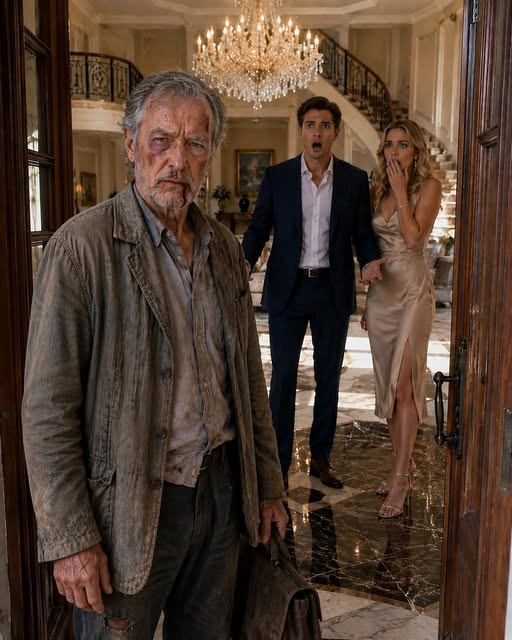
“What is this, Dad?” he had sneered, tossing the priceless family heirloom onto the hard mahogany table like a piece of junk mail. “Another lesson in ‘hard work’? I’m thirty years old. I run a venture fund. I don’t need a scratched-up watch from a dead ditch-digger, and I certainly don’t need you showing up to my house looking like you just crawled out of a construction pipe, expecting us to bow down in appreciation.”
The guests had chuckled nervously, looking away. Amber had leaned back, that quiet, cruel smile spreading across her flawless face.
I had stood there, my old back straight, looking at the son I had sacrificed my own youth to elevate. “Brandon,” I had said softly, “don’t ever forget who laid the foundation beneath your feet. Without my ditch, your tower doesn’t have a prayer.”
That was the match that caught the gasoline.
Brandon had stood up, his face twisted in a manic, alcohol-fueled rage. He didn’t just push me; he lunged across the space, his fist colliding with my jaw with the full, unbridled force of his built-up resentment.
And as I fell against the marble floor, the taste of blood filling my mouth, I didn’t scream. I didn’t fight back. I simply opened my eyes, looked at the grandfather clock on the wall, and started to count.
One.
Two.
Three.
Every blow was a line of code deleting him from my future. By the thirty0th strike, when his friends finally pulled him away, breathing heavily as if he had conquered an enemy on a battlefield, the transformation inside my soul was absolute. I wiped the blood from my lip, picked up my father’s watch from the floor, and walked out into the cold February rain without saying a single word.
Chapter 3: The Unraveling of a False King
By 1:30 PM on Wednesday, the River Oaks mansion was entirely vacant. The moving trucks hired by the new Dallas trust had swept through the property with military efficiency, depositing Amber’s luxury designer wardrobes and imported Italian furniture onto the public sidewalk in secure storage crates.
Brandon’s venture capital offices downtown were located on the top floor of the Sterling Tower—a building whose primary structural steel had been anchored by my own construction company twenty years prior.
He sat at his grand glass desk, his hands shaking as he stared at the financial terminal on his screen. His corporate phone was buzzing nonstop with frantic alerts from his primary lenders.
The door to his private office swung open, and I walked inside. I wasn’t carrying a weapon, and I wasn’t accompanied by police officers. I wore my usual dark canvas jacket, a clean white shirt beneath it, and my grandfather’s watch secured firmly to my left wrist. The slight purple bruising on my face was a prominent, unescapable declaration of the truth.
Brandon jumped to his feet, his tailored suit jacket wrinkled, his eyes bloodshot with an explosive mixture of fear and fury. “You think this is a game, old man? You think you can use some ancient shell company to throw my wife onto the street? I’ve already contacted three civil litigators. We’re filing an emergency injunction to reverse the sale for fraudulent asset concealment!”
“Sit down, Brandon,” I said, my voice completely devoid of anger, carrying only the freezing, industrial weight of a man who had survived three economic collapses.
I sat in the leather chair across from him, placing a small, blue digital storage drive on the center of his glass desk.
“You should look at the secondary ledger before you spend your remaining capital on retainers for lawyers who already know they can’t win,” I said gently.
Brandon frowned, his eyes darting from my face to the blue drive. He plugged it into his terminal. As the files populated the screen, the remaining color drained from his face with such violent speed that his skin took on the translucent grey of wet cement.
“What… what is this?” he whispered, his hands dropping to his lap.
“That is the master debt schedule for Reeves & Associates Venture Capital LLC,” I explained, leaning back. “You thought you were a financial genius because your fund generated twenty percent returns last year. But you forgot to look at the primary underwriting. Sixty percent of your operational liquidity wasn’t derived from independent investors, Brandon. It was routed through an institutional line of credit issued by Vanguard Bank & Trust.”
“And?”
“And Vanguard Bank & Trust is a wholly owned subsidiary of the Sterling-Reeves Foundation,” I revealed, offering a small, quiet smile that made his jaw tighten in terror. “I didn’t just own the house you slept in, son. I own the debt that keeps your firm alive. The moment your hand struck my face for the thirtieth time last night, Arthur Vance executed a non-compliance default on your corporate lines. As of noon today, Vanguard Bank has called in your twelve-million-dollar operational loan. You have twenty-four hours to produce the capital, or the bank takes possession of your entire venture portfolio.”
Brandon staggered backward, hitting his high-back leather chair like a man who had been shot. The grand, untouchable king of River Oaks was suddenly looking into the absolute, cavernous void of total financial ruin.
“Dad… please,” he choked out, his voice cracking, the same voice that had sneered at my father’s watch twelve hours earlier. “We can talk about this. I lost my temper. The alcohol… Amber was pressuring me about the country club dues… I didn’t mean to—”
“You meant every single blow, Brandon,” I said, standing up and looking down at him with a profound, final sorrow. “You didn’t just hit an old man last night. You tried to beat the foundation out from under your own life because you thought the tower was floating on its own. But gravity always wins.”
Chapter 4: The Ghost in the Foundation
The legal and financial destruction of Brandon Reeves was swift, clinical, and completely absolute. Because the contracts my father and I had built over forty years were structurally flawless, there were no loopholes for his expensive litigators to exploit.
Within forty-eight hours, Vanguard Bank & Trust initiated the involuntary asset liquidation of Reeves & Associates. His portfolio companies—the tech startups and luxury real estate shares he had boasted about at his birthday dinner—were systematically absorbed by my foundation to clear his default. His shiny luxury cars were repossessed from the country club parking lot, and Amber, true to her transactional nature, filed for a legal separation within a week of their eviction, taking her remaining storage crates and leaving Brandon completely alone in a rented one-bedroom apartment on the industrial edge of the city.
He was stripped of his money, his prestige, his false friends, and his tailored suits. He was reduced to exactly what he had tried to make me feel like: a ghost ghosting through a city that didn’t know his name.
But the story didn’t end with a father’s cold revenge. The true, unpredictable twist—the one that no one in the Texas business community could have anticipated—unfolded three months later, in May of 2026.
I stood on the concrete observation deck overlooking our newest major project: the construction of the Arthur Reeves Memorial Youth Sanctuary—a massive, sixty-acre educational and vocational complex in East Houston designed to provide free technical training, engineering scholarships, and housing for underprivileged youth. It was a fifty-million-dollar project, funded entirely by the liquidation of Brandon’s former assets and the sale of the River Oaks mansion.
The noon sun was hot, smelling of fresh asphalt, iron, and the sweet, raw scent of turned earth. The heavy machinery groaned dynamically in the valley below, a symphony of real work that made my heart beat with a deep, ancestral peace.
A young woman walked up the stairs of the observation deck, carrying two cold bottles of water and a set of architectural blueprint adjustments. She was twenty-six years old, her dark hair pulled back in a practical ponytail, her hands dusted with the faint grey powder of Portland cement.
Her name was Clara Sterling.
She wasn’t Brandon’s sister; she was the daughter of my former grading foreman, Marcus Sterling, the man who had saved my life during a catastrophic trench collapse on the interstate expansion thirty years ago. When Marcus passed away from cancer ten years ago, I had quietly stepped in, financing Clara’s education at Texas A&M, where she had graduated top of her class in structural civil engineering.
She didn’t care about luxury cars or River Oaks country clubs. She lived in a modest apartment near the job site, wore steel-toed boots with pride, and spent her evenings analyzing soil composition charts. She was the true repository of my father’s spirit, the child of my work if not my blood.
“The structural engineers just cleared the secondary foundation pour for the main dormitory, Mr. Reeves,” Clara smiled, handing me a bottle of water, her eyes sparkling with the vibrant, unyielding light of someone who built things to last. “We hit the bed-rock depth exactly as specified in your original 1994 grading manuals. The structure is locked in. It’ll stand for a hundred years.”
I looked down at the massive concrete columns anchoring the youth center to the Texas earth. “It’s not just a structure, Clara. It’s a legacy.”
“I know,” she said softly, looking out over the job site. “I saw your son yesterday, Franklin.”
I paused, looking at her profile. “Where?”
“He was at the employment office near our primary mixing plant,” Clara revealed, her voice entirely devoid of malice, carrying only a quiet, solemn respect. “He was applying for an entry-level layout position on our road crews. He was wearing an old canvas shirt, his hands were covered in blisters, and he was holding that 1964 Omega watch you left on his table. He told the foreman he wanted to learn how to dig a ditch from the bottom up.”
A sudden, powerful wave of emotion crashed over my chest, stealing the breath from my lungs. The thirtieth blow hadn’t just been the end of his old life; it had been the violent, agonizing birth of his humanity. He hadn’t run away to New York or hidden behind a trust fund; he had stayed in the dirt of Houston, choosing to face the foundation he had tried so desperately to destroy.
“Did the foreman hire him?” I asked, my voice dropping to a low, gravelly vibration.
Clara turned to look at me, a brilliant, beautiful smile breaking across her face—an unexpected, transformative happy ending written in the very concrete we were pouring.
“I told the foreman to put him on my crew, Franklin,” Clara said gently, resting her hand over mine. “He has a lot to learn about real work. But I think he finally has the right teacher.”
Chapter 5: The Eternal Blueprint
Two months later, the hot July sun of 2026 washed over the completed grand courtyard of the Arthur Reeves Sanctuary. The space was beautiful, filled with the joyful, echoey laughter of hundreds of young boys and girls who had just received their first vocational assignments and engineering scholarships.
A large bronze plaque stood at the center of the courtyard, its letters glistening in the brilliant Texas light:
THE ARTHUR REEVES SANCTUARY:
Dedicated to those who dig the trenches, pour the concrete, and understand that the strength of the tower lies entirely in the truth of its foundation.
I sat on a wooden bench beneath the shade of a grand live oak tree, a cup of black coffee clutched comfortably between my old hands. My lip was completely healed, my back straight, and my heart was filled with a peace so profound it defied description.
A shadow fell over my bench, and I looked up.
A man stood before me. He didn’t wear a tailored Italian suit, and he didn’t smell of expensive European cologne. He wore a heavy, stained high-visibility orange vest, a pair of worn denim jeans dusted with limestone powder, and a white hard hat held loosely under his left arm. His skin was deeply tanned by the Texas sun, his forearms corded with new, lean muscle, and his hands—once soft and manicured—were covered in thick, rough callouses.
It was Brandon.
He didn’t look at me with the superior, thin smile of the River Oaks venture capitalist. He looked at me with the clear, steady eyes of a man who had spent twelve weeks working twelve-hour shifts in the grading trenches of East Houston. The arrogance had been completely burned away, replaced by the heavy, silent dignity of an authentic workman.
Secured tightly to his left wrist, its leather strap stained with industrial grease but its glass face polished clean, was the 1964 Omega Seamaster.
“Dad,” Brandon said softly, his voice clear and entirely free of the old hesitation.
I stood up from the bench, facing my son under the infinite blue sky. The ledger of our lives was finally balanced, and the profit was pure redemption.
“You’re late for the shift change, Brandon,” I said, a faint, proud smile breaking across my face.
“Clara kept us over to verify the alignment on the northern retention wall,” Brandon replied, stepping closer, his hands reaching out to grab my shoulders. And as his rough, calloused fingers pressed against my canvas jacket, it wasn’t a push, and it wasn’t a blow. It was the tight, unyielding embrace of a son who had finally found his father in the dark.
“I dug the ditch, Dad,” Brandon whispered into my shoulder, his voice thick with a profound, emotional reverence. “I dug it thirty feet deep, right into the limestone. I finally understand what you were building.”
I held him tight, my eyes overflowing with hot, victorious tears as I looked over his shoulder at the grand columns of the youth sanctuary rising beautifully into the bright afternoon air.
“You did well, son,” I smiled, wiping a tear from my eye as I looked at the man he had chosen to become. “Welcome to the foundation.”
We walked down the steps of the courtyard together, stepping into the warm Texas sun, leaving the empty castles of greed behind forever, our boots striking the solid concrete side-by-side as we moved toward a future that could never be broken.
