Section I: The Silent Graveyard
I have walked through doors in places where the air itself seemed to be holding its breath. I have heard rounds snap past my ears, smelled burned rubber on streets without working lights, and slept with one boot on because sleep was never really sleep when you were the man everyone expected to stay calm.
For fifteen years, calm was what people called me.
Then I came home to my own front porch.
The Uber dropped me near the end of Maple Drive just after 4:00 in the afternoon. May sunlight washed over clipped lawns, basketball hoops, mailboxes, and small American flags hanging beside garage doors. Somewhere down the block, a sprinkler ticked in steady little clicks, and the warm air smelled like cut grass and somebody’s charcoal grill starting too early.
I had come home early to surprise my daughter, Violet.
She was turning sixteen in two days. I had missed too many candles, too many school concerts, too many ordinary afternoons that fathers are supposed to remember without being reminded by photos. Violet always told me it was okay on video calls, but her smile would go tight around the edges when she said, “I know you tried, Dad.”
This time, I wanted to walk in with my duffel over my shoulder, hear her scream my name, and be nothing more dangerous than a father who got home in time.
I had not told Harper. I had not told Violet. I wanted one clean moment before life found a way to take it back.
Halfway up the driveway, I saw the front door.
It was open.
Not wide. Not kicked in. Just cracked an inch, like someone had pulled it shut without caring whether it latched. The father in me wanted to call out and laugh. The soldier in me killed that sound before it reached my throat.
The street behind me stayed normal. A dog barked twice. A delivery van turned the corner. Mr. Lawson’s sprinkler kept tapping against the same patch of grass like nothing evil had ever learned my address.
I stepped onto the porch and pushed the door with two fingers.
“Harper?”
My voice landed too low in the foyer.
No answer.
The house smelled wrong. Not smoke. Not food left out. Something wet, sharp, metallic. I knew that smell before my mind let me name it, and for one second I hated every war that had trained me to recognize it so fast.
Blood.
I moved through the living room first because training does not care what your heart wants. Sofa cushions straight. Remote on the coffee table. A half-full glass of lemonade sweating beside Violet’s math notebook. No drawers dumped. No lamp broken. No jewelry box dragged open.
Not robbery. Not panic. Not random.
A house tells you what happened if you stop begging it not to.
Then I looked down the hallway.
My daughter was on the floor.
For one impossible second, my brain refused her. It gave me pieces instead: one sneaker, one backpack strap, one pale hand curled near her chest. Then the pieces became Violet, and the whole world dropped out from under me.
“No. No, baby.”
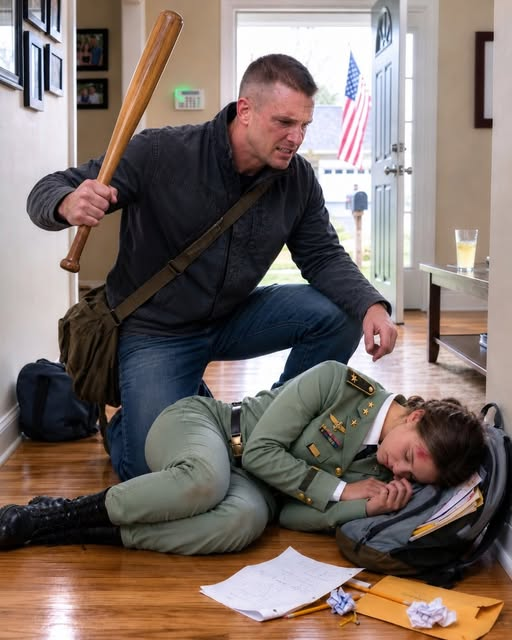
I hit the hardwood beside her so hard pain cracked through both knees. Her face was swollen and bruised, her hair dark near the temple, her body curled inward like she had tried to become small enough for the hallway to protect her. Her school backpack lay open beside her, papers bent under one strap, a birthday-card envelope half crushed beneath the zipper.
I touched her neck.
Nothing.
Then, faint as a thread under water, I felt it.
A pulse.
I called 911 with one hand and kept the other against her throat because I was afraid that if I stopped feeling it, it would disappear.
“Sixteen-year-old female,” I said, and my own voice sounded like it belonged to another man. “Severe head trauma. Still breathing. Send an ambulance now.”
The dispatcher asked questions. I answered like a checklist. Address. Condition. Possible assault. No, I did not know where the attacker was. Yes, the scene might still be unsafe. No, I was not leaving her.
Sirens came closer.
I held Violet’s hand and whispered whatever broken promises fathers whisper when they are too late. Her skin was cold. Her fingers had blood under the nails. She had fought them. My little girl had fought in the same hallway where I once sat cross-legged teaching her how to tie her shoes.
For one ugly breath, rage rose in me so hard my vision narrowed. I pictured finding whoever had done it before the ambulance even made the turn. I pictured my hands around a throat, not checking for life but taking it.
Then Violet’s pulse fluttered under my fingertips, and I stayed useful.
At the hospital, they took her from me under white lights. A nurse at the intake desk asked for her birthday, allergies, emergency contact. I answered because paperwork is what the world asks of you while your child is behind double doors.
Harper arrived twenty minutes later, hair loose, mascara streaked, blouse wrinkled like she had dressed while running. She folded into me so hard I had to catch her.
“Mason, where is she? Is she alive?”
“Surgery,” I said. “They’re trying to relieve pressure.”
The sound that came out of her did not sound human.
Detective Grant showed up about an hour later in a brown jacket that smelled faintly of cigarettes and rain. He looked at my bloody shirt. He looked at the hospital floor. He did not look long enough at my face.
“Looks like a break-in,” he said.
I stared at him. “A break-in.”
“We’ve had a few in the area. Wrong place, wrong time. Your daughter probably surprised them.”
“She was in her own home.”
“I understand you’re upset.”
That was when I knew he was useless.
Because while he was saying robbery, my mind was back in the living room. The untouched drawers. The sweating lemonade. The math notebook. The door cracked but not forced. The silence that had been placed there, not left behind.
Then I remembered the alarm keypad by the side wall.
The little light had been green.
Not red.
Not broken.
Ready.
I opened the security app with hands that did not shake, and the event history loaded line by line until the hospital hallway seemed to tilt under my boots.
It did not say forced entry.
It said: 4:12 P.M. System Disarmed via Master Passcode.
Section II: The Traitor’s Footsteps
My heart did not speed up; it went stone cold. I had served three combat tours as a Tier-1 Army Ranger with the 75th Ranger Regiment, tracking high-value targets across arid valleys and dense urban mazes. I knew the precise difference between a chaotic, opportunistic attack and a calculated execution.
The alarm hadn’t been hacked. It hadn’t been triggered and quickly canceled.
It had been disarmed by someone who knew the four-digit code.
Only four people on earth possessed that code: me, Harper, Violet, and Harper’s younger brother, Julian—a thirty-year-old financial analyst who lived three miles away and frequently crashed on our couch when his volatile investments turned sour.
I looked across the surgical waiting room. Harper was sitting on a plastic chair, her head in her hands, her body rocking back and forth in rhythmic agony. She was a mother whose world had just collapsed. Her grief was raw, messy, and entirely real.
I sat down beside her, wrapping my arm around her shaking shoulders. “Harper,” I whispered softly. “Where was Julian today?”
She blinked up through swollen eyes, confused. “Julian? I… I don’t know. He was supposed to swing by the house around three to drop off Violet’s birthday present before he went to his office downtown. Mason, why are you asking about Julian right now?”
“Just trying to build a timeline,” I murmured, kissing her forehead. “Stay here. If the surgeon comes out, call me instantly. I need to step outside for fresh air.”
I didn’t step outside for fresh air. I walked straight to the hospital parking garage, climbed into our second car, and plugged my tactical diagnostic drive into my laptop.
I pulled up our home’s cloud-stored security camera footage. The physical NVR unit inside the house had been ripped from the hallway closet—a detail Detective Grant had casually chalked up to thieves taking electronics. But the cloud backup, which I had routed through an encrypted personal server years ago, still retained the cached audio-visual buffers from the moment of the assault.
I scrubbed back to 4:08 P.M.
The footage from the foyer camera flickered to life.
The front door opened quietly. No pry bar. No shattered glass. A tall man in a dark hoodie and leather gloves stepped inside, moving with deliberate, practiced familiarity. Behind him walked a second man—heavier, wearing a medical mask and carrying a thick canvas bag.
The first man reached up, pulled down his hood, and looked directly toward the keypad to disarm the system.
My stomach turned to ice.
It was Julian.
He wasn’t dropping off a birthday present. He was guiding a stranger into my home.
The audio feed picked up their hushed, urgent voices.
“Where is it?” the heavy man grunted in a low rasp.
“In the hallway wall safe behind the mirror,” Julian hissed back, his hands trembling as he punched in the alarm code. “I told you, my brother-in-law keeps a secondary hard drive with his offshore cryptographic keys and emergency cash reserves in there. There’s at least three hundred grand in bearer bonds and crypto cold-wallets. Just take it and let’s go before the kid gets home!”
“You said the house would be empty,” the heavy man muttered.
“It is empty! Violet’s at track practice until five!”
Then, the heavy thud of the front door latching made them both freeze.
On the video feed, sixteen-year-old Violet walked into the frame from the kitchen, holding her half-full glass of lemonade. She had come home early because her track coach had canceled practice due to the heat.
“Uncle Julian?” Violet’s soft voice echoed through the speaker. “What are you doing? Who is that?”
Julian’s face went ghastly pale. “Violet! What… why are you here?!”
The heavy man didn’t hesitate. He pulled an iron crowbar from his canvas bag and took a step toward my daughter.
“Julian, no!” Violet screamed, dropping her glass. “Dad! DAD!”
“Grab her!” Julian panicked, grabbing Violet’s arm as she tried to bolt for the door. “Don’t let her yell! She knows us! She’ll tell Mason!”
What followed on that video was a nightmare that no father should ever witness. Violet fought with everything she had—scratching, kicking, screaming her father’s name into the empty house. But Julian held her arms while the heavy man struck her brutally across the head with the iron bar, dropping her limp onto the hardwood floor.
“Is she dead?!” Julian shrieked on the recording, backing away in terror.
“Shut up and grab the drive!” the heavy man barked, dragging Violet’s unconscious body into the side hallway out of sight of the window. “We take the safe contents, make it look like a botched home invasion, and leave!”
They spent three minutes tearing open the wall safe, grabbing the hard drive and cash, and fleeing out the cracked front door at 4:15 P.M.—just five minutes before my Uber pulled into the driveway.
I sat in the dark interior of my car, staring at the frozen screen.
My hands didn’t tremble. My breathing slowed to a cold, rhythmic cadence. The temperature in my blood dropped below freezing.
Detective Grant thought this was a neighborhood burglary. He was going to file reports, talk to neighbors, and waste precious hours while my daughter lay dying in an ICU.
They had no idea they had just declared war on a Tier-1 Army Ranger who hunts predators for a living.
I closed the laptop, reached under the passenger seat, and unlatched a concealed steel gun box. Inside lay my customized Sig Sauer P322, a tactical combat knife, a roll of heavy reinforced zip-ties, and a military-grade satellite location tracer.
I whispered into the silent darkness of the parking garage:
“Traitors will die tonight.”
Section III: The Hunt Begins
A man who believes he has committed the perfect crime always returns to a place where he feels safe.
For Julian, that place was a high-end, private gambling lounge concealed in the basement of an upscale Italian restaurant downtown—La Rosa’s. Julian owed over two hundred thousand dollars to a local underground bookmaker named Leo “The Hammer” Vance. It was the debt that had been drowning him for months, the debt that had driven him to sell out his own niece.
At 7:45 P.M., rain began to slick the asphalt outside La Rosa’s.
I didn’t kick the back door open. I didn’t make a scene. I wore a dark rain jacket, a low baseball cap, and moved through the alley shadow like an eclipse.
The restaurant’s rear security guard—a large man in a tight suit—stood near the kitchen exit, smoking a cigarette under a metal awning. He saw me approaching, his hand instinctively reaching beneath his jacket.
“Private entrance, buddy,” the guard grunted. “You need to walk around to—”
I closed the six-foot gap before he could finish his breath. My palm struck his chin in an ascending palm-heel strike, snapping his head back while my left hand controlled his wrist, twisting it upward and disarming his weapon before it cleared his holster. I drove his forehead into the brick wall with calculated, silent force. He collapsed into the trash alcove without making a single loud sound.
I caught his falling radio, slipped his keycard from his belt, and stepped through the heavy steel door into the basement corridor.
The lounge smelled of cigar smoke, aged whiskey, and stale sweat. Six men were gathered around a green felt poker table near the back.
In the center of the table sat Julian, flushed with bourbon, clutching a stack of high-value casino chips, laughing loudly with two men beside him. Sitting across from him was a broad-shouldered man with a jagged scar across his cheek—the heavy man from the video, Vance’s primary enforcer, known on the street as “Griz.”
“I told you I’d bring the cash, Griz!” Julian crowed, tossing a fresh stack of hundred-dollar bills onto the table. “My brother-in-law is an idiot who leaves crypto keys sitting in an old wall safe! Easiest score of my life!”
Griz chuckled, taking a sip of scotch. “Yeah, well, the kid took a hard hit. If she wakes up and talks to the cops—”
“She won’t wake up,” Julian dismissed with a cold, wave of his hand. “And even if she does, she was out cold before she saw anything. The cops think it was some junkies looking for jewelry.”
I stepped out from the shadows of the corridor into the low light of the lounge.
“The cops do,” I said.
The room went dead silent.
Julian’s glass froze halfway to his lips. He turned slowly, his eyes locking onto my figure standing near the doorway. The color drained from his face so fast he looked like a corpse.
“M-Mason?!” Julian gasped, stumbling backward out of his chair, knocking his bourbon glass onto the green felt. “What… what are you doing here?!”
Griz’s eyes narrowed instantly. Recognizing the military posture and the lethal calmness in my frame, his hand dropped toward the holster under his arm. “Who the hell is this guy?”
“Don’t,” I told Griz.
Griz ignored the warning. He pulled his 9mm pistol from his jacket.
In one fluid, seamless motion trained through thousands of hours of close-quarters combat drills, I drew my silenced sidearm from my waistband.
THWIP. THWIP.
Two suppressed rounds struck Griz’s right shoulder and forearm with surgical precision. The force shattered his bone, dropping his weapon onto the floor as he let out a choked, agonized scream, clutching his ruined arm.
The other four gamblers shrieked, throwing their hands into the air, falling onto their knees against the carpet.
“Everyone except Julian and Griz—get out,” I commanded, my voice flat, soft, and terrifyingly steady. “If anyone touches a phone or alerts the street, I won’t shoot your arms next time.”
The four men scrambled over each other, sprinting out the rear exit like terrified rats.
I walked over, picked up Griz’s fallen weapon, cleared the chamber, tossed the magazine aside, and pulled the heavy steel door shut behind them, sliding the internal lock into place.
Julian was on his knees behind the poker table, shaking violently, tears spilling down his cheeks. “Mason! Please! I swear to God, I didn’t want anyone to get hurt! It was Griz! Griz hit her! I tried to stop him!”
I walked over to Julian, grabbed him by his collar, and lifted his entire body off the floor, slamming him against the mahogany bar until the liquor bottles rattled.
“I watched the video, Julian,” I whispered, bringing my face three inches from his twitching eyes. “I watched you hold my daughter’s arms while he struck her with an iron bar.”
Section IV: The Interrogation
Julian let out a wet, pathetic sob, his bladder giving way, soaking his expensive designer trousers. “Mason, please! I was in debt! They were going to break my legs! I thought the house was empty! I swear I didn’t know Violet would be there!”
“She was turning sixteen in two days,” I said, my voice completely devoid of human warmth. “She made you a birthday card last year, Julian. She called you her favorite uncle.”
I reached into my pocket, pulled out the heavy zip-ties, and bound Griz’s remaining good arm to a steel support pillar near the bar, ignoring his groans of pain. Then I threw Julian into a heavy leather chair in the center of the room, securing his wrists tightly to the armrests.
“Where is the hard drive?” I asked.
Griz gritted his teeth, blood dripping from his shattered arm onto his boots. “Go to hell, soldier boy. You shoot us in here, you’re doing life in state prison. The cops—”
I didn’t let him finish the sentence. I grabbed the iron crowbar Griz had used at my house—which was sitting inside his canvas bag on the poker table—and drove the flat end directly into Griz’s kneecap.
A sickening CRACK echoed through the room, followed by a scream so loud it rattled the light fixtures overhead.
“I am not a cop, Griz,” I said quietly, leaning down over his pale, sweating face. “I am a father whose child is currently lying in an ICU with a fractured skull. I have no rules, no tactical boundaries, and nowhere else I need to be tonight. Where is the drive?”
Griz gasped for air, his eyes wild with pure, unadulterated terror. “In… in the briefcase under the bar! On the bottom shelf! The crypto keys are in there! Take it! Just don’t hit me again!”
I walked behind the bar, reached onto the bottom shelf, and pulled out my stolen wall-safe drive, along with the stack of stolen cash and bearer bonds.
Julian was weeping hysterically now, his frame shaking the chair. “Mason, please… I’m family! I’m Harper’s brother! Think about what this will do to Harper! If you kill me, it will break her heart!”
I stopped.
I looked at Julian. The coward who had used my family’s warmth to feed his pathetic addictions, who had stood by while his niece’s blood pooled on the hardwood floor, was now hiding behind the very woman he had betrayed.
“You’re right, Julian,” I said softly, setting the hard drive onto the table. “Harper has suffered enough today. She doesn’t need to mourn a brother.”
Julian let out a massive, shuddering sigh of relief. “Thank you… oh God, thank you, Mason! I’ll leave the state! I’ll never come back! I swear—”
“I said she won’t mourn a brother,” I interrupted, stepping toward him, pulling my phone from my pocket. “I didn’t say you were walking away.”
I unlocked my phone and dialed Detective Grant’s direct line.
“Detective Grant,” I said into the receiver. “This is Mason Sterling.”
“Mason?” Grant’s voice came through, sounding tired. “Look, I know you’re stressed, but we’re still running checks on the neighborhood CCTV—”
“I am currently inside the basement lounge at La Rosa’s on 4th Street,” I interrupted calmly. “I have bound and secured Julian Vance and Vance’s enforcer, ‘Griz.’ Beside them on the table is my stolen hard drive, the iron crowbar used to strike my daughter—complete with her blood and Griz’s fingerprints—and a cloud video recording showing both of them entering my house with Julian’s master passcode.”
A heavy, breathless silence fell over the line.
“Mason… what did you do?!” Grant stammered, his chair screeching on the other end. “Stay right there! Don’t touch them!”
“They are alive, Detective,” I said, looking down at Julian’s terrified, tear-streaked face. “Because my daughter deserves to see both of them stand in a court of law, hear her voice, and spend the next thirty years rotting in a federal prison.”
I hung up the phone.
I walked over to Julian, leaned down, and tapped the cold barrel of my sidearm against his cheek.
“You are going to tell the prosecutor every single detail of what you did,” I whispered into his ear. “And if you ever breathe my daughter’s name again, prison walls won’t protect you from me.”
Section V: The Unexpected Awakening
I arrived back at the hospital at 11:30 P.M.
The rain had stopped, leaving the streets wet and reflective under the streetlights. I had changed my shirt in the car, washed the grime from my hands, and walked back into the surgical waiting room with a calm, unyielding stride.
Harper was sitting on the bench, holding two paper cups of cold coffee, looking utterly defeated.
When she saw me walk through the doors, she stood up, her eyes wide. “Mason! Where were you? I tried calling you!”
“I took care of something,” I said gently, pulling her into my arms, wrapping my coat around her shivering shoulders.
Before she could ask another question, the heavy double doors of the Intensive Care Unit swung open.
Doctor Aris—the lead neurosurgeon—walked out into the hallway. He pulled off his surgical mask, his face exhausted, but his eyes carrying a warm, gentle light.
Harper gasped, clutching my arm so hard her nails bit through my jacket. “Doctor… please…”
“Mrs. Sterling, Mr. Sterling,” Dr. Aris said, a genuine smile breaking across his face. “The surgery was a complete success. We relieved the intracranial pressure without any complications. Her brain swelling has dropped significantly.”
Harper let out a choked, sob-filled scream, collapsing against my chest.
“Can… can we see her?” I asked, my own voice trembling for the first time all night.
“She’s awake,” Dr. Aris smiled warmly. “And she’s already asking for her father.”
Section VI: The True Horizon
The ICU room was quiet, bathed in the soft, rhythmic humming of heart monitors and the gentle blue glow of medical displays.
Violet lay in the center of the bed, her head wrapped in white bandages, her face bruised, but her dark, bright eyes open, clear, and fully present.
When the door pushed open and I walked in beside Harper, Violet’s face lit up with a fragile, beautiful smile.
“Dad…” she whispered, her voice raspy and weak.
I dropped to my knees beside her bed, taking her pale, tiny hand into my large, calloused palms, pressing my forehead against her fingers.
“I’m here, baby,” I sobbed quietly, tears finally spilling freely down my face. “Dad’s right here. I’m not going anywhere.”
“You came home early…” Violet murmured, a tiny giggle catching in her throat before she winced slightly. “You surprised me…”
“I’m never leaving again, Violet,” I promised, kissing her knuckles over and over. “I’m done with the deployments. I’m done with the wars. I’m staying right here.”
Harper sat on the other side of the bed, crying tears of pure, unadulterated joy, holding Violet’s other hand.
“Sweetheart,” Harper whispered softly, wiping a tear from Violet’s cheek. “The police… they caught the men who did this. Uncle Julian… he’s going away for a very long time.”
Violet looked at me, her dark eyes holding an incredible depth of maturity and understanding that far exceeded her sixteen years. She didn’t look terrified. She didn’t look broken. She looked at her father—the soldier who had come home, the man who had protected her home, and the father who loved her beyond measure.
“I knew you’d find them, Dad,” Violet whispered softly, squeezing my fingers with all the strength in her little hand. “I knew you wouldn’t let them win.”
Two days later, on a warm, sunlit May afternoon, we brought sixteen small pink candles into Violet’s hospital room.
The room was filled with flowers, warm cards, and the delicious smell of a fresh chocolate cake I had bought from the bakery down the street.
As Violet blew out her candles, surrounded by her mother and me, the warm California sunshine poured through the window, washing over us, burning away the cold shadows of the past, and illuminating a future that no traitor could ever touch.
I had fought wars across the world to protect strangers. But as I held my daughter in my arms, listening to her laugh under the bright afternoon light, I knew that the greatest victory of my life was right here in this room.
I was no longer just a soldier.
I was a father, and I was finally home.
