Chapter 1: The Last Wish in Room 412
Two years ago, I was thirty-four years old and working as a nursing assistant in a small retirement home when I met Elise.
She was eighty-two—outspoken, stubborn, and strong-willed—but she also had the rare gift of making every room feel warmer simply by being in it. While other residents sat silently watching television or staring out the rain-streaked windows, Elise would sit in the armchair near the sunny corner of the sunroom, knitting colorful scarves that she gave away to anyone who looked like they were having a bad day.
Most of the residents were visited by their children, grandchildren, or other relatives. Saturdays were always the hardest days on the floor. Families would stream through the double glass doors, carrying bouquets of fresh flowers, homemade pies, and bright drawings from little kids. Elise’s door, however, remained quietly closed on those days.
Elise had absolutely no one.
Little by little, I became the person she looked forward to seeing every day. I brought her tea—earl grey with two drops of honey, exactly the way she liked it—stayed with her after my grueling twelve-hour shifts, and listened to the stories she told about her life. She talked about growing up near the coast, the smell of salt air in October, and the tiny antique shop she used to run decades ago. Over time, she stopped being just another resident in my care—she became family to me.
Still, one thing always puzzled me.
Wherever she went, Elise carried the same old, worn hospital bag. It was made of faded canvas, its dark blue dye rubbed pale along the seams, with a brass zipper that looked like it had been mended dozens of times with coarse black thread. She never let anyone touch it. If a nurse tried to move it while cleaning her bedside table, she would gently but firmly take it back, hugging it tightly against her ribs like a mother shielding a newborn child.
“That old rag ought to go in the incinerator, Elise,” the head nurse, Brenda, used to joke with a scoff. “It’s a walking biohazard.”
Elise would only smile, her sharp blue eyes softening as she rested her frail hand over the canvas. “Some things hold memories too heavy to throw away, dear,” she would reply softly.
Then came a bitter Tuesday in late November. Elise’s lungs began to fail, and she was transported emergency-style to Saint Jude’s General Hospital. I rushed over immediately after my shift ended at 7:00 PM, still wearing my faded green scrubs. The ICU room was cold, filled with the rhythmical, mechanical hum of life support monitors and the harsh glow of fluorescent tubes.
She was propped up on three pillows, looking impossibly small among the white sheets. But sitting right beside her hip, resting against the guardrail, was the navy blue canvas bag.
When she saw me step through the doorway, her tired eyes lit up with a fragile warmth. She motioned with her trembling fingers for me to approach. I pulled a plastic chair close to her bed, sat down, and took her cool, thin hand in mine.
She took my hand, looked me straight in the eyes, and whispered,
“I have one last wish.”
A bittersweet smile crossed her face.
“I know this will sound strange, but I don’t have much time left. I’ve spent so many years alone… I don’t want to leave this world without knowing what it’s feels like to have a husband. Would you marry me?“
I froze. The steady beep… beep… beep… of the heart monitor felt deafeningly loud in the heavy silence that followed. I searched her eyes, expecting to see confusion or the cloudiness of delirium. But there was none. Her gaze was crystal clear, steady, and filled with a profound, aching vulnerability.
“Arthur,” she rasped softly, her voice barely a thread. “I know what people will say. I know how it looks. An eighty-two-year-old dying woman and a young nursing assistant. But I have watched you for two years. You possess a heart that this cold world doesn’t deserve. You give love without asking for a single thing in return. Please… grant an old woman the dignity of not dying as a forgotten stranger.”
I knew many people would judge me.
I knew my coworkers would whisper behind my back in the breakroom, accusing me of taking advantage of a senile patient or chasing an inheritance that didn’t exist. I knew others would never understand my decision.
But if marrying her could give this deeply lonely woman one final moment of happiness, I simply couldn’t say no.
“Yes, Elise,” I choked out, tears brimming in my eyes as I squeezed her frail fingers. “It would be my honor.”
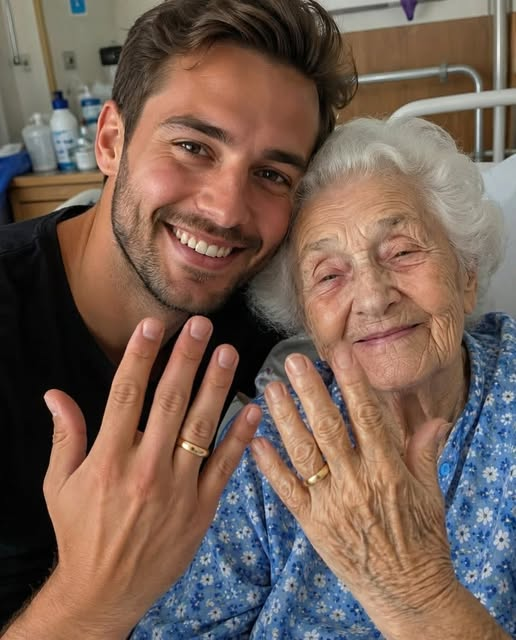
One week later, Elise and I were married in a simple, intimate ceremony held in her hospital room. The hospital chaplain officiated. A young night-shift nurse stood as our witness, wiping away tears as she placed a small spray of plastic daisies on the bedside tray. I bought two simple steel bands from a local pawnshop for twenty dollars. As I slid the thin ring onto her delicate, translucent ring finger, Elise wept quietly, holding my hand against her cheek like it was the most precious treasure on earth.
For three days, I didn’t leave her side. I slept sitting up in the vinyl hospital chair, holding her hand through the night. She didn’t speak much—she was too weak—but whenever she opened her eyes and saw me sitting there, wearing my matching steel band, a peaceful calm settled over her face.
Three days later, she passed away peacefully in her sleep while the morning sun was just beginning to hit the glass.
Chapter 2: The Blue Canvas Bag
The funeral was as quiet as her life had been.
It was held at a small chapel on the outskirts of town. I paid for the modest casket out of my modest savings, standing alone in the front pew under the vaulted wooden ceiling. There were no family members present. No distant cousins, no old friends from her youth, no neighbors. Just me, the minister, and the soft rustle of dry leaves outside the stained-glass windows.
As the casket was lowered into the ground, I felt a profound emptiness settle deep in my chest. She was gone, leaving behind only the gentle memory of her laughter and the quiet warmth she had brought into my ordinary life.
I was standing beside my battered sedan in the cemetery parking lot, watching the gray fog roll over the tombstones, when I heard the sharp click of dress shoes on the wet asphalt.
A tall, sharp-featured man in a impeccably tailored charcoal suit was walking toward me. He carried a sleek black leather briefcase in his left hand, but in his right hand, held with almost reverent care, was the worn blue hospital bag Elise had protected for all those years.
He stopped two feet in front of me. His expression was serious, almost stoic, but his dark eyes held a deep, assessing curiosity.
“Mr. Arthur Pendelton?” the man asked, his voice deep and formal.
“Yes,” I replied, wiping a tear from my cold cheek. “Who are you?”
“My name is Richard Harrison. I am a senior partner at Harrison, Sterling & Vance Law Firm in Manhattan,” he said, extending a gloved hand. I shook it hesitantly.
He looked down at the old bag in his hands, then stepped forward and placed the heavy blue canvas bag directly into my arms.
“She wanted you to have this the moment she was laid to rest,” Richard said quietly.
The bag felt surprisingly heavy—much heavier than clothes or toiletries would warrant. The fabric smelled faintly of lavender, lavender soap, and old paper.
“I don’t understand,” I confessed, holding the bag against my chest just as Elise used to do. “Elise never mentioned having a lawyer. She lived on state assistance at the care facility. Her monthly stipend barely covered her personal items.”
A strange, unreadable shadow crossed the lawyer’s face. He reached into his coat pocket and pulled out a heavy brass key attached to a dark leather fob. He reached out and placed the key on top of the bag.
Then he looked at me calmly and said,
“She chose you for a reason.”
“A reason for what?” I pressed, my voice trembling slightly in the crisp afternoon air. “What’s inside this bag, Mr. Harrison? Why did she keep it locked away from everyone?”
Richard Harrison took a step back, buttoning his suit jacket. “What is inside that bag, Arthur, will either ruin your life or change the trajectory of the human race. Elise spent forty years hiding from the world. She tested every soul that crossed her path. Dozens of people failed her test. You were the only one who passed.”
Before I could demand a clear answer, the lawyer turned on his heel, stepped into the back of a waiting black town car, and drove away into the thick autumn mist, leaving me standing completely alone in the silent cemetery.
Chapter 3: The Discovery in the Attic
I drove back to my cramped, one-bedroom apartment on the third floor of a noisy complex near the train tracks. The apartment was cold and quiet. I locked the front door behind me, dropped my coat on a chair, and walked straight to the kitchen table.
I placed the blue canvas bag in the center of the wooden table under the bright overhead bulb.
My hands were shaking as I picked up the brass key Richard Harrison had given me. I looked closely at the bag’s brass zipper. Tucked neatly beneath the zipper pull was a small, heavy brass padlock that I had never noticed before because Elise always kept the top flap folded over.
I inserted the key into the padlock. It turned with a crisp, heavy click.
Slowly, I pulled the zipper open.
I expected to find old photo albums, perhaps a few pieces of vintage costume jewelry, or yellowed love letters from a long-lost romance. Instead, what I found made my heart drop into my stomach.
The entire interior of the bag was lined with lead-shielded foam padding. Resting inside were three distinct items:
- A thick, leather-bound journal filled with dense, hand-written formulas, chemical diagrams, and dated entries spanning from 1982 to 2018.
- A sealed, tamper-evident military glass vial containing a glowing, deep-amber liquid labeled “Compound-77: Neuro-Regenerative Isolate.”
- A stack of legal deeds, patents, and stock certificates tied to a corporation named Vanguard Bio-Tech Laboratories.
My head spun. I sank into the wooden chair, my eyes wide as I picked up the leather-bound journal. I flipped to the very first page. Written in elegant, precise calligraphy was an inscription:
Property of Dr. Elise Montgomery-Vanguard.
Chief Scientific Officer, Vanguard Laboratories.
If found, do not return to the government. Do not return to my family. They destroyed my life to possess this work.
Dr. Elise Montgomery?
I sat in dead silence for nearly ten minutes, staring at the name. The gentle, forgotten old woman who knitted scarves in the retirement home sunroom was a high-ranking scientist?
I frantically began turning the pages of the journal. The story that unfolded in those yellowed pages was a terrifying masterpiece of tragedy, corporate espionage, and absolute betrayal.
In the late 1970s and early 1980s, Dr. Elise Montgomery was one of the world’s leading neurobiologists. She had developed a revolutionary chemical compound—Compound-77—capable of completely repairing damaged brain tissue, reversing advanced Alzheimer’s disease, and restoring lost cognitive function within days. It was a medical breakthrough worth tens of billions of dollars—a discovery that would alter human history.
But as the research reached its final phase, her husband, Julian Vanguard, and her younger brother, Victor, betrayed her.
Driven by insatiable greed, Julian and Victor secretly forged documents to strip Elise of her intellectual property rights. When she discovered their plot and threatened to expose them to the federal authorities, they attempted to have her forcibly committed to a private psychiatric facility, claiming she was suffering from paranoid schizophrenia and severe delusions.
They took her company. They stole her name. They scrubbed her achievements from scientific journals.
They turned her into a ghost.
However, on the night she was meant to be dragged away to the institution, Elise escaped into the rainy darkness carrying only one thing: the original lab notes, the master patents, and the only viable original strain of Compound-77 in existence. Without that master strain, Vanguard Bio-Tech was never able to replicate the formula. For forty years, the company sat on trillions in potential value, unable to monetize the drug because the key element was missing.
Elise went into hiding under a stolen identity, living in poverty, changing her name, moving from small town to small town, carrying the million-dollar secret inside an old navy blue canvas hospital bag.
She knew that if she ever checked into a hospital using her real name, or if anyone discovered what was in that bag, her husband and brother would find her and take it by force.
Chapter 4: The Test of the Heart
I sat back in my chair, drenched in a cold sweat. The gravity of what I was holding pressed down on me like a ton of lead.
I turned to the very last page of the journal. The ink was fresher here, written in the shaky, familiar handwriting I had come to love over the past two years. The entry was dated just four days before she died—the day before she asked me to marry her.
November 18
My body is failing me now. My lungs can no longer hold the breath of this world. My forty-year exile is coming to its natural end.
For four decades, I have lived in absolute isolation. I watched human beings closely. I watched doctors, nurses, relatives, and strangers. Every time I thought about trusting someone with my life’s work, I saw the glint of greed in their eyes. I saw how easily people sell their souls for money, power, and prestige.
And then, I met Arthur.
Arthur, who worked double shifts for minimum wage, yet bought extra blankets for cold residents out of his own pocket.
Arthur, who sat with me for hours listening to an old woman’s ramblings when he could have gone home to rest.
Arthur, who never asked me where I came from, never cared that I had no family, and loved me simply because I was a human being in need of kindness.
I needed to know if his goodness was absolute. I needed to see if he would honor a dying, broke old woman’s ultimate humiliation—marrying her in a cold hospital room just to grant her peace.
He said yes without a second of hesitation.
He didn’t marry a wealthy heiress. He married a pauper. He didn’t do it for money, fame, or recognition. He did it out of pure, untainted human compassion.
Arthur, if you are reading this, you are now the sole owner of Vanguard Bio-Tech’s core patents, the master strain of Compound-77, and my entire hidden estate, valued at over eighty million dollars.
Use it to heal the world. But beware: Julian and Victor are still alive. And they are searching for you.
My breath caught in my throat. Eighty million dollars. A cure for Alzheimer’s. A target on my back.
Suddenly, loud, heavy footfalls echoed down the corridor outside my apartment door.
I snapped the journal shut, shoved it back into the blue canvas bag, and pulled the zipper tight just as a thunderous blow rattled my apartment door.
“POLICE! OPEN UP!” a voice barked from the hallway.
I jumped up, my heart hammering against my ribs. I looked through the tiny peep-hole of my door. Standing outside were two tall men in dark suits—not police officers. Standing behind them, holding a silver walking cane, was an elderly man with cold, cruel eyes and a silver mustache.
It was Victor Montgomery—Elise’s brother.
“Break it down,” Victor ordered coldly, pointing his cane at the lock.
Chapter 5: The Ambush and the Standoff
Before I could lock the deadbolt further, the door burst open with a violent CRACK. The wooden frame splintered, and the two heavy-set men shoved their way into my living room, throwing me hard against the kitchen counter.
I fell to the floor, pain shooting up my shoulder, but I scrambled back up, grabbing the blue canvas bag and holding it behind my back.
Victor Montgomery walked into my small apartment, glancing around the worn furniture and peeling wallpaper with an expression of profound disgust. He adjusted his silk tie and leaned on his polished wooden cane.
“So,” Victor said, his voice smooth as silk and cold as ice. “This is the noble nursing assistant who played prince charming to my pathetic sister.”
“Get out of my house,” I breathed, backing toward the kitchen window. “You have no right to be here!”
“I have every right,” Victor sneered, stepping closer. “My sister was mentally incompetent. For two weeks, our legal team traced her whereabouts to that miserable retirement home. Imagine our surprise when we discovered she had married a zero-dollar-a-year nobody three days before shedding her mortal coil.”
He pointed the rubber tip of his cane straight at the navy blue bag in my arms.
“Hand over the bag, Arthur,” Victor said softly. “You don’t know what you’re dealing with. That bag contains corporate assets belonging to Vanguard Bio-Tech. You signed a marriage certificate with a crazy woman. In the eyes of the law, that marriage was a farce, and I am her legal next-of-kin.”
“She wasn’t crazy!” I shouted, tears of rage springing to my eyes. “She was terrified of you! You and Julian stole her life, you tried to lock her in an asylum, and she spent forty years hiding in the dark because of your disgusting greed!”
Victor’s face darkened, the smooth composure cracking to reveal a sharp, predatory snarl.
“Julian died five years ago, boy,” Victor growled, taking a step toward me while his two men closed off my escape routes. “I am the sole controlling shareholder of Vanguard now. That compound inside that bag is worth billions. Do you honestly think a pathetic little wiping-bot like you is going to stand in my way? Give me the bag, or my men will throw you out of that third-story window and make it look like an unfortunate suicide driven by grief.”
The two men stepped forward, reaching into their jackets to reveal heavy handguns holstered beneath their arms.
I squeezed the blue canvas bag tight against my chest. My mind raced. I was outnumbered, outgunned, and cornered in a tiny kitchen on the third floor. I looked at the bag—the bag Elise had spent her entire life protecting. If I gave it to him, her forty years of suffering would mean nothing. The cure for millions of suffering people would become a cash cow for a monster.
I looked Victor straight in the eye, took a deep breath, and prepared to throw myself out the window with the bag.
“Touch him, Victor, and you’ll spend the rest of your natural life in a federal penitentiary.”
A calm, commanding voice echoed from the shattered doorway.
Chapter 6: The Unpredictable Reckoning
Everyone in the room froze.
Victor spun around, his silver cane slipping slightly on the linoleum floor.
Standing in the doorway was Richard Harrison, the lawyer from the cemetery. But he wasn’t alone. Standing behind him were four armed federal agents wearing blue jackets stamped with gold letters: FBI: FINANCIAL CRIMES AND FRAUD DIVISION.
Victor’s face drained of all color. “Harrison? What is the meaning of this? This is a civil corporate matter!”
“It ceased being a corporate matter twenty minutes ago, Victor,” Richard Harrison said smoothly, stepping into the apartment and displaying a signed judicial order. “This is Federal District Judge Samuel Vance’s emergency warrant for your arrest.”
“Arrest?!” Victor spat, stepping back nervously. “On what grounds?!”
“On the grounds of attempted murder, grand corporate fraud, forty years of tax evasion, and conspiracy to commit human rights violations,” Richard announced calmly.
I stood frozen against the counter, completely stunned. “Mr. Harrison… how did you know they were coming here?”
Richard Harrison turned to me, a warm, genuine smile breaking across his stern face for the very first time.
“Arthur,” Richard said softly, “did you really think Elise left you completely unprotected?”
Victor let out an angry, desperate roar. “She was an old, broke woman! She didn’t have the power to do this!”
“She wasn’t broke, Victor,” Richard corrected, turning his piercing gaze onto the trembling old man. “Thirty years ago, Elise secretly contacted my father, who was the senior founder of our firm. She couldn’t reveal her location, but she established a blind, irrevocable trust. Every year, using secondary patents she filed under anonymous shell companies, she accumulated wealth. She paid our firm a massive retainer for thirty straight years to do one single job.”
Richard stepped closer to Victor, his eyes narrowing.
“Her instructions were simple,” Richard explained. “The moment she died, our firm was ordered to track down whoever held her canvas bag. If that person turned out to be a mercenary hired by you, we were to let you take it and then seize the assets legally. But if that person was genuine—if that person loved her for who she was without knowing about the money—we were to deploy our full legal and security network to protect that person and destroy you.“
Richard pointed to the corner of my kitchen ceiling. Tucked discreetly inside the smoke detector was a tiny red light, blinking steadily.
“Your entire conversation—including your threats to throw Arthur out of the window—was broadcast live to the FBI Field Office in Manhattan,” Richard said coldly.
The four FBI agents surged into the kitchen. Within seconds, Victor’s two bodyguards were forced to the floor and handcuffed. Victor himself was slammed against the kitchen counter—the very counter I had been pinned against—and his hands were bound tightly behind his back.
As the agents dragged the screaming, cursing old man out of my apartment, the hallway fell into a sudden, peaceful quiet.
Chapter 7: The True Legacy
I sat down heavily at the kitchen table, clutching the blue canvas bag, my legs shaking so violently I could barely keep my feet flat on the floor.
Richard Harrison walked over, pulled out a chair, and sat down across from me. He reached into his briefcase and pulled out a fresh stack of legal documents, placing them gently beside the leather-bound journal.
“Is it over?” I whispered, my voice trembling.
“Victor will never see the outside of a courtroom again,” Richard assured me gently. “His assets are frozen, Vanguard Bio-Tech is under federal receivership, and the patents have officially reverted to Dr. Elise Montgomery’s estate.”
He slid a pen across the table toward me.
“As Elise’s legal husband and sole heir,” Richard continued, “you are now the Chairman and controlling owner of Vanguard Laboratories, as well as the administrator of the eighty-four-million-dollar Montgomery Medical Trust.”
I looked down at the pen, then at the old blue canvas bag.
“I don’t know how to run a biotech company, Mr. Harrison,” I said honestly, tears blurring my vision. “I’m just a nursing assistant. I clean rooms, I bring people tea, I hold their hands when they’re scared…”
Richard smiled softly, reaching out to pat my shoulder.
“And that, Arthur, is precisely why she chose you,” Richard said quietly. “The world doesn’t need another greedy executive sitting in a corner office. The world needs someone who knows what it feels like to sit beside a dying person in the dark. The scientists will run the labs. You will run the heart of the company.”
Two months later.
I stood on the stage of the grand auditorium at the National Institutes of Health in Washington, D.C.
Photographers’ flashes blindingly illuminated the hall as hundreds of world-renowned doctors, scientists, journalists, and government officials stood on their feet, erupting into a thunderous, standing ovation.
Behind me, displayed on a massive LED screen, were the words: THE ELISE MONTGOMERY FOUNDATION FOR NEUROLOGICAL HEALING.
We had officially released Compound-77 to the world—not as an expensive luxury drug for the ultra-wealthy, but as a freely accessible medical treatment funded entirely by the Montgomery Trust. In just eight weeks of clinical trials, hundreds of Alzheimer’s patients had regained their memories, recognizing their children’s faces and speaking their spouses’ names for the first time in years.
I stood at the wooden podium, dressed in a sharp black suit. But pinned proudly to the lapel of my jacket was not a gold pin or a high-society medal.
It was a small, two-inch square piece of faded navy blue canvas, cut from the very bag Elise had carried for forty years.
I looked out into the crowd, touching the simple twenty-dollar steel ring still sitting on my left hand.
“Many people thought I married a lonely, broke old woman out of pity,” I spoke into the microphone, my voice echoing clearly across the vast auditorium. “They thought I was giving her a gift.”
I paused, feeling a warm, gentle breeze sweep through my heart, as if an invisible hand were resting softly on my shoulder.
“But the truth is, she gave me the greatest gift a human being can ever receive. She showed me that love is not about what you take from this world—it is about what you leave behind when you go.”
The crowd cheered, but in my mind, the noise faded away. I looked up toward the bright lights of the ceiling, smiled, and whispered into the quiet depths of my soul:
“We did it, Elise. Your bag is finally open.”
