The Walk Across the Stage
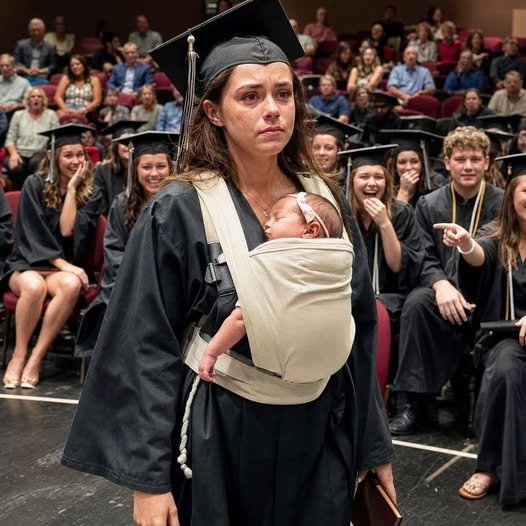
They started laughing the moment I walked onto the graduation stage with a newborn baby in my arms. Someone sitting behind me even mumbled, “Just like its mother…” But what the principal said next silenced the room.
The laughter began before my name was even announced. By the time I stepped onto the graduation stage with a newborn asleep against my chest, the entire auditorium seemed to have decided I was a disgrace.
I heard someone behind me whisper, “Just like its mother.”
My arms tightened around baby Noah.
I was twenty-two, top of my class, and an orphan who had spent half her life being told that people like me should be grateful for whatever scraps they received. The woman laughing loudest was my aunt, Marlene, the same woman who had taken me in after my parents died and reminded me every day that food, clothes, and a bed were debts I could never repay.
Beside her sat her daughter, Vanessa, wearing the white honor stole she had stolen from me through a forged disciplinary complaint.
Three weeks earlier, I had found Noah abandoned outside St. Catherine’s Clinic in a cardboard carrier, wrapped in a hospital blanket. His mother had died from complications shortly after giving birth. His father was unknown. No grandparents came forward.
“He’ll go into the system,” the social worker told me.
I looked at his tiny fist curled around my finger and saw myself at six years old, waiting in a county office while strangers argued over who had to take me.
“No,” I said. “He comes home with me.”
Temporary guardianship was approved because I had already completed foster-care training through my social work program. Marlene called it a stunt.
Vanessa called it proof that I was “trash collecting trash.”
Then they escalated.
A complaint appeared claiming I had cheated on my final research project and behaved irresponsibly by bringing “an unrelated infant” to campus. Vanessa’s boyfriend, Caleb, worked in the registrar’s office. My scholarship was suspended. My graduation status was placed under review.
Marlene smiled when she heard.
“You should skip the ceremony,” she said. “Save yourself the humiliation.”
But I knew something she did not.
I had spent two years volunteering with a legal-aid clinic, learning how records, signatures, and financial trails could expose lies that powerful people considered invisible.
My research project had not merely been an assignment. It had uncovered a pattern of scholarship theft, falsified student records, and redirected donor funds. Names, dates, bank transfers—everything led back to Caleb, Vanessa, and one administrator who had protected them.
So I walked onto that stage holding Noah, not because I was ashamed, but because I wanted them all watching when the truth arrived.
The principal rose from his chair.
The laughter continued.
Then he lifted one hand and said, “Before Miss Clara Hayes receives her diploma, this institution owes her a public apology.”
The room went silent.
The Anatomy of a Frame Job
The sudden, absolute silence in the four-thousand-seat auditorium was so dense it felt physical. The ambient noise of rustling program papers, soft coughing, and smug snickers dissolved instantly. On the third row of the family seating section, Aunt Marlene’s triumphant, wide-mouthed smile froze. Beside her, Vanessa’s hand hovered mid-air, having been in the middle of twisting her long blonde hair over the sparkling white honor stole draped around her neck—the stole that belonged to me.
Principal Arthur Vance adjusted his wire-rimmed glasses, his hands visibly trembling as he smoothed out a thick, cream-colored document resting on the podium. He wasn’t looking at the crowd. He was looking directly at me, his eyes filled with a mixture of profound shame and profound respect.
“Over the past forty-eight hours,” Principal Vance’s voice echoed through the high-end sound system, booming off the vaulted ceilings of the university arena, “an exhaustive independent investigation was conducted by the State Department of Academic Integrity and the Regional District Attorney’s Financial Crimes Unit.”
A sharp murmur rippled through the faculty seated behind the podium. Dean Sterling, the senior administrator who had signed off on my scholarship suspension just four days prior, suddenly shifted in his plush leather chair, his face taking on the pale, sickly hue of spoiled milk.
“It has come to the light of the board,” Principal Vance continued, his tone hardening into steel, “that Miss Clara Hayes was the target of a malicious, coordinated conspiracy designed to destroy her academic standing, strip her of her rightful honors, and conceal systemic criminal fraud within this institution’s registrar and financial aid offices.”
Vanessa snapped her head toward Caleb, who was standing near the side exit doors in his navy registrar staff blazer. Caleb was already backing up toward the hallway, his face drained of all color, his eyes darting frantically toward the push-bars of the emergency exit.
“Security, please hold the doors,” Principal Vance commanded calmly into the microphone.
Four uniformed campus security officers, accompanied by two plainclothes officers who had been quietly standing near the wings, moved with terrifying speed. Before Caleb could even touch the metal door handle, two officers grabbed his arms, pinning him against the wall.
A collective gasp exploded across the auditorium. Phones flew into the air as hundreds of students began recording the scene.
“Three weeks ago,” Principal Vance said, his voice resolute, “a forged disciplinary complaint was lodged against Miss Hayes, accusing her of academic dishonesty regarding her senior capstone thesis. That complaint was manufactured by student administrative assistant Caleb Thorne, utilizing administrative clearance credentials illicitly provided by Dean Harold Sterling.”
Dean Sterling stood up, his voice cracking with desperation. “Arthur, this is absurd! You cannot air internal administrative matters on this stage—”
“Sit down, Harold!” Principal Vance barked, turning his head to glare at the man. “You are relieved of your duties effective ten minutes ago. Federal marshals are waiting in your office.”
The room went completely wild. Students began cheering, while parents leaned over seats to whisper frantically.
“Miss Hayes’s research capstone,” Principal Vance proceeded, lowering his voice into a reverent pitch that captivated every soul in the arena, “was not a stolen work. It was an extraordinary, courageous forensic audit of the Oakridge University Scholarship Foundation. An audit that revealed that over three hundred thousand dollars in merit-based endowment funds—specifically funds designated for orphaned and low-income students—were systematically siphoned into private offshore accounts over the last three years.”
I stood on the center of the stage, my posture straight, my chin lifted. Against my chest, baby Noah stirred softly, his little mouth making quiet suckling noises in his sleep, completely oblivious to the earthquake occurring around us.
“Among those fraudulent transfers,” Principal Vance revealed, looking directly into the family section, “were funds stolen directly from Clara Hayes’s private trust—a trust established by her late parents, which was quietly diverted by her court-appointed guardian, Marlene Vance, in collusion with Dean Sterling.”
Aunt Marlene gasped so hard she choked, clutching her pearl necklace as if it were suffocating her. The surrounding parents instantly shrank away from her, leaving Marlene and Vanessa sitting in a literal island of isolation amidst a sea of horrified stares.
“Furthermore,” Principal Vance added, his voice dripping with absolute disgust, “the white honor stole currently worn by Miss Vanessa Vance was awarded under falsified grade-point metrics entered manually by Caleb Thorne. That honor belongs, by an insurmountable margin of academic excellence, to Clara Hayes.”
Principal Vance stepped out from behind the podium. He picked up a deep navy velvet box and a gleaming white silk stole from the awards table. He walked across the wooden floorboards, stopping directly in front of me.
With tears brimming in his eyes, the elderly principal bowed his head. “Clara… on behalf of this university, on behalf of every person who failed to see your light because of the shadows cast by wicked people… I ask for your forgiveness. You are our Valedictorian. And you are the pride of this institution.”
The Shadows of the Past
As Principal Vance draped the white honor stole over my shoulders, placing it gently around baby Noah’s swaddling blanket, the auditorium erupted into a standing ovation. Four thousand people stood on their feet, clapping, cheering, and shouting my name. The very classmates who had snickered minutes ago were now wiping away tears, their hands coming together in a thunderous rhythm of redemption.
I looked down at Marlene and Vanessa.
Vanessa was tearing the fake stole off her neck, her face contorted in ugly, hysterical sobs as two campus officers approached their row to hand them formal subpoenas. Marlene was frantically shouting at the officers, threatening lawsuits, but no one was listening to her anymore. The veil had been torn away. The invincible suburban matriarch who had treated me like a charity project for sixteen years was finally exposed for what she truly was: a thief who had fed on an orphan’s inheritance.
When my parents died in a tragic car accident when I was six years old, I remembered sitting in a cold, sterile county room. I remembered Marlene arriving in a black coat, smelling of expensive perfume, taking my hand with a smile that never quite reached her eyes.
For sixteen years, she maintained the narrative. Every piece of clothing I wore was a “generous hand-me-down.” Every meal I ate was “food taken from her own daughter’s mouth.” She made sure I slept in the drafty attic room above the garage, made sure I did the household chores before sunrise, and constantly reminded me that without her grace, I would have ended up in a state foster home.
She made me feel small. She made me feel like an eternal debtor.
When I earned a full academic scholarship to Oakridge University, she told the neighbors it was a “diversity charity grant.” When I worked two jobs to pay for my books and living expenses, she told family friends I was “frivolous with money.”
And when I found Noah, she thought she had finally found the ultimate weapon to destroy me.
The memory of the night I found Noah flashed through my mind with vivid clarity. It had been a freezing, rain-soaked Tuesday. I had been leaving my late-night internship at St. Catherine’s Legal Aid Clinic when I heard a faint, high-pitched crying coming from the alleyway beside the building.
I had followed the sound to a soggy cardboard box tucked behind a commercial dumpster. Wrapped in a thin, stained hospital blanket was a tiny, blue-lipped baby boy, shivering uncontrollably against the damp air. Beside him was a crumpled, rain-smeared piece of paper written by a dying, desperate teenage mother: Please love him. I have no one left. His name is Noah.
I had held that freezing baby against my skin beneath my coat, running six blocks to the emergency room, breathing my own warmth into his tiny lungs until the doctors took him into the incubator.
When the social worker later told me that Noah had no legal family and would be placed into the overcrowded, underfunded county emergency shelter system, my heart had fractured. I knew what that system felt like. I knew the terrifying uncertainty of lying in a bed that wasn’t yours, listening to strangers decide your destiny in the hallway.
I had looked at the social worker and said, “He is not going into the system. I will be his home.”
Marlene had mocked me. Vanessa had posted rumors online calling me an unwed, unstable mother. They thought they were dragging me down into the mud. They didn’t realize that in trying to destroy me, they had forced me to dig up the truth.
My capstone thesis hadn’t started as an investigation into my family. It had started as a simple research paper on municipal foster care funding. But as I traced the flow of state grants allocated for child protection, I kept running into a private holding company called Oakridge Educational Services LLC.
A few late nights of cross-referencing public records revealed that the LLC was registered to Dean Harold Sterling. And the primary bank accounts receiving the laundered funds belonged to none other than Marlene Vance.
They hadn’t taken me in out of the goodness of their hearts sixteen years ago. They had taken me in because my father’s life insurance policy was worth two million dollars—a policy that Marlene had spent sixteen years quietly embezzling while pretending I was a burden.
The Clamor in the Hallway
The graduation ceremony concluded in a blur of cheers, flashing cameras, and congratulations from professors who had previously turned a blind eye. As I walked off the stage, holding Noah close to my chest, a pathway cleared through the crowd.
I stepped out into the grand marble foyer of the university center. Waiting near the glass doors were three state troopers, two agents from the Attorney General’s Fraud Unit, and a woman in a crisp charcoal suit holding a leather briefcase.
The woman in the suit stepped forward, her heels clicking sharply against the marble floor. She had a warm, intelligent face and piercing dark eyes.
“Clara Hayes?” she asked smoothly.
“Yes,” I replied, adjusting my hold on Noah.
“My name is Eleanor Vance—no relation to your aunt, I assure you,” she added with a dry, professional smile. “I am the Lead Special Prosecutor for the State Attorney General’s Office. We’ve been reviewing the digital evidence binder you submitted to the state tip-line forty-eight hours ago.”
“Was it sufficient?” I asked softly.
Eleanor Vance let out a short, admiring laugh. “Sufficient? Miss Hayes, your forensic tracing of those ledger entries was more meticulous than most work I see from senior state auditors. Because of your capstone submission, we obtained emergency freeze orders on twelve bank accounts at 6:00 AM this morning.”
Before I could answer, a loud, shrill scream echoed from the main auditorium doors.
“Get your hands off me! Do you know who I am?!”
Aunt Marlene was being escorted out of the building in handcuffs by two state troopers. Her expensive hair was disheveled, her makeup smeared with sweat and tears. Right behind her was Vanessa, sobbing uncontrollably, her wrists also bound in steel restraints as a female officer guided her forward.
When Marlene caught sight of me standing with the Special Prosecutor, her face contorted into a mask of pure, unadulterated venom.
“You ungrateful little snake!” Marlene shrieked, struggling against the trooper’s grip. “I fed you! I gave you a roof over your head for sixteen years! You would have been a state ward living in a dumpster if it wasn’t for me!”
I took a slow, deliberate step forward, stopping just inches from where she stood restrained.
“You didn’t give me a roof, Marlene,” I said, my voice eerily calm, resonating with a quiet authority that made the surrounding crowd fall silent. “My parents bought that roof. You spent sixteen years living off the blood money of my dead mother and father while forcing me to sleep in an attic.”
Marlene flinched as if I had struck her across the face.
“And as for Noah,” I continued, looking down at the sweet, sleeping face of the child in my arms, then back up into her cold eyes, “you called him trash. But he brought the light that finally burned down your house of lies.”
“Clara, please!” Vanessa blubbered, looking at me with wild, terrified eyes. “I didn’t know about the money! I swear I didn’t know! Caleb told me he was just helping me get the honors stole because you didn’t deserve it! Talk to them, Clara! Tell them not to arrest me!”
I looked at Vanessa—the girl who had worn my clothes, taken my credit for assignments, mocked my isolation, and stolen my honors.
“You knew enough to sign the falsified affidavit, Vanessa,” I said softly. “You built your entire life on things you stole from me. It’s time you learn how to build something on your own.”
“Take them away,” Special Prosecutor Vance commanded quietly.
The officers led Marlene and Vanessa out the heavy glass doors into the bright summer sunlight, where two police cruisers were waiting with flashing lights. A crowd of students had gathered on the lawn, taking videos as the woman who had dominated local high society was placed into the back of a squad car.
I stood in the marble foyer, letting out a long, shuddering breath. The air in my lungs felt different. For the first time since I was six years old, I didn’t feel the suffocating weight of an imaginary debt crushing my chest. I was free.
The Unraveling of the Empire
The weeks following graduation moved with the velocity of a avalanche.
The investigation triggered by my capstone thesis tore through the local government and university administration like wildfire. Dean Harold Sterling pleaded guilty to state corruption, wire fraud, and embezzlement charges within ten days, offering full testimony against his co-conspirators in exchange for a reduced sentence.
Caleb Thorne was expelled from the university and charged with felony computer crimes and record falsification. His career in higher education administration was permanently destroyed before it had even begun.
Marlene Vance faced a federal indictment consisting of fourteen counts of grand larceny, fraud, and embezzlement of a minor’s trust estate. The state foreclosed on her luxurious suburban mansion—a house that had been purchased using funds stolen from my father’s life insurance payout. Every asset she owned, from her luxury vehicles to her investment accounts, was seized by the state asset recovery unit.
Vanessa was sentenced to community service, three years of probation, and permanent expulsion from the university system due to her active participation in the academic fraud conspiracy.
Two months after the graduation ceremony, I sat in a high-rise office in downtown Cleveland, sitting across from Mr. Richard Sterling (no relation to the disgraced Dean), a senior court-appointed trustee specializing in asset restoration.
“Miss Hayes,” Mr. Sterling said, sliding a thick leather-bound document across the desk toward me. “The forensic audit of your parents’ estate is officially complete.”
I leaned forward, cradling two-month-old Noah on my lap. He had grown so much—his cheeks were chubby and rosy, his bright blue eyes wide and curious as he stared at the sunlight bouncing off the glass desk.
“What are the final numbers, Mr. Sterling?” I asked softly.
“After the liquidation of Marlene Vance’s real estate holdings, the recovery of the offshore accounts in the Cayman Islands, and the court-ordered restitution from the university’s insurance bond…” Mr. Sterling paused, looking at me with deep admiration. “Your parents’ trust has been fully restored to its original value, plus accrued interest. The total standing in your primary account is three point four million dollars.”
I closed my eyes. Tears squeezed past my lashes, hot and silent, dripping down onto my linen dress.
It wasn’t about the money. It had never been about the money. It was about the fact that my mother and father had worked their entire lives to ensure I would be protected, loved, and provided for. Marlene had tried to erase their love, but truth had brought it back.
“There is one more thing,” Mr. Sterling added, pulling a smaller blue folder from his desk drawer. “Regarding the legal status of Noah.”
My heart instantly skipped a beat. My grip tightened slightly on the baby. “Is there a problem with the adoption proceedings?”
“Not a problem,” Mr. Sterling smiled warmly. “A resolution. The biological mother’s estate records were officially cleared by the state. Because you completed your master’s degree in social work last month, and because your financial stability and home environment are now beyond reproach… the family court judge signed the final adoption decree this morning.”
He slid the document toward me.
At the top of the crisp white page, embossed with the golden seal of the State Family Court, were the words: OFFICIAL CERTIFICATE OF ADOPTION.
Below it, in dark black ink, was his new legal name: Noah Arthur Hayes.
I covered my mouth with my hand, letting out a soft, sob of pure, unadulterated joy. I pulled the certificate close, then leaned down to press my lips against Noah’s soft forehead. He let out a tiny, sweet gurgle, his small hand reaching up to grab my chin.
“He’s officially yours, Clara,” Mr. Sterling said softly. “Nobody can ever take him away from you.”
The Hidden Blueprint
Six months later.
The crisp autumn air blew golden oak leaves across the wide brick courtyard of the St. Catherine’s Community Center. The old, dilapidated building that had once been a struggling neighborhood clinic had undergone a complete, brilliant transformation over the past four months.
The peeling paint was gone, replaced by warm cedar paneling, gleaming glass windows, and beautiful solar roofing. Above the double glass entrance doors was a brand-new brass plaque that caught the bright afternoon sun:
THE HAYES MEMORIAL FOUNDATION & FOSTER ADVOCACY CENTER
I stood on the front lawn, wearing a comfortable cream-colored sweater and jeans, holding eight-month-old Noah on my hip. He was babbling happily, pointing his tiny hand at the colorful balloons tied to the entrance railing.
Beside me stood Principal Vance—who had officially retired from the university to serve as the chief educational director of our new foundation—along with Special Prosecutor Eleanor Vance, who had joined our advisory board.
Using a portion of the restored inheritance from my parents, I had purchased the St. Catherine’s facility, transforming it into a state-of-the-art emergency shelter, legal aid clinic, and educational center for orphaned children and foster youth. We provided free legal defense against administrative fraud, college scholarship guidance, and immediate, loving shelter for children waiting for permanent placements.
“It’s breathtaking, Clara,” Principal Vance said, his eyes misting as he looked up at the building. “Your parents would be overwhelmed with pride.”
“They built the foundation, Principal Vance,” I smiled softly, kissing Noah’s cheek. “I just built the doors.”
As the crowd of community members, social workers, and local families gathered on the lawn for the ribbon-cutting ceremony, a sleek grey sedan pulled up quietly to the curb across the street.
The window rolled down slightly.
Sitting in the passenger seat was a woman wearing a plain canvas coat, her hair tied back in a messy bun. She was working a clipboard, holding a stack of court-mandated community service logs.
It was Vanessa.
She was currently assigned to city street-sweeping detail as part of her probation terms. She looked through the glass at the sparkling new center, at the massive crowd of reporters capturing the grand opening, and at me—standing at the center of it all, radiant, beloved, and surrounded by real purpose.
For a brief second, our eyes met across the busy street.
There was no hatred left in my heart when I looked at her. There was only a profound, peaceful distance. She had tried to steal my life, but in doing so, she had forced me to build a legacy that would outlive us all.
Vanessa slowly rolled the car window back up, and the sedan pulled away into the afternoon traffic, disappearing into the cold shadows of the city.
I turned back to the crowd, picking up the large ceremonial ribbon-scissors.
The reporters gathered round, flashbulbs popping like stars in the autumn afternoon. A young female journalist from the local newspaper raised her microphone.
“Miss Hayes!” the reporter called out. “One year ago, people looked at you on that graduation stage and thought your life was over before it even began. How did you find the strength to turn a devastating scandal into the biggest foster advocacy victory this state has seen in decades?”
I looked at the crowd. I looked at the gleaming building behind me, built to protect the children who had nowhere else to go. And then I looked down at Noah, who was smiling up at me with bright, fearless blue eyes.
I smiled—a real, radiant, unbroken smile that echoed straight from my soul.
“When people try to throw you into the dark,” I said, my voice carrying clearly across the quiet crowd, “they forget that some seeds are meant to grow in the dirt. My family didn’t leave me a fortune of money… they left me a legacy of truth. And truth is a light that no lie can ever put out.”
With a decisive snip, the bright red ribbon fell to the ground.
The crowd erupted into wild applause, cheering and throwing autumn leaves into the air. Noah let out a joyous squeal, clapping his little hands together as the afternoon sun bathed us in golden, unbroken warmth.
We had survived the fire. We had dismantled the lies. And together, in the bright light of a new day, we were finally, wonderfully home.
