The Splash in the Garden
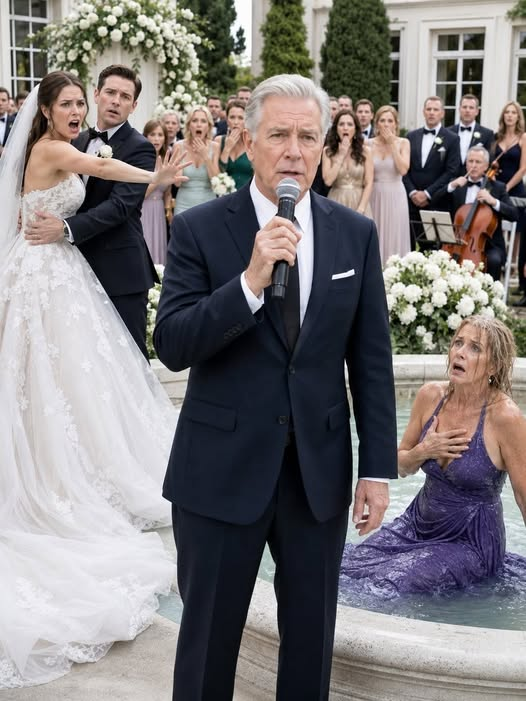
“Get your hands off me, you low-class woman!” my daughter-in-law shouted just after shoving my wife in front of nearly two hundred guests.
Loretta fell backward into the decorative pond in the garden. Her ivory dress darkened instantly, one of her shoes floated among the lilies, and the other sank to the bottom. For a moment, no one reacted. The music didn’t even stop.
The worst part wasn’t seeing my wife trembling in the water.
It was watching our son, Austin, walk over to his brand-new wife, wrap an arm around her waist, and smile as if what had just happened were nothing more than a harmless prank.
My name is Howard Miller, and for five years I quietly financed the life my son proudly pretended he had built on his own.
Austin always begged me not to tell Brittany.
“Dad, she’s very proud. If she finds out you’re helping us, she’ll think we’re living off you.”
The truth was, they were.
I paid off the loan on his pickup truck, covered months of rent, cleared two credit card balances, and transferred money every time his “business” hit another crisis.
In total, more than two million dollars had come out of my accounts.
Loretta knew about every dollar, although she never agreed with keeping it a secret.
“You’re not helping him grow,” she often told me. “You’re building him a stage so he can pretend he’s already grown up.”
I refused to listen.
From the day Brittany received her engagement ring, she began treating Loretta like a clumsy servant.
She criticized the way Loretta set the table, mocked her cooking, and corrected everything she said whenever other people were around.
One afternoon, Loretta brought over a dish of baked lasagna she had been cooking since before dawn.
“With all due respect, Mother-in-law, this kind of heavy food belongs in a cheap diner,” Brittany said, pushing the pot aside with two fingers. “In this house, we actually care about what we eat.”
Loretta smiled to avoid an argument, but that night she cried in silence.
At the engagement party, Brittany seated her near the service exit, far away from the immediate family. Austin claimed it was “because of the seating arrangement.”
A few months later, Brittany announced that after the wedding, we would have to ask permission before visiting them.
Loretta warned me.
“That girl isn’t nervous about the wedding. She’s figuring out how to push us out of our son’s life.”
Once again, I made excuses for her.
I also paid nearly eighty thousand dollars for the wedding at a country estate in Nashville and promised to contribute another two and a half million dollars toward the penthouse apartment where they planned to live.
All the contracts were in my name because Austin claimed that paperwork stressed Brittany out.
That afternoon, Loretta helped adjust the bride’s veil, welcomed guests, and even solved a problem with the floral arrangements.
But when she started chatting with the bride’s relatives and making them laugh, Brittany became furious.
She led Loretta over to the decorative pond and accused her of stealing the spotlight.
Loretta calmly replied that she was simply celebrating her son’s wedding.
Then Brittany shoved her.
Our daughter, Paige, rushed over and helped her mother out of the water.
Austin, meanwhile, wrapped his arms around his wife.
I walked over to the band, held out my hand, and asked for the microphone.
The music stopped.
Every eye turned toward me.
I looked at Brittany, then at my son, and said,
“Now I’d like the bride to tell everyone whose money is paying for the celebration she’s enjoying today.”
The entire reception hall fell silent.
What I did next changed our family forever.
No one could have imagined what was about to happen.
The Unmasking on the Pavilion
The silence that swept across the sunlit estate grounds was suffocating. The warm breeze carrying the scent of magnolia blosoms felt suddenly still, as if even nature held its breath. Nearly two hundred guests—dressed in designer suits, shimmering gowns, and high-end couture—stood frozen with champagne flutes suspended in mid-air.
Brittany’s face flushed a vivid, humiliated red, contrasting sharply with her ice-white silk wedding dress. Her mother, sitting in the front row with a diamond necklace sparkling against her neck, gasped audibly.
“Howard, what on earth are you doing?” Austin hissed, stepping forward, his knuckles white as he clenched his fists at his sides. “You’re ruining our wedding! Drop the microphone right now!”
“Ruining it?” I asked, my voice echoing clearly through the high-end speakers surrounding the courtyard. I didn’t raise my tone. I didn’t scream. The coldest truth sounds most lethal when spoken in a whisper. “No, Austin. A wedding is a celebration of unity, respect, and truth. What happened by that pond just now was none of those things.”
I looked down at my wife, Loretta. Paige was wrapping a heavy woolen coat around her shivering shoulders. Water dripped from her silver-streaked hair onto the stone pavement, her eyes wide with a mix of shock and old, deep heartbreak. For five years, I had protected my son’s ego at the expense of my wife’s dignity. Not for one more second.
“Brittany,” I said, turning my gaze directly onto my daughter-in-law. Her chin was thrust out in defiant anger, though a flicker of fear danced in her eyes. “You just called my wife a ‘low-class nobody.’ You told her she didn’t belong here, among your elevated family and high-society friends.”
“She was embarrassing us!” Brittany snapped, losing her composure as she gestured wildly. “She was blabbering to my uncles, wearing that cheap dress, acting like she owned the place!”
“That ‘cheap dress’ was tailored by hand,” I said softly. “And as for owning the place… let’s talk about ownership.”
I pulled a crisp black leather folder out from the inner pocket of my suit jacket. I had brought it to the wedding intending to hand it to Austin during the speeches as a surprise gift—the final, signed deed to the luxury penthouse overlooking downtown Nashville.
“This estate,” I began, tapping the folder, “costs eighty thousand dollars for the day. My son told you he booked it with his earnings as a ‘senior partner’ at his firm. But the invoice was paid from my business operating account three weeks ago. The open bar? My credit card. The three-tier fondant cake you just cut? Paid for by the woman currently dripping pond water onto the grass.”
Gasps rippled through the crowd. Brittany’s father, a prominent local attorney who had bragged all afternoon about his daughter marrying a self-made millionaire, slowly sat down in his chair, his face pale.
“Dad, stop it!” Austin yelled, taking a aggressive step toward the stage. “You promised me! You promised you wouldn’t do this!”
“I promised to help you stand on your own feet, Austin. I didn’t promise to fund a fantasy that turns you into a coward who lets his mother get pushed into a well!” I locked eyes with my son, and for the first time in his life, he saw no softness in me. “And as for the two-and-a-half-million-dollar apartment you told Brittany you bought as a wedding gift…”
Brittany’s eyes snapped to Austin, sudden horror breaking through her haughty posture. “Austin… what is he talking about?”
“The purchase agreement is in this folder,” I announced to the entire gathering. “Fully paid, fully cleared. But the buyer listed on the title isn’t Austin Miller. It’s Howard and Loretta Miller. And five minutes ago, I was prepared to transfer the deed to both of your names.”
Brittany swallowed hard, her mouth opening and closing like a fish out of water. “Howard… Mr. Miller… please, there’s been a terrible mistake—”
“There certainly has been,” I interrupted. “The mistake was thinking my silence was weakness.”
I opened the folder, pulled out the notarized deed, and deliberately tore it in half. The sharp sound of ripping paper echoed through the silent microphone. I let the pieces fall from my fingers, scattering across the wooden floorboards of the stage like snow.
“The apartment offer is revoked. The financial support ends today. Austin, your truck payment is due on the first of the month. Good luck.”
I set the microphone down on the stand, walked off the stage, and walked straight over to my wife. Taking Loretta’s cold, wet hand in mine, I looked her in the eyes and kissed her forehead.
“Let’s go home, sweetheart,” I said.
Paige picked up Loretta’s lost shoe from the edge of the pond, gave her brother a look of pure disgust, and walked with us toward the exit. Behind us, the silence broke into absolute, chaotic shouting as Brittany turned on Austin, her furious screams echoing across the estate grounds as the fairy-tale wedding disintegrated into dust.
The Ashes of the Aftermath
The days following the wedding were a storm of public embarrassment and quiet reckonings.
Within forty-eight hours, news of the “Nashville Wedding Fiasco” had spread through our social circles like wildfire. Brittany’s family, obsessed with status, was utterly humiliated. But the real destruction was taking place inside Austin’s newly constructed fantasy world.
Without my monthly transfers, his reality came crashing down with terrifying speed. His “boutique consulting firm” was little more than an empty office space with an expensive lease he couldn’t afford. The private membership clubs, the designer suits, the high-end dinners—it had all been an illusion built on my bank account.
Four days after the wedding, I was sitting in my home office when the front door opened.
I heard heavy, hesitating footsteps coming down the hallway. Austin stood in the doorway. He looked nothing like the polished groom from Saturday. His eyes were bloodshot, his hair unkempt, his designer shirt wrinkled and stained at the collar.
“Dad,” he croaked, his voice cracking.
I didn’t stand up. I stayed behind my desk, holding a mug of black coffee. “If you came here to ask for money, the answer is no.”
“I’m not here for money,” he whispered, stepping into the room and collapsing into the leather armchair opposite me. He dropped his face into his hands and began to sob—deep, ragged sounds that rattled his entire frame. “She left me, Dad. Brittany filed for an annulment yesterday.”
I remained quiet, letting the truth sit in the room between us.
“She called me a liar, a parasite… she said I tricked her into marrying a nobody,” Austin choked out through his tears. “She took everything she bought with her own money and moved back to her parents’ house. And the apartment manager called today… they’re evicting me from my office because the rent check bounced.”
I set my coffee mug down with a soft click. “And what did you expect, Austin? You built a relationship on lies. You let her believe you were a millionaire, and to keep up the lie, you allowed her to treat your mother like garbage.”
“I was stupid!” he yelled, pulling his hands away from his face, eyes wide with desperate panic. “I thought if she knew I was just a guy working off my dad’s dime, she’d leave me! I loved her, Dad!”
“No,” a soft voice spoke from the doorway.
Loretta stood there, wrapped in a warm cardigan, her face pale but her expression remarkably calm. Austin froze, looking up at his mother with a mix of guilt and shame so thick he couldn’t look her in the eyes.
“You didn’t love her, Austin,” Loretta said gently, walking into the room and sitting on the small sofa by the window. “You loved the way she made you feel like you belonged in a world you hadn’t earned yet. And she didn’t love you—she loved the penthouse and the illusion of wealth.”
“Mom… I’m so sorry,” Austin wept, dropping to his knees on the rug beside her chair. He buried his face in her lap, just like he used to do when he was a little boy who had scraped his knee. “I am so, so sorry for what happened at the pond. I was a coward. I stood there and watched her hurt you…”
Loretta gently placed her hand on his head, running her fingers through his messy hair. “A mother’s heart breaks easily for her child, Austin,” she murmured softly. “But forgiving you doesn’t mean enabling you anymore.”
I leaned forward over the desk. “Your mother is right. I failed you too, Austin. By writing checks every time you stumbled, I robbed you of your spine. I let you believe that money could replace character. That ends now.”
Austin looked up, wiped his wet face with his sleeve, and nodded slowly. “What do I do, Dad? I have nothing left. My credit is ruined. I don’t even have enough to pay my truck note.”
“Then sell the truck,” I said flatly. “Buy a reliable used car. Move out of your luxury rental and find a modest one-bedroom apartment. And if you want to work, my friend Marcus runs a commercial construction firm. He needs a junior site supervisor. The pay is honest, the hours are long, and you’ll be wearing work boots, not Italian leather.”
Austin stared at me for a long moment. A month ago, he would have scoffed at the idea of working on a construction site. But as he looked around at the parents he had pushed aside, a profound change seemed to settle into his shoulders.
“When do I start?” he asked quietly.
The Unseen Debt
Two years passed.
The wound that had torn our family apart did not heal overnight, but it began to mend through the slow, painful work of reality. Austin sold his truck, moved into a tiny studio apartment downtown, and took the job at Marcus’s construction company.
He didn’t miss a day of work. Rain or shine, he was on-site by six in the morning. His hands grew calloused, his skin darkened under the sun, and the hollow arrogance that had once defined his posture melted away, replaced by a quiet, grounded humility. Every Sunday, he came to our house for dinner. He helped his mother wash the dishes, brought groceries, and never once asked for a single dollar.
He had paid off his debts entirely on his own.
One rainy Tuesday morning, I received a phone call at my office from an estate attorney named Gerald Vance.
“Mr. Howard Miller?” the voice was formal and crisp.
“Speaking.”
“I am representing the estate of the late Florence Cooper. I believe you knew her?”
I frowned, searching my memory. “Florence Cooper? No, I don’t believe I’ve ever met anyone by that name.”
“That is understandable,” Attorney Vance replied smoothly. “Mrs. Cooper was a very private woman. However, before her passing last month at the age of ninety-two, she instructed me to contact you upon her death regarding a property matter and a substantial financial trust.”
I sat up straighter in my chair. “I think you have the wrong Howard Miller, counselor.”
“I assure you, I do not,” Vance said. “Are you married to Loretta Miller, maiden name Loretta Vance?”
“Yes…”
“Then there is no mistake. I require your presence, along with your wife and your son Austin, at my office in downtown Nashville this Thursday at two o’clock. It concerns a secret that Mrs. Cooper kept for nearly thirty years—one that directly involves your son.”
A cold spike of unease ran through my chest. I looked at the phone, my mind racing with a thousand questions. I called Loretta immediately, but she was just as baffled as I was; she had never heard the name Florence Cooper in her life.
When Thursday afternoon arrived, the three of us—Loretta, Austin, and I—sat in the rich, mahogany-paneled conference room of Vance & Associates on the top floor of a downtown skyscraper.
Attorney Vance, a tall man with silver hair and sharp wire-rimmed glasses, sat across from us. He opened a thick, faded yellow folder bound with string.
“Thank you all for coming,” Vance began, placing his hands flat on the desk. “What I am about to read to you will sound extraordinary, but I have all the verified bank records, legal deeds, and blood-line verifications right here.”
Austin looked at me nervously, pulling at his collar. “Is this about my old debts? Did someone file a lawsuit?”
“No, Mr. Miller,” Vance said gently. “This is about an inheritance.”
Vance cleared his throat and pulled out a handwritten letter written on yellowed parchment paper.
“Thirty years ago,” Vance read, “Florence Cooper was the sole heiress to the Cooper Rail & Timber fortune—one of the largest private estates in the state of Tennessee. She was a woman of immense wealth, but she suffered a tragic loss early in life when her only daughter passed away in a car accident, leaving no children.”
Loretta leaned forward, listening intently. “What does this have to do with us?”
“In the summer of 1998,” Vance continued, “Mrs. Cooper was living incognito in a quiet suburban neighborhood outside Memphis, trying to recover from severe depression following her daughter’s death. She lived in a small cottage, pretending to be an impoverished, lonely old woman, testing whether anyone in the world possessed genuine human kindness without the influence of her vast wealth.”
Vance looked up from the paper, his eyes locking onto Loretta.
“During that summer, a young woman who worked at a local bakery noticed the elderly lady sitting on her porch alone every single day. For three months, this young woman brought her fresh bread, sat with her in the heat, mended her garden fence, and even paid for her heating bill out of her own meager wages when winter approached—never asking for a single penny in return.”
Loretta gasped, her hands flying to her mouth as tears suddenly welled in her eyes. “Mrs. Gable… the old woman in the yellow house on Elm Street?”
“Her real name was Florence Cooper,” Vance smiled softly. “Mrs. Gable was an alias. When you and Howard moved away to Nashville a year later, Mrs. Cooper tracked your lives quietly through private investigators. She watched you raise your children. She saw how hard you worked, Howard, to build your business from scratch.”
I sat frozen, a wave of profound astonishment washing over me. I remembered that summer—Loretta coming home exhausted from the bakery, telling me about “poor Mrs. Gable” who had no family left, worrying about whether the old woman was eating enough.
“Before Mrs. Cooper passed,” Vance said, leaning over the table, “she established a irrevocable trust. She watched what happened at your son’s wedding two years ago.”
Austin went pale. “She… she knew about that?”
“Mrs. Cooper’s private investigators were monitoring the family’s welfare,” Vance revealed. “When she learned how Brittany and her family treated Loretta—and how Austin allowed his mother to be humiliated for money—she altered her final codicil.”
Vance pulled out a legal document stamped with a red wax seal.
“The Cooper Estate holds assets valued at thirty-four million dollars, including commercial real estate, stock portfolios, and a three-hundred-acre historical estate in the rolling hills of Franklin, Tennessee.”
The number hung in the air like a thunderclap. Thirty-four million dollars.
“Who… who did she leave it to?” I managed to ask, my voice barely a whisper.
Attorney Vance folded his hands over the document. “Mrs. Cooper was deeply moved by what happened after the wedding. She saw how Austin took responsibility for his mistakes, how he humbled himself, worked on construction sites, and rebuilt his character from the ground up.”
Vance looked directly at Austin.
“Mrs. Cooper’s will states: ‘To Austin Miller, who proved that a man can fall into the trap of foolish pride, but still have the courage to pick himself up and become worthy of his mother’s love—I leave the entirety of the thirty-four-million-dollar Cooper Trust.’“
The Unpredictable Harvest
The room fell into an absolute, breathless shock.
Austin stared at the attorney, his jaw slack, his hands trembling violently on his lap. “Me? No… no, that’s impossible. I don’t deserve this. I was a monster! I let my mother get pushed into a pond for money!”
“And then you spent two years working twelve-hour days in the dirt to earn twelve dollars an hour, never complaining, never asking for a hand-out,” Vance replied softly. “Mrs. Cooper believed that true wealth is not what you inherit or pretend to have—it’s what remains when everything else is stripped away.”
“I can’t accept it,” Austin blurted out, turning to Loretta, tears streaming down his calloused cheeks. “Mom, it belongs to you! You were the one who helped her! You were the one who brought her bread and cared for her when she had nobody!”
Loretta looked at her son, her heart overflowing with a pride that money could never buy. She reached across the table, taking his rough, dirty hands in her smooth ones.
“Austin,” she said gently, her voice breaking with emotion. “When you were born, I prayed that you would grow up to be a man of integrity. For a while, we lost you to the noise of the world. But these last two years… watching you wake up at dawn, watching you bow your head and apologize, watching you become humble… that was the greatest gift I ever received.”
She smiled through her tears, looking up at the attorney, then back at our son.
“The money isn’t a reward for who you were, Austin. It’s a responsibility for who you are now.”
Austin sobbed openly, burying his face in his mother’s hands right there in the law office, just as he had on the rug in my office two years prior. But this time, he wasn’t crying out of shame or defeat. He was crying out of grace.
The terms of the trust were finalized over the next month.
Austin didn’t buy a fleet of sports cars. He didn’t buy designer suits or move into a luxury penthouse downtown.
Instead, his first act as trustee was to establish the Loretta Miller Foundation for Working Families—a twenty-million-dollar endowment dedicated to providing interest-free loans, emergency housing support, and trade school scholarships for young men and women struggling to build honest lives from the ground up.
He used a portion of the remaining estate to buy the historical three-hundred-acre property in Franklin.
Six months later, on a gorgeous, crisp autumn afternoon, our family gathered on the sweeping front lawn of the estate. The trees were blazing with vibrant reds, oranges, and golds under a cloudless blue sky.
A small wooden pavilion sat beside a large, crystal-clear natural lake on the property.
Loretta and I stood on the porch of the main house, watching Austin. He was wearing a simple blazer over a clean button-down shirt, laughing happily as he helped Paige set up folding chairs for a small, intimate family gathering.
A sleek, black car pulled up the long gravel driveway.
Out stepped a young woman with warm brown hair, wearing a simple sundress, holding a basket of freshly baked pastries. Her name was Hannah—a quiet, kind-hearted kindergarten teacher Austin had met six months ago at a local community center where he volunteered on weekends. She didn’t know about the thirty-four million dollars when they started dating. She only knew Austin as the hard-working site supervisor who spent his Saturdays fixing broken playground equipment for children.
When she walked up to him, Austin smiled—a real, genuine, unguarded smile that reached all the way to his eyes. He wrapped his arm around her waist, leaned down, and kissed her cheek softly before leading her over to meet us.
Loretta leaned her head against my shoulder as I wrapped my arm around her waist.
“You know, Howard,” she whispered, watching our son hand a pastry to his sister while laughing under the golden autumn light. “Sometimes, the things that seem like the end of the world are just the soil where something beautiful is planted.”
I looked down at my wife, holding her close against the crisp afternoon breeze.
“Five years ago, I thought I was buying my son a life with two million dollars,” I murmured, kissing her soft hair. “Turns out, it took losing every cent—and falling into a pond—for all of us to finally find what was priceless.”
Down by the water, the sun reflected off the clear lake like millions of tiny diamonds, illuminating a family that had been broken by pride, rebuilt by truth, and blessed by a grace no one could have ever predicted.
