The Division of the Dead
Forty days after my father was laid to rest, my family gathered to divide everything he had owned. They passed around his house, his SUV, his savings, and my grandmother’s gold as though I wasn’t even sitting there. When they finally remembered I existed, the only thing left was an old red wardrobe with chipped paint and one broken leg propped up by a brick… so I smiled and told them I’d take it.
It had been exactly forty days since my father passed away.
Before that, he spent seventy-three days in the county hospital. During those seventy-three days, I called my brother, Brandon, more times than I could remember. Every time, he had another major deadline at work. I called my sister, Ashley, too, but she always said she couldn’t find anyone to watch the children.
Neither of them spent a single night with Dad.
I did.
For seventy-three nights, I slept in the freezing hospital hallway with my back against the wall, my folded coat serving as a pillow, listening through the door every few minutes just to make sure he was still breathing.
Toward the end, Dad could no longer speak. He simply held my hand while his eyes kept drifting toward the doorway.
I knew exactly who he was waiting for.
They never showed up.
After he died, my mother called Brandon before anyone else. He never asked when the funeral would be. He never said he was coming immediately. The very first thing he wanted to know was who was paying for the funeral.
Ashley didn’t contribute a single dollar.
I paid for everything myself. The casket. The memorial service. The food. The burial plot. Every expense. It totaled forty-five hundred dollars, all from my own savings.
I recorded every payment inside a small notebook.
Not because I intended to ask anyone to pay me back.
I wrote it down because I knew one day they would pretend none of it had happened.
And that was exactly what they did when the family gathered to divide Dad’s estate.
No one mentioned the funeral expenses.
No one mentioned those seventy-three nights at the hospital.
No one acknowledged who had stayed beside him until the very end.
My mother sat in the center of the living room with a steel lockbox resting on the coffee table. Inside were the deed to Dad’s house in the Columbus suburbs, the title for his Ford Expedition, two bank passbooks, and my grandmother’s heavy gold bracelets.
Brandon sat beside his wife.
Ashley sat on the opposite side, leaning comfortably against her husband.
I took the chair near the edge of the room, exactly where I always seemed to belong in that family.
Mom opened the lockbox and began making decisions.
“Brandon carries the biggest mortgage,” she said. “The house should go to him.”
Just like that.
The house.
Three bedrooms. A spacious living room. A large backyard. A two-car garage. The home my father had spent decades paying off.
Brandon didn’t even bother pretending to object.
He simply nodded, as though the decision had already been made before I ever walked through the door.
Then Mom pulled out the SUV title and slid it toward Ashley.
“You have children. You need the extra space.”
Ashley smiled immediately, unable to hide how pleased she was.
Next came the bank passbooks.
Fifteen hundred dollars for Brandon.
Twenty-five hundred dollars for Ashley.
Then Mom placed my grandmother’s gold bracelets into Ashley’s hands too, apparently deciding that family memories belonged to favorites as well.
I remained silent.
I watched more than three hundred fifty thousand dollars in assets get distributed throughout the room while nobody mentioned my name. Not by mistake. Not out of guilt. Not even as a courtesy.
Finally, my mother looked over at me.
“Well,” she said, pointing toward the corner of the room, “that’s what’s left.”
Standing there was my father’s old wardrobe.
It had once been painted a rich cherry red, although years of wear had left much of the paint peeling away. One leg was broken, and someone had shoved a landscaping brick underneath it to stop the wardrobe from leaning over.
My sister-in-law let out a quiet laugh.
“That thing probably isn’t even worth burning.”
Ashley wrinkled her nose.
“It would make my whole house look awful.”
My mother gave me the same look she had worn my entire life whenever she expected me to accept less and somehow feel thankful for it.
“You’re the youngest,” she said. “Don’t be greedy.”
Greedy.
That word almost made me smile.
Growing up, Brandon had always been “the man of the house.”
Ashley had always been the princess.
And I had always been expected to understand.
To compromise.
To step aside.
To need less.
My parents paid for Brandon’s SAT tutoring. They bought Ashley every prom dress she ever wanted and helped finance every celebration she dreamed up. I studied from secondhand textbooks, worked my own way through state college, and even went into credit card debt helping Brandon with the down payment on his first apartment.
Eight years later…
He still hadn’t repaid a single cent.
Whenever I questioned whether any of it was fair, my mother always answered the same way.
“In a family, we don’t keep score.”
But on that day…
I finally did.
A fully paid house for Brandon.
An SUV, cash, and gold for Ashley.
And for me…
One broken wardrobe balanced on top of a brick.
I slowly stood and walked across the room.
My fingertips brushed against the cracked red paint, and something inside my chest tightened. I would have recognized that wardrobe anywhere. It had stood in that same corner for as long as I could remember.
Dad kept his old flannel shirts inside it.
His garage tools.
Stacks of old newspapers.
Boxes filled with things no one else considered important.
The forgotten pieces of a quiet man’s life.
I bent down and carefully pulled the brick away from underneath it.
The wardrobe creaked and leaned slightly.
My uncle, who had remained silent in the back of the room the entire time, suddenly frowned.
My sister-in-law laughed again.
Ashley didn’t even bother lifting her eyes from her phone.
But my mother…
She stared directly at me.
For just a split second, I saw her expression change.
It wasn’t anger.
It wasn’t irritation.
It was nervousness.
That was the moment I knew.
There was something about that wardrobe she desperately hoped I would never discover.
I straightened up and looked around the room.
“Fine,” I said calmly. “I’ll take it.”
Nobody offered to help.
Brandon kept sipping his coffee.
Ashley continued scrolling through her phone.
My mother stood outside on the porch with her arms folded while my uncle and I struggled to carry the heavy wardrobe into the rented U-Haul.
The entire time, she watched me as though she expected me to change my mind.
I never did.
Because sometimes the one thing everyone laughs at ends up being the most valuable thing in the room.
And sometimes the smallest inheritance is the one that uncovers the biggest secret of all.
The False Floor and the Sealed Envelope
It took three hours to haul the U-Haul back to my modest, one-bedroom apartment on the far side of town. My uncle Uncle Ned, Dad’s younger brother, had driven with me in silence. He was a quiet, weathered man who spent his life working freight lines, a man who rarely spoke unless something truly needed to be said.
When we finally wrestled the hulking piece of furniture through my front doorway, setting it down against the blank living room wall, Ned wiped his sweating brow with a grease-stained handkerchief. He looked at the leaning wardrobe, then looked at me, his weathered eyes narrowing with a look I couldn’t quite decipher.
“Your dad wasn’t a fool, Leo,” Ned muttered softly, his voice gravelly. “He knew what people were. He knew who they were.”
“I know, Uncle Ned,” I said softly. “I just wanted something of his. Something they didn’t tear apart like wild dogs.”
Ned gave a slow, somber nod, patted my shoulder with a heavy hand, and left.
The apartment went completely quiet. Rain began to patter against the windowpane, blurring the streetlights outside.
I stood in front of the wardrobe. The paint was flaking off in long, dry ribbons, exposing the dark, dense oak beneath. It was heavy—unusually heavy, even for solid oak. As I opened the double doors, the rusted iron hinges screeched in protest. Inside, it smelled of cedar, old paper, tobacco, and the faint, unmistakable scent of my father’s pine-scented aftershave.
I removed the few lingering items inside: a faded denim jacket, three dusty cans of WD-40, and a stack of Popular Mechanics magazines from 1994.
The bottom of the wardrobe was covered by a thick, dark plank of wood.
I knelt down, resting my palms on the cool surface. Something felt off. The interior depth of the wardrobe didn’t match its exterior height. The bottom sat at least eight inches higher than the base where the broken leg met the floor.
Remembering my mother’s pale, terrified face as I pulled the brick away, my heart began to beat wildly against my ribs.
I ran my fingers along the edges of the bottom plank. Near the back corner, concealed under decades of grime, was a small, round iron ring countersunk into the wood. I hooked my finger through the ring and pulled upward.
With a soft, suction-like pop, the entire false floor lifted away.
Beneath it lay a hidden compartment.
My breath hitched in my throat.
Inside rested a heavy, fireproof metal box painted black, alongside a thick, yellowed envelope bound tightly with string. On the front of the envelope, written in my father’s precise, steady cursive, were five words:
TO LEO. WHEN THEY LEAVE YOU NOTHING.
My hands trembled violently as I untied the string. My dad hadn’t forgotten me. He hadn’t been oblivious to the cruelty of my mother, Brandon, and Ashley during his final days. He had known exactly what was coming.
I slid the contents out of the envelope. Inside was a handwritten letter, several legal documents stamped with official seals, and a small brass key.
I unfolded the letter and began to read my father’s final words.
My dearest Leo,
If you are reading this, it means I am gone, and it means your mother, brother, and sister have treated you precisely as I feared they would. It means they took the house, the cars, the money, and left you sitting in the corner like an outsider.
Forgive me, son. Forgive me for staying silent during those final years. I was tired, my body was breaking, and fighting them felt like trying to hold back the tide. But do not think for a single second that I did not see you. I saw you sleeping on that cold hospital floor. I felt your hand holding mine when the pain was too much to bear. You were the only one who loved the man, not the estate.
The house you grew up in was never paid off by my salary alone, Leo. In fact, thirty years ago, your mother committed something unforgivable. Something I swept under the rug to keep our family together. A secret that has haunted me every day of my life.
The woman you call your mother is not who you think she is. And the family you tried so hard to love has been living on a foundation of stolen blood.
Use the key. Open the black box. Take what is inside to the lawyer named on the blue folder—Arthur Pendelton. Do not show mercy, Leo. Because they never showed any to you.
With all my love,
Dad
I sat frozen on the hardwood floor, the letter shaking in my hands. “Living on a foundation of stolen blood.” What did that mean? What had my mother done?
I grabbed the small brass key and inserted it into the lock of the heavy black box. It turned with a smooth, heavy click.
I lifted the lid.
Inside were three items: an old leather-bound diary belonging to my late father, a certified birth certificate, and a stack of stock certificates issued in 1996 for a local logistics company called Apex Global.
I picked up the birth certificate first. My eyes scanned the lines of faded blue ink, and the world beneath my feet suddenly seemed to drop away into a bottomless chasm.
Name of Child: Leo Edward Miller.
Date of Birth: October 14, 1998.
Father: Edward Thomas Miller.
Mother: Clara Elizabeth Vance.
Clara Vance.
My mother’s name was Eleanor. Eleanor Miller.
I blinked, staring at the paper in absolute disbelief. I picked up my father’s diary, flipping rapidly to the pages marked with red sticky notes from 1998. The handwriting was ragged, stained with dried tears.
October 16, 1998:
Clara is gone. The complications from the delivery were too severe. My heart is broken into a million pieces, but I hold tiny Leo in my arms and see her eyes in his. Eleanor promises she will raise him as her own. She says she loves him. But I see how she looks at him. She sees him as a reminder that I loved Clara before I ever returned to her. God help me, I pray she doesn’t take her hatred out on this innocent boy.
A cold, suffocating shock paralyzed me.
Eleanor wasn’t my biological mother.
My father had been married to a woman named Clara Vance—a brilliant woman who had passed away giving birth to me. Eleanor was Dad’s second wife, a bitter woman who had forced my father to hide my true origins, treating me like a bastard burden while showering her own children, Brandon and Ashley, with everything.
But the horror didn’t stop there.
I picked up the blue folder containing the legal documents and stock certificates. The papers outlined a corporate trust established in 1996 by Clara Vance’s father—my biological grandfather.
Before her death, Clara had been the primary shareholder of Apex Global. When she died, her ownership of the multi-million-dollar logistics firm was placed into an irrevocable trust meant to be passed down entirely to her only living heir upon my father’s death.
My father had not owned the house, the savings, or the property in his own name. The entire estate—the Columbus house, the bank accounts, the very funds Eleanor had just distributed—were bought and maintained using the dividends from MY mother’s trust.
And according to the legal terms established by my father and Clara’s estate lawyer, Eleanor had zero legal claim to any of it.
Furthermore, the stock certificates inside the black box represented a 60% controlling interest in Apex Global—a company currently valued at over forty-eight million dollars.
My father hadn’t left me a broken wardrobe.
He had given me the keys to an empire, while leaving my mother and siblings sitting on a mountain of fraud.
The Day of Reckoning
Two weeks passed.
During those fourteen days, I worked quietly alongside Arthur Pendelton, my father’s long-time trusted attorney. Pendelton was an elderly man with sharp eyes and an unyielding sense of justice. When I showed him the contents of the black box, he nearly wept.
“Edward came to me ten years ago,” Pendelton told me, his voice trembling with anger. “Eleanor had been pressuring him, threatening to divorce him and drain his assets if he ever told you the truth about Clara. She forced him to keep you in the dark. But Edward set up a trap. He allowed her to think she had won. He let her believe she could distribute his estate however she pleased after his death.”
“And by doing so?” I asked.
“By distributing assets that belonged entirely to Clara Vance’s trust without your consent,” Pendelton smiled darkly, “Eleanor, Brandon, and Ashley have just committed grand larceny, real estate fraud, and illegal asset conversion on a federal level.”
The legal notices were served on a bright, sunny Thursday morning.
My mother had invited Brandon, Ashley, and their spouses over to the Columbus house to celebrate. Brandon had already listed his old townhome for sale and was planning to move into Dad’s house the following week. Ashley had already taken the Ford Expedition to a dealership to trade it in for a luxury sedan, and she was proudly wearing my grandmother’s gold bracelets at every family gathering.
They were hosting a celebratory backyard barbecue.
They didn’t invite me.
I arrived at 1:00 PM in a sleek black town car, accompanied by Mr. Pendelton, two uniformed county sheriff’s deputies, and a court-appointed receiver.
As I walked up the paved driveway of the home I had grown up in—the home where I had been made to feel like a beggar—Brandon was standing by the grill, holding a beer. Ashley was sitting on the patio furniture, laughing. My mother was laying out a spread of food on the outdoor table.
When Brandon saw me walk around the side of the house flanked by police officers, he stopped laughing.
“What the hell is this?” Brandon demanded, dropping his spatula. “Leo? What are you doing here? And who are these people?”
My mother froze. Her face turned pale the moment her eyes met mine, then darted to Mr. Pendelton.
“Leo,” Eleanor said, her voice dropping an octave, laced with warning. “Whatever game you’re playing, stop it right now. You got your share. You took the wardrobe. You have no business being here.”
“Actually, Eleanor, he has every business being here,” Mr. Pendelton stepped forward, unbuttoning his suit jacket and pulling a thick stack of court injunctions from his briefcase. “I am Arthur Pendelton, court-appointed representative for the Estate of Clara Vance and the Trust of Leo Edward Miller.”
The name Clara Vance hit Eleanor like an iron fist.
She stumbled backward, catching herself on the edge of the glass patio table. Her lips trembled, but no sound came out.
“Who the hell is Clara Vance?” Ashley snapped, getting up from her lounge chair, her gold bracelets clinking loudly. “Mom, what is he talking about? Tell them to get off our property!”
“It isn’t your property, Ashley,” I said calmly, looking my sister dead in the eye. “It never was.”
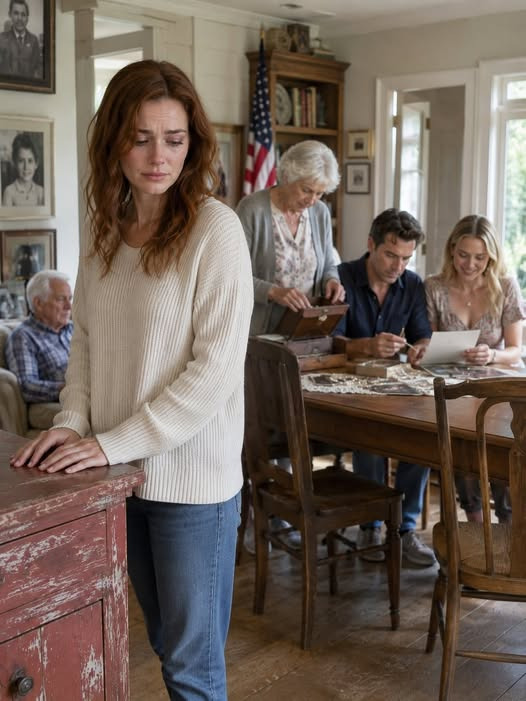
“Are you insane?!” Brandon shouted, stepping toward me aggressively, only for one of the sheriff’s deputies to step into his path, placing a hand firmly on his holster.
“Sir, back up,” the deputy ordered coldly.
Pendelton cleared his throat and began reading from the legal injunction.
“As of 8:00 AM this morning, the Franklin County Probate Court has issued an emergency freeze on all assets, real estate titles, bank accounts, and personal property distributed by Eleanor Miller following the death of Edward Miller.”
“You can’t freeze my money!” Brandon yelled, panic finally cracking through his arrogant facade. “Dad gave me this house! Mom signed the deed over to me!”
“Your father did not own this house, Mr. Miller,” Pendelton stated smoothly. “This property was purchased in 1999 using capital drawn exclusively from the Clara Vance Charitable Trust. Eleanor Miller held no legal title to transfer. Her signature on those deeds constitutes grand fraud.”
“That’s a lie!” Ashley shrieked. “Mom is Dad’s legal wife! Everything he had belongs to her, and she gave it to us!”
“Eleanor is indeed your father’s widow,” Pendelton conceded. “However, she is not Leo’s biological mother.”
The patio fell into a dead, suffocating silence.
Brandon blinked, looking from Pendelton to Eleanor. “What… what did you just say?”
Ashley looked utterly bewildered. “Mom? What is he talking about? Leo is your son!”
Eleanor closed her eyes, tears of rage and fear spilling down her wrinkled cheeks. She couldn’t look at her children. She couldn’t look at me.
“I am the son of Clara Vance,” I said, my voice echoing clearly across the manicured backyard. “The woman Mom hated. The woman whose memory she tried to erase. For twenty-six years, you treated me like trash in this house. You treated me like a charity case who should be grateful for scraps. You let me sleep on a hospital floor for seventy-three days while you sat at home calculating how to split Dad’s money.”
“Leo, please…” Eleanor whimpered, reaching out a trembling hand. “We’re family…”
“In a family, we don’t keep score, right Mom?” I threw her own words right back in her face. “Well, I kept score. And the game is over.”
Pendelton stepped forward, handing the legal summons directly to Eleanor, Brandon, and Ashley.
“You are hereby served with a formal order to vacate these premises within twenty-four hours,” Pendelton announced. “Furthermore, the Ford Expedition traded in by Ashley Miller must be returned immediately, or grand theft charges will be filed. The gold bracelets handed to Ashley are trust heirlooms belonging exclusively to Leo; if they are not surrendered to the deputies right now, Ashley Miller will be taken into custody.”
Ashley let out a horrified gasp, clutching her wrists. “No! Mom, do something! Brandon, stop them!”
“How are we supposed to stop them?!” Brandon roared, turning on his sister in a blind panic. “I already put a down payment on a new ski boat because I thought I was getting this house! I sold my townhome! I don’t have anywhere to live!”
“I don’t care where you live, Brandon,” I said coldly. “Maybe you can ask for an extension on that major work deadline you always had when Dad was dying.”
Ashley frantically unclasped the heavy gold bracelets, her hands shaking so violently she dropped one onto the concrete. She sobbed uncontrollably as the deputy picked it up and handed it to me.
“You’re monsters!” Ashley screamed at Eleanor, breaking down into hysterical sobs. “You lied to us! You told us everything was fine! You ruined my life!”
“Brandon, Ashley, listen to me!” Eleanor pleaded, but her children backed away from her as if she were contagious. The greed that had bound them together was ripping them apart in real-time.
“Don’t touch me!” Brandon spat at his mother, his face red with fury. “You stole a house that wasn’t yours and dragged us into a federal crime! I hope you’re happy!”
I watched them tear each other to pieces, feeling no rage, no satisfaction—only a deep, quiet relief. The truth had finally scrubbed away decades of lies.
The Unpredictable Heirloom
The court battles were swift and brutal.
Faced with undeniable documentation, forensic accounting records, and my father’s explicit video deposition recorded with Mr. Pendelton two years before his death, Eleanor was forced to sign a full surrender of all claims to the estate to avoid prison time for fraud.
Brandon was forced to cancel his home sale, forfeiting his down payments and plunging into severe financial distress. Ashley was forced to pay back every single dollar she had spent from the unauthorized bank passbooks, taking out a massive personal loan just to stay out of jail.
They lost the house. They lost the cars. They lost the cash.
And I became the sole owner of Apex Global, transitioning from a humble corporate worker to the head of a multi-million-dollar logistics firm.
Two months after the court proceedings concluded, I stood inside the vacant Columbus house. The furniture had been removed, the rooms cleared out. The house was going to be sold, with 100% of the proceeds donated to the county hospital’s pediatric palliative care unit—in memory of my father, Edward, and my mother, Clara.
I returned to my small apartment that evening.
The old red wardrobe still stood against the living room wall. I had hired a master carpenter to restore it. He had fixed the broken leg, replacing the brick with a hand-carved oak support, and polished the deep cherry finish until it gleamed like liquid ruby.
It was no longer an eyesore. It was a masterpiece.
I ran my hand along the smooth wood, missing my dad, but feeling his presence stronger than ever.
As I opened the doors to place my father’s old flannel jacket back inside, I noticed something sticking out from the top corner of the inner frame—a area the carpenter had meticulously cleaned and polished.
There was a tiny, recessed keyhole near the upper molding, hidden behind a decorative wooden rosette.
I frowned. I had assumed the false bottom was the only secret the wardrobe held.
I knelt down and retrieved the brass key Mr. Pendelton had handed back to me after the legal cases closed—the key that opened the black box. On a whim, I looked at the tip of the key. It had a dual-bit end.
I reached up, slid the wooden rosette aside, and inserted the key into the hidden upper lock.
It fitted perfectly.
With a soft click, the entire back panel of the upper shelf swung forward on hidden brass piano hinges.
My heart stopped.
I leaned closer, shining my phone’s flashlight into the exposed cavity.
It didn’t contain money. It didn’t contain stock certificates or legal deeds.
Inside lay a velvet-lined wooden tray containing five small, gleaming glass vials sealed with gold wax, alongside a dusty leather journal stamped with the emblem of the United States Patent and Trademark Office, dated 1978.
I carefully pulled out the journal. The name on the inner cover wasn’t my father’s. It wasn’t my mother Clara’s.
It was my grandmother’s name—Clara’s mother, Dr. Evelyn Vance, a pioneering chemist who had worked in early pharmaceutical research.
I opened the journal to the first page.
Project Sunburst: A stabilized, natural synthesis for early-stage pancreatic and cellular regeneration.
Patent No. US-4109822.
Assigned exclusively to Evelyn Vance.
My eyes widened in utter disbelief.
I picked up my phone and called Mr. Pendelton immediately, my voice breathless.
“Arthur… you need to come to my apartment right now,” I stammered. “There’s something else inside the wardrobe.”
A Light Beyond the Shadows
Within forty-eight hours, forensic patent attorneys and medical researchers from Ohio State University were standing inside my living room, examining the contents of the upper compartment.
The discovery was earth-shattering.
My grandmother, Dr. Evelyn Vance, had developed a revolutionary chemical compound in the late 1970s that had been thought lost to history when her lab burned down in 1982. The medical world had spent forty years trying to replicate her lost formula—a synthesis capable of radically improving treatment outcomes for rare blood disorders.
My father hadn’t just hidden my inheritance. He had been safeguarding a billion-dollar medical breakthrough that my biological grandmother had entrusted to him before her death, hiding it inside the one piece of furniture he knew Eleanor would always despise and ignore because of its chipped red paint.
The patents were still legally valid under international orphan-drug recovery acts, and as the sole living heir of Evelyn Vance and Clara Vance, the full intellectual property rights belonged to me.
Six months later, Apex Global partnered with global medical research foundations to license the compound. The deal was finalized for an unprecedented sum, turning the Vance-Miller foundation into one of the most powerful medical philanthropies in North America.
I didn’t keep the wealth for myself. I established research hospitals, funded medical care for families who couldn’t afford it, and ensured that no family would ever have to watch a loved one suffer in a cold hospital hallway alone.
One crisp autumn evening, I sat on the porch of a beautiful new home overlooking a quiet lake just outside Columbus.
The air was fresh, smelling of pine and fallen leaves.
Inside the house, the restored cherry-red wardrobe stood proudly in the center of my study—a constant reminder that true value is never seen by those who only look at the surface.
A soft knock sounded at the front door.
I opened it to find Uncle Ned standing there, holding a small wooden box. He looked at me, a warm, proud smile breaking through his weathered face.
“Thought you might want these, Leo,” Ned said softly, opening the box. Inside were my dad’s old pocket watch and a collection of handmade wooden chess pieces he used to carve. “Your dad always said you were the strongest of us. He was right.”
“Thanks, Uncle Ned,” I said, my chest swelling with emotion. “Come on in. I’ve got coffee brewing.”
As Ned walked inside, I stepped out onto the porch for a moment, looking up at the clear, starry night sky.
I thought about the seventy-three nights I had spent sleeping on that freezing hospital floor. I thought about the coldness of my family, the greed that had consumed them, and the quiet, brilliant father who had planned my redemption from the shadows.
They thought they were giving me trash.
They thought they were leaving me with nothing.
But in the end, my father had given me everything—a future, a purpose, and a legacy that would heal the world.
I took a deep breath of the crisp autumn air, smiled to myself, and walked back inside, closing the door softly behind me.
