The Fabric of a Broken Life
The family courtroom in Concord, New Hampshire, felt even colder than the icy January morning outside. I sat at a small wooden table with my eight-year-old son, Toby, beside me. His sneakers hung above the floor, gently swinging beneath the chair whenever his nerves got the better of him.
That morning, I had dressed him in his cleanest pair of jeans, a navy shirt with a tiny embroidered moon above the pocket, and the winter shoes I had carefully polished using nothing more than a damp kitchen towel. The shirt wasn’t new. Its collar had softened after countless washes, and a faint stain still clung to the lower hem. I had scrubbed at it more than once, but some marks simply refused to disappear.
Across the courtroom, my former husband, Russell Davenport, sat confidently beside his attorney. Russell wore a tailored charcoal suit, spotless leather shoes, and the silver watch he had bought shortly after insisting he couldn’t afford to send child support on time. He looked polished, composed, and completely prepared.
I wore a cream blazer from a thrift store over a simple black dress. I had no lawyer sitting beside me. All I had was a folder packed with school reports, medical records, rent receipts, work schedules, and months of printed text messages proving how often Russell had broken his promises.
His attorney, Benedict Welch, rose to address the judge.
“Your Honor, this case is not about whether Mrs. Davenport loves her son,” he began in a calm, practiced voice. “The question is whether love alone can make up for an ongoing lack of stability.”
My fingers tightened around the sharp edge of the wooden table until my knuckles turned white. Judge Leonard adjusted his glasses, peering down over his heavy frame. “Go ahead, Mr. Welch.”
Welch raised a large, high-definition printed photograph. It showed Toby leaving school just three days earlier, wearing the same navy shirt.
“This photograph highlights the issue,” Welch continued, walking slowly past our table. “The child repeatedly appears in worn clothing. His mother works inconsistent hours, lives in a modest apartment, and relies heavily on an elderly family member to care for him.”
Toby’s feet abruptly stopped swinging.
Welch pointed his pen directly at the faint stain near the bottom of the shirt in the photograph. “She cannot even provide her son with clothing that is consistently presentable.”
Several people in the gallery shifted their attention toward us. Toby lowered his eyes, his small hands pulling nervously at his sleeves. At that moment, I understood exactly what Russell was trying to accomplish. He wasn’t simply asking for shared custody. He wanted full legal and physical custody, trying to convince the judge that financial hardship meant I loved my child less.
Russell had walked away from our marriage two years earlier. He packed his clothes, his coffee maker, the television from our bedroom, and nearly everything else he considered valuable. Then he moved into a newly built townhouse across the city and assured me we could handle financial support privately.
“We’re adults, Brenda,” he had said, standing by the front door with his designer suitcases. “There’s no need to make this complicated or involve courts.”
Within three months, he had stopped responding to most of my messages. Short, cold replies replaced his former warmth, usually claiming his new business consulting firm was facing cash flow issues.
Shortly afterward, my mother, Martha, moved into our apartment. She arrived carrying one suitcase, a slow cooker, and enough determination for the entire family. She never asked whether I wanted help; she simply stepped in and started helping.
“You can fall apart later,” she told me that first night as I sobbed over my empty bank statement. “Right now your son needs dinner, and you need some sleep.”
Our apartment sat above a neighborhood bakery and a small dental office. Delivery trucks rattled the windows every morning at five, the heater only worked when it felt like cooperating, and the tiny kitchen barely had enough room for two people to stand together. Still, it was our home—filled with the rich aroma of fresh bread from downstairs and unconditional love.
I worked breakfast shifts at a local diner and cleaned office buildings three evenings every week. On weekends, I delivered groceries whenever my aging sedan agreed to start. Some mornings I left before Toby woke up; some nights I came home after he was already asleep.
But I never missed a single parent-teacher conference. I packed his lunches the night before, tucking handwritten notes beneath his sandwiches. I checked his homework after midnight even when my eyes burned and struggled to stay open.
Toby noticed far more than I ever wanted him to. He knew when I ate plain cereal for dinner because the chicken was saved for him and my mother. He knew why I kept lowering the thermostat to sixty degrees. He knew the crispest apple always went into his lunchbox while I kept the bruised one for myself.
One evening, he found me sitting alone at the kitchen table surrounded by red-lettered overdue bills.
“Are we in trouble?” he had asked softly, rubbing his eyes.
I immediately flipped the papers upside down, swallowing my pride. “No, sweetheart. I’m just deciding which one deserves my attention first.”
He climbed onto the chair beside me, wrapping his small arms around my shoulder. “When I have homework,” he said, “I usually finish the easiest part first. Maybe bills work the same way.”
I had laughed through my tears that night. That was Toby. He somehow managed to find hope even in a pile of overdue bills.
The Moon and the Shadow
I had bought the navy shirt four months before the custody hearing. Toby had become fascinated with astronomy after his second-grade class visited a science museum downtown. He talked endlessly about planets, distant galaxies, and how starlight could travel across space for years before reaching Earth.
One evening, after finishing a grueling four-hour cleaning shift in a freezing office tower, I walked past a high-end department store preparing to close. The shirt hung on a clearance rack near the window. It was simple, soft, made of rich indigo cotton, and decorated with a tiny silver moon stitched right above the breast pocket.
I had only eighteen dollars left in my checking account until payday. The shirt cost twelve dollars.
I knew I should have kept the money for gas or groceries. But I imagined Toby’s face the moment he unwrapped it. For once, I wanted to give my son something brand new—something that hadn’t belonged to another child first. When I brought it home, his eyes lit up so bright they rivaled the constellations he adored. He wore it everywhere, treating it like a astronaut’s sacred uniform.
Now, sitting in the sterile courtroom, that very shirt was being used as weaponized proof that I was an unfit mother.
“Your Honor,” Benedict Welch continued, turning to face Judge Leonard. “My client, Mr. Davenport, has established a lucrative consultancy. He resides in a four-bedroom residence in a premier school district. He has a dedicated room for Toby, private tutoring lined up, and the financial means to provide top-tier clothing, nutrition, and opportunities. Mrs. Davenport, while well-intentioned, is drowning. Her apartment is cramped, her income is precarious, and as you can see from the evidence, she cannot even maintain her child’s basic hygiene and wardrobe.”
“That’s not true!” I blurted out, unable to contain the agony choking my throat. I stood up, clutching my folder of papers. “That stain isn’t from neglect! He wore that shirt when—”
“Mrs. Davenport, please,” Judge Leonard interrupted, raising a stern hand. “You will have your turn to speak. Maintain order in my courtroom.”
I sat back down, my heart hammering against my ribs. Beside me, I saw Russell smile—a tiny, arrogant tilt of his lips that he quickly masked with a look of somber concern for the judge. He glanced at his luxury silver watch, leaning over to whisper something in Welch’s ear. They were winning, and they knew it.
“Your Honor,” Welch said smoothly, “we call Mr. Russell Davenport to the stand to clarify his financial contributions and his desire to provide his son with a proper life.”
Russell stood up, adjusting his immaculate charcoal jacket. He stepped into the witness box with the practiced grace of a seasoned corporate executive. He took the oath, swearing to tell the truth, his voice booming with calm, persuasive authority.
“Russell,” Welch began, “can you describe your current financial stability compared to when you and Brenda separated?”
“Certainly, Benedict,” Russell said, leaning forward slightly. “When Brenda and I split, my business was in a delicate rebuilding phase. I was barely making ends meet myself, which is why I was unable to provide substantial child support initially. I gave Brenda what I could, when I could.”
I clenched my fists under the table. What he could? He had sent a grand total of three hundred dollars in two years.
“And now?” Welch asked.
“Now, through hard work and strategic investments, my firm is highly profitable,” Russell declared proudly. “I make comfortably into the six figures. I want to give Toby everything he deserves: private tennis lessons, trips to science centers across the country, a college fund. It breaks my heart to see him in stained, secondhand rags, living above a noisy bakery, while his mother works three menial jobs just to keep the lights on.”
Judge Leonard was taking notes, his expression unreadable. He looked at Russell, then turned his gaze toward me and Toby.
“Mr. Davenport,” Judge Leonard spoke up. “Your ex-wife’s filings indicate you are currently over sixteen thousand dollars in arrears for court-ordered temporary support. If your business was thriving, why were those payments not remitted?”
Welch quickly stepped in. “Your Honor, as my client’s tax returns demonstrate, the cash flow only stabilized within the last sixty days. Mr. Davenport was preparing to make a lump-sum payment once this custody arrangement was finalized to ensure the funds were directly allocated to Toby’s new life.”
It was a brilliant, sinister spin. They were framing his refusal to pay support as a prudent, protective measure to keep me from “wasting” the money on our living expenses.
“I see,” Judge Leonard noted, though his eyes narrowed slightly. He looked over at me. “Mrs. Davenport, as you are representing yourself, do you have any questions for the witness?”
A Mother’s Stand
My knees trembled as I stood up behind the small wooden table. The air in the room felt suffocatingly thin. I looked at Russell, the man who had promised to love me through better or worse, looking back at me with cold, patronizing pity.
“Russell,” I began, my voice shaking slightly before I forced it to steady. “You testified that your business was struggling for the past two years, correct?”
“Yes, Brenda. It was a tough period,” he answered smoothly.
I opened my thrift-store folder, pulling out a printout I had spent three nights searching for online. “If your firm was struggling so deeply that you couldn’t send fifty dollars a week for Toby’s groceries, how were you able to take a ten-day vacation to Cabo San Lucas last July?”
Welch immediately jumped up. “Objection, Your Honor! Irrelevant to the current custody determination.”
“It goes directly to credibility, Your Honor,” I countered, looking straight at the judge. “He claimed an inability to pay support while funding luxury vacations.”
Judge Leonard gestured with his pen. “Overruled. The witness will answer.”
Russell’s jaw tightened slightly, his polished composure wavering for a fraction of a second. “That trip was a client networking retreat. It was a tax-deductible business expense, not personal leisure.”
“I see,” I said. “And the silver watch you’re wearing right now? The Tag Heuer? Did you buy that for networking too, while Toby was wearing shoes a half-size too small because I couldn’t afford new ones that month?”
“Mrs. Davenport,” Judge Leonard warned gently, “stick to questions regarding the child’s care.”
I took a deep, shuddering breath, turning to face the judge directly. “Your Honor, I don’t have a tailored suit. I don’t have a four-bedroom house or a six-figure salary. But every single dollar I earn goes to my son. I work three jobs because I refuse to let him go hungry. My mother watches him while I work so he is never left alone with strangers. His clothes may be washed a hundred times, but they are washed with love. That stain on his shirt…”
Tears threatened to spill over my eyelashes, but I forced them back. “…that stain isn’t neglect. It’s from grape juice. Three months ago, when Toby had a fever of one hundred and three, I stayed up all night sitting on the floor beside his bed, holding a glass of juice with ice for him. He was shivering, and he spilled it on his favorite shirt. I scrubbed it, but it didn’t come out. I offered to throw the shirt away, but he cried and begged me to keep it because he loved the moon on it.”
A silence fell over the courtroom. A few spectators in the back row shifted uncomfortably.
Russell sneered softly, leaning toward the microphone. “Emotional appeals don’t change reality, Brenda. The child is wearing rags. He lives in poverty. Love doesn’t pay for medical insurance or a college education.”
“That is enough,” Judge Leonard cut in, looking down at his watch. “We will take a fifteen-minute recess before I hear closing statements and deliver my ruling on temporary physical custody.”
He slammed his gavel down with a sharp crack that echoed off the high mahogany walls.
The Secret Beneath the Seams
During the recess, the courtroom cleared out slightly. Russell and Welch walked out into the carpeted hallway, laughing softly as they discussed where to eat lunch.
I sat back down at the table, dropping my head into my hands. The weight of the world felt like a crushing boulder resting on my neck. I was going to lose him. The legal system, with its cold metrics of income brackets, square footage, and pristine wardrobes, was going to take my little boy away from me and hand him over to the man who had abandoned us.
A small, warm hand gently touched my shoulder.
I looked up. Toby was standing beside my chair. His big brown eyes looked searching and unusually quiet.
“Mommy?” he whispered.
“Yes, baby?” I wiped a rogue tear from my cheek, forcing a smile. “Are you doing okay? Do you need some water?”
“I need to tell the judge something,” Toby said firmly.
I blinked, surprised by the sudden, intense resolve in his young voice. “Oh, honey… kids aren’t usually allowed to testify in court unless the judge asks them privately in his office. It’s okay. I’m fighting for us.”
“No, Mommy,” Toby insisted, his hands gripping his shirt hem. “You don’t understand. I need to show him my shirt.”
Before I could ask what he meant, the courtroom doors opened again. Judge Leonard re-entered from his chambers, his black robe swishing around his ankles. Russell and Benedict Welch walked back in, looking entirely victorious and relaxed.
Judge Leonard took his seat at the bench, arranging his papers. “We are back on the record in the matter of Davenport v. Davenport. Mrs. Davenport, since you are pro se, you may deliver your short closing statement before I make my determination regarding primary residency.”
I stood up, clearing my throat, trying to assemble the shattered pieces of my heart into a persuasive argument. “Your Honor… I just ask that you look at the whole picture—”
Suddenly, Toby stood up beside me.
His little feet didn’t wobble. He stepped right out from behind the wooden defense table, walking straight toward the center aisle, directly in front of the judge’s high bench.
“Toby, wait!” I whispered frantically, reaching out to catch his arm.
Welch instantly stood up. “Your Honor, this is highly irregular! The mother is using the child to manipulate the court!”
Judge Leonard raised a hand, looking down over his spectacles at the tiny eight-year-old boy standing in the middle of his vast, formal courtroom. The judge’s expression wasn’t angry; it was intensely curious.
“Son,” Judge Leonard said in a soft, surprisingly gentle voice. “Your mother is speaking right now. You need to sit back down beside her.”
Toby stood his ground. “Judge, mister… my dad’s lawyer lied about my shirt.”
Russell gasped softly, leaning forward. “Toby, sit down right now!” Russell barked in a harsh, quiet command.
“Mr. Davenport, control your tone in my courtroom!” Judge Leonard warned sternly, glaring at Russell before looking back at Toby. “What do you mean he lied about your shirt, son?”
Toby looked up at the judge, his small voice echoing clearly off the high plaster ceiling. “He said my shirt proves my mom doesn’t take care of me. He said the stain makes it dirty. But this isn’t just a stained shirt.”
Toby reached down with his small fingers. He grabbed the bottom hem of his navy shirt, unbuttoned the bottom three buttons, and flipped the fabric inside out, pulling the lower front panel upward to reveal the hidden white lining beneath the embroidered moon.
The entire courtroom went dead silent.
The Hidden Words
Scrawled across the inner white lining of the shirt, written in black, indelible fine-tip Permanent Marker, were rows upon rows of neat, tiny handwriting.
Judge Leonard leaned over the edge of his mahogany desk, straining his eyes. “What is written on the inside of your shirt, Toby?”
Toby looked at his father, then turned his gaze up to the judge. “My dad told me never to tell Mommy. He said if I told her, he would stop taking me to the playground. But every time my dad picked me up for his weekend visits, he would take me to his big house, put me in his room, and give me his phone to play games while he talked on his computer.”
Russell’s face suddenly drained of every ounce of color. He stood up halfway out of his chair. “Your Honor, this is absurd! The child is being coached!”
“Sit down, Mr. Davenport! One more outburst and I will hold you in contempt!” Judge Leonard snapped, his voice thunderous. He turned back to Toby, his tone softening instantly. “Go on, Toby. Read what you wrote.”
Toby pointed his small finger at the first row of dates written on the inside of his navy shirt.
“October 12th,” Toby read aloud, his voice steady and clear. “Dad picked me up at 2 PM. He left me at his house with his friend Mark and went to buy a new car. He came back at 8 PM. He told me to tell Mommy we went to the zoo.”
I covered my mouth with both hands, my heart stopping in my chest.
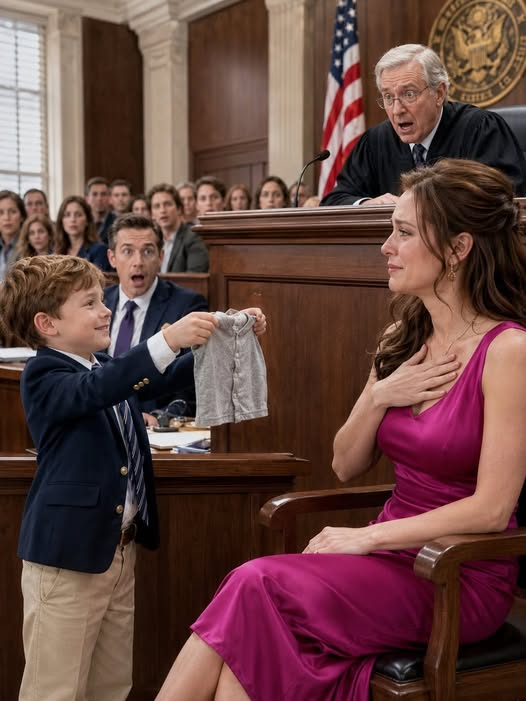
Toby shifted his finger down to the next line.
“November 4th,” Toby continued reading. “Dad forgot it was his weekend. He came two hours late. He gave me twenty dollars and told me not to tell Mommy he was at a party in Boston. He told me to tell her he was working hard to buy me clothes.”
Russell was shaking now. His attorney, Benedict Welch, slowly lowered his pen, staring at his client in absolute, horrified shock.
Toby pointed right next to the grape juice stain on the outer hem.
“December 18th,” Toby read, his voice trembling slightly with emotion now. “I asked Dad for new shoes because my toes hurted. Dad said he didn’t have money for shoes because Mommy takes all his money. But then I saw his drawer. He had four big stacks of hundred-dollar bills wrapped in rubber bands inside his closet safe. He told me if I touched it, I wouldn’t get any Christmas presents.”
Toby lowered his shirt, looking straight at Judge Leonard.
“My mom bought me this shirt with her last twelve dollars,” Toby said, a single tear finally rolling down his small cheek. “She stays up all night cleaning toilets so I can have food. The stain on the outside is from when she took care of me when I was sick. But the writings on the inside are the dates my dad lied to me. I wrote them down with my school marker so I wouldn’t forget, because my dad told me I was too dumb to remember.”
Silence gripped the courtroom so tightly you could hear the soft whirring of the overhead radiator.
I was weeping silently at the table, my shoulders shaking, staring at my brilliant, brave little boy. He had carried this burden, secretly documenting his father’s neglect and deceit on the very piece of clothing I had sacrificed to buy him.
Judge Leonard sat frozen for several long seconds. He slowly removed his glasses, rubbing the bridge of his nose. When he looked up, his eyes were burning with an icy, terrifying fury directed entirely at Russell Davenport.
The Hammer of Justice
“Mr. Welch,” Judge Leonard said, his voice terrifyingly calm. “Is your client prepared to swear under oath right now that those entries detailing hidden cash and abandoned visitations are false?”
Benedict Welch looked at Russell. Russell was staring at his desk, his face ash-gray, sweating profusely through his tailored charcoal suit. He couldn’t speak. He couldn’t even look his own attorney in the eye.
“Your Honor…” Welch stammered, his professional polish completely shattered. “I… I was not made aware of these… details. We request a brief adjournment—”
“Request denied,” Judge Leonard barked, slamming his hand on the desk.
The judge looked down at Toby, his expression melting into profound warmth and respect. “Toby, thank you. You are a very observant, very brave young man. You may go sit back down beside your mother.”
Toby walked back to our table. I immediately pulled him onto my lap, burying my face in his neck, holding him so tight I felt his heartbeat against mine. “I’m sorry, Mommy,” he whispered into my ear. “I ruined the shirt.”
“No, baby,” I sobbed quietly, kissing his hair over and over. “You saved us. You made it beautiful.”
Judge Leonard adjusted his papers, his posture rigid as he prepared to read his verdict.
“In my twenty-four years on the family court bench,” Judge Leonard began, his voice echoing authoritatively through the silent room, “I have rarely witnessed a display of calculated deception as despicable as the one presented by Mr. Russell Davenport today.”
Russell flinched as if he had been struck.
“Mr. Davenport came into this courtroom in a three-thousand-dollar suit, parading his wealth, accusing a hardworking, devoted mother of neglect because of a stained shirt,” the judge continued, his eyes glaring like hot coals at the defense table. “Yet, it is revealed that this mother sacrificed her last dollars to give her child a gift of love, while Mr. Davenport hid thousands in cash, neglected his parental duties, emotionally manipulated his son, and committed perjury regarding his financial status.”
Judge Leonard picked up his pen, signing the legal documents on his desk with sharp, decisive strokes.
“I am issuing the following binding orders immediately:”
The courtroom held its breath.
“First, sole physical and sole legal custody of Toby Davenport is awarded entirely to the mother, Brenda Davenport. Mr. Davenport’s visitation rights are hereby suspended indefinitely, pending a comprehensive psychological evaluation and court-monitored supervised visitation.”
Russell let out a low, choked groan, dropping his head into his hands.
“Second,” Judge Leonard continued, “Mr. Davenport is ordered to immediately surrender all financial records, including access to the aforementioned personal safe, to a court-appointed forensic auditor. The sixteen thousand dollars in child support arrears must be paid in full within forty-eight hours, alongside a recalculated monthly support obligation reflective of his true, hidden income.”
Judge Leonard looked up, locking eyes with Russell. “Furthermore, I am referring this matter directly to the State Attorney’s Office for investigation into perjury, child endangerment through neglect, and tax evasion.”
The judge then turned his gaze toward me and Toby. His stern face softened into a warm, genuine smile.
“Mrs. Davenport,” Judge Leonard said softly. “You may not have a four-bedroom house or a tailored blazer. But you have provided your son with something far more valuable than material luxury: an unshakable foundation of love, truth, and resilience. This court honors your dedication.”
Crack!
The gavel struck the sound block, bringing the trial to an absolute, decisive close.
Starlight on the Porch
Six months later, the warm July sun shone brightly over the rolling green hills of New Hampshire.
The cold, icy January courtroom felt like a distant, bad dream. The forensic audit ordered by Judge Leonard had uncovered over three hundred thousand dollars in undeclared assets hidden by Russell. Faced with severe criminal tax evasion charges, Russell was forced to settle out of court, liquidating several properties to clear his massive legal penalties and pay a substantial, permanent child support trust for Toby.
We didn’t stay in the cramped apartment above the bakery.
With the court-ordered settlement and my own steady income—I had used part of the funds to take night classes and earn my administrative degree—we moved into a cozy, three-bedroom yellow cottage on the edge of town. It had a wraparound porch, a big backyard filled with wild daisies, and a dedicated room for my mother, Martha, who now spent her afternoons baking pies in a large, sunlit kitchen without delivery trucks rattling her windows.
On a warm Saturday evening, Toby and I sat together on the front porch steps.
The sky above us was a deep, velvet indigo, slowly filling with the bright, winking lights of the evening stars. Toby was wearing a brand-new pair of sneakers, his legs swinging happily over the wooden step.
In his lap lay the navy moon shirt.
It was neatly folded, washed, and framed inside a clear shadow box I had made for him. On the back of the frame, I had written a quote we both loved about astronomy.
“Mommy?” Toby asked, looking up at the sky.
“Yes, sweetheart?”
“Do you think starlight really takes millions of years to reach us?”
I wrapped my arm around his shoulders, pulling him close as the cool summer breeze rustled the leaves in our yard.
“I do,” I smiled, looking down at his bright, happy face, then up at the glowing crescent moon above the trees. “Sometimes, the brightest light has to travel through a whole lot of dark before it finally reaches home. But once it gets here, nothing can ever put it out.”
Toby leaned his head against my arm, watching the stars shine brightly over our new life—a life built not on wealth, but on the unbreakable thread of a mother’s love and the brave truth of a little boy.
