The Ghost at the Wedding
The first thing I noticed when I stepped into the St. Aurelia Hotel ballroom was the smell of money.
Not clean luxury. Something heavier. Champagne. White orchids. Beeswax candles. Expensive perfume. Polished marble. Lobster drifting from silver trays along the walls.
Hundreds of guests moved beneath crystal chandeliers as if the entire night had been designed around their comfort. Women in silk gowns laughed softly. Men in tuxedos held drinks they barely touched. White-gloved servers passed through the crowd with caviar, smoked seafood, and tiny canapés I could not name.
I stood near the entrance in a plain navy dress from a clearance rack, old heels, and no jewelry except the small silver bracelet hidden beneath my sleeve.
For one second, I thought about leaving.
Then I saw my nephew.
Julian Voss stood beneath an arch of white roses beside his bride, speaking with guests near the head table. When he saw me, his face changed instantly. Relief. Real relief. As if he had been waiting all night to breathe.
“Aunt Elise,” he mouthed.
I lifted my hand slightly.
It had been twenty-one years since I had attended a Voss family event. No birthdays. No funerals. No galas. Not even my grandmother’s memorial. I had stood outside in the rain that day, listening from beyond the walls.
The last time I saw my father, Conrad Voss, he was standing in the doorway of our old house with my two suitcases at his feet. Rain poured from the gutters. My mother stood behind him, pressing a handkerchief to her mouth, more embarrassed than heartbroken. My brother, Damian, leaned against the stairs with a smile, as if he had been waiting for this moment for years.
I was nineteen.
“You are a disgrace,” my father said. “You were meant to marry Bennett Vale. That was your duty.”
“I don’t love him,” I said.
“You were not raised to chase love. You were raised to serve this family.”
“I won’t do it.”
Something in his face closed forever. He threw my bags into the rain.
“Then go,” he said. “Become nothing. And don’t come back when the world teaches you what you are worth.”
Damian laughed behind him.
“You will never be anything without this name,” my father added.
I did not cry. I simply left.
For twenty-one years, those words followed me. Not as truth. As weight. And I learned how to carry it.
Now I was back.
The wedding was everything my father worshipped. Gold-trimmed cake. Ice sculptures. String music. Champagne towers. Guests whose names appeared in finance pages and political columns. Conrad Voss had built his entire life around rooms like this.
I found my seat near the back, beside a decorative palm and a speaker hidden under flowers. Table 42. A forgotten corner on purpose.
My place card read only: ELISE VOSS. No title. No guest. No recognition.
Perfect.
I had barely sat down when the room changed. Voices softened. Heads turned. Whispers began moving through the guests.
I followed their eyes.
My father stood across the ballroom. Conrad Voss still carried himself like a man who expected the world to move aside for him. Silver hair. Perfect tuxedo. Crystal glass in hand.
But when he saw me, something in his expression cracked. Only for a second. Shock. Then control returned.
Damian stood beside him, already smiling. “Well,” he said loudly, “the ghost came back.”
My father did not smile. His eyes moved slowly over my dress, my shoes, my face.
“Elise,” he said. “I wasn’t sure Julian’s sentimentality would go this far.”
I lifted my glass. “Hello, Conrad.”
Someone nearby gasped at the name.
Damian chuckled. “Still dramatic, I see.”
My father stepped closer. His voice lowered, but not enough to stop people from listening. “Pity got you invited,” he said. “Nothing else.”
Then he looked straight at me. “You do not belong here.”
The silence around us sharpened. For a moment, I was nineteen again. Standing in the rain. Suitcases in puddles. A daughter erased from her own family.
Then I took a slow sip of wine. Cold. Bitter. Perfectly ordinary.
I smiled.
The Toast That Shattered the Room
Conrad sneered, opening his mouth to add another cruel parting blow, but before the words could leave his throat, the chime of a silver spoon tapping against crystal resonated through the ballroom speakers.
The string quartet faded into silence.
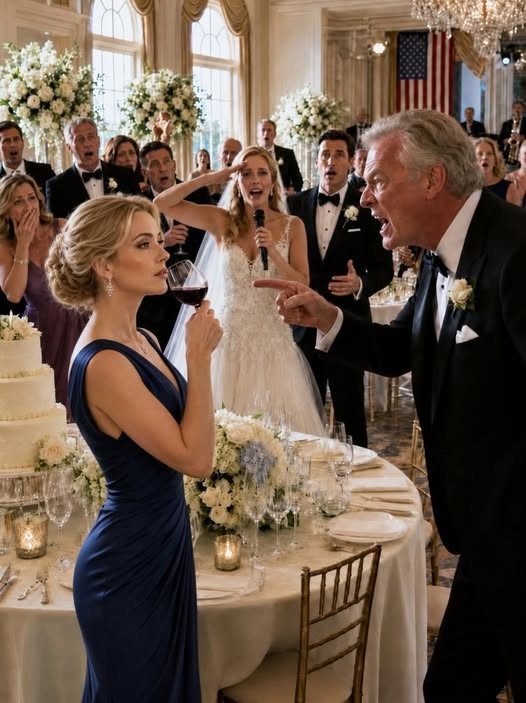
The bride, a breathtaking woman in a structured satin gown, stepped up to the head table’s microphone. Her posture was razor-sharp, her chin held high with a distinct, military-grade poise that stood in stark contrast to the soft, fluid grace of the socialites in the pews. This was Captain Clara Vance—now Clara Voss—a decorated naval intelligence officer who had recently transitioned to a classified strategic role in defense procurement.
Conrad smoothed his lapels, puffing his chest out as he prepared to assume his place as the patriarch of the evening. He assumed Clara was about to toast him—the man whose corporate fortune had financed the extravagant flowers, the venue, and the security detail surrounding the perimeter.
Clara adjusted the microphone. Her eyes swept over the sea of tuxedos, past the hedge fund managers, past the political donors, completely bypassing Conrad and Damian.
Her eyes locked directly onto Table 42. Onto me.
In a move that stunned the entire room, Clara snapped her heels together with a sharp, echoing click. Her right hand cut through the air, snapping a flawless, rigid military salute directly toward my forgotten corner.
A collective gasp rippled through the four hundred guests.
“Everyone, please raise your glass,” Clara’s voice boomed through the speakers, commanding, crystal-clear, and unyielding. “For a toast to Admiral Elise Voss—Commander of the Pacific Strategic Fleet, Director of Naval Intelligence, and the highest-ranking officer this nation has seen in a generation.”
The ballroom collapsed into absolute, suffocating silence.
Conrad’s champagne flute slipped from his fingers. The crystal shattered against the polished marble floor, sparkling wine splashing over his hand-tailored leather shoes, but he didn’t even flinch. He couldn’t. His jaw hung open, his face draining of color so fast he looked as though he had been struck by a physical blow.
Damian’s sneer froze mid-twist, turning into a comical, horrifying grimace. “Ad… Admiral?” he choked out, looking between the bride and my plain navy dress. “That’s… that’s impossible. She’s a failure. She does temporary work…”
“She didn’t do temporary work, you arrogant fool,” Julian, my nephew, said as he stepped up beside his bride, his voice echoing with years of suppressed resentment against his father and grandfather. “For twenty-one years, while you were throwing galas with borrowed corporate debt, Aunt Elise was commanding nuclear aircraft carrier strike groups in international waters.”
I didn’t stand up immediately. I set my wine glass down with a soft, quiet click against the tablecloth.
I looked at Conrad. His hands were trembling. The man who had spent two decades telling the world his daughter was a penniless outcast was now staring at a woman who held the launch codes, the operational authority, and the absolute respect of the entire United States Department of Defense.
The room began to murmur, then buzz, then surge. High-ranking military officials in full mess-dress uniforms scattered throughout the ballroom—men and women Conrad had invited purely to show off his political connections—stood up simultaneously.
One by one, the generals, captains, and defense contractors in the room snapped to attention, their eyes fixed on Table 42, waiting for my signal.
I slowly stood up, smoothing the front of my clearance-rack navy dress.
“Thank you, Captain Vance,” I said softly, my unamplified voice cutting through the stillness with the effortless authority of a woman used to giving orders on the bridge of a battleship. “At ease.”
The Price of a Forgotten Name
The reception dissolved into a surreal spectacle.
Guests who had ignored Table 42 moments earlier were now practically tripping over decorative palms to get near me. Senators, CEOs, and foreign diplomats—the very men Conrad had spent six months trying to recruit for his failing private equity firm—elbowed past my brother Damian just to offer their congratulations.
Conrad stood frozen in the center of the floor, isolated in a sea of people who were suddenly ignoring him entirely.
I walked toward the head table, greeting Julian and Clara with a warm, genuine embrace.
“You didn’t have to break protocol, Clara,” I murmured, smiling at the brilliant young officer my nephew had chosen.
“With all due respect, Admiral,” Clara whispered back with a fierce, proud smile, “I spent four months watching your father treat Julian like a pawn. I wasn’t going to let him disrespect the woman who secretly paid for Julian’s Annapolis tuition.”
My eyes shifted slightly. Twenty-one years ago, when I left home with two rain-soaked suitcases, I didn’t beg for help. I walked straight into a naval recruitment office in downtown Philadelphia. I took the oath. I climbed the ranks through sheer, relentless competence—serving on destroyers, mastering intelligence logistics, and eventually rising through the joint chiefs’ apparatus.
When Julian was eighteen and showing immense promise, I ensured his academy entry was handled quietly, without a single dollar from Conrad’s corrupt foundation.
I turned around to find Conrad and Damian standing five feet away.
Conrad looked older now. The illusion of his invincible wealth was peeling away like wet wallpaper. Up close, I could see the desperate strain in his eyes—the look of a gambler who had bet his entire life on the wrong hand.
“Elise…” Conrad stammered, his voice stripped of every drop of its former authority. “You… you never told us. You let us believe…”
“You never asked,” I said plainly.
Damian stepped forward, his face flushed with a mixture of embarrassment and sudden, sickening greed. “Elise—Admiral—this is incredible! Do you have any idea what your position means for Voss Industries? The naval logistics contracts that are opening up next quarter—if you could just put in a word with the procurement board—”
I looked at my brother. Really looked at him.
He was thirty-nine years old, still living off our father’s credit lines, still wearing suits he hadn’t earned, still bullying anyone he perceived as weaker than himself.
“Damian,” I said smoothly, “do you remember what Father said to me in the rain twenty-one years ago?”
Damian swallowed hard, sweating beneath his collar. “Elise, that was two decades ago! We were young, we were stressed—”
“He said, ‘You will never be anything without this name,’” I recalled, every word crystalline and sharp. “So when I received my commission, I dropped the name. In the Department of Defense records, I am registered under my mother’s maiden name: Admiral Elise Vance.”
Conrad gasped, clutching his chest. “What… what are you saying?”
“I am saying,” I stepped closer, looking my father straight in the eyes, “that Voss Industries applied for a twenty-million-dollar maritime logistics grant last month. The review board sat on my desk three days ago.”
Conrad’s breath hitched. “Elise… please. The company is over-leveraged. If we don’t get that grant, the lenders will foreclose on the estate by the end of the quarter. That’s why we threw this wedding! To show the investors we were stable!”
The final piece of the puzzle fell into place. The gold-trimmed cake, the ice sculptures, the lobster—it was all a hollow shell. A desperate, theatrical lie to mask impending bankruptcy. They hadn’t invited me out of pity; Julian had invited me because he loved me, but my father had allowed it because he assumed I was a nobody he could use as a target to make himself feel powerful in front of his wealthy guests.
I leaned in, my voice dropping into a low, terrifying calm.
“I rejected the application this morning,” I said. “Not out of revenge, Conrad. But because your company’s financial records show systemic fraud, padded invoices, and gross negligence. I do not award government contracts to men who lack honor.”
The Unseen Masterstroke
Conrad stumbles backward, slamming his back against an ice sculpture that was slowly melting beneath the warm ballroom lights. Water dripped down his tuxedo jacket, but he didn’t move to wipe it off.
“You… you destroyed us,” Damian whispered, his eyes wide with horror as he realized the gravy train had finally hit the end of the tracks. “You destroyed your own family!”
“No, Damian,” I replied, taking a slow, calm sip of my wine. “Conrad destroyed this family twenty-one years ago when he threw a nineteen-year-old girl into the storm because she refused to be sold to the highest bidder. You simply watched him do it and laughed.”
I turned my back on them, walking toward the grand terrace doors where the cool evening air was blowing in from the bay.
The party continued around us, but the center of gravity had permanently shifted. Investors who had been surrounding Conrad ten minutes earlier were now drifting away, quietly dialing their risk-management teams to pull their funds before the news of Voss Industries’ failed grant went public at midnight.
As I stepped onto the terrace, looking out over the moonlit harbor where three naval destroyers sat silently anchored in the distance, I heard fast, heavy footsteps behind me.
It was my father.
He stood in the doorway of the terrace, looking broken, defeated, and utterly stripped of his grandeur.
“Elise,” he whispered, his voice cracking with a strange, pathetic desperation. “Is there… is there truly nothing left between us? No mercy?”
I looked back at him over my shoulder.
I thought about the cold nights on the deck of a frigate in the North Atlantic. I thought about the years of working twenty-hour shifts, proving myself in rooms full of men who thought a woman couldn’t handle command. I thought about the sheer, unshakeable strength I had found in the very darkness he had thrown me into.
“You taught me a very valuable lesson, Conrad,” I said softly.
He took a hopeful step forward. “What lesson?”
I smiled—a calm, beautiful, effortless smile that reached all the way to my eyes.
“You told me to go out into the world and find out what I was worth,” I said, the ocean breeze catching the hem of my navy dress. “And I found out I was worth far too much to ever step foot in your shadow again.”
A New Horizon
The morning sun broke over the waters of the Chesapeake Bay, casting a brilliant golden light across the polished teak deck of the flagship USS Independence.
I stood on the bridge, wearing my full service dress white uniform. The four gold stars on my shoulder boards gleamed under the clear morning sky.
Beside me stood Julian and Clara, both dressed in their naval uniforms, looking out over the horizon with bright, unburdened smiles.
My chief of staff stepped up beside me, handing me a leather-bound briefing folder.
“Morning report, Admiral,” he said crisply. “Voss Industries filed for Chapter 11 bankruptcy at midnight. The estate in Greenwich has been listed for public auction.”
I looked at the folder for a fraction of a second, then closed it without opening it.
“Thank you, Commander,” I said smoothly. “File it under archived intelligence.”
“Aye, Admiral.”
I walked out onto the starboard wing of the bridge, feeling the cool, salt-laced wind against my face. Behind me, the massive engines of the carrier rumbled to life, sending a deep, rhythmic vibration through the steel deck—a sound of immense, unstoppable power moving forward into the open sea.
My father had thought he was discarding a broken piece of trash on a rainy night twenty-one years ago. He had never understood that some seeds don’t die when you bury them in the dirt.
Some seeds grow into storms.
I raised my binoculars, looking out at the endless, open blue horizon stretching out before us, where the sky met the water in an unbroken line of light.
I was no longer the ghost at the wedding. I was no longer the girl in the rain.
I was the commander of my own destiny—and my voyage was just beginning.
