The Geography of Abandonment
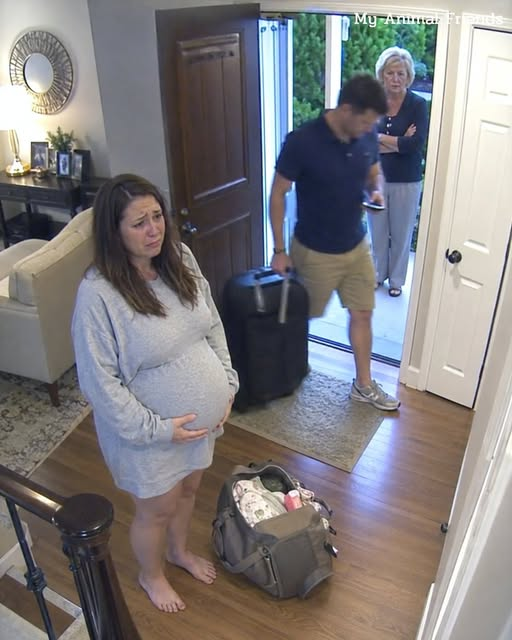
The morning Ethan left, the hospital bag was already by the front door. It had tiny socks in the side pocket, a folder of birth papers in the front pouch, and the phone charger I had packed twice because pregnancy had made me forgetful and careful at the same time. I was standing in the hallway in one of his old sweatshirts, one hand under my stomach, watching him roll a suitcase around that bag like it was a pile of laundry he meant to deal with later.
His mother honked from the driveway before I could ask him again. She sat behind the wheel with sunglasses on, looking straight ahead like she had not noticed the very pregnant woman framed in the doorway. His father was in the passenger seat scrolling on his phone, and neither of them got out to ask if I needed anything.
“Ethan, I could go into labor today,” I said.
He checked his watch as if the baby and I were making him late on purpose. “Due dates are estimates, Maddie. Don’t start a fight. Stay quiet and call an Uber if you have to.”
There was a time when that sentence would have made me cry. A few months earlier, I might have begged him to choose me, or tried to explain why a wife should not have to audition for basic kindness on the day her first child might arrive. But by then I had already learned that some people turn your pain into a negotiation because they know you are tired enough to accept a bad deal.
He added the part he thought made him reasonable. “The tickets are non-refundable.”
I looked at his suitcase, then at my hospital bag, then at the man whose name was still printed as my emergency contact. My son shifted under my ribs, heavy and slow, and for the first time all morning I felt something steadier than panic. I did not scream, and I did not beg.
I only nodded and said, “Okay.”
Ethan heard surrender in that word. I heard a door closing.
After the SUV pulled away, the house looked cruelly normal. The toaster still smelled burnt, folded onesies were stacked on the kitchen table, and the nursery upstairs was painted a soft green he had once promised would be calming. I stood there for a minute, barefoot and swollen, listening until the engine faded down our suburban street.
Then I locked the door and called Rebecca Lawson, the attorney whose number I had saved under an ordinary name in my phone.
“He left,” I said when she answered.
Rebecca did not waste time being shocked. “Today?”
“Today.”
“Are you safe?”
That question almost broke me because no one in Ethan’s family had asked it. Not the husband driving toward a resort. Not the mother-in-law smiling behind tinted glass. Not the father-in-law who had watched his son abandon a pregnant wife and decided it was not his problem.
“Yes,” I said. “For now.”
“Then we do exactly what we planned,” she told me. “No threats. No dramatic texts. Protect your health, protect the baby, and let his choices speak for themselves.”
Six weeks earlier, I had sat in Rebecca’s office with a hotel receipt, a disappearing message on Ethan’s watch, and a marriage full of excuses I had been making for him. She had asked me when he last came to a prenatal appointment, when he last chose me over his mother, and when I last felt safe depending on him. Every answer was worse than the last.
Rebecca never pushed revenge. She pushed preparation. I opened my own account for my own paycheck, copied our financial records, changed the passwords to my medical portal, and updated the paperwork at my obstetrician’s office. Ethan’s name came off my emergency contact form. Clare, my older sister, went on it.
The nurse had asked if I wanted my chart marked private. At the time, signing that form felt dramatic. That night, when my contractions started seven minutes apart, it felt like mercy.
Clare arrived with my favorite hoodie, a paper bag of food, and the kind of face people make when they are trying not to cry until you are ready. She took the hospital bag before I could lift it. “No,” she said softly. “You’ve carried enough.”
At labor and delivery, the nurse checked my chart and confirmed the approved contacts. Clare. My parents. No one else. When she asked if that was still correct, I felt the weight of Ethan’s absence and said yes.
Labor stripped the room down to truth. There were monitors, cold water, shaking hands, Clare’s palm against my back, and the steady sound of my son’s heartbeat filling every place Ethan should have been. Around midnight, his text came through from Arizona.
Landed. Hotel is nice. Try not to stress.
I was six centimeters dilated when I read it. By the time the next contraction passed, the message felt like it belonged to someone else’s life.
At 3:42 in the morning, Noah James Walker arrived red-faced and furious, with a cry so strong the nurse laughed. They placed him on my chest, warm and real, and I found out that a heart can be broken and still make room for a miracle.
Clare cried beside the bed. I did not ask why Ethan was missing from the picture anymore. I looked at my son’s tiny hand curled against me and understood that the first person who stayed had earned the place beside me.
Before sunrise, Rebecca filed the documents we had already prepared. Not revenge, not a stunt, and not some fantasy of overnight victory. Legal separation, preservation of marital accounts, medical privacy, and temporary boundaries around communication and custody until everyone could sit in front of professionals.
By the second evening, Ethan’s messages had changed. First confusion, then irritation, then command. His mother had called the hospital and been told they could not confirm whether I was there. He wanted to know why I was acting like this. He wanted to know where I was. He wanted me to call him now.
I looked at Noah asleep against my chest, then at the phone lighting up again in my hand. For once in my marriage, Ethan could wait.
The Return to an Empty Hearth
Two days after Noah was born, the discharge papers were signed, and Clare drove us home. The late afternoon light spilled through the blinds of our living room, painting long, pale stripes across the carpet. Everything in the house smelled faintly of stale coffee and abandoned routines. I sat in the armchair holding Noah, wrapped in a blanket Clare had knitted, feeling a deep, fragile stillness taking root in my chest.
At 5:15 PM, the front door rattled violently.
Ethan burst through the doorway, his skin flushed red from the Florida sun, carrying a golf bag over his shoulder and a half-eaten bag of airport snacks in his hand. His mother, Evelyn, trailed right behind him, her eyes sharp and angry, clutching her designer handbag like a weapon.
“What the hell is going on?” Ethan yelled, his voice bouncing off the high ceiling. “My mom called the hospital three times! They told her I wasn’t on the list! Do you have any idea how embarrassing that is? They treated my mother like a stranger!”
He slammed his golf bag against the entry wall. Evelyn stepped into the foyer, her eyes sweeping over me, over Clare sitting quietly at the kitchen table, and finally landing on the tiny blue bundle cradled against my ribs.
“Maddie, this is completely absurd,” Evelyn snapped, crossing her arms. “Ethan goes away for a pre-planned family retreat, and you throw a hysterical tantrum? You blocked his calls! You hid his own child from him!”
I didn’t flinch. I didn’t raise my voice. I looked at Ethan, noting the faint smell of golf course beer hovering around him, and felt an overwhelming wave of indifference.
“I’m doing what you told me,” I answered, my voice steady and quiet.
Ethan blinked, taking a step back as if I had struck him. His jaw worked silently for a moment, his anger stumbling over the cold wall of my composure. “What… what are you talking about?” his voice cracked, losing its aggressive edge.
“You told me to stay quiet,” I said, meeting his eyes without blinking. “You told me to call an Uber. So I stayed quiet. I called Clare. I birthed our son while you were on the ninth hole in Scottsdale.”
“Maddie, I—” Ethan began, taking a step toward me, his hands raising in a posture of sudden, frantic defense. “I didn’t think you were actually going into labor! The doctor said—”
“The doctor said the date was an estimate,” I interrupted softly. “You decided non-refundable golf tickets mattered more than being here when your child was born. You made your choice, Ethan. I just accepted it.”
Evelyn huffed, stepping between us. “Oh, stop the drama, Maddie! You’re a mother now, act like one! Ethan is back. Show him his son and stop this childish game.”
Clare stood up from the kitchen table, holding a thick manila folder. She walked over and handed it directly to Ethan, ignoring his mother entirely.
“What’s this?” Ethan muttered, his fingers trembling as he pulled out the legal documents.
“Legal separation papers,” I said. “And a court-ordered temporary injunction. As of six o’clock this morning, all marital financial accounts are frozen to prevent unauthorized withdrawals. Medical updates are restricted to approved contacts—which do not include you or your family. And any communication regarding Noah will go through a co-parenting application.”
Ethan’s face went completely pale. The paper rustled violently in his hands as his eyes skimmed over the signature pages, stopping at the bold seal of the family court.
“Separation?” he whispered, looking up at me, his eyes wide with genuine horror for the first time in his life. “Maddie, no. You can’t do this. We’re a family!”
“We were a family when I begged you not to leave,” I told him, looking down at Noah’s tiny, peaceful face. “You left a wife. You came back to a mother who knows what her son is worth.”
Evelyn grabbed Ethan’s arm, her voice shrill. “Ethan, don’t let her intimidate you! Call your father’s lawyer right now! She can’t keep you from your son!”
“She’s not keeping him from Noah, Evelyn,” Clare cut in, her voice dripping with ice. “She’s keeping him from destroying her. Now, both of you need to leave. The papers specify that Ethan has two hours to pack his personal belongings, and then he must vacate the premises.”
Ethan stared at me, searching my face for the woman who used to cry when he ignored her, the woman who used to apologize for being inconvenient. But that woman was gone, burned away in the quiet, agonizing heat of a hospital room at three in the morning.
“Maddie… please,” Ethan begged, a tear finally cutting through the dust on his cheek. “Let me hold him. Please.”
I looked at him for a long moment. Then, with measured, careful grace, I stood up and held Noah close to my chest, leaning down so Ethan could see his son’s smooth, sleeping face for brief seconds.
“He looks like you,” I whispered. “I hope he learns to be braver than you.”
I turned my back on him and walked upstairs to the nursery, closing the door softly behind me, leaving the echo of his sobs dying against the silence of the lower floor.
The Unraveling of the Walkers
Over the next four weeks, the quiet strength I had built in that nursery was tested by a storm of Ethan’s making.
Driven by his mother’s rage and his own wounded pride, Ethan didn’t go quietly. His father, Richard Walker, hired a ruthless high-profile family law attorney who immediately filed motions to dismiss our separation agreement, demanding full emergency custody of Noah and alleging that I was mentally unstable due to postpartum depression.
They tried to paint me as a bitter, vengeful woman who had planned a ambush to ruin a devoted husband’s life. Evelyn started telling mutual friends that I had kicked Ethan out over a minor misunderstanding, framing him as a victim of a calculating wife.
Every afternoon, while Noah napped, I sat at my dining room table with Rebecca Lawson, reviewing financial statements, medical records, and legal briefs.
“They’re playing dirty, Maddie,” Rebecca said, sliding a document across the table. “They’re trying to freeze your personal accounts, claiming you siphoned marital funds prior to the birth.”
I looked at the paperwork, feeling a familiar tightness in my chest, but I took a slow breath and let it pass. “Let them look,” I said calmly. “Every penny in my personal account came from my own salary. I kept records of every transaction for the last three years.”
“I know,” Rebecca smiled tightly. “And that’s going to be their undoing. But there’s something else.”
She pulled out a second folder, labeled with the logo of Ethan’s employer—a major regional architecture firm where he worked as a senior project manager.
“When we served the freeze on the joint accounts,” Rebecca explained, leaning forward, “the bank was legally required to audit all attached credit lines. We discovered three large, recurring wire transfers coming into your joint account over the last eight months, originating from an offshore commercial holding company.”
I frowned. “Ethan always said those were performance bonuses from his firm.”
“They weren’t,” Rebecca said softly. “Ethan hasn’t been receiving bonuses, Maddie. He’s been receiving ‘consulting fees’ from a real estate development firm owned by his father, Richard.”
The realization hit me with sudden, blinding clarity. Richard Walker’s development company had been bidding on major municipal contracts in our city—contracts that Ethan’s architecture firm was actively evaluating and approving.
“It’s a kickback scheme,” I whispered.
“It’s a massive, illegal conflict of interest,” Rebecca corrected. “And Ethan was using your joint account—the one with your name on it—to launder the payments, likely assuming that as a quiet, stay-at-home mother, you would never look closely at the tax schedules.”
My blood ran cold. Ethan hadn’t just abandoned me on the day of Noah’s birth; he had systematically used my trust to shield himself and his family from financial fraud. If the federal regulators caught wind of it without context, I could have been dragged into criminal charges as a co-signatory on the account.
“What do we do?” I asked, my knuckles turning white against the table.
“We hand the full, unredacted audit to the forensic accountant assigned by the family court,” Rebecca said coldly. “We don’t make threats. We let his choices speak for themselves.”
Two weeks later, we stood in the grand, marble-tiled corridor of the county courthouse for our first formal custody and asset hearing.
Ethan arrived surrounded by his parents and his slick, expensive attorney. He was wearing his best suit, but he looked hollow—dark circles shadowed his eyes, and his posture was stiff with anxiety. When he saw me walking down the hall in a sharp navy blazer, carrying a leather portfolio, he tried to catch my eye, but I looked straight past him.
Evelyn sneered as we approached the courtroom doors. “Enjoy your little moment in court, Maddie,” she whispered as I passed. “By the end of today, the judge will see who you really are.”
“I certainly hope so, Evelyn,” I replied softly. “Because I know exactly who I am.”
The Final Reckoning
The courtroom was vast, quiet, and imposing. Judge Eleanor Vance, a formidable woman with graying hair and sharp, piercing eyes, sat behind the raised wooden bench, reviewing the thick stacks of briefs submitted by both sides.
Ethan’s attorney, a man named Sterling, took the podium first. He delivered a dramatic, emotionally charged opening statement, accusing me of cold calculation, parental alienation, and financial manipulation.
“Your Honor,” Sterling proclaimed, gesturing toward Ethan, who sat trying to look like a heartbroken father. “Mr. Walker is a hardworking, devoted husband who made a single, innocent mistake regarding a business trip’s timing. In response, his wife locked him out of his own home, denied him the birth of his firstborn son, and executed a ruthless financial blockade designed to destroy his reputation!”
Judge Vance raised a single hand, stopping Sterling mid-sentence. She adjusted her glasses and looked down at the documents before her.
“Mr. Sterling,” Judge Vance said, her voice dry and smooth as paper. “I have read your brief. I have also read the forensic financial report submitted by Mrs. Walker’s counsel this morning.”
A quiet rustle went through the room. Richard Walker, sitting in the gallery behind Ethan, shifted uncomfortably in his seat.
“Mrs. Lawson,” Judge Vance said, turning her attention to Rebecca. “Would you care to clarify the origin of the exhibits attached to Section D of your filing?”
Rebecca stood up smoothly. “Gladly, Your Honor. Section D contains certified bank records showing that for the past eighteen months, Mr. Walker has deposited over one hundred and forty thousand dollars in undocumented payments from his father’s firm into the joint account he shared with my client. These transactions were concealed from Mrs. Walker, while Mr. Walker simultaneously restricted her access to primary credit lines during her high-risk pregnancy.”
Sterling stammered, stepping forward. “Your Honor! Those are private family business matters, entirely irrelevant to the issue of temporary custody!”
“Irrelevant?” Judge Vance’s voice cut through the air like a blade. “Mr. Sterling, your client is asking this court to declare his wife financially untrustworthy, while evidence suggests he was utilizing her name and marital accounts to hide illegal kickbacks from his own employer!”
Ethan turned violently around to look at his father. “Dad… what is she talking about? You said those payments were clean!”
“Quiet, Ethan!” Richard hissed from the gallery, his face turning a dark, mottled red.
“Order in the court!” Judge Vance slammed her gavel, her gaze sweeping over the Walker family with profound disgust. “I have seen many bitter custody battles in my years on the bench, but rarely have I seen a display of such calculated neglect and financial deceit.”
She turned her sharp eyes directly onto Ethan.
“Mr. Walker,” she said, her tone icy. “You abandoned your heavily pregnant wife on her due date to attend a leisure trip. You left her without support, instructions, or care, suggesting she ‘call an Uber’ if she went into labor with your child. You then attempted to use legal maneuvers to strip her of financial security while actively exposing her to criminal liability through your illicit transactions.”
Ethan slumped in his chair, his head dropping into his hands.
“This court finds no merit whatsoever in the petitioner’s motion for emergency custody,” Judge Vance declared firmly. “Primary physical custody of Noah James Walker remains exclusively with Mrs. Maddie Walker. Mr. Walker’s visitation will be strictly supervised, contingent upon his full cooperation with the upcoming federal financial investigation into his account activities.”
She struck the gavel down with a resounding THUD.
“We are adjourned.”
The courtroom erupted into quiet, urgent whispers. Sterling was frantically gathering his papers, yelling at Richard, while Evelyn burst into hysterical, angry tears.
Ethan slowly stood up, looking across the room at me. His face was completely broken, the slick, arrogant veneer he had worn for years stripped away entirely, leaving behind a small, terrified boy who had finally realized the gravity of what he had destroyed.
He stumbled toward my table, his hands trembling. “Maddie… please. Tell me this isn’t how it ends. Please. I’ll give up the money. I’ll fire my lawyer. Just… just let me come home.”
I looked at him, feeling the final, lingering knots of anger in my chest dissolve into simple, clean pity.
“You can’t come home, Ethan,” I said, my voice carrying the steady, unshakeable calm of a woman who had survived the dark. “Because the home you left didn’t exist. You built it out of quiet submission, and I’ve stopped being quiet.”
I turned, took Rebecca’s arm, and walked out of the courtroom without looking back once.
The Unexpected Unfolding
Three months passed. The Florida heat softened into the mild, gold-tinted breeze of early autumn.
The fallout from the court hearing had been swift and devastating for the Walker family. The financial audit triggered an internal investigation at Ethan’s firm, resulting in his immediate termination. Richard Walker’s development company was slapped with massive state fines, leaving the family’s once-boasted wealth heavily diminished. Ethan had been forced to move into a modest one-bedroom apartment on the far side of town, working an entry-level drafting job just to pay his legal fees and child support.
Yet, despite everything, I held no malice in my heart. Every Tuesday afternoon, as mandated by the court, Ethan arrived at a local family center for his two hours of supervised visitation with Noah. I never spoke ill of him, never delayed his visits, and always ensured Noah was clean, fed, and dressed in soft, warm clothes. I wanted my son to know his father, but I wanted him to grow up knowing that love was built on respect, not endurance.
One crisp Tuesday afternoon, I was sitting on a park bench outside the family center, waiting for Ethan’s session to finish, when an older man in a charcoal suit approached carrying a thermos and a small leather notebook.
It was Arthur Vance—the former chief managing partner of the architectural firm where Ethan had worked, and, unexpectedly, the father of Judge Eleanor Vance. I had met him briefly during the corporate deposition weeks prior.
“Mind if I sit down, Maddie?” Arthur asked softly, his voice rich and gentle.
“Not at all, Mr. Vance,” I said, making room on the bench.
He sat down, taking a slow sip from his thermos, watching the leaves drift down onto the manicured grass.
“I wanted to apologize to you personally,” Arthur said after a long moment. “For what my firm let happen under our roof. Ethan was a talented designer, but we turned a blind eye to his arrogance because his father brought in business. We failed to see the character of the man we were promoting.”
“You couldn’t have known, Mr. Vance,” I said softly. “He was very good at hiding who he was.”
Arthur smiled gently, turning to look at me. “You, on the other hand, are terrible at hiding who you are.”
I blinked, surprised. “What do you mean?”
“During the deposition, while your attorney was dismantling Ethan’s legal defense, I was looking through your background filings,” Arthur explained, pulling out his leather notebook. “I noticed that before you stepped back to support Ethan’s career, you held a master’s degree in urban structural planning from Columbia. You designed the preliminary sustainability framework for the downtown riverfront project four years ago.”
I felt a sudden, strange flutter in my chest—a long-forgotten spark of the woman I used to be before I shrank myself to fit into Ethan’s shadow.
“I… yes,” I admitted, a soft smile touching my lips. “I loved that work. But Ethan thought it was better for his career if I stayed home and managed the household.”
Arthur chuckled, a deep, warm sound. “Ethan Walker was an idiot, my dear. A talented draftsman, perhaps, but a terrible judge of true value.”
He opened the notebook, sliding a thick manuscript toward me. On the cover page were the words: Vance & Associates: Riverfront Revitalization Initiative.
“We lost our lead director last month,” Arthur said, his eyes shining with quiet respect. “The city board is demanding a complete redesign focused on community integration and sustainable family spaces. I don’t need another arrogant corporate climber, Maddie. I need someone who understands resilience. I need someone who knows how to build things that last.”
I stared at the document, my breath catching in my throat. “Are you… offering me a job?”
“I’m offering you the Lead Directorship,” Arthur corrected firmly. “Full flexible hours, on-site childcare facilities at our main tower, and a salary that will ensure you and young Noah will never have to depend on anyone else for the rest of your lives.”
Tears pricked the corners of my eyes—not tears of pain or betrayal, but tears of overwhelming, radiant relief. The universe had taken away a broken marriage and returned to me my voice, my purpose, and my future.
“I don’t know what to say,” I whispered.
“Say you’ll accept,” Arthur smiled, standing up and buttoning his jacket. “We start on Monday.”
A Garden Built on Truth
One year later, the sun was setting over the newly completed Downtown Riverfront Park—a glowing, green sanctuary of winding pathways, cedar benches, and water fountains that reflected the pink and gold sky.
Hundreds of local residents were gathered on the lawn for the ribbon-cutting ceremony. Children laughed as they ran through the splash pads, while young mothers pushed strollers along the paved walkways I had carefully designed to be wide, smooth, and accessible.
I stood near the wooden podium, wearing a crisp cream-colored linen suit, holding one-year-old Noah in my arms. He had thick brown curls now and bright, curious eyes that took in the world with endless wonder. Beside me stood Clare, holding a large basket of flowers, and Rebecca, who had become one of my closest friends.
A few rows back in the crowd, sitting quietly on a public bench, was Ethan.
He looked vastly different now. His hair was cut short, his clothes were simple and unpretentious, and the hard, aggressive line of his jaw had softened into something quiet and reflective. Over the past year, through mandated therapy and steady, disciplined effort, Ethan had begun the painful work of growing up. He paid his support on time, he treated me with profound respect during handoffs, and he had finally begun to learn how to be a father to Noah without the toxic influence of his mother.
When our eyes met across the crowd, he offered a small, sad, but genuinely happy smile, raising his hands to join the applause as Arthur Vance stepped up to the microphone.
“Welcome, everyone,” Arthur’s voice boomed softly over the speakers. “Today, we open a space that was designed not just with steel and stone, but with heart. A space meant to remind us that no matter how difficult the journey, we can always build something beautiful out of new beginnings.”
He turned to look at me, gesturing toward the podium. “Please welcome the Chief Urban Architect of the Riverfront Initiative—Maddie Walker!”
The crowd erupted into thunderous applause.
I walked up the wooden steps, holding Noah against my shoulder. Looking out over the sea of smiling faces, over the park filled with life and light, I felt a deep, unshakeable warmth radiating through my entire body.
I thought back to that cold, terrifying morning in my suburban hallway, standing in an oversized sweatshirt, watching a man roll a suitcase around a hospital bag. I remembered the heavy, suffocating fear that I was being abandoned to the dark.
I had thought that day was the end of my story.
I didn’t know it was just the moment the light came in.
I leaned down to the microphone, looking out at the world I had built with my own two hands, and smiled.
“Thank you,” I said, my voice clear, strong, and entirely free of fear. “Welcome home.”
If you found yourself standing in that hallway, holding the bag alone, what would be the first choice you would make for your future?
