The Death of a Wife
For several terrifying minutes, I was dead while doctors fought to save me after the birth of my triplets. Outside the ICU, my billionaire husband was signing divorce papers—and when a doctor warned him I might not survive, he looked at his lawyer and asked, “How fast can we finalize this?”
The sharp smell of antiseptic still drags me back to that day. Hours earlier, complications had forced doctors to perform an emergency C-section, and although my three beautiful babies survived, my heart stopped before I could hold any of them.
Machines breathed for me while an exhausted medical team shocked my heart and monitored every fading beat. They refused to let the woman who had just become a mother of three disappear on the operating table.
Meanwhile, Grant Holloway stood in the hallway wearing a custom-tailored suit that cost more than most people earned in a month. He was not crying, praying, or demanding updates about his wife and newborn children.
He was waiting for his attorney.
I later learned that the lawyer arrived carrying a thick stack of divorce papers. Glancing nervously toward the ICU doors, he asked, “Mr. Holloway, your wife is in critical condition. Are you certain you want to do this now?”
Grant did not hesitate. He signed every page with the same cold expression he used when approving another business deal.
“How quickly can this be finalized?” he asked.
Even the attorney froze.
Moments later, one of my doctors stepped into the hallway, visibly drained after helping stabilize me. “Mr. Holloway, your wife is alive, but she remains in critical condition. We need a family member to authorize additional treatment.”
Grant calmly closed the folder.
“I am no longer her husband.”
The doctor stared at him in disbelief. Grant checked his watch and added, “As of two minutes ago, exactly. Please update your records.”
Then he walked away without asking whether I would survive. He never asked about our triplets, never looked through the nursery window, and never turned back.
As the elevator doors closed, his phone buzzed. A message from another woman appeared on the screen: Is it done?
Grant smiled and typed one word.
Yes.
He drove away believing he had erased every burden from his life—a critically ill wife, three newborn babies, mounting medical bills, and the responsibility he had never truly wanted. At least, that was what he believed.
Three days later, I opened my eyes.
The first thing I learned was that my health insurance had been canceled. The second nearly destroyed me.
Because my legal status had changed so suddenly, my newborn triplets had been placed under administrative review. A hospital administrator pulled me aside with tears in her eyes and whispered, “You are no longer listed as immediate family.”
My marriage, legal protections, access, and rights had vanished with the stroke of Grant’s pen. Weak, barely able to sit upright, I realized the man I had trusted had tried to erase me while I was fighting for my life.
But Grant had made one catastrophic mistake.
The moment our divorce became official, it activated a hidden clause inside a family trust created years before our marriage. It was not merely a legal safeguard—it was a financial time bomb, and the countdown had already begun.
By the time Grant finally called and said, “We need to talk,” the process was irreversible. For the first time in his life, all his money could not stop what was coming next.
The ICU Shadow
The fluorescent lights of St. Jude’s Memorial Hospital buzzed above my head with a low, monotonous hum that felt like a drill against my skull. My vision was swimming in a sea of gray and white. Every breath felt as though someone had stuffed glass into my chest. The C-section incision burned, a searing line of agony across my abdomen, but it was nothing compared to the ice creeping through my veins.
Dr. Sarah Lin, the chief of maternal-fetal medicine who had spent forty-five grueling minutes pulling my flatlining heart back from the void, stood beside my bed. Her surgical mask was tucked beneath her chin, her eyes dark with exhaustion and an overwhelming, furious pity.
“He cancelled the primary policy, Clara,” Dr. Lin said, her voice dropping to a harsh whisper so the staff in the hallway wouldn’t hear. “Grant filed a special administrative affidavit claiming ‘marital dissolution due to fraudulent non-disclosure.’ Because Holloway Enterprises owns the self-insured corporate umbrella, he stripped your coverage retroactively to midnight.”
I tried to swallow, but my throat was a desert. “My… my babies…” I rasped, my voice sounding like dry leaves scraping over concrete. “Where are my babies?”
“They are in the Neonatal Intensive Care Unit,” Dr. Lin said, reaching out to gently cover my trembling, IV-bruised hand with her own. “Two boys and a girl. They are small, Clara—under four pounds each—but they are fighters. They are breathing on their own. But…” She hesitated, her jaw tightening.
“Tell me,” I choked out, a single, hot tear cutting through the dried sweat on my cheek.
“When Grant filed the emergency divorce decree using a pre-signed jurisdictional waiver from a corrupt family court judge he keeps on his payroll, he didn’t just sever his ties to you. He filed a petition to disclaim paternity, alleging the children were not his, and revoked your legal guardianship pending a state welfare evaluation. Because you were comatose and legally ‘unrepresented,’ social services stepped in.”
A ragged sob tore out of my throat, sending a spike of excruciating pain straight through my surgical stitches. “He… he disowned his own children?”
“He disowned you,” Dr. Lin corrected bitterly. “He didn’t want the financial liability of a wife who might spend six months in a vegetative state and three premature infants requiring millions in specialized care.” She leaned closer, her eyes flashing with steel. “He wanted a clean slate for Victoria Sterling.”
Victoria Sterling. The heiress to Sterling Logistics. The woman Grant had been ‘consulting’ with for the last eight months while I sat at home in a high-risk pregnancy, swollen, nauseous, and completely isolated in his sprawling, empty estate in Greenwich.
I closed my eyes. The image of Grant’s smooth, handsome face flickered in my mind—the man who had swept me off my feet six years ago when I was just a junior archivist at the city’s historical trust. He had seemed like a savior then, romantic, protective, and overwhelmingly attentive. I had believed his charm was real. I had believed his love was a fortress.
I hadn’t realized that to Grant Holloway, people were merely assets to be acquired when the market was bullish, and liquidated the second they threatened his profit margins.
“Dr. Lin,” I whispered, opening my eyes. The fog of the anesthetic was finally clearing, replaced by a cold, terrifyingly sharp clarity. “Get me a phone. And get me Arthur Vance.”
Dr. Lin blinked, startled. “Arthur Vance? The estate litigation attorney? Clara, he charges two thousand dollars an hour. He represents sovereign wealth funds—”
“He was my grandfather’s personal legal counsel,” I said, my voice growing stronger with every breath, forged in the fires of a mother’s absolute fury. “Grant thought he married a penniless orphan with no connections. He forgot to check who wrote the deed to the land his entire corporate headquarters sits on.”
The Forgotten Archive
To understand the magnitude of the trap Grant Holloway had just sprung on himself, one had to understand how the Holloway fortune came to exist in the first place.
Grant’s father, Richard Holloway, had built Holloway Enterprises in the late 1980s. But Richard hadn’t built it alone. The foundational asset of the entire conglomerate—a three-hundred-acre industrial deep-water port on the Hudson River—had been leased under a unique ninety-nine-year land trust created in 1932 by my great-grandfather, Bartholomew Sterling-Vance.
When my parents died in a plane crash when I was twelve, I was raised by my eccentric, fiercely protective grandfather, Julian. Julian hated the flashy, predatory world of modern private equity. Before he passed away during my senior year at Columbia, he made sure my true inheritance was wrapped in three layers of private Swiss trusts, administered by Arthur Vance.
Julian’s instructions to me were simple: “Live a quiet life, Clara. Find a man who loves you for your heart, not your ledger. Let the trust sit in the shadows until you truly need it. You will know when the time comes.”
When I met Grant, I wanted so desperately to be loved for me that I never mentioned the trust. I let him pay for dinners. I let him buy our house. I let him assume I was a quiet, unassuming girl with a modest salary from the historical society. And when we married, I signed his rigid, hundred-page prenuptial agreement without batting an eye—because I didn’t care about his money.
The prenuptial agreement stated clearly that in the event of a divorce, I would receive a lump sum of $250,000 and zero equity in Holloway Enterprises.
Grant thought he had executed a masterstroke. By divorcing me while I was unconscious, claiming non-disclosure of medical pre-conditions, he believed he could trigger the prenuptial payout, cancel my insurance, throw me to the wolves of state welfare, and marry Victoria Sterling to merge their logistics empires.
He had no idea that the prenuptial agreement contained a mandatory cross-default clause linked to my grandfather’s land trust.
At 4:00 PM that afternoon, Arthur Vance stepped into my hospital room.
He was seventy-two years old, with silver hair, sharp blue eyes, and a bespoke pinstripe suit that made him look like a Supreme Court justice. He carried a heavy leather briefcase that smelled of old parchment and expensive tobacco.
“Clara, my dear child,” Arthur said, his voice dropping into a deep, comforting rumble as he sat in the vinyl chair beside my bed. He looked at the heart monitors, then at my pale face, and his expression hardened into pure granite. “I saw the court filings. What that boy did outside the ICU… it is an abomination. It violates every rule of basic human decency.”
“Is the trust intact, Arthur?” I asked, my fingers clutching the hospital blanket.
“Intact?” Arthur smiled, a cold, predatory flash of teeth. “Clara, your grandfather was a brilliant man. Clause 14-B of the Sterling-Vance Sovereign Trust states that if any party attempting to merge or acquire land assets from Holloway Enterprises commits an act of bad-faith civil fraud against the primary beneficiary—that’s you—the ninety-nine-year lease on the Hudson Port terminates instantly.“
I took a deep breath. “And the sub-leases?”
“Holloway Enterprises subleases that port to seventy percent of the shipping lanes in the Northeast,” Arthur explained smoothly, opening his briefcase and pulling out a sheaf of thick, gold-embossed documents. “Without that lease, Grant’s company is legally trespassing on private property. The valuation of Holloway Enterprises doesn’t just drop, Clara. It turns into a smoking crater of debt by the end of the week.”
“And my babies?” I asked, my voice cracking. “Social services—”
“I have already filed an emergency petition with the Chief Judge of the Family Court,” Arthur interrupted, tapping his gold pen against the papers. “By six o’clock tonight, your full legal guardianship will be restored. I have also authorized a private medical retainer. St. Jude’s has been paid a five-million-dollar advance from your trust to cover every second of your children’s care in the NICU. You are no longer a patient at their mercy, Clara. You own the wing.“
A heavy, shuddering breath escaped my chest. For the first time in three days, the crushing weight on my ribs lifted.
“Now,” Arthur said, leaning forward, his eyes gleaming with legal venom. “Grant Holloway called my office an hour ago. He believes I am representing you in a standard contested divorce. He wants to meet tomorrow morning at his attorney’s office to offer you a ‘settlement’ of five hundred thousand dollars if you sign a non-disclosure agreement regarding his affair with Victoria.”
I looked out the window at the gray New York skyline.
“Tell him I’ll be there,” I whispered.
The Settlement Table
The top floor of the Glass Tower on Madison Avenue was the glittering heart of Holloway Enterprises. The conference room featured floor-to-ceiling windows overlooking Central Park, a sleek black marble table, and leather chairs that smelled of unearned luxury.
Grant sat at the head of the table in a charcoal Tom Ford suit. Beside him sat his lead corporate attorney, Richard Hayes, a slick, shark-like litigator who had built his career on crushing minor shareholders and ex-wives.
Sitting in the corner, looking elegantly bored while sipping an oat-milk latte, was Victoria Sterling. She wore a cream Chanel suit and a diamond ring on her left hand that was large enough to blind a passerby.
“She’s ten minutes late,” Victoria purred, glancing at her Cartier watch. “Honestly, Grant, why couldn’t your lawyers just mail the check to her hospital bed? Do we really need to sit here and endure a tragic tearful performance?”
“It’s about closure, babe,” Grant said, adjusting his cufflinks with a smug smile. “Clara needs to realize that dragging this through the courts will only bankrupt her. She has no money, no job, and three premature infants to feed. When she sees five hundred thousand in liquid cash, she’ll sign the NDA and disappear back to whatever middle-class hole she came from.”
The double frosted-glass doors of the conference room swung open.
Grant didn’t look up immediately. “Glad you could make it, Clara. Let’s make this quick. I have a press conference with the governor at noon regarding the port expansion—”
He froze.
I didn’t enter the room in a wheelchair. I didn’t enter in a hospital gown, looking pale, defeated, or broken.
I walked into the room wearing a tailored midnight-blue pantsuit from Alexander McQueen. My hair was styled in sleek, razor-sharp waves. My skin was smooth, my posture erect, and my eyes held a freezing, absolute calm that made the air in the room drop ten degrees.
Beside me walked Arthur Vance, followed by three junior partners carrying heavy black leather litigation boxes. Behind them walked two senior federal auditors from the Securities and Exchange Commission.
Grant blinked, his smug smirk faltering for a microsecond. “What… what is this? Who are these people?”
“Good morning, Grant,” I said smoothly, taking my seat at the far end of the table. I did not smile. I did not scowl. I looked at him the way an entomologist looks at a specimen pinned to a board.
Richard Hayes, Grant’s lawyer, frowned, glaring at Arthur Vance. “Arthur? What are you doing here? You represent corporate institutions, not civil divorcees.”
“I represent the Sterling-Vance Sovereign Trust, Mr. Hayes,” Arthur replied crisply, opening his leather portfolio with practiced, deliberate elegance. “And by extension, I represent the sole legal beneficiary of the Hudson Maritime Reserves—Mrs. Clara Hawthorne-Sterling.”
Grant let out a loud, mocking laugh, though it sounded slightly hollow in the quiet room. “Sterling? What are you talking about? Clara’s last name was Jenkins before she took mine! She’s an orphan who worked for forty grand a year at a museum!”
Victoria sneered, setting her latte down on the marble table. “Is this a joke? Grant, tell them to get out. We have a contract to execute.”
“Mr. Holloway,” Arthur Vance said, ignoring Victoria entirely. “On Tuesday at 2:14 PM, while my client was undergoing emergency resuscitation following the birth of your three children, you executed a fraudulent divorce decree claiming non-disclosure of medical history. You also unilaterally revoked her medical insurance and disclaimed paternity.”
“It was a legal business decision!” Grant snapped, leaning forward, his knuckles turning white against the table. “She was in a coma! The company couldn’t take the financial hit of a prolonged medical crisis while we were negotiating the merger with Sterling Logistics! She signed a prenup, Arthur! She gets two hundred and fifty grand and a handshake. Now take your little circus and leave.”
“Ah, the prenup,” Arthur murmured, pulling a crisp white document from his box. “Paragraph 18, Subsection C. ‘Any bad-faith attempt to terminate marital ties during an acute medical emergency shall constitute a material breach of good-faith covenant, rendering all financial waivers null and void.'”
Grant’s lawyer, Hayes, snatched the paper from Arthur’s hand, his eyes scanning the lines rapidly. The color slowly drained from Hayes’s face. “Where… where did you get this clause? This wasn’t in the standard draft—”
“It was in the addendum signed by your client six years ago at the Westchester registry,” Arthur said coldly. “Which means the prenuptial agreement is dead, Mr. Holloway. But that is merely the appetizer.”
Arthur leaned back, gesturing to one of the SEC auditors sitting beside him.
“Grant,” I said, my voice cutting through the room like a silver blade. “Do you know who owns the land beneath the Hudson Port?”
Grant frowned, a sudden, sharp knot of anxiety forming in his stomach. “Holloway Enterprises holds a ninety-nine-year lease from the Vance Maritime Trust.”
“Correction,” I said, leaning forward, placing my hands flat on the table. “The Sterling-Vance Sovereign Trust. My grandfather was Julian Sterling-Vance. I am the sole owner of the land your entire company sits on.”
The Dominoes Fall
The silence in the room was so absolute you could hear the faint hum of the air conditioning unit fifty stories above the street.
Grant stared at me, his mouth opening and closing like a fish out of water. “You… you’re lying. You worked at a museum! You drove a five-year-old Honda when I met you!”
“I worked at the museum because I loved history, Grant,” I replied softly. “I drove a Honda because I didn’t need a sports car to prove my worth. I kept my trust private because I wanted a husband who loved me for who I was. But you… you saw a quiet girl you thought you could use, manipulate, and toss into a trash can the moment she became inconvenient.”
Victoria turned sharply to Grant, her polished composure cracking wide open. “Grant? What is she talking about? The port lease is the primary asset for our merger! Sterling Logistics is putting up two hundred million dollars based on that lease!”
“Mr. Hayes,” Arthur Vance interjected, sliding a second thick document across the black marble table. “This is a formal Notice of Immediate Lease Termination based on bad-faith corporate conduct and criminal fraud committed by the Chief Executive Officer of Holloway Enterprises. As of 9:00 AM this morning, Holloway Enterprises is officially evicted from the Hudson Maritime Reserve.”
“You can’t evict us!” Grant roared, slamming both hands onto the table as he stood up, his face purple with rage. “I’ll sue you! I’ll tie this up in appellate court for ten years! I have fifty million dollars in liquid capital!”
The SEC auditor sitting beside Arthur calmly pulled a black tablet from his briefcase and turned it toward Grant.
“Mr. Holloway,” the auditor said crisp, dry tone. “Fifteen minutes ago, the Securities and Exchange Commission issued an emergency freeze on all primary accounts tied to Holloway Enterprises. We received a complete forensic audit from Mrs. Sterling’s legal team detailing six years of systemic tax evasion, illegal offshore asset transfers to Panamanian shell entities, and insider trading linked to your proposed merger with Sterling Logistics.”
Victoria gasped, pulling her hand away from Grant as if he had suddenly caught fire. “Insider trading?!”
“Furthermore,” the auditor continued, “the District Attorney’s office has just issued an arrest warrant for corporate fraud and reckless endangerment, following the discovery of your forged affidavits regarding your wife’s medical consent.”
Grant sank back into his leather chair. The arrogant, polished billionaire who had walked away from my dying body outside the ICU three days ago was gone. In his place sat a hollow, terrified man whose carefully constructed illusion of power was dissolving into ash right before his eyes.
“Clara…” Grant stammered, his voice cracking, a desperate, pathetic pleading taking over his tone. “Clara, please… we have children! Think of the triplets! We’re a family!”
I stood up slowly, smoothing the front of my McQueen jacket.
I looked down at him with total, unadulterated clarity.
“I thought of the triplets, Grant,” I whispered, leaning over the table until my face was inches from his. “When I was dying on that table, while my heart was stopped, I thought of my babies. And while I was fighting to take my next breath so I could be their mother, you were checking your watch to see how fast you could erase us.”
I turned my back on him.
“Arthur,” I said as I walked toward the heavy glass doors. “Execute the takeover.”
The Fall of an Empire
The collapse of Holloway Enterprises was swift, brutal, and broadcast across every financial news network in North America.
By Friday afternoon, the stock had plummeted eighty-four percent—the largest single-day loss for a mid-cap logistics firm in Wall Street history. Major lenders defaulted on their loans, third-party shipping lines canceled their contracts, and the board of directors voted unanimously to remove Grant Holloway as CEO.
At 4:00 PM, as Grant was being escorted out of the Glass Tower in handcuffs by federal marshals, Victoria Sterling held a hasty press conference on the building steps, announcing the complete termination of her engagement and severing all corporate ties between Sterling Logistics and the Holloway family.
Grant was left with nothing. His personal assets were seized by the federal government to satisfy unpaid back taxes and corporate fines. His reputation was utterly destroyed. His name became a national shorthand for corporate sociopathy and marital cruelty.
While Grant was being processed in a cold, concrete holding cell in lower Manhattan, I was sitting in the private family suite on the fifth floor of St. Jude’s Memorial Hospital.
The room was warm, filled with soft sunlight, fresh flowers, and the gentle, rhythmic hum of baby monitors.
In three small, heated cribs beside my bed lay my children: Leo, Alexander, and Maya.
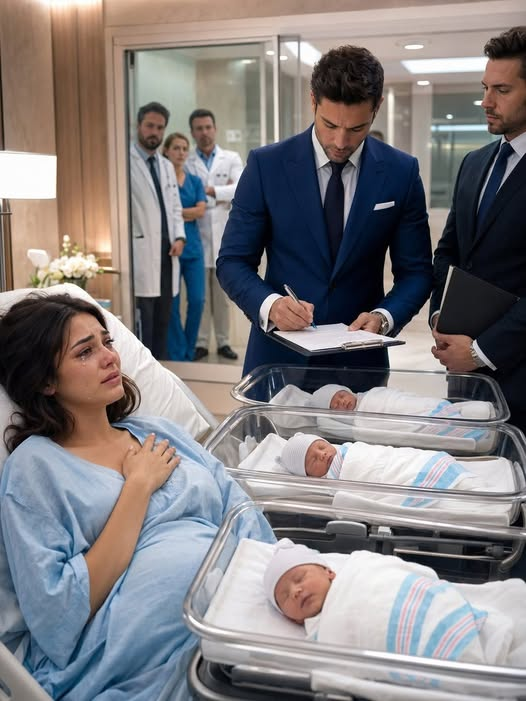
They were gaining weight rapidly. Their tiny cheeks were turning pink, their lungs growing stronger with every passing day.
Dr. Sarah Lin walked into the room, holding a clipboard, a bright, genuine smile illuminating her exhausted face.
“All three vitals are rock-solid, Clara,” Dr. Lin said, checking the monitors with a gentle touch. “Leo gained two ounces today. Alexander and Maya are officially off oxygen support. They are going home by the end of the month.”
I closed my eyes, letting a hot tear of pure, overwhelming gratitude spill down my cheek. “Thank you, Sarah. For everything. If you hadn’t fought for me on that table…”
“You fought for yourself, Clara,” Dr. Lin said softly, placing a hand on my shoulder. “Your heart stopped, but your spirit refused to leave those babies. You are the strongest woman I have ever met.”
The door opened gently, and Arthur Vance stepped into the suite. He set his leather briefcase on the table, pulled off his silk scarf, and walked over to look down at the three tiny infants sleeping peacefully in their cribs.
“They look like you, my dear,” Arthur murmured, his eyes softening with deep, ancient affection. “They have your grandfather’s jawline.”
“How are the legal proceedings, Arthur?” I asked.
“The family court judge signed the final decree this morning,” Arthur reported, pulling a gold-embossed folder from his coat. “Grant’s parental rights have been permanently terminated based on criminal abandonment and fraud. You have sole legal and physical custody. The children’s last names have been legally changed to Sterling.”
He handed me the documents.
“And Holloway Enterprises?”
“The bankruptcy court approved the asset sale an hour ago,” Arthur smiled—a warm, triumphant expression. “The Sterling-Vance Sovereign Trust has acquired ninety-eight percent of the liquidated assets for pennies on the dollar. You are now the sole owner of the port, the fleet, and the building, Clara.”
I looked down at the official deed resting on my lap.
The company that my ex-husband had tried to protect by leaving me to die on an operating table now belonged entirely to the woman he had tried to erase—and to the three children he had disowned before they even had a chance to open their eyes.
The Unbroken Sunrise
One year later.
The summer sun washed over the sprawling lawn of the Sterling-Vance Estate in Hudson Valley, casting a golden glow across the rolling green hills, the ancient oak trees, and the sparkling blue waters of the river below.
The air smelled of fresh-cut grass, blooming hydrangeas, and warm sunshine.
On the wide stone terrace overlooking the valley, a massive velvet blanket was spread across the grass. Three healthy, chubby-cheeked toddlers were crawling around, babbling happily, playing with wooden blocks and brightly colored soft toys.
Leo, with his mop of dark curls, was trying desperately to pull himself up using the leg of a wooden lounge chair. Alexander was sitting upright, meticulously banging two plastic blocks together with focused intensity. And little Maya, her bright blue eyes sparkling with mischief, was crawling as fast as her tiny knees could carry her toward a golden retriever puppy resting in the shade.
I sat on the edge of the blanket in a simple white linen dress, laughing as I caught Maya just before she could grab the puppy’s tail, pulling her into my lap and tickling her belly until she let out a loud, ringing squeal of delight.
Sitting across from me, sipping a cup of dark roast coffee, was Dr. Sarah Lin. She had recently resigned from her hospital position to become the Executive Director of the Clara Sterling Foundation for Maternal and Child Health—a fifty-million-dollar non-profit organization we had established to fund emergency medical care for uninsured mothers and premature infants across the state.
“They’re growing so fast, Clara,” Sarah smiled, watching Leo successfully stand up on his wobbly legs and let out a triumphant babble. “It feels like yesterday we were watching them through the glass of the NICU.”
“They are my whole world, Sarah,” I whispered, holding Maya tight against my chest, feeling the warm, steady beat of her heart against mine.
Arthur Vance walked out onto the terrace from the main house, holding a leather folder and a newspaper under his arm. He looked relaxed, his silver hair catching the summer light.
“Good morning, ladies,” Arthur greeted, sitting down in one of the wicker chairs.
“Any news from the city, Arthur?” I asked gently.
Arthur opened the newspaper and laid it on the wooden table.
On page six, a small article was circled in red ink:
FORMER EXECUTIVE GRANT HOLLOWAY SENTENCED TO 12 YEARS IN FEDERAL PENITENTIARY FOR CORPORATE FRAUD AND TAX EVASION.
The article briefly noted that Grant’s final appeal for personal bankruptcy protection had been denied, and that his remaining assets had been seized to pay restitution to the workers’ pension fund that he had attempted to raid before his arrest.
I looked at the photograph of Grant in the newspaper—a man in an orange jumpsuit, looking old, broken, and completely forgotten.
I felt no rage. I felt no bitter surge of revenge. Looking at his picture was like looking at a stranger whose life had no bearing whatsoever on the warmth, beauty, and joy surrounding me on this sunlit terrace.
He had believed that power came from money, suits, and ruthless cruelty. He had believed that leaving a dying wife and three helpless newborns behind was a smart business move.
He had never understood that true power isn’t built on balance sheets or corporate acquisitions. True power is forged in the unconditional love of a mother who refuses to stay dead.
“Mama!” Leo babbled loudly, wobbling three steps across the blanket before tumbling safely into my open arms.
Alexander crawled over to join us, burying his head against my waist, while Maya giggled, wrapping her tiny hands around my fingers.
I pulled all three of my children close to my heart, kissing their foreheads, breathing in the sweet, clean scent of baby powder, sunshine, and victory.
“Look at the river, my sweet angels,” I whispered, pointing down toward the sparkling waters of the Hudson, where massive ships glided peacefully under the blue summer sky—ships bearing the proud, restored emblem of the Sterling Trust.
The past was buried. My name was restored. My children were safe, healthy, and surrounded by absolute, unbreakable love.
And as the warm afternoon breeze rustled through the green leaves of the oak trees above, carrying the bright, joyful sound of my children’s laughter high into the cloudless sky, I smiled—knowing that my broken heart had not only healed, but had built a fortress that would stand unbroken forever.
