The Cold Open
The first day of freedom wasn’t what I imagined.
There was no relief.
No celebration.
Just the smell of diesel fumes, stale coffee, and cold morning air as I stepped out of prison carrying a plastic bag filled with everything I owned.
For three years, one thought had kept me going.
My father.
Every night, I pictured him sitting in his favorite leather chair, waiting for the day I came home.
He was the only person who still believed I was more than my conviction.
The only person who remembered who I had been before the headlines, the courtroom, and the prison walls.
I couldn’t wait to see him.
So the moment I was released, I headed straight for his house.
But something felt wrong the instant I arrived.
The porch had been repainted.
The garden looked completely different.
Luxury vehicles sat in the driveway.
Even the front door had changed.
Nothing looked like home anymore.
Still, I climbed the steps and knocked.
When the door opened, it wasn’t my father standing there.
It was my stepmother, Linda.
She looked perfectly comfortable.
Perfectly prepared.
Almost as if she had been expecting me.
“You’re out,” she said coldly.
My stomach tightened.
“Where’s Dad?”
Her expression didn’t change.
“Your father died last year.”
The words hit me like a punch to the chest.
I waited for her to explain.
To apologize.
To tell me there had been some mistake.
But she simply crossed her arms.
“We live here now.”
I stared past her into the house.
Every trace of my father was gone.
The furniture had changed.
The photographs had disappeared.
It looked like someone had erased him completely.
“Why didn’t anyone tell me?” I asked.
Linda smirked.
“You were in prison, Leo. What exactly were we supposed to do?”
I could barely breathe.
“I want to see his things.”
“There are no things.”
“I want to see his room.”
“There’s nothing here for you.”
Then she slowly closed the door in my face.
The sound of the lock clicking shut felt like another funeral.
Only this time, I wasn’t invited.
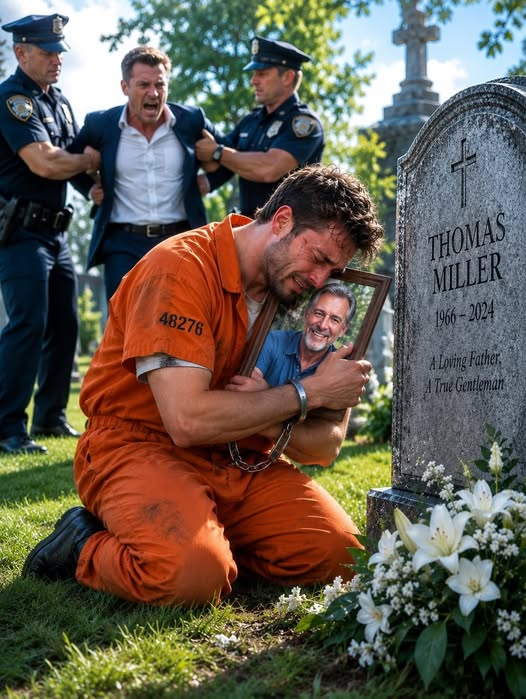
Lost and desperate, I drove to the town cemetery.
If my father was gone, I needed to stand at his grave.
I needed proof.
An elderly groundskeeper noticed me wandering among the headstones.
“Looking for someone?” he asked.
“My father,” I replied. “Thomas Miller.”
The old man went quiet.
Then he looked at me with something that felt disturbingly close to pity.
“Don’t waste your time searching.”
My heart skipped.
“What do you mean?”
He lowered his voice.
“Your father isn’t buried here.”
A chill shot through my entire body.
“What are you talking about?”
The groundskeeper introduced himself as Harold.
He explained that he had known my father for years.
Then he reached into his jacket and pulled out a worn brown envelope.
“He told me to give you this if you ever came looking for him.”
My hands shook as I accepted it.
Inside was a folded letter.
And a key.
Taped to a small card.
The handwriting on the front belonged unmistakably to my father.
The same neat block letters I had seen my entire life.
For a moment, I couldn’t move.
Because if my father had planned this…
If he knew I would come looking…
Then maybe Linda had lied about far more than a funeral.
And whatever secret my father had hidden was important enough to leave behind instructions from beyond the grave.
As I unfolded the letter, I realized my journey home had never really been about finding my father.
It was about uncovering the truth someone had worked very hard to bury.
The Cipher in the Envelope
I sat on a moss-covered stone bench near the cemetery gates, my thumb trembling as I traced the raised edges of the heavy brass key. The wind picked up, howling through the towering oak trees and carrying the damp, metallic scent of an oncoming autumn storm.
Harold stood a few feet away, leaning heavily on his wooden rake. His pale blue eyes were clouded with age, but his gaze was sharp, resting on me with a quiet, solemn intensity.
“How long ago did he give you this, Harold?” I asked, my voice barely louder than a whisper against the rustling leaves.
“Fourteen months,” Harold murmured, pulling a small silver pocket watch from his vest. “It was raining just like this. Thomas came walking up the gravel path alone. He looked frail, Leo. But his mind… his mind was sharp as a razor. He knew what was coming. He told me, ‘Harold, my son was set up. When he gets out, they’re going to tell him I’m dead and buried in plot 402. Don’t let him look for a headstone that doesn’t hold my bones.’“
My blood ran cold. “He knew I’d come here?”
“He knew his wife,” Harold said bitterly, spitting onto the grass. “Linda Miller is a viper, son. The moment Thomas fell ill, she brought her adult son, Julian, into the house. They took over the firm, fired your father’s loyal staff, and shut down the estate. When the obituary ran in the local paper last November, there was no public viewing. No church service. Just a private cremation notice signed by Linda.”
I unfolded the thick, yellowed parchment inside the envelope. My father’s handwriting stared back at me, crisp and authoritative—the penmanship of a man who had built Miller Logistics from a single flatbed truck into a fifty-million-dollar maritime transport empire.
My dearest Leo,
If you are reading this, the three years of your unjust exile have finally come to an end. I am so deeply sorry, my boy. I failed to protect you when Linda and Julian planted those offshore embezzlement files in your desk three years ago. I was blind to their greed until it was too late to save you from that courtroom.
By the time I uncovered the paper trail proving your innocence, Linda realized I knew the truth. She began poisoning my tea with digitalis—slowly, methodically, building a medical record of cardiac failure with a corrupt doctor on her payroll.
I do not have much time left. But I will not let them enjoy the fruits of their treason. The key taped to this letter belongs to Safety Deposit Box 814 at the Old Dominion Bank in downtown Blackwood. Inside, you will find the master ledger of Miller Logistics, the original unredacted server logs from the night you were framed, and my true, unrevoked last will and testament.
Do not weep for me at an empty grave, Leo. Take back what is yours. Burn their palace to the ground.
Your loving father,
Thomas Miller
A tear struck the ink, smudging the edge of his signature.
I clamped my jaw shut, the grief that had been threatening to drown me suddenly hardening into something fierce, wild, and absolute. They hadn’t just stolen my youth and my father’s fortune—they had murdered him in cold blood and erased his memory.
I looked up at Harold. “Is there really no body?”
Harold leaned in closer, his voice dropping into a raspy whisper. “There was a coffin delivered to the crematorium in Portland late one night. But the driver was Julian’s personal assistant. No medical examiner signed off on the transport log. If you ask me, Thomas isn’t under the dirt, Leo. They did something far worse.”
“What do you mean?”
“Check the vault, son,” Harold said, stepping back into the shadows of the mausoleum. “Check the vault before Linda realizes you have the key.”
The Vault at Old Dominion
By 2:00 PM, the storm had fully unleashed its fury over the city of Blackwood. Sheets of freezing rain lashed against the granite facade of the Old Dominion Bank, a century-old institution that stood as a monument to the town’s founding wealth.
I walked through the heavy brass revolving doors, my soaked jacket clinging to my shoulders. The plastic bag containing my prison release documents felt heavy in my pocket, but my right hand was clutched firmly around the brass key.
I walked straight to the safe deposit counter in the basement vault.
A silver-haired clerk named Mr. Abernathy looked up through his bifocals. He blinked, staring at my worn face, my prison-issued boots, and the raw exhaustion etched around my eyes.
“May I help you, sir?” he asked politely.
“I need access to Box 814,” I said, laying the brass key on the polished marble counter. “Under the name of Thomas Miller.”
Abernathy went still. He looked from the key to my face, his eyes widening in sudden recognition. “Leo? Leo Miller? Good heavens… we were told you were serving a five-year sentence.”
“I was released early on good behavior,” I replied quietly. “My father left instructions for me to access his box upon my release.”
Abernathy swallowed hard, looking nervously toward the security cameras mounted in the corners of the vault room. “Mr. Miller… your stepmother, Mrs. Linda Miller, came in here six months ago with a court order signed by Judge Harrison. She claimed your father was deceased and demanded access to all his accounts and safety deposit boxes.”
My heart dropped into my stomach. “Did she open Box 814?”
Abernathy leaned over the counter, lowering his voice. “She tried. But your father was a brilliant man, Leo. Box 814 was registered under a dual-signatory irrevocable trust created under the laws of Delaware. The bank’s protocol required both the brass key and a biometric palm print from the primary beneficiary—you. When she couldn’t open it, she flew into a rage, threatened to sue the bank, and had Judge Harrison issue a freeze on the box.”
A wave of pure relief washed over me, followed instantly by a surge of adrenaline. “Is the freeze still active?”
“Judge Harrison’s order expired forty-eight hours ago because her legal team failed to file the renewal paperwork,” Abernathy whispered with a faint, rebellious wink. “Follow me.”
He led me past two heavy iron gates into the depth of the underground vault. He slotted his master key into the left side of Box 814, and I inserted my brass key into the right.
Click.
The heavy steel drawer slid forward.
I pulled out a thick, black leather briefcase secured with a biometric scanner on the latch. I pressed my right palm against the glass screen. The scanner beeped green, and the heavy metal latches popped open with a sharp recoil.
Inside sat three distinct items:
- A sleek silver hard drive containing thousands of encrypted financial files.
- A bound leather ledger detailing fifteen years of secret offshore accounts under Linda and Julian’s names.
- A sealed, official document from the State Department bearing a red wax seal.
I broke the wax seal on the State Department document and pulled out the contents.
As my eyes scanned the top line, my breath hitched in my throat. My vision went blurry, my hands shaking so violently the paper rattled in the quiet vault.
It wasn’t a death certificate.
It was a Protective Custody and Witness Relocation Authorization Order issued by the Federal Bureau of Investigation, dated ten months ago.
SUBJECT: Thomas Miller
STATUS: Living / Federal Protection Program (WITSEC)
CASE FILE: #884-DOJ-BLACKWOOD
NOTE: Subject’s death was faked with the assistance of the U.S. Attorney’s Office to prevent immediate assassination by syndicate associates tied to Linda Miller and Julian Vance.
My jaw hung open. I fell back against the steel wall of the vault, a breathless, hysterical laugh tearing out of my chest.
My father wasn’t dead.
He was alive.
The Ghost in the Machine
I spent the next three hours sitting in the private back room of the Blackwood Public Library, the silver hard drive plugged into a burner laptop I had purchased with the hundred dollars Harold had slipped into my pocket at the cemetery.
The files on the drive were an absolute masterclass in forensic accounting.
My father hadn’t just been a logistics manager; he had spent the last two years of his life acting as a confidential informant for the Department of Justice.
When Linda married my father seven years ago, she brought her son, Julian Vance, into the family business. Julian was a charming, sociopathic MBA graduate who immediately began converting Miller Logistics into a massive laundering conduit for an international drug trafficking syndicate operating out of the Port of Baltimore.
When I stumbled upon the discrepancies three years ago, Julian realized I was on the verge of exposing them. They fabricated an internal audit, placed two hundred thousand dollars of stolen company funds into my personal bank account, and bribed a county prosecutor to put me away before I could blow the whistle.
My father had been forced to play along to keep me alive in prison. He feigned ignorance, pretended to trust Linda, and slowly gathered the digital evidence necessary to dismantle their entire criminal network.
When Linda tried to poison him with digitalis fourteen months ago, my father didn’t go to the local hospital—he went straight to the Federal Bureau of Investigation in Washington, D.C.
The FBI faked his death, staged a private cremation with a dummy coffin, and placed him in an undisclosed medical facility under federal marshal protection while they built a RICO indictment against Linda, Julian, and their syndicate handlers.
And taped to the back of the State Department document was a second, tiny note in my father’s handwriting:
Leo,
Tonight is the annual Miller Logistics Charity Gala at the Blackwood Country Club. Linda and Julian are announcing the public sale of the company to a syndicate front corporation for eighty million dollars.
At 8:00 PM, the sale will be finalized. They believe I am in a grave, and they believe you are broken in a cell.
The silver drive contains an auto-executable script. Plug it into the main AV server at the country club before 8:00 PM. I will do the rest from the shadows.
Show them no mercy, my son.
I looked at the clock on the library wall.
It was 6:45 PM.
I closed the laptop, packed the hard drive into my jacket, and stood up. The worn, helpless boy who had walked out of prison six hours ago was gone.
In his place stood a man holding the detonator to an empire built on lies.
The Gala of Ghosts
The Blackwood Country Club was a glittering palace of glass, chandeliers, and unearned luxury.
Outside, dozens of valet drivers in black vests were parking Mercedes, Bentleys, and Lamborghinis along the manicured driveway. Inside the grand ballroom, two hundred of Blackwood’s most prominent politicians, judges, business leaders, and socialites walked across polished marble floors, sipping vintage champagne beneath towering crystal fixtures.
At the center of the room, standing on a raised wooden stage beneath a massive banner that read “MILLER LOGISTICS: A LEGACY OF EXCELLENCE,” stood Linda Miller.
She looked magnificent and terrifying. She wore a floor-length emerald green silk gown, an eleven-carat diamond necklace glittering against her throat—a necklace that had belonged to my biological mother.
Beside her stood her son, Julian Vance. He wore a bespoke velvet tuxedo, holding a glass of scotch in one hand and a leather-bound acquisition contract in the other. He was surrounded by a group of smiling foreign investors in tailored suits.
I entered the country club through the service entrance near the kitchens, wearing a black waiter’s jacket I had taken from an unlocked staff van in the parking lot.
Nobody looked at me. To the wealthy guests, service staff were invisible—ghosts moving through the background of their lavish lives.
I navigated the narrow back corridors until I reached the AV control room overlooking the ballroom. The door was locked, but a quick shove against the old brass latch popped the lock instantly.
The control room was empty, illuminated only by the glow of three large monitors displaying the live video feed of the stage below.
I walked over to the central media server—the master terminal connected to the grand projector screens flanking the main stage.
I pulled the silver hard drive from my pocket and slotted it into the primary USB port.
A black command prompt window popped up on the monitor screen. Text began scrolling rapidly across the black background in bright green code:
[SYSTEM INITIATED: OPERATION GHOST_LEDGER]
[CONNECTING TO SECURE DOJ SERVER... CONNECTED]
[OVERRIDING LOCAL AV INPUT... COMPLETE]
[EXECUTING BROADCAST IN 3... 2... 1...]
Down in the ballroom, the string quartet suddenly stopped playing as the microphone on the stage emitted a sharp, ear-splitting burst of feedback.
The two hundred guests paused, turning their heads toward the stage.
Julian Vance stepped up to the podium, offering a smooth, charismatic smile as he adjusted the microphone.
“Good evening, ladies and gentlemen,” Julian’s voice boomed through the loudspeakers. “Tonight is a bittersweet moment for the Miller family. One year ago, we lost my beloved stepfather, Thomas Miller. But tonight, my mother and I are proud to usher his legacy into a new era by announcing the official merger of Miller Logistics with Apex Global Investments!”
The crowd began to applaud politely.
Linda stepped up beside her son, placing her hand over her heart, forcing a tear to swell in her eye with practiced, sociopathic perfection. “Thomas would have been so proud,” she said into the microphone, her voice trembling with fake emotion. “He loved this company. He loved this town. And I know he is looking down on us from heaven tonight, giving us his blessing.”
Suddenly, the massive crystal chandeliers above the ballroom dimmed into pitch blackness.
The crowd gasped in confusion.
A second later, the two massive fifty-foot projector screens flanking the stage roared to life with a blinding white light.
The Voice from the Grave
The room went dead silent as a video began to play across the massive screens.
It wasn’t a corporate promotional video.
It was a high-definition recording taken from an interrogation room inside the United States District Court in Washington, D.C.
Sitting at a steel table in a navy suit, looking healthy, vibrant, and utterly alive, was Thomas Miller.
The entire ballroom let out a collective, terrifying gasp.
Linda’s microphone dropped from her hand, hitting the stage floor with a deafening thud that echoed through the speakers. Her face went as pale as flour, her lips parting in an expression of pure, unadulterated horror.
Julian took three fast steps backward, slamming his back against the backdrop wall, his eyes bulging out of his head as if he were looking at a demon rising from hell.
“Good evening, Blackwood,” Thomas Miller’s voice boomed through the country club speakers, clear, powerful, and rich with unshakeable authority.
“I apologize for missing my own funeral,” Thomas continued, a cold, triumphant smile spreading across his face on the fifty-foot screens. “But as you can see, the reports of my death were greatly exaggerated.”
Panicked whispers erupted across the ballroom like wildfire. Guests began pulling out their phones, filming the screens, pointing at Linda, who was trembling so violently she could barely stand.
“For the past fourteen months,” my father’s recorded voice announced, “I have been living under the protection of the Federal Bureau of Investigation while assisting the Department of Justice in a comprehensive investigation into corporate fraud, illegal wiretapping, attempted murder, and enterprise racketeering.”
The video feed shifted, replacing my father’s face with a series of high-resolution documents:
- Bank wire records showing Linda transferring twelve million dollars from Miller Logistics into an offshore account in Grand Cayman.
- Audio recordings of Julian Vance speaking with a syndicate broker, explicitly discussing how they framed Leo Miller to take control of the company.
- Medical toxicology reports signed by the State Forensic Examiner, proving that Linda had been lacing Thomas Miller’s tea with lethal doses of digitalis.
“Linda,” Thomas’s voice echoed across the room, cold as a winter night. “Julian. You thought you were clever. You thought you could frame my innocent son, poison my body, and sell my life’s work to criminals. But you forgot one fundamental law of physics…”
The screen shifted back to my father’s face. He looked directly into the camera lens, as if staring straight into Linda’s soul.
“…what is done in the dark will always be dragged into the light.”
The ballroom double doors at the back of the room were suddenly kicked open with a thunderous crash that shook the walls.
Dozens of armed Federal Marshals, FBI tactical agents, and State Police officers flooded into the room, their weapons raised, their tactical flashlights cutting through the dim light of the ballroom.
“FEDERAL AGENTS! NOBODY MOVE! GET ON THE GROUND!”
The crowd dissolved into absolute chaos. Guests shrieked, ducking behind tables and marble pillars as federal agents swarmed the stage.
Julian dropped his glass of scotch, turning to run toward the rear emergency exit behind the curtains.
I stepped out from behind the curtain, blocking his path.
Julian froze, staring at me in complete, paralyzing terror. “Leo…?” he stammered, his voice cracking into a high-pitched whimper. “You… you were in prison…”
“My sentence was overturned an hour ago by a federal magistrate, Julian,” I said, my voice dropping into a quiet, lethal register as I stepped toward him.
He lunged at me in a desperate, panicked attempt to push past, but three years of hard labor in a maximum-security prison had turned my body into stone.
I seized his lapels, twisted his momentum, and slammed him face-down onto the wooden stage floor with a sickening thud. Before he could scream, an FBI agent dropped his knee onto Julian’s back, snapping steel handcuffs around his wrists.
Beside the podium, two female federal agents grabbed Linda by her emerald silk arms.
She thrashed and screamed like a feral animal, her diamond necklace tearing from her throat and crashing against the floorboards, scattering diamonds across the stage.
“Get your filthy hands off me!” Linda shrieked, her manicured nails clawing at the air. “I am the owner of this company! I am Mrs. Thomas Miller!”
The lead FBI agent pulled a heavy paper document from his jacket, holding it directly in front of her weeping face.
“Linda Vance,” the agent declared loudly, his voice echoing across the silent ballroom. “You are under arrest for attempted murder, grand larceny, corporate fraud, and federal conspiracy. You have the right to remain silent.”
As she was pulled down the stage steps in handcuffs, her eyes met mine.
I didn’t yell at her. I didn’t laugh. I simply stood at the edge of the stage, my arms folded across my chest, watching her empire crumble into absolute, irreparable ruin.
The True Horizon
Three weeks later.
The morning sun broke over the autumn hills surrounding the Miller Estate, painting the ancient oak trees in vibrant shades of gold, crimson, and copper. The smell of fresh-cut grass and ocean air filled the warm breeze.
I stood on the broad wooden porch of the house—my house—wearing a simple flannel shirt and jeans.
The luxury sports cars were gone from the driveway. The ugly repainted trim had been stripped away, restored to its original, warm cedar wood. The house looked like home again.
A black government sedan pulled up to the curb outside the front gate.
The rear door opened slowly.
A tall man stepped out, leaning on a polished mahogany walking stick. He wore a crisp navy blazer, his silver hair catching the morning sunlight. He looked older, his face lined with the deep scars of survival, but his posture was straight, his eyes clear and blue as an autumn sky.
It was my father.
My breath caught in my throat. The cup of coffee in my hand trembled, but I didn’t drop it.
I walked down the porch steps, my boots striking the gravel path, stepping out onto the lawn.
My father stopped at the edge of the driveway. He looked at the restored porch, at the garden, and then slowly turned his gaze to me.
Tears welled in his eyes, carving lines through the dust on his cheeks.
“Leo…” he whispered, his voice trembling with a deep, ancient emotion.
I didn’t say a word. I crossed the grass in three fast strides and threw my arms around his shoulders, pulling him into a tight, fierce embrace.
He held me back with surprising strength, his hands clutching the back of my jacket, weeping openly against my shoulder—the tears of a father who had fought through hell, death, and deception to bring his son home.
“I’m sorry, Leo,” my father sobbed quietly. “I’m so sorry I let them take three years of your life…”
“You gave me my life back, Dad,” I whispered, holding him tighter. “You gave us both our lives back.”
We stood on the lawn for a long time, held in the warm, healing embrace of a sunrise that had been three long years in coming.
Later that afternoon, my father and I walked together up the gravel path of the Blackwood Cemetery.
The air was quiet, save for the gentle chirping of birds in the oak trees above. We walked past the rows of stone headstones until we reached a small, peaceful sunlit clearing near the edge of the woods.
Standing near a stone bench was Harold, the old groundskeeper.
He smiled warmly when he saw us approaching, setting his rake against a tree and stepping forward to shake my father’s hand with deep, quiet respect.
“Good to see you on two feet, Thomas,” Harold chuckled softly.
“Good to be above the grass, Harold,” my father replied with a quiet smile.
My father pulled a small silver box from his coat pocket and laid it gently on the stone bench beneath the shadow of a blooming wild rosebush.
Inside the box were two things: my old prison ID card, and the brass key to Box 814.
“What’s this, Dad?” I asked quietly.
My father looked at me, resting his hand over my shoulder, his eyes shining with profound peace and unbreakable pride.
“This is where we bury the past, Leo,” my father said softly. “The lies are dead. The ghosts are gone. Today, we start living.”
I looked out over the rolling green hills of Blackwood, feeling the warm autumn wind against my face, knowing that the dark night was finally over.
We had survived the storm, conquered the lies, and together, as father and son, we walked out of the graveyard and into the bright, endless light of our new beginning.
