The Paperwork of Abandonment
I was seven months pregnant with triplets when my husband handed me divorce papers and rushed off to start a new life with another woman. Three years later, he would stand frozen in a crowded Denver ballroom, staring at three little boys and the man they called “Dad”—a man who shared none of their blood but loved them as his own. By then, the truth would be impossible to ignore: the family he abandoned had found something far stronger than the life he chose instead.
My name is Natalie Brooks.
There was a time when I believed my husband, Graham Voss, and I would grow old together.
Instead, I found myself sitting across from him in a private conference room overlooking downtown Denver, my hands resting on my pregnant stomach while three tiny babies kicked beneath my ribs.
Triplets.
Our sons.
The children he was about to walk away from.
Three copies of a divorce agreement sat on the table between us.
“Just sign them, Natalie,” Graham said, sliding a pen toward me. “There’s no reason to make this harder than it has to be.”
I stared at him.
Months earlier, I had been choosing baby names and decorating a nursery.
Now I was being asked to sign away the future I thought we were building.
“For me?” I asked quietly. “Or because you’re trying to catch a flight to Miami?”
His jaw tightened.
The attorney looked down at the table.
Nobody answered.
The silence told me everything.
“I never thought you’d do this,” I whispered.
Graham checked his watch again.
“I’ve moved on.”
Those four words hurt more than I expected.
Outside, rain streaked down the windows.
Inside, my marriage ended.
I signed.
Not because I wanted to.
Because I finally understood there was nothing left to save.
Within months, Graham had remarried.
The photos spread across social media like salt in an open wound.
Luxury resorts.
Private yachts.
Designer suits.
Perfect smiles.
Meanwhile, I was learning how to survive alone with three newborn boys.
Some nights I barely slept.
Some days I cried in the shower so my sons wouldn’t hear me.
Then, when the boys were six months old, fate introduced me to Vincent Romano.
Everyone in Denver knew the name.
Some spoke it with admiration.
Others with fear.
Vincent was powerful, wealthy, and surrounded by mystery.
Yet when he looked at my sons, all I saw was kindness.
One afternoon, while helping me load groceries into my car, he smiled at the boys.
“They’re troublemakers already.”
I laughed for the first time in weeks.
“You have no idea.”
Over time, he became a regular presence in our lives.
He fixed broken things around the house.
Read bedtime stories.
Attended pediatric appointments.
And somehow, without either of us planning it, he became family.
One evening, after the boys had fallen asleep, Vincent took my hand.
“I know they aren’t mine,” he said softly. “But I love them anyway.”
Tears filled my eyes.
“And I love you.”
A year later, we were married.
The boys called him Dad.
Not because anyone told them to.
Because that’s who he was.
Then came the charity gala.
The event everyone in Denver attended.
Business leaders.
Politicians.
Socialites.
And Graham.
For the first time in years, our paths crossed.
I watched his confident smile disappear as three little boys ran across the ballroom.
“Dad!” they shouted.
Straight toward Vincent.
Graham stared.
The boys had his eyes.
His smile.
His features.
But they were holding Vincent’s hands.
Calling Vincent their father.
Then one of the boys turned and pointed directly at Graham.
“Mom,” he asked innocently, “who’s that man?”
The entire room seemed to go silent.
And for the first time, I saw genuine panic in Graham’s eyes as Vincent slowly stepped forward.
The Architecture of Betrayal
To understand how a man could walk away from his own unborn children, you have to understand the predatory mechanics of Graham Voss.
Graham wasn’t merely ambitious; he was a social climber who viewed people as stepping stones. When we met six years earlier, I was a senior financial analyst at a mid-sized asset firm, and he was an up-and-coming executive at Voss Logistics—a firm founded by his late father. I helped him refine his pitch decks, introduced him to my father’s network of real estate investors, and spent five years building a quiet, respectable life by his side.
When I found out I was carrying triplets, I thought our happiness was complete.
What I didn’t know was that Graham had already spent eight months transferring company equity into offshore accounts. He had aligned himself with Chloe Sterling—the twenty-six-year-old heiress to Sterling Global Infrastructure—a woman whose family possessed the exact capital Graham needed to elevate Voss Logistics into a multi-billion-dollar powerhouse.
To Graham, three infants and a pregnant wife were an expensive liability that would slow down his corporate trajectory. His divorce strategy was surgical: offer me a modest lump sum, demand I waive future spousal support, and structure his income so that child support calculations appeared negligible on paper.
When I sat in that conference room three years ago, exhausted and heavy with life, I didn’t have the strength to fight a team of high-priced corporate litigators. I walked out of that building with two hundred thousand dollars—barely enough to cover medical expenses and rent a small house in the Denver suburbs—and three lives growing inside me.
The months following the birth of Julian, Leo, and Ethan were a blurry, feverish haze of survival.
Triplets meant forty-eight diapers a day, round-the-clock feedings, and a relentless, bone-deep exhaustion that made my hands shake while holding the bottles. While Graham was throwing lavish galas in Saint-Tropez with Chloe, I was counting pennies to afford specialized infant formula.
My father had passed away two years before the divorce, leaving behind only a modest home and an old, dust-covered filing cabinet in his garage. He had been a quiet man who spent his life working as a chief land surveyor for the state of Colorado. In the chaos of raising three infants, I had shoved his old boxes into my basement, never giving them a second thought.
Then came the rainy Tuesday in November when my car battery died in the parking lot of a local grocery store.
I was standing beside my trunk, struggling to adjust a rain cover over a heavy triple stroller while all three boys cried in unison. The wind was howling off the Rockies, freezing and wet.
A dark metallic-gray SUV pulled into the adjacent space. A tall man in a tailored charcoal wool coat stepped out, holding a large black umbrella. He didn’t hesitate. He stepped between my stroller and the driving rain, holding the umbrella over my sons while reaching down to adjust Julian’s slipping blanket with surprising tenderness.
“You look like a captain whose ship is taking on water, ma’am,” he said. His voice was a deep, calm baritone that seemed to instantly soothe the chaos.
I wiped a wet strand of hair from my eyes, breathing heavily. “More like a captain whose ship has lost its engine.”
He smiled—a slow, genuine expression that reached his dark, perceptive eyes. That was the day Vincent Romano stepped into our world.
The Quiet Sentinel
Vincent Romano was a ghost story in Denver’s financial district.
The media described him as a reclusive venture capitalist who had made billions acquiring distressed logistics and energy infrastructure across North America. The rumors whispered that he was a man you never wanted to cross—a formidable, razor-sharp strategist who had dismantled corrupt corporate syndicates without ever raising his voice.
To my sons, however, Vincent was simply the tall man who knew how to build the tallest wooden block towers in the living room and who never ran out of patience when three toddlers demanded to hear the same story about a lost bear three times in a row.
He didn’t woo me with diamonds or grand, theatrical gestures. He wooed me by showing up.
He showed up at 6:00 AM on mornings when Julian had a fever, carrying warm coffee and fresh bagels. He showed up on weekends with a toolbox, quietly repairing the drafty windows in my rented cottage. He sat on the floor in his expensive trousers, letting Leo and Ethan use his arms as jungle gyms while I finally took a two-hour nap.
“Why are you doing this, Vincent?” I asked him one evening, nine months after we met. We were sitting on my small back porch, watching the stars over the distant mountains while the boys slept inside. “You could have any woman in this city. You could have a quiet, effortless life without three chaotic toddlers.”
Vincent set his coffee mug down on the wooden railing. He looked at me, his eyes dark, intense, and filled with an absolute, unshakeable truth.
“I grew up in an orphanage in Chicago, Natalie,” Vincent said softly. “I spent my youth surrounded by people who looked at me and saw a burden. When I look at your sons, I don’t see a burden. I see a kingdom. And when I look at you, I see the bravest woman I have ever known.”
He reached into his coat pocket, pulling out a small velvet box. Inside rested a simple, unadorned platinum band.
“I don’t need to give them my blood to give them my name,” Vincent said. “Let me protect you, Natalie. Let me be the father they deserve.”
We were married three months later in a quiet, private ceremony at a historic chapel in Aspen. There were no cameras, no press releases, and no public announcements. I didn’t want my new life to become a spectacle for Graham to mock. I wanted peace.
For two years, we lived in a world of profound, beautiful quiet. Vincent bought a sprawling estate at the base of the foothills, filling the yard with swing sets, sandbox forts, and golden retriever puppies. He officially adopted Julian, Leo, and Ethan, inscribing their names alongside his in his legal trust documents.
The boys adored him. They wore tiny matching suit jackets to match his when he worked in his home office, sitting at a small wooden desk beside his massive mahogany desk, “signing” their coloring books while he managed global acquisitions.
Meanwhile, Graham’s social media presence had begun to shift.
Behind the glittering photos of yachts and red-carpet galas, rumors were circulating in the business journals that Voss Logistics was choking on debt. Graham’s high-stakes expansion into international maritime shipping—financed largely through Chloe Sterling’s family connections—was failing miserably due to supply chain bottlenecks and massive regulatory fines.
Graham needed a miracle. And he believed he was going to find it at the Annual Denver Children’s Hospital Charity Gala.
The Clash of Two Worlds
The Grand Ballroom of the Brown Palace Hotel was a sea of shimmering silk, tuxedos, and crystal chandeliers. Five hundred of Colorado’s most influential citizens filled the space, sipping vintage champagne while a string quartet played near the rose-adorned stage.
I wore a floor-length emerald silk dress, my hair styled in soft, elegant waves, a delicate diamond pendant resting against my collarbone—a gift from Vincent on our second anniversary.
Beside me, Vincent looked imposing and impeccably handsome in a bespoke tuxedo, his broad shoulders and commanding presence effortlessly drawing the respect of every CEO and politician in the room.
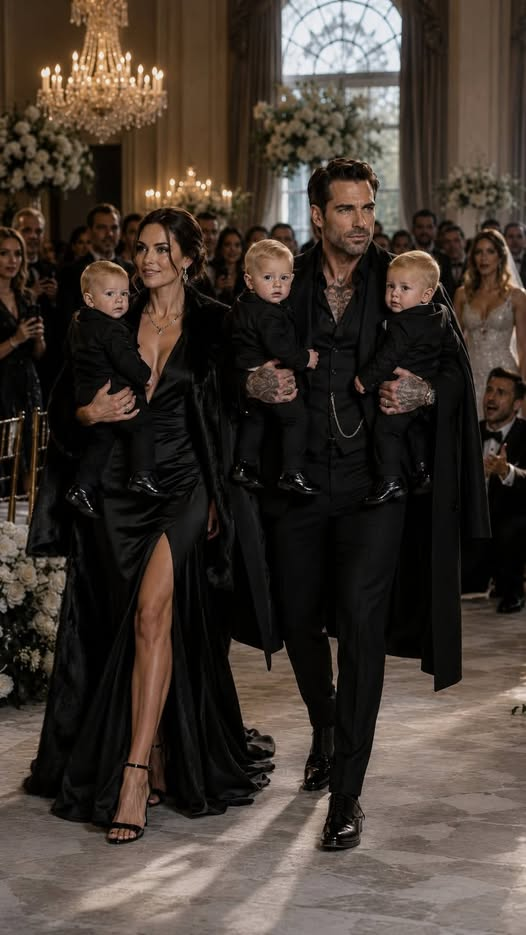
Julian, Leo, and Ethan—now three years old—were dressed in matching tiny velvet tuxedos with miniature bowtie clips. They were bright-eyed, energetic, and completely unbothered by the grand venue, holding Vincent’s fingers as they navigated through the crowd.
“Remember the rule, boys,” Vincent knelt down, adjusting Ethan’s bowtie with a warm smile. “No running near the dessert tower.”
“Yes, Dad!” the three boys chorused in unison, their clear, ringing voices echoing over the polite chatter of nearby guests.
Across the ballroom, standing near the main bar with a glass of scotch in his hand, was Graham Voss.
Beside him stood Chloe Sterling, looking sleek and bored in a backless metallic gown. Graham looked thinner than I remembered, a tight, anxious strain around his eyes that even his expensive golden tan couldn’t entirely mask. He was deep in conversation with a group of investors, frantically pitching his company’s newest venture.
Then, his eyes drifted across the room.
He froze.
His scotch glass hovered inches from his lips. The color drained from his face so fast it looked as though he had been struck by an electric shock.
His eyes moved from my face to the emerald gown, then down to the three little boys holding Vincent’s hands.
The boys had his sharp jawline. They had his dark brown curls. They had his distinct hazel eyes. They were unmistakable, living, breathing copies of Graham Voss.
Graham dropped his glass onto a passing waiter’s tray, completely ignoring Chloe’s startled question as he took three fast, unsteadily steps across the marble floor.
“Natalie…?” Graham gasped, his voice cracking beneath the weight of absolute, paralyzed shock.
I stood my ground, my hand resting gently on Vincent’s arm. I felt no rage. I felt no fear. I felt only the profound, sterile distance of a woman looking at a ghost who no longer had the power to haunt her.
“Hello, Graham,” I said calmly.
Graham’s eyes darted frantically between Vincent and me, then dropped to the three boys. His lips trembled. “Are… are those…?”
“Dad!” Julian shouted suddenly, pulling away from Vincent’s hand to wrap his tiny arms around Vincent’s leg. “Look! They have chocolate cake over there!”
Vincent smiled, reaching down to lift Julian effortlessly into his arms, resting the boy against his broad chest with practiced, natural warmth. Leo and Ethan immediately clutched Vincent’s trousers, giggling as they leaned against his boots.
Graham stared, his jaw hanging open, his breath hitching in his chest. The sight of his biological sons looking at another man with pure, unreserved adoration was a physical blow that left him visibly staggering.
Then, three-year-old Leo turned his head, pointing his tiny finger directly at Graham’s pale face.
“Mom,” Leo asked innocently, his bright hazel eyes wide with curiosity, “who’s that man?”
The silence around our circle was absolute. Nearby business leaders who had been watching the interaction went dead quiet, their eyes darting between Graham’s trembling face and Vincent’s stone-cold, unshakeable composure.
For the first time in his life, I saw genuine, unadulterated panic in Graham’s eyes.
Vincent stepped forward, holding Julian in one arm while his other hand remained resting protectively over my waist. He looked down at Graham from his full height, his dark eyes freezing and absolute.
“His name is Graham, son,” Vincent said, his deep voice carrying clearly over the quiet ballroom. “He’s just someone who used to know your mother.”
The Desperate Gambler
Graham looked as if he had been slapped across the face. “Vincent… Vincent Romano? What is this? Natalie, what the hell is going on here?!”
Chloe Sterling swept up beside Graham, her eyes narrowing as she looked at me, then at Vincent. “Graham, who are these people? Why are you shouting at Vincent Romano?”
“They’re my sons, Chloe!” Graham shouted, his voice cracking into a high-pitched, hysterical register that drew the attention of half the ballroom. “Those are my boys!”
“They were your responsibility, Mr. Voss,” Vincent corrected him, his voice dangerously low, dropping into the terrifying, razor-sharp tone that made seasoned executives sweat in boardrooms. “Until you signed three copies of a surrender agreement in a rainstorm three years ago to catch a flight to Miami.”
The crowd surrounding us gasped. Whispers rippled through the room like wildfire:
“Did he say he abandoned triplets?”
“That’s Graham Voss… he left his pregnant wife for the Sterling girl!”
“My God, look at those boys… they’re Romano’s adopted sons now!”
Graham’s face turned purple with embarrassment. “I… I was misled! The divorce settlement was unfair! Natalie hid assets from me!”
“You received forty-two million dollars in liquid capital during your merger with Sterling Global, Graham,” I said, my voice steady, sharp, and clear. “You left me with two hundred thousand dollars and three high-risk infant medical bills. You didn’t care if we survived in a cold apartment, as long as your yacht payments cleared.”
Graham stepped toward me, his hands shaking. “Natalie, please… let me talk to them! They’re my blood! You can’t keep my sons away from me!”
Vincent stepped directly into Graham’s path. The height and breadth of Vincent’s frame completely blocked Graham from reaching my children.
“Touch them, Graham,” Vincent whispered, a lethal, quiet promise in his eyes, “and you will find out how cold Denver can really get.”
Graham took a desperate step back, his eyes darting wildly. He realized he was losing everything—his dignity, his public standing, and his last shred of reputation—in front of the very investors he had been trying to impress all evening.
“You think you’ve won, Romano?!” Graham hissed, trying desperately to salvage his crumbling ego. “You think you can just buy my family with your billions?! Voss Logistics is expanding! I’m closing a fifty-million-dollar credit line with the state development board tomorrow! I’ll take you to court! I’ll sue for full parental rights!”
Vincent pulled a sleek, silver fountain pen from his breast pocket, casually unscrewing the cap.
“You won’t be closing that credit line tomorrow, Graham,” Vincent said calmly.
Graham frowned, a sudden, cold dread pooling in his stomach. “What are you talking about?”
“The state development board requires a primary collateral guarantor,” Vincent explained, sliding his hands into his pockets. “As of 4:00 PM today, Romano Capital acquired eighty-two percent of the voting debt of Voss Logistics. You don’t own that company anymore, Graham. I do.”
The Audit of a Liar
Graham stared at Vincent as if the floor had suddenly opened up beneath his feet. “What… what did you say?”
Chloe Sterling gasped, her eyes widening in terror. “Father told me yesterday that an anonymous institutional group was buying up our distressed bonds… Vincent, that was you?!”
“Your company was built on stolen land surveys and fraudulent material certifications, Graham,” Vincent continued smoothly, pulling a crisp, gold-stamped legal folder from his inner jacket pocket and handing it to a nearby security chief. “My legal team spent six months auditing your father’s estate records. It turns out, Natalie’s late father—Arthur Brooks—was the original patent holder for the automated supply-chain routing software that powers your entire fleet.”
I blinked, looking at Vincent in complete, breathtaking surprise. “My father…?”
“Your father was a genius, Natalie,” Vincent murmured, looking down at me with profound warmth. “Graham’s father stole Arthur’s software schematics thirty years ago while Arthur was working for the state. When Graham divorced you, he knew that if you ever conducted a proper forensic audit of your father’s old filing cabinets, you would discover that you owned sixty percent of the underlying patents of Voss Logistics.”
The entire ballroom was dead silent. Every eye was fixed on Graham, whose face had gone from purple to a ghostly, sickly white.
“That’s… that’s a lie!” Graham whimpered, his hands trembling so violently he dropped his speech notes onto the floor.
“The federal court in Washington didn’t think it was a lie when they issued the preliminary injunction two hours ago,” Vincent said calmly. “As of this evening, all operational accounts for Voss Logistics have been frozen pending asset restitution to Natalie Brooks-Romano.”
Chloe Sterling looked at Graham with pure, unadulterated disgust. She pulled her diamond ring from her finger, threw it onto the marble floor at his feet, and turned her back on him, walking away into the crowd without a single word.
“Chloe! Wait!” Graham cried out, reaching for her, but two uniformed security officers stepped into his path, blocking him completely.
“Mr. Voss,” the lead security officer said sternly, “you are being requested to accompany us to the manager’s office. Federal marshals are waiting to serve you with formal asset seizure notices.”
Graham stood frozen in the center of the glittering ballroom, surrounded by five hundred people who were staring at him with total, unreserved contempt. The billionaire playboy who had sacrificed his unborn sons for wealth and status was now destitute, publicly ruined, and stripped of every lie he had spent a lifetime constructing.
As the officers escorted a weeping, broken Graham through the side exit of the ballroom, three-year-old Ethan looked up at Vincent, tugging gently on his velvet lapel.
“Dad?” Ethan asked softly. “Is that bad man gone now?”
Vincent knelt down, lifting Ethan and Leo into his arms alongside Julian, holding all three of his sons close against his chest.
“He’s gone, son,” Vincent whispered, kissing each of their foreheads in turn. “And he’s never coming back.”
The Sovereign Inheritance
Six months later.
The spring sunshine washed over the rolling green hills of our estate at the base of the Rockies. The air was crisp, clean, and filled with the sweet scent of blooming wildflowers and fresh mountain pine.
A massive wooden playground structure—complete with towers, slides, and swing sets—sat near the edge of the lawn.
Julian, Leo, and Ethan were running through the grass, laughing hysterically as they chased two golden retriever puppies across the lawn, their tiny velvet tuxedos replaced by comfortable denim overalls and muddy sneakers.
I sat on the wide stone patio, wearing a simple white linen dress, a warm mug of tea resting between my hands.
Vincent walked out from the house, wearing a soft gray sweater and jeans, holding a thin blue folder under his arm. He sat down beside me on the wooden bench, sliding his arm around my waist and pulling me gentle against his side.
“How was the final settlement hearing?” I asked, resting my head against his shoulder.
“The bankruptcy judge approved the total liquidation of Voss Logistics,” Vincent reported, his voice filled with a quiet, deeply satisfying peace. “Every dollar of the liquidated assets—roughly sixty-five million—has been placed into an irrevocable, protected trust fund held jointly in the names of Julian, Leo, and Ethan.”
“And Graham?”
“He was sentenced to four years in a federal facility for corporate tax fraud and patent infringement,” Vincent said gently. “His appeals were denied. He will be paying restitution for the rest of his life.”
I took a long, deep breath, watching my three sons tumble safely into a pile of soft green grass, their clear, ringing laughter floating through the warm afternoon air like a song.
For three years, I had carried the heavy, burning scar of a betrayal that had threatened to break my spirit. I had believed that being abandoned while carrying three lives was a tragedy that would define the rest of my days.
But as I looked at the man sitting beside me—a man who had stepped into our darkness and built a fortress of love, strength, and unshakeable protection around my children—I realized that Graham’s abandonment had not been a tragedy at all.
It had been the miraculous, divine doorway that led us to our true home.
Vincent reached into his pocket, pulling out a small brass key, and laid it in my palm.
“What’s this?” I asked, smiling.
“That’s the key to the new Arthur Brooks Marine Research Center in Boulder,” Vincent said, kissing my temple. “We broke ground on the construction this morning. Your father’s name will be on the front of the building forever, Natalie.”
Tears of pure, overwhelming gratitude filled my eyes, spilling softly down my cheeks. I leaned up, pressing my lips against Vincent’s in a lingering, fierce kiss that held all the love, devotion, and peace in my heart.
“Mommy! Dad! Look!” Leo screamed happily from the lawn, holding up a large, bright yellow dandelion he had just picked. “Look what I found!”
All three boys came sprinting across the grass, their wobbly legs carrying them fast as they could toward the patio, throwing themselves into our arms with pure, unreserved joy.
Vincent caught them all, pulling them into a tight, warm mountain of hugs, his deep laughter echoing across the sunny yard.
“You found a masterpiece, Leo,” Vincent whispered, looking over the boys’ heads to lock his dark, loving eyes onto mine. “Just like I did.”
And as the warm afternoon breeze rustled through the pine trees above us, carrying the bright, unbroken sound of our children’s laughter high into the cloudless blue sky, I held my family tight—knowing that true legacy isn’t written in corporate ledgers or bloodlines, but in the unbreakable strength of a love that chooses to stay.
