Section I: The Thread in the Storm
“My daddy said he’d only be gone for thirty minutes… but it’s been four whole days.”
Seven-year-old Ashley’s voice reached the 911 line like a frayed thread, nearly swallowed by rain drumming against the metal awning outside her small rental house.
Eric, the night operator, leaned toward his headset.
“What’s your name, sweetheart?”
“Ashley. I’m seven.”
The address on his screen pointed to a working-class neighborhood at the edge of town, where the homes sat close together behind short chain-link fences and everyone noticed everyone else’s cars.
“Ashley, are you alone?”
She went quiet.
Then came a tiny sob.
“Yes. Daddy went to get my medicine and food. He said he’d come right back, but he didn’t.” Her breath hitched. “My tummy hurts really bad.”
Eric’s hand tightened around his pen.
“When did you last eat?”
“I don’t remember. There was soup, but it smelled funny. I drank water from the sink. I gave some to Buddy too.”
“Who’s Buddy?”
“My stuffed puppy.”
Eric signaled the nearest patrol unit while keeping his voice calm.
“An officer named Natalie is coming to help you. Stay on the phone with me, okay? You’re doing exactly the right thing.”
When Officer Natalie arrived, the house was almost completely dark.
Rainwater streamed off the porch roof, the mailbox leaned toward the curb, and a curtain shifted behind the front window.
Natalie knocked softly.
“Ashley? It’s Natalie. I’m here to help.”
The door opened less than an inch.
One frightened eye appeared in the gap.
“You’re not gonna yell at me?”
Natalie crouched so the child would not have to look up at a uniform.
“No, sweetheart. Nobody is going to yell at you.”
The door opened wider.
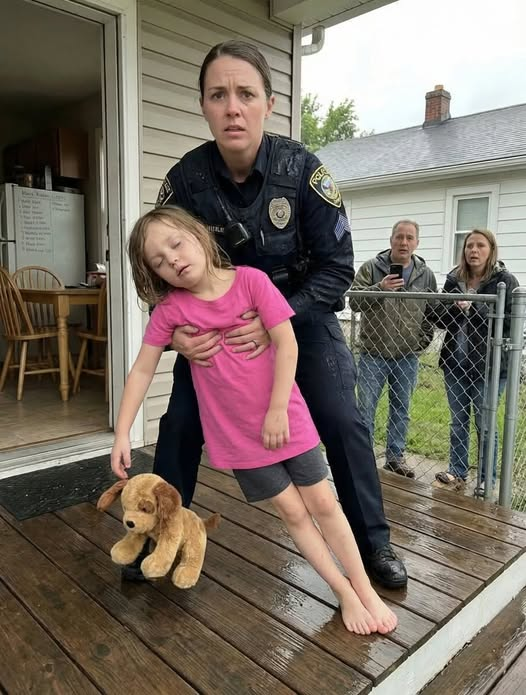
Ashley stood barefoot on the cold floor in one of her father’s oversized T-shirts, clutching a worn stuffed puppy by one ear. Her lips were cracked, her arms looked painfully thin, and her stomach was swollen beneath the cotton.
Natalie felt anger rise in her chest, but she forced it down. Ashley needed steady hands, not another frightened adult.
Inside, the refrigerator held little more than a cloudy container of soup and a bottle of mustard.
On the kitchen table sat a handwritten list:
Rice. Chicken. Electrolyte drinks. Ashley’s medicine.
Beside the phone was another note:
Urgent appointment. Call first thing Monday.
Those were not the words of a man packing to disappear.
By then, neighbors had begun gathering beyond the fence.
One woman folded her arms beneath a raincoat and said, loudly enough for everyone to hear, “I knew Andrew couldn’t handle raising a little girl by himself.”
Another neighbor lifted a phone.
“That poor child. He abandoned her.”
Natalie looked from the urgent note to the child swaying in the doorway.
“Ashley, I’m going to pick you up now.”
Ashley nodded once.
Natalie slid one arm behind her back and the other beneath her knees.
The little girl whispered, “Please don’t leave Buddy.”
“I won’t.”
Natalie had barely lifted her when Ashley’s body went limp.
Her stuffed puppy dropped toward the wet porch boards as Natalie caught her tighter and shouted into her radio.
“Minor unconscious. Possible severe dehydration. Send medical now.”
The neighbors stopped talking.
Natalie pressed two fingers to Ashley’s neck, felt the faint pulse, and pulled the child close beneath her rain jacket.
Then she looked toward the people who had already decided what kind of man Andrew was.
“This does not look like abandonment,” she said. “Something happened to him.”
The ambulance carried Ashley away through the storm while phone videos spread faster than facts.
By midnight, Andrew’s name was attached to words like monster, coward, and deadbeat.
But on the kitchen table, the grocery list remained beside the urgent appointment note, both written in the same careful block letters.
And just before Natalie left the empty house, her radio crackled.
A road crew had found a blue pickup below a washed-out guardrail four miles away.
The driver was nowhere in sight.
Section II: The Judgment of the Court of Public Opinion
By sunrise, the rain had settled into a thick, clinging mist that obscured the pine trees along State Route 9.
The blue 2012 Ford F-150 sat wedged between two limestone boulders at the bottom of a fifty-foot ravine. The driver’s side door was sprung open, its steel frame bent like a broken wing. Mud and crushed ferns covered the windshield, but inside the cab, the driver’s seat was empty. There was no pool of blood on the upholstery, no shattered bone on the pavement—only a single, waterlogged pharmacy bag resting in the passenger footwell, containing a prescription bottle for pediatric antibiotics that had never been opened.
Officer Natalie Hayes stood at the edge of the embankment, her yellow rain slicker gleaming against the drab grey of the morning.
“Any sign of him?” she called down to the rescue crew wading through the swollen creek below.
“Nothing, Officer,” the team lead shouted back, wiping red clay from his visor. “If he went into the river when the flash flood hit on Thursday night, he could be five miles downstream by now. Or he dragged himself out and wandered into the timber. But there’s no body here.”
Natalie’s jaw tightened. She reached into her pocket and pulled out the plastic evidence bag containing the notes she had recovered from the kitchen table.
Andrew Vance was thirty-two years old. A widowed freelance mechanic who had lost his wife, Sarah, to a sudden brain aneurysm three years earlier. According to the town’s social media chatter, Andrew had become increasingly reclusive over the past six months, taking fewer jobs at the local garage, selling off his tools piece by piece, and missing neighborhood association meetings.
To the people of Oak Ridge, the story was simple, neat, and outrageously cruel: a struggling young father, overwhelmed by poverty and the weight of raising a sickly seven-year-old child alone, had cracked under the pressure. He had packed his truck, driven to the state line, staged a wreck during a torrential storm, and fled into the dark to start a new life, leaving his daughter to starve in a cold house.
The viral video recorded by Mrs. Gable—the neighbor across the street—had reached three hundred thousand views by mid-morning. The local news channel was running a live segment from outside St. Jude Children’s Hospital, where Ashley was currently hooked up to intravenous fluids in the pediatric intensive care unit.
“He left her with a cup of spoiled soup,” Mrs. Gable had declared on camera, her voice dripping with self-righteous fury. “I always told my husband there was something off about Andrew Vance. He never smiled. He never brought her to the summer barbecues. A real father doesn’t run when things get tough.”
Natalie stared down at the empty pickup truck, feeling a cold, knotting sensation in her stomach.
She drove directly from the crash site to the hospital.
When she stepped into Room 412, the room was quiet save for the rhythmic, soothing beep of the heart monitor. Ashley looked tiny beneath the heavy white blankets, her pale skin contrasting sharply with the dark purple shadows under her hollow eyes. An IV line was taped securely to the back of her small left hand.
Sitting in a chair beside the bed was Dr. Aris Thorne, a senior pediatric specialist with a quiet, observant demeanor.
“How is she, Doctor?” Natalie asked softly, setting a paper cup of warm tea on the bedside table.
“Severely dehydrated, malnourished, and her blood work shows an elevated white blood cell count indicative of an untreated bacterial infection in her kidneys,” Dr. Thorne replied, his voice heavy. “Another twelve hours without fluid, Officer, and her organs would have begun to shut down entirely. She’s a tough little girl, but she was on the absolute brink.”
At the sound of their voices, Ashley’s eyelashes fluttered open. Her eyes, a striking, deep emerald green, shifted slowly around the room until they found Natalie.
“Natalie?” she whispered, her voice like dry leaves scraping across stone.
“I’m right here, sweetheart,” Natalie said, sitting on the edge of the mattress and gently smoothing the child’s damp bangs away from her forehead. “You’re safe now. The doctors are giving you medicine to make your tummy stop hurting.”
Ashley didn’t ask for food. She didn’t ask for toys. Her small fingers reached out under the sheet, hunting frantically until they brushed against the worn plush ear of her stuffed puppy, Buddy, which Natalie had carefully sanitized and placed beside her pillow.
She clutched the toy to her chest, her small frame trembling.
“Is Daddy in trouble?” Ashley asked, her emerald eyes brimming with big, silent tears. “Did the police arrest him because I cried?”
Natalie felt a sudden, sharp ache in her throat. “No, Ashley. Nobody is arresting your daddy. We’re just trying to find him. Can you tell me what happened on Thursday night before he left?”
Ashley swallowed hard, pressing Buddy against her chin.
“Daddy was sitting on the floor by my bed,” she whispered, her voice dipping into a rhythm that sounded rehearsed, almost like a poem she had been forced to memorize. “He was touching my head with a wet towel because I was burning up. He was crying, but he told me not to be scared.”
“What did he say to you, Ashley?”
Ashley looked up at the ceiling, her small brow furrowing as she tried to recall the exact words.
“He said… ‘Daddy has to go get the special medicine now, Ash. I’m going to make the dark go away.’ Then he kissed my forehead three times. He said… ‘Daddy says it’s love… but it’s love.’“
Natalie frowned, leaning closer. “He said ‘it’s love… but it’s love’?”
“He said it twice,” Ashley insisted, nodding her head weakly. “He always says it when he leaves for work. He says, ‘Daddy loves you, Ash. It’s love… but it’s love.'”
Dr. Thorne glanced at Natalie from across the bed, shaking his head slightly. “Extreme trauma and fever can distort a child’s linguistic memory, Officer. She’s repeating a phrase her father likely used as a comforting cadence.”
Natalie didn’t answer. She pulled out her notebook and wrote the phrase down word for word: Daddy says it’s love… but it’s love.
It made no grammatical sense. It sounded like the nonsensical rambling of a confused child or a father delirious with stress. Yet, as Natalie looked at the conviction in Ashley’s eyes, she knew one thing with absolute certainty: Andrew Vance had not vanished because he stopped loving his daughter.
He had vanished because of something buried within those six words.
Section III: The Paper Trail of a Vanishing Man
By Monday afternoon, the police department was under immense pressure to file formal criminal warrants for Andrew Vance’s arrest on charges of felony child abandonment and severe endangerment.
The mayor had given a press conference praising the quick action of 911 operator Eric and Officer Natalie Hayes, while simultaneously denouncing Andrew as “a disgrace to the values of our community.”
Natalie, however, refused to sign off on the abandonment narrative.
While the search dogs continued to circle the muddy banks of the Blackwood River near the crash site, Natalie obtained a judicial search warrant for Andrew’s rental home. She returned to the dark, silent house alone, determined to reconstruct the last six months of Andrew Vance’s life.
The living room was sparse, almost monastic. There was no television, no expensive electronics, no alcohol bottles in the trash. The furniture was old—a faded plaid sofa, a single floor lamp, and a small wooden desk in the corner.
Natalie sat at the desk and began opening the drawers.
Inside, she found neat, meticulous stacks of paper organized in Manila folders. But as she flipped through the financial records, a terrifying picture began to emerge.
Six months earlier, Andrew had possessed a healthy savings account of thirty-eight thousand dollars—the payout from his late wife’s modest life insurance policy.
Over the past one hundred and eighty days, that balance had been systematically bled dry.
There were cash withdrawals of five hundred dollars, one thousand dollars, sometimes fifteen hundred dollars at a time, executed at obscure ATMs across three different counties.
Even more alarming were the medical receipts tucked into the back of the bottom drawer.
Natalie unfolded a lab report from the University Medical Center dated four months prior. The patient name was not Ashley Vance.
It was Andrew Vance.
Natalie’s breath hitched in her throat as her eyes scanned the clinical diagnosis printed in bold, stark lettering across the top of the page:
ADVANCED HUNTINGTON’S DISEASE – EARLY ONSET / STAGE III.
Characterized by rapid neurological degeneration, severe motor dysfunction, involuntary chorea, cognitive decline, and acute memory fragmentation.
Attached to the diagnosis was a confidential physician’s note written by a neurologist named Dr. Robert Vance—Andrew’s estranged uncle:
Andrew,
The genetic progression is moving far faster than we anticipated. The tremors in your hands and the sudden blackouts you experienced while working at the garage are direct symptoms of the neural decay. You have, at most, three to six months before you lose independent motor control entirely.
You must make legal arrangements for Ashley immediately. You cannot care for a child when you can no longer hold a spoon.
Natalie leaned back in the desk chair, her heart hammering against her ribs like a trapped bird.
Andrew wasn’t a deadbeat father who had grown tired of his responsibilities. Andrew was a dying man whose brain was literally deteriorating inside his skull.
He had hidden his terminal, agonizing illness from his daughter, from his neighbors, and from the town. He had quit his job at the garage not out of laziness, but because his hands could no longer hold a wrench without shaking violently. He had sold his tools to buy private, off-the-book medications to slow down his neurological collapse just long enough to keep his daughter fed.
Then Natalie found the second folder.
It was labeled simply: THE TRUST.
Inside were receipts for wire transfers totaling thirty thousand dollars—the remainder of his entire life savings—sent to an offshore escrow account managed by a private legal firm in Boston.
Attached to the transfer was a handwritten note in Andrew’s shaky, deteriorating handwriting:
To the Trustee:
This fund is reserved exclusively for Ashley Vance upon my legal death or permanent incapacitation. Under no circumstances is this money to be released to state welfare or foster agencies. It is to be transferred directly to her designated legal guardian upon verification of the key.
Natalie turned the page, looking for the name of the designated legal guardian.
The line was blank.
Beside it, Andrew had written in frantic, heavily pressed pencil:
The key is with her. She doesn’t know it yet. It’s love… but it’s love.
Natalie stared at the words written on the paper. The exact same nonsensical phrase Ashley had repeated in her hospital bed.
It wasn’t a baby talk phrase. It wasn’t a hallucination brought on by fever.
It was a code.
Section IV: The Cipher of a Father’s Devotion
Natalie rushed out of the rental house, her siren blaring as she cut through the evening traffic back to St. Jude Children’s Hospital.
When she entered Room 412, Ashley was awake, sitting up in bed, drawing a picture with colored pencils that a pediatric nurse had given her. The picture showed a large blue truck, a house with a green door, and two figures holding hands—a tall man with yellow hair and a small girl holding a brown dog.
“Ashley,” Natalie said gently, closing the door behind her and pulling her chair close to the bed. “I need to talk to you about the special words your daddy said to you.”
Ashley looked up from her drawing, her green eyes wide and clear now that the fever had subsided. “About Buddy?”
“About what he said before he went to get your medicine. ‘It’s love… but it’s love.’“
Ashley set her blue crayon down. She reached out and picked up her plush puppy, Buddy.
“Daddy didn’t say ‘it’s love,’ Natalie,” Ashley said softly, her small voice ringing with absolute, pristine clarity. “He said letters.”
Natalie froze. “Letters?”
“S-P-E-L-L,” Ashley said, sounding out the letters carefully, just as her father had taught her. “Daddy spelled it out for me when we played our quiet game. He said: ‘It’s L-U-V… but it’s L-O-V-E.'”
Natalie felt a sudden, electrical jolt travel down her spine.
She pulled out her notebook and wrote down the letters as Ashley spoke them:
I-T-S-L-U-V-B-U-T-I-T-S-L-O-V-E
It wasn’t a phrase. It was an acronym—or a phonetically constructed cipher.
“Ashley,” Natalie said, her voice trembling slightly with urgency. “Did your daddy ever give you a game with numbers or letters? Did he hide something inside your toys?”
Ashley blinked slowly. She looked down at the plush puppy in her lap.
“Buddy was sick last month,” Ashley whispered. “His tummy had a tear in it from when the neighbor’s dog grabbed him. Daddy said he was going to operate on Buddy and make him super strong.”
Natalie’s hands moved instantly. “May I see Buddy, sweetheart?”
Ashley hesitated for a second, then gently handed the worn plush toy over.
Natalie turned the toy over in her hands. The stitching along the back seam was crude, done with thick, heavy black nylon thread—the kind of industrial thread a mechanic would keep in his toolbox.
Natalie reached into her pocket, pulled out her small pocket knife, and carefully sliced through the black thread.
She reached her fingers deep into the soft polyester stuffing of the plush dog.
Her fingertips brushed against something hard, flat, and metallic.
She pulled it out.
It was a heavy, stainless-steel USB drive, engraved with a single word on its casing:
RESURRECTION.
Taped to the USB drive was a small, laminated card containing a ten-digit banking access code and a signed, notarized legal document:
LAST WILL AND TESTAMENT OF ANDREW VANCE.
In the event of my death or cognitive collapse, full legal guardianship of my daughter, Ashley Vance, and the complete administration of her 1.2-million-dollar trust fund shall be awarded to…
Natalie stared at the name printed on the legal document.
The name was not a stranger’s. It was not a distant relative’s.
It was Dr. Aris Thorne—the very pediatric specialist currently treating Ashley in Room 412.
Section V: The Unraveling of the Miracle
Natalie stood up so fast her chair screeched against the linoleum floor.
At that exact moment, the door to Room 412 opened, and Dr. Aris Thorne stepped into the room holding a medical chart. When his eyes fell on the stainless-steel USB drive and the notarized legal document in Natalie’s hand, he stopped dead in his tracks.
“Officer Hayes…” Dr. Thorne said quietly, his voice dropping into a tone of deep, profound sadness. “You found it.”
“Doctor Thorne,” Natalie said, her hand resting instinctively near her service weapon. “What is this? Why is your name on Andrew Vance’s legal guardianship papers? And where did a freelance mechanic get a 1.2-million-dollar trust fund?”
Dr. Thorne closed the medical chart, walked slowly over to the window, and pulled down the blinds.
“Four years ago,” Dr. Thorne began, his voice rich with an old, heavy grief, “my seven-year-old daughter, Emily, died in this very hospital from a rare, aggressive form of pediatric leukemia. We needed an emergency bone marrow transplant, but her tissue type was so extraordinarily rare that no match existed on the national donor registry.”
Natalie listened, her pulse racing.
“Andrew Vance,” Dr. Thorne continued, looking over at Ashley, “was working as a maintenance contractor in the hospital basement at the time. When he heard about my daughter’s case on the internal bulletin board, he volunteered to be tested. He wasn’t a match for Emily… but he stayed with me in the waiting room the night she passed away. He held my hand while I wept over my daughter’s body. He was the only person in this city who didn’t look at me like a doctor—he looked at me like a grieving father.”
Dr. Thorne wiped a hand over his face.
“Two years later, Andrew came to my private office,” Thorne said softly. “He had just been diagnosed with Huntington’s disease. He knew his body was going to betray him. He knew his mind was going to rot. But even more than his own death, he was terrified of what would happen to Ashley if the state put her into the foster care system.”
“So what did he do?” Natalie whispered.
“He sold the only thing of value he had left in this world,” Dr. Thorne revealed, tears welling in his sharp, intelligent eyes. “His own body.”
Natalie gasped.
“Andrew entered an experimental, highly covert human clinical trial conducted by an international pharmaceutical syndicate in Boston,” Dr. Thorne explained, his voice shaking with awe and horror. “They were developing a radical gene-editing therapy for early-stage Huntington’s. The trial paid a massive, unprecedented cash bounty to terminal patients willing to undergo high-risk, unapproved spinal injections. Andrew knew the injections had an eighty-percent fatality rate. But if he survived the six-month protocol, he would be paid 1.2 million dollars in an offshore trust.”
The room was so quiet you could hear the rain tapping against the window pane outside.
“He took the injections,” Dr. Thorne whispered. “He suffered agonizing, secret pain for six months. He let those researchers inject experimental viral vectors into his spine—all so he could secure a financial empire for his little girl before his brain failed him entirely.”
“And the car crash?” Natalie demanded. “The crash four days ago?!”
Dr. Thorne reached into his white coat pocket and pulled out his personal cell phone. He opened an encrypted messaging app and handed the screen to Natalie.
There was a single text message sent from Andrew Vance’s phone, timestamped Thursday night at 11:12 PM—just twenty minutes before the crash:
Aris,
The seizure hit me while I was driving back with her prescription. I can feel the hemorrhage starting in my brainstem. My hands are locked on the wheel. I’m steering the truck into the ravine so the vehicle doesn’t hit anyone on the main road.
The key is in Buddy’s stomach. The cipher is ‘ITS LUV BUT ITS LOVE.’
Take care of my little girl, Aris. Tell her Daddy made the dark go away.
Natalie buried her face in her hands, a fierce, unstoppable sob tearing through her chest.
Andrew Vance had not abandoned his child. He had suffered a catastrophic, fatal neurological seizure brought on by the experimental trial while driving home with her medicine. In his final seconds of consciousness, realizing he was losing control of his vehicle on a rain-slicked highway, he had intentionally steered his truck off the road into an empty ravine to avoid plowing into oncoming traffic.
He had dragged his broken, dying body out of the wreckage, crawled into the thick brush of the forest so his daughter wouldn’t have to see his crushed corpse on the news, and died alone in the dark under the cold rain, holding his daughter’s name in his heart until his last breath.
Section VI: The Tears of a Neighborhood
By Tuesday morning, the truth broke over the town of Oak Ridge like a blinding, inescapable light.
Police search teams, guided by the final GPS coordinates extracted from Andrew’s phone, recovered his body from a deep pine hollow three hundred yards from the crash site. He was lying beneath a canopy of white wild roses, his hands folded peacefully across his chest, clutching a small, laminated photograph of Ashley and his late wife, Sarah.
The district attorney officially dropped all prospective charges against Andrew Vance, issuing a formal, public apology to his memory.
The viral video that had branded Andrew a “monster” was deleted, replaced by an international news broadcast detailing the unimaginable, heroic sacrifice of a father who had traded his own life and endured human experimentation to save his child from poverty and foster care.
On Wednesday afternoon, a candlelight vigil was held outside the small rental house on Maple Street.
Nearly two hundred people gathered in the soft afternoon light—the very same neighbors who had stood behind the chain-link fence four days earlier, whispering cruel accusations and filming his daughter’s agony.
Mrs. Gable stood near the front porch, holding a bouquet of white lilies, her head bowed in profound, crushing shame. Tears ran freely down her face as she laid the flowers beside the front door.
“We didn’t know,” she wept to a local news reporter, her voice shaking with remorse. “We judged him because he kept to himself… because he didn’t ask for help. We thought he was weak. God forgive us… he was the strongest man among us.“
The entire neighborhood stood in silence, weeping under the gray sky, leaving hundreds of stuffed animals, candles, and flowers on the porch where a hero had once walked.
Section VII: The Sanctuary of Tomorrow
One month later.
The summer sun washed over the rolling, green hills of a quiet farm three miles outside of town.
The house was a beautiful, two-story craftsman home surrounded by tall oak trees, a wide wrap-around porch, and a barn filled with horses.
Dr. Aris Thorne sat on a wooden bench on the porch, watching seven-year-old Ashley running across the sunlit lawn. She wore a bright yellow sundress, her green eyes shining with a vibrant, healthy light, her laughter ringing out across the quiet valley as she chased a golden retriever puppy through the grass.
The court had formally approved Dr. Thorne’s legal guardianship of Ashley Vance. With the 1.2-million-dollar trust fund secured, Ashley was protected for the rest of her life—her education, her medical care, and her future guaranteed beyond any shadow of a doubt.
Officer Natalie Hayes walked up the wooden porch steps, carrying a small, beautifully framed photograph.
“How is she doing today, Aris?” Natalie asked softly, sitting on the bench beside him.
“She has good days and hard days,” Dr. Thorne replied, a gentle, paternal smile touching his face. “Every night before she goes to sleep, we sit together and talk about her father. She knows everything now. She knows he went away to make sure she would always be safe.”
Ashley saw Natalie and came running up the steps, her cheeks rosy, her small hands holding her plush puppy, Buddy.
“Natalie!” Ashley cheered, throwing her arms around the officer’s waist in a tight, affectionate hug.
“Hey, beautiful girl,” Natalie smiled, kneeling down and kissing Ashley’s forehead. She handed her the framed photograph.
Ashley looked down at the frame.
It was a restored, high-resolution photograph of her father, Andrew, standing in the doorway of their old rental house, smiling warmly, holding a young Ashley on his shoulders under a bright blue sky.
“We put it right beside your bed,” Natalie said gently.
Ashley touched her father’s face through the glass, her small thumb tracing his gentle smile. She didn’t cry. Instead, a deep, beautiful, knowing peace illuminated her eyes.
She clutched Buddy to her chest, looked up at the wide, endless blue sky above the farm, and whispered the words her father had carved into her heart forever:
“Daddy loves me. It’s L-U-V… but it’s L-O-V-E.”
Dr. Thorne wrapped his arm around her shoulders, pulling her close into the warm embrace of a new family—a family forged through tragedy, bound by sacrifice, and redeemed by an absolute, unyielding love that even death could never destroy.
