Section I: The Wall of Silence
I’m 29 years old.
I’m unmarried.
I don’t have a spouse, a huge house, or piles of money in the bank.
What I do have is five scared children sitting a few feet away from me.
The oldest is just six.
The youngest recently turned one.
Right now, they’re pressed together on a stiff bench outside a family courtroom, clinging to one another as if letting go would mean losing everything they still have.
In under an hour, a judge could approve an order sending each of them to a separate foster home.
The documents call it “separate placement.”
To me…
it’s the instant a family stops being a family.
Just three weeks ago, these children lost everything they had ever known.
I’d never seen them before.
But the second I saw their picture on an emergency foster placement notice, I couldn’t stop thinking about them.
I called social services immediately.
Their response was blunt.
“Mr. Carter, you’re a single man. Taking in five children under seven isn’t realistic.”
They had already found homes for them.
Four separate homes.
In different towns.
The idea of those small children being taken away in separate cars, crying for one another, was something I couldn’t push from my mind.
So I made the largest decision of my life.
I drained my savings account.
Purchased five child car seats.
Converted my workshop into a shared bedroom with bunk beds.
And used the rest of my money hiring a family solicitor.
Now I’m standing before Judge Miller.
The state’s lawyer is doing everything he can to persuade the court I’m entirely unprepared.
He describes me as impulsive.
Naive.
A young man with no understanding how difficult raising five children will be.
“He works long hours as a self-employed carpenter, Your Honor,” the state’s attorney, Mr. Harrison, declared, gesturing toward me with a gold pen. “His income fluctuates wildly. He has no parenting experience, no partner to assist him, and his residence—until three weeks ago—was a commercial carpentry shop with an attached studio flat.”
Judge Miller leaned forward over his elevated bench, his thick gray eyebrows pulling together into a sharp line. He peered down at me through half-moon spectacles.
“Mr. Carter,” Judge Miller spoke, his voice echoing off the high wood-paneled walls of Courtroom 3B. “Five children under the age of seven is a monumental responsibility for a two-parent household with substantial financial means. For a single twenty-nine-year-old man, it borders on the impossible. Why are you putting yourself through this?”
I swallowed past the lump in my dry throat. My solicitor, Mr. Vance, nudged my arm gently, encouraging me to speak.
“Because if I don’t, Your Honor,” I said, my voice steady despite the adrenaline surging through my veins, “their memories of each other will fade before they’re old enough to understand why they were torn apart.”
In the second row of the gallery sat the five children. Six-year-old Leo, his knuckles white as he held the hands of his four-year-old twin sisters, Maya and Chloe. Two-year-old Noah sat quietly in a stroller beside them, while one-year-old baby Lily slept in a portable bassinet tucked near the aisle.
Their parents had been taken in a tragic highway accident three weeks ago. No surviving extended family had come forward. To the state, they were five file folders needing placement. To me, they were a fragile circle of warmth that was about to be shattered forever.
Mr. Harrison snorted softly. “Sentimentality does not pay for formula, diapers, school supplies, or pediatric care, Your Honor. We have four vetted, licensed foster homes ready to take these children today. Splitting them is unfortunate, but it is standard procedure when a single family unit cannot accommodate five siblings simultaneously.”
“Mr. Carter,” Judge Miller said, his tone softening slightly, yet remaining stern. “The state raises a valid point. Compassion is noble, but the law requires stability, capability, and a clear rationale. You are not a relative. You are not a registered foster parent. Why would a young, unmarried craftsman sacrifice his youth, his savings, and his freedom for five complete strangers?”
The courtroom went quiet. The clock on the back wall ticked rhythmically.
I looked down at my hands—calloused, stained with mahogany varnish, and scarred from years of manual labor. Then I looked back up at the judge.
“Because they aren’t strangers, Your Honor,” I whispered. “And I’ve been keeping a promise to their father for twenty years.”
Section II: The Memory of a Wooden Toy
A sudden, sharp ripple of whispers swept through the spectators. Mr. Harrison froze, his gold pen hovering over his legal pad. My solicitor turned to look at me in genuine surprise—I hadn’t told even him the full truth of why I had hired him.
Judge Miller sat up straighter, his sharp eyes locking onto mine. “Explain yourself, Mr. Carter. Are you claiming a prior relationship with the deceased parents?”
“Not with the mother, sir,” I began, stepping slightly forward from behind the defense table. “And I hadn’t seen their father, David Miller—no relation to you, sir—in nearly fifteen years. But twenty years ago, when I was nine years old, I lived in a damp, decaying house on the east side of this very city.”
I paused, feeling the cold ghost of my own childhood touch my spine.
“My father was a violent alcoholic,” I continued quietly, every word cutting through the silent room like a knife. “He spent every penny we had on booze. My mother worked double shifts at a laundromat just to pay rent, leaving me alone most evenings. I was small, malnourished, and terrified of my own home.”
In the gallery, young Leo leaned forward, his small six-year-old eyes wide as he listened to my voice.
“There was an older boy in our neighborhood,” I said. “He was fourteen. His name was David. Every afternoon after school, while other kids were playing sports, David would sit on his front porch working with scrap wood he found behind construction sites. He didn’t have much, but he had a set of hand chisels his grandfather had given him.”
I reached into the inner pocket of my worn suit jacket. I pulled out a small object and placed it gently onto the wooden surface of the podium.
It was a small, hand-carved wooden robin, polished to a dull shine by years of touch, though one of its wings was slightly chipped.
“One freezing evening in November,” I whispered, “my father locked me out of the house in my socks because I accidentally spilled a glass of water. I sat under the porch stairs, shaking from the cold, crying so hard I couldn’t breathe.”
The courtroom was so quiet you could hear the soft, rhythmic breathing of baby Lily asleep in her bassinet.
“David saw me from his window,” I continued, feeling a tear track down my cheek without my permission. “He came outside, took off his winter jacket, and wrapped it around my shoulders. He sat with me under those dark stairs for three hours until my mother came home from work. And while we sat there in the freezing cold… he pulled this wooden bird out of his pocket and placed it in my hands.”
I looked at the judge.
“David told me, ‘As long as you hold onto this, Lucas, you’re never alone. Somebody’s always watching out for you.’ For five years, David was my protector. He taught me how to use a carving knife. He taught me that real men build things—they don’t tear them down. He gave me the trade that keeps a roof over my head today.”
Judge Miller adjusted his spectacles, his hand visibly motionless over his notepad.
“When I was fourteen, my mother saved enough money for us to move across the state to escape my father,” I said softly. “I lost touch with David. But I never forgot his face, his voice, or what he did for a terrified, helpless child.”
I pointed toward the five children sitting in the gallery.
“Three weeks ago, when I saw that emergency placement notice on the community board,” I said, my voice rising with a raw, undeniable power, “I saw the name: David Miller’s children. I saw the picture of five little souls about to be scattered like autumn leaves. David spent his youth protecting a child who wasn’t his. How could I call myself a man if I let his own children be torn apart?”
Section III: The Weight of the Ledger
Mr. Harrison, the state’s attorney, cleared his throat awkwardly. He looked down at his papers, his previous aggressive confidence visibly shaken. Yet, he braced himself against the podium.
“Your Honor,” Harrison began, though his tone was significantly less harsh now, “while Mr. Carter’s personal history is tragic and his gratitude is commendable, gratitude cannot replace a structured, state-approved family environment. We are talking about five children under seven. The sheer cost of food, clothing, medical insurance, and future education—”
“Mr. Harrison,” Judge Miller interrupted, raising a single finger to silence him. The judge looked at me. “Mr. Carter, what is your current bank balance?”
“As of this morning, sir,” I answered honestly, “I have eight hundred and forty-two dollars in my checking account.”
A soft gasp echoed through the gallery. Several social workers shook their heads sadly.
“And your carpentry business?” Judge Miller pressed. “How many employees do you have?”
“Just me, Your Honor,” I replied. “I build custom furniture, cabinets, and restore architectural woodwork. On average, I make about forty-five thousand dollars a year.”
“Forty-five thousand dollars,” Judge Miller repeated, writing the number down. “Mr. Carter, that is barely enough to support two people in this county, let alone six. How do you intend to feed five growing children, buy five sets of clothes, pay for childcare while you work, and cover healthcare costs?”
I took a deep breath. This was the wall I knew I had to climb.
“I’ve spent the last three weeks preparing, Your Honor,” I said, pulling a blue folder from my solicitor’s briefcase. “I have converted my workshop’s lumber storage room into a five-bed dormitory room with hand-built oak bunk beds—each fitted with safety railings and new mattresses. I built a private outdoor play area behind the shop with a wooden swing set and sandbox.”
I placed a stack of notarized documents onto the clerk’s desk.
“I have arranged a flexible work schedule,” I continued. “Three local master craftsmen—retired furniture makers who live in my neighborhood—have volunteered to supervise my shop four hours a day so I can be home when the children wake up and when they sleep. The local parish daycare has offered full tuition waivers for the three youngest children until they reach school age.”
Judge Miller flipped through the notarized letters, his eyebrows raising slightly at the signatures of the community members, business owners, and local tradesmen who had signed affidavits of support.
“That is impressive community backing, Mr. Carter,” Judge Miller said softly. “But volunteer help is temporary. Financial reality is permanent.”
“I know, Your Honor,” I admitted, looking down. “I know eight hundred dollars sounds impossible. But I have no debt. I own my building outright—my mother left it to me when she passed away two years ago. I don’t pay rent or a mortgage. Every dollar I earn goes directly to living expenses.”
I stepped away from the podium and turned to face the five children.
Six-year-old Leo was watching me intently. He had wrapped his arms tightly around his four-year-old sisters, Chloe and Maya. Their little eyes were wide, filled with a quiet, terrifying awareness that their destiny was being decided in this room.
“If you split them today, Your Honor,” I said, turning back to the judge, “Leo will go to a home in Springfield. The twins will go to a foster family in Oakridge. Noah and Lily will go to a couple in the south of the county. They will grow up as strangers. They will forget the sound of their mother’s lullabies, and they will forget the sound of their father’s voice.”
I placed both hands flat on the wooden rail dividing the courtroom.
“I might not have a huge house, sir. I might not have a mountain of gold. But I have two hands, a clean home, an open heart, and a promise I intend to keep until my last breath. Give me six months. Give me a temporary guardianship order. If I fail to provide for them, if I fall short by a single meal or a single smile… take them. But give these children a chance to stay together.”
Section IV: The Voice of a Child
The silence in Courtroom 3B was absolute.
For nearly two full minutes, no one moved. The court reporter’s fingers rested motionless on her keys. Mr. Harrison stared at his leather shoes, unable to offer another legal rebuttal. My solicitor, Mr. Vance, wiped his brow with a handkerchief, watching the bench anxiously.
Judge Miller slowly removed his glasses and set them on his desk. He rubbed the bridge of his nose, leaning back in his tall leather armchair.
“This court has seen thousands of cases,” Judge Miller spoke, his deep voice carrying a solemn weight. “I have seen wealthy couples with mansions fight over custody as if children were property. I have seen parents abandon their blood for comfort. Rarely do I see a man stand before me willing to drown his own youth to save a dead friend’s legacy.”
He looked toward the gallery.
“Mr. Harrison, does the state have any evidence of physical danger, moral failing, or criminal record regarding Mr. Lucas Carter?”
Harrison hesitated, checking his tablet quickly. “No, Your Honor. Background checks are clean. No criminal history, no history of substance abuse, clean financial record despite low liquidity.”
“And the home inspection report?” the judge asked.
The social worker sitting beside Harrison stood up reluctantly. “Your Honor… I inspected Mr. Carter’s converted shop five days ago. Mechanically and structurally, it is sound. The living spaces are immaculate. The bunk beds are… extraordinarily well-crafted. However, we flagged it due to the lack of a traditional maternal figure and financial fragility.”
Judge Miller nodded slowly. He looked back at me.
“Mr. Carter,” the judge said, “a heart full of love does not automatically make a home fit for five children. But a system that breaks siblings apart without exploring every viable alternative is a system that has failed its humanity.”
He picked up his wooden gavel. My heart hammered against my ribs so violently I thought it would burst.
Suddenly, a small voice broke through the tension of the room.
“Excuse me, mister judge?”
Everyone turned.
Six-year-old Leo had slid off the high wooden bench in the gallery. He was standing in the center aisle, clutching a small, battered blue sketchbook in his hands. His knees were trembling, but his posture was straight.
The social worker tried to gently guide him back down. “Leo, honey, sit back down—”
“Let him speak,” Judge Miller commanded softly, gesturing to the bailiff to stand down.
Leo took three brave steps forward, his small shoes squeaking on the polished floor. He looked up at the high judge’s bench, then looked at me.
“Lucas has the bird,” Leo whispered, his voice trembling.
Judge Miller leaned over his bench, looking down at the little boy with profound gentleness. “What did you say, son?”
Leo pointed a small, thin finger at the podium where my hand-carved wooden robin lay.
“My daddy had a drawing in his old book,” Leo said, his eyes filling with big, silent tears. “He drew a picture of a little boy and a wooden bird. He told me… he told me if anything ever happened to him, a man named Lucas would come for us. Because Lucas was the bravest boy Daddy ever knew.”
Leo opened his blue sketchbook. He held up a yellowed, folded piece of paper that had been tucked inside the cover.
My breath caught in my throat. I couldn’t move.
The social worker took the paper from Leo’s hands and carried it up to the bench. Judge Miller unfolded it carefully.
It was a page torn from an old notebook, dated ten years ago. Written in David’s heavy, familiar handwriting was a single short paragraph:
“If my life ever cuts short, and my children are left alone in this cold world, find Lucas Carter. He holds the carved robin I gave him under the stairs. He was just a boy, but he had the heart of a giant. He will not let my blood be scattered.”
Judge Miller read the note once. He read it a second time.
When he looked up, the veteran judge’s eyes were glistening with unshed tears.
He looked at the state’s attorney. “Do you have any further objections, Mr. Harrison?”
Harrison looked at the note, looked at the five tiny children huddled together in the gallery, and slowly shook his head. “The state withdraws its motion for separate placement, Your Honor.”
Section V: The Judgment of Grace
Judge Miller picked up his pen and signed the thick document before him with rapid, firm strokes.
BANG.
The sound of the gavel striking the wooden block echoed through the room like a thunderclap of freedom.
“It is the order of this court,” Judge Miller declared, his voice ringing with absolute certainty, “that temporary full legal and physical guardianship of Leo, Maya, Chloe, Noah, and Lily Miller be awarded immediately to Mr. Lucas Carter.”
The courtroom erupted into quiet gasps and frantic scribbling from the press observers at the back. My solicitor slapped my shoulder with a broad, beaming smile.
I fell forward onto the podium, burying my face in my hands, sobbing tears of pure, overwhelming relief.
“Mr. Carter,” Judge Miller spoke, calling me back to attention.
I wiped my eyes and looked up at the bench.
“You will be subject to monthly social services check-ins,” the judge continued, smiling warmly for the first time all morning. “And a full financial review will take place in six months. But I have a feeling, young man, that you are going to prove every skeptic in this city wrong.”
“Thank you, Your Honor,” I choked out, my voice cracking. “Thank you.”
“Court is adjourned.”
As the judge stepped down from the bench, I turned toward the gallery.
Leo didn’t wait. He ran down the aisle, throwing his small arms around my waist, burying his face into my coat. The four-year-old twins, Maya and Chloe, followed right behind him, wrapping their arms around my legs.
I dropped to my knees on the hardwood floor, gathering all three of them into a tight, protective embrace.
“We’re going home,” I whispered into Leo’s hair, holding them as if I would never let go. “We’re going home, and nobody is ever going to split you up again.”
Section VI: The Miracle of the Workshop
Six months passed like a whirlwind of flour, sawdust, bedtime stories, and endless laughter.
My quiet, cavernous carpentry shop was no longer just a place of work—it had become a vibrant, chaotic sanctuary of life. The high ceilings echoed with the sound of children’s laughter. The long oak workbench now served double duty as a dining table where five little mouths were fed three hot meals a day.
It wasn’t easy.
There were nights when I slept for only three hours, balancing custom cabinet orders with soothing baby Lily’s teething cries or comforting Noah through nightmares. There were days when my back silver-ached from carrying two toddlers while planing mahogany planks.
But the community had rallied behind us in ways I could never have anticipated.
The retired craftsmen from my neighborhood didn’t just supervise the shop—they became surrogate grandfathers, teaching Leo how to sand pine blocks and helping the twins paint wooden toys. Local businesses left boxes of clothes and non-perishable food on our doorstep.
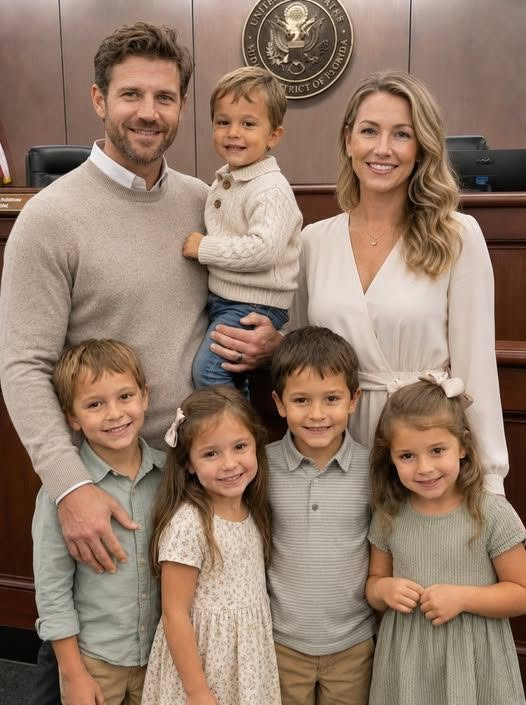
Yet, as the six-month final review hearing approached, a heavy cloud of financial dread hung over my head.
Despite working eighteen-hour days, my checking account sat at just under two thousand dollars.
The state’s financial threshold for permanent adoption required proof of stable long-term capital or an income stream capable of supporting a family of six long-term. Forty-five thousand dollars a year was barely squeaking by. I knew Mr. Harrison and the review board would be forced to question my long-term sustainability.
On the eve of the final hearing, I sat at my drafting table late at night, staring at a mountain of unpaid utility bills, pediatric invoices, and material receipts.
The children were fast asleep in their oak bunk beds upstairs.
I held the small, chipped wooden robin in my palm, rubbing the smooth mahogany wing.
“I’m trying, David,” I whispered into the dark, silent shop. “I’m giving them everything I have. But I don’t know if it’s enough for the law.”
The next morning, I dressed the five children in their finest clothes. We drove to the county courthouse in my battered white van, equipped with five pristine, state-approved child car seats.
When we stepped into Courtroom 3B, the atmosphere felt entirely different.
Judge Miller sat at the bench, looking down at us with his familiar, sharp gaze. Mr. Harrison sat at the state’s table, alongside the chief social worker, Sarah Jenkins.
I took my place at the podium, holding Leo’s hand, while the four younger siblings sat quietly in the front row under the supervision of my solicitor.
“Good morning, Mr. Carter,” Judge Miller spoke, his voice grave. “We are here today for the six-month evaluation to determine if temporary guardianship should be converted into permanent legal adoption.”
“Good morning, Your Honor,” I said, bracing myself.
Judge Miller looked at Ms. Jenkins. “Ms. Jenkins, present the state’s report.”
Ms. Jenkins stood up, holding a thick Manila folder.
“Your Honor,” she began, her voice steady, “over the past six months, social services has conducted unannounced bi-weekly home visits. We have evaluated the children’s physical health, emotional stability, educational progress, and living conditions.”
I held my breath, my knuckles turning white around Leo’s small hand.
“The results,” Ms. Jenkins said, a sudden, wide smile breaking across her face, “are extraordinary. All five children have shown remarkable emotional recovery. Their medical checks are perfect. Leo is at the top of his primary school class. The home is clean, safe, and filled with exceptional love and structure.”
A quiet wave of relief washed over me, but Ms. Jenkins turned a page in her file, her smile dimming slightly.
“However,” she continued, “financial solvency remains a major concern. Mr. Carter’s liquid reserves are below three thousand dollars. His projected annual income remains at forty-five thousand dollars. To approve a permanent five-child adoption, state guidelines require a minimum household stability cushion of at least one hundred thousand dollars in reserve or liquid equity.”
My heart sank into my stomach. It was exactly what I had feared.
“Mr. Harrison,” Judge Miller asked, turning to the prosecutor. “Does the state recommend an extension of temporary guardianship?”
Harrison stood up. But instead of reading from his legal pad, he looked at me, then looked toward the back of the gallery.
“Your Honor,” Harrison said, his voice surprisingly rich with emotion, “the state was prepared to request a six-month extension. However… an unexpected development occurred late yesterday afternoon regarding the estate of the children’s late father, David Miller.”
I frowned, bewildered. “David’s estate? David didn’t have an estate. He worked as a structural welder. He lived in a rented apartment.”
A man in an expensive navy suit stood up from the back row of the gallery and walked down the center aisle toward the podium. He carried a leather briefcase bearing the gold emblem of a major international law firm.
“May I address the court, Your Honor?” the attorney asked politely.
Judge Miller nodded. “State your name and representation for the record.”
“My name is Richard Sterling, senior partner at Sterling, Vance & Associates,” the attorney announced. “I represent the global intellectual property trust of the late David Miller.”
The entire courtroom went dead silent.
I stared at the attorney as if he were speaking a foreign language. “Intellectual property trust? What are you talking about?”
Mr. Sterling pulled a thick stack of certified legal documents from his briefcase and placed them on the clerk’s desk.
“Fifteen years ago,” Sterling explained, turning to face me and the judge, “when David Miller was working as a structural welder on high-rise commercial buildings, he noticed a critical flaw in traditional seismic steel joints used in earthquake-prone architecture.”
My mind raced back to memories of David sitting on his front porch, constantly sketching complex geometric patterns in his notebooks while carving wooden toys.
“David designed and patented a revolutionary, self-damping structural steel coupler,” Sterling revealed, his voice echoing through the silent room. “Because he lacked the capital to commercialize it, he licensed the patent to an international engineering conglomerate on a twenty-year deferred-royalty structure.”
Judge Miller’s eyes widened behind his glasses. “Deferred royalties?”
“Yes, Your Honor,” Sterling smiled broadly. “The twenty-year deferral period ended exactly three weeks ago. Two days ago, our firm finalized the global auditing of the patent’s usage across four hundred international skyscraper projects over the last decade.”
Sterling pulled a certified bank document from his pocket and held it up for the judge to see.
“The patent royalties belonging exclusively to the heirs of David Miller—currently held in an irrevocable family trust managed by their legal guardian—amount to a cleared balance of twenty-four million, eight hundred thousand dollars.”
Section VII: The Legacy of Love
A collective gasp exploded across the courtroom.
My solicitor dropped his pen. The court reporter gasped, covering her mouth. I stood completely frozen, staring at Mr. Sterling as if the world had suddenly ceased to make sense.
Twenty-four million dollars.
“Furthermore,” Mr. Sterling continued, turning his warm gaze toward me, “David Miller’s final trust codicil, executed eight years ago shortly after the birth of his first child, contained an explicit instruction.”
Sterling opened a small leather folder and read the text aloud:
“In the event of my passing, the entirety of my patent trust shall be placed under the sole, unrestricted management of Lucas Carter—the boy who kept my wooden robin. A monthly management stipend of fifteen thousand dollars shall be drawn directly from the trust interest to compensate Lucas for his time, care, and dedication to my family.”
Tears burst from my eyes before I could stop them.
David hadn’t just given me a wooden bird twenty years ago under those freezing stairs. He had watched me grow from afar. He had known my heart, he had trusted my character, and he had quietly built a fortune that would ensure I never had to worry about feeding his children ever again.
Judge Miller looked down at the certified bank papers, then at the social services report, and finally at me.
The veteran judge slowly closed his folder. A brilliant, joy-filled smile spread across his face.
“Well, Mr. Harrison,” Judge Miller chuckled, his voice thick with emotion, “it appears the financial solvency requirement has been… adequately satisfied.”
Mr. Harrison laughed out loud, throwing his hands up in defeat. “The state wholeheartedly agrees, Your Honor! We urge the court to issue a permanent decree immediately!”
Judge Miller raised his wooden gavel one final time.
“By the authority vested in me by the State,” Judge Miller proclaimed, his voice booming with absolute majesty, “I hereby order that Leo, Maya, Chloe, Noah, and Lily Miller are officially, permanently, and legally adopted by Mr. Lucas Carter!”
BANG!
The room erupted into wild, deafening applause.
The social workers were crying. Mr. Harrison was cheering. My solicitor hugged Mr. Sterling, while the spectators in the gallery stood to give a roaring ovation.
I collapsed to my knees right there at the podium.
Leo threw his arms around my neck, crying tears of pure, ecstatic joy. “We’re your kids now, Lucas! We’re your real kids!”
Maya, Chloe, and little Noah piled onto me on the floor, while Ms. Jenkins gently carried baby Lily over and placed her into my arms. I pulled all five of them into my chest, burying my face in their hugs, weeping unashamedly in front of the entire court.
Section VIII: The House Built on Love
Five years later.
The morning sun cast long, golden beams across the rolling green hills of our thirty-acre farm on the outskirts of the city.
Where a dilapidated old barn once stood, there now rose a magnificent, custom-built timber-frame home—designed, crafted, and raised by my own hands, with a little help from five enthusiastic assistants.
The air was filled with the sweet scent of pine, fresh-cut grass, and hot pancakes floating from the wide open kitchen windows.
Eleven-year-old Leo sat at the head of a massive, hand-carved oak dining table that stretched across the sunlit porch. Beside him, nine-year-old twins Maya and Chloe were busily setting down plates, while seven-year-old Noah was helping six-year-old Lily tie her shoes.
I walked out onto the porch carrying a large wooden tray of fresh fruit and warm syrup.
I was thirty-four years old now. My hands were still calloused, my hair had a few silver strands at the temples, but my heart had never been fuller.
We hadn’t moved to some secluded luxury mansion in Europe or bought fleets of sports cars with David’s royalties. The vast majority of the trust was locked safely away in educational funds for the children’s futures, while another portion was used to found The Robin Foundation—a charity that funded legal aid and financial assistance to help keep sibling groups together in the foster care system across the country.
“Dad! Look!” Leo called out, holding up a sleek new wooden carving he had been working on for two weeks.
I set the tray down on the table and leaned over his shoulder to inspect it.
It was a hand-carved wooden nest, beautifully detailed, holding five small wooden birds tucked safely under the wings of a larger, strong wooden robin.
“It’s us,” Leo said proudly, his dark eyes shining with deep love and gratitude. “That’s you, Dad. Protecting all of us.”
I reached into my pocket and pulled out the old, chipped wooden bird David had given me twenty-five years ago on a freezing night under dark stairs. I set it gently right beside Leo’s new carving in the center of the oak table.
The little robin wasn’t just a toy anymore. It was a bridge across time. A promise kept. A testament to the fact that love is not defined by blood, but by the hands that build a sanctuary when the world falls apart.
I looked around the table at my five healthy, laughing, beautiful children.
They were safe. They were together. And they were home.
“Alright, team,” I smiled, pulling out my chair at the head of the table as the morning sun warmed our faces. “Eat up. We’ve got a swing set to build today.”
