Principal Halloway stared at my phone for several long seconds.
Then he laughed.
Not because anything was funny.
Because he still believed power belonged only to people like him.
“The Army?” he scoffed.
“This is a private school, Mr. Carter.”
“You’re in the wrong chain of command.”
Mrs. Gable folded her arms tighter.
“Call whoever you want.”
“No one is going to destroy a hundred-year-old school because one little girl couldn’t handle discipline.”
My daughter tightened her grip around my hand.
I felt her trembling.
I knelt beside her.
“You did nothing wrong.”
She searched my face.
“Are they going to make me leave?”
“No.”
“Look at me.”
She raised tear-filled eyes.
“I promise you…”
“…no one will ever lock you in a room again.”
I stood.
Without another word, I pressed a single button on my phone.
The recording began playing through the office speaker.
Mrs. Gable’s own voice filled the room.
“This is how I deal with students like her.”
Then the principal’s voice.
“If that video ever leaves your phone, your daughter will be expelled.”
Another pause.
“We’ll make sure no respected private school accepts her.”
The room became painfully quiet.
Neither of them had realized I never stopped recording.
Principal Halloway lunged toward the phone.
“Turn that off!”
I stepped back.
“No.”
His face reddened.
“You recorded us without permission.”
“I documented threats against a child.”
“That’s different.”
“No,” I replied calmly.
“It isn’t.”
Before he could answer, my phone rang.
Colonel James Whitaker.
Chief Counsel for Army Legal Command.
I answered immediately.
“Colonel.”
“General Carter,” he replied.
“I received your emergency message.”
General.
The word echoed through the office.
Mrs. Gable blinked.
Principal Halloway froze.
Neither of them spoke.
Whitaker continued.
“I’ve already contacted civilian counsel.”
“The Inspector General has also been notified because your daughter was targeted while you were deployed under federal orders earlier this year.”
“I understand.”
“Is the child safe?”
“Yes.”
“For now.”
“Good.”
“Do not discuss anything further with school staff.”
“Our attorneys are on the way.”
The call ended.
Nobody in the office moved.
Mrs. Gable looked from me to the principal.
“General?”
She almost whispered it.
Principal Halloway swallowed hard.
“You…”
“You’re…”
“I told you,” I answered quietly.
“My daughter deserves justice because she’s a child.”
“Not because of my rank.”
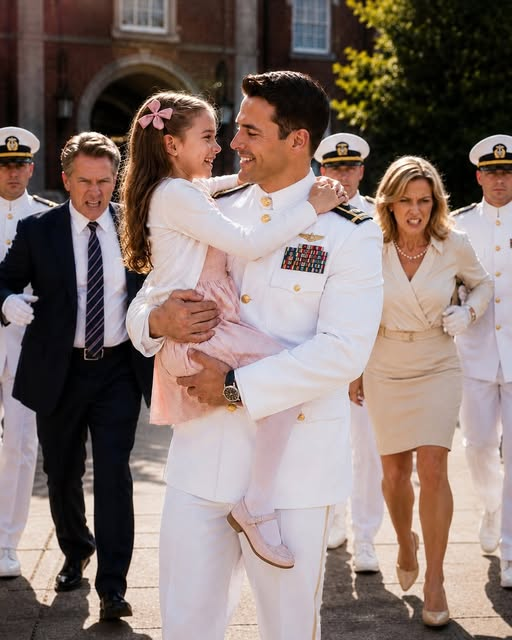
He attempted a weak smile.
“Perhaps…”
“…we’ve all become emotional today.”
I looked at him without expression.
“Five minutes ago…”
“…you threatened to destroy an eight-year-old girl’s future.”
“Now you want to negotiate.”
His shoulders slumped.
A loud knock interrupted the silence.
The office secretary opened the door, visibly shaken.
“Sir…”
“There are police officers here.”
“And…”
She looked directly at me.
“…three attorneys from the Army.”
Principal Halloway’s face turned completely white.
Before anyone could speak again, a fourth person stepped through the doorway.
An elderly woman in a navy blazer.
Silver hair.
Calm eyes.
She carried an identification badge from the State Department of Education.
She looked first at my daughter.
Then at the locked storage-room key still lying on the principal’s desk.
Finally, she turned toward Halloway.
Her voice remained perfectly calm.
“Principal Halloway…”
“…before anyone says another word…”
“…I’d like to know why an eight-year-old child was locked inside a storage room without adult supervision.”
No one answered.
Because for the first time that afternoon…
…the people who believed they controlled the story were no longer the ones asking the questions.
