Chapter 1: The Shirt They Thought Would Prove Their Case
The family courtroom in Knoxville, Tennessee, felt even colder than the January morning outside.
I sat at a small wooden table with my eight-year-old son, Nolan, beside me. His feet couldn’t quite touch the floor, so they gently swung beneath his chair whenever he became anxious.
That morning, I had dressed him in his cleanest pair of jeans, a navy-blue shirt with a tiny embroidered moon above the pocket, and the winter shoes I had carefully cleaned with a damp kitchen cloth.
The shirt wasn’t brand new.
Its collar had become soft after many trips through the washing machine, and a faint mark remained near the bottom. I had tried more than once to make it disappear, but some marks simply become part of a favorite piece of clothing.
Across the courtroom sat my former husband, Grant Bellamy, beside his attorney.
Grant wore a tailored charcoal suit, polished leather shoes, and the same silver watch he had bought not long after telling me he needed more time before sending financial support for Nolan.
He looked confident.
Successful.
Prepared.
I wore a cream-colored blazer I had purchased secondhand over a simple black dress.
I couldn’t afford an attorney.
Instead, I carried a worn folder filled with school records, medical appointment summaries, rent receipts, work schedules, and messages showing how many promises Grant had quietly failed to keep.
His attorney, Preston Carroway, stood and addressed the judge.
“Your Honor, today’s hearing isn’t about whether Mrs. Bellamy loves her son,” he said calmly. “The question is whether love alone can provide the stable environment every child deserves.”
My fingers tightened around the edge of the table.
Judge Harlan looked over his glasses.
“Go ahead, Mr. Carroway.”
The attorney raised a printed photograph.
It showed Nolan leaving school just three days earlier.
He was wearing the same navy-blue shirt.
“This photograph illustrates our concern,” Carroway continued. “The child is repeatedly seen wearing noticeably worn clothing. His mother works inconsistent hours, lives in a modest apartment, and relies heavily on an older family member for childcare.”
Beside me, Nolan’s feet stopped moving.
The attorney pointed toward the faint mark near the bottom of my son’s shirt.
“She cannot even provide consistently well-presented clothing for her child.”
Several people in the courtroom quietly turned to look at us.
Nolan lowered his eyes to his shirt.
In that moment, I understood this hearing wasn’t simply about parenting time.
Grant wanted everyone to believe that having fewer resources somehow meant loving our son less.
Chapter 2: The Story Behind That Photograph
Grant walked away from our marriage two years earlier.
He packed his clothes, his expensive coffee machine, the television from our bedroom, and nearly everything he considered valuable before moving into a newer townhouse across the city.
He told me we could settle financial matters ourselves.
“We’re adults, Audrey,” he had said. “There’s no reason to make this more complicated than it needs to be.”
Within three months, most of my messages went unanswered.
Not long afterward, my mother, Ruth, moved into our apartment.
She arrived carrying one suitcase, her slow cooker, and enough determination to support all three of us.
She never asked if I wanted help.
She simply began helping.
“You’ll have time to heal later,” she told me on her first evening there. “Right now, Nolan needs dinner, and you need rest.”
Our apartment sat above a neighborhood bakery beside a small dental office.
Delivery trucks rattled the windows every morning.
The heater worked only when it decided to cooperate.
The kitchen barely had enough room for two people to stand together.
But it was our home.
I worked early breakfast shifts at a local diner.
Three evenings each week, I cleaned office buildings.
On weekends, I delivered groceries whenever my aging sedan agreed to start.
Some mornings, I left before Nolan woke up.
Some nights, I came home after he was already asleep.
Even so, I never missed a parent-teacher conference.
I packed his lunches the night before.
I tucked little notes beneath his sandwiches.
And after midnight, no matter how tired I felt, I checked every homework assignment.
Nolan noticed more than I ever wanted him to.
He knew when I ate cereal for dinner because there was only enough chicken for him and my mother.
He noticed every time I quietly lowered the thermostat.
He knew the crisp apple always went into his lunchbox while I kept the softer one for myself.
One evening, he found me sitting at the kitchen table surrounded by unpaid bills.
“Mom… are we okay?” he asked softly.
I quickly turned the papers over.
“Of course, sweetheart. I’m just deciding which one I should take care of first.”
He climbed onto the chair beside me.
“When I have a lot of homework,” he said, “I always start with the easiest one. Maybe bills work the same way.”
I smiled even as my eyes filled with tears.
That was Nolan.
He could always find hope where other people only saw problems.
Chapter 3: The Little Moon on His Favorite Shirt
I bought that navy-blue shirt about four months before the hearing.
After a school trip to the science museum, Nolan became fascinated with the night sky.
He talked endlessly about planets, stars, and how light could travel across space for years before reaching us.
One evening, after finishing an office cleaning job downtown, I passed a department store preparing to close.
The shirt hung alone on a clearance rack.
It was simple, soft, and embroidered with a tiny silver moon.
I had only eighteen dollars left before payday.
The shirt cost twelve.
I knew groceries would have been the wiser choice.
But I imagined Nolan’s smile the moment he opened the bag.
For once…
I wanted to give him something that belonged only to him.
When I brought it home, his face lit up in a way that made every extra hour of cleaning office floors worth it. He put it on immediately, running his small thumb across the metallic threads of the crescent moon over his heart. “It feels like a space suit, Mom,” he had whispered. From that night on, it was the shirt he chose whenever he needed to feel brave—for school speeches, dentist appointments, and the uncomfortable bi-weekly Sunday dinners at Grant’s townhouse.
The faint mark near the bottom of the hem wasn’t dirt. It was a smudge of permanent silver fabric marker. A month earlier, while working on a school project about the solar system, Nolan had tried to draw a tiny constellation near his waist. When I noticed it, I hadn’t scolded him; I had simply laughed, kissed his forehead, and told him his shirt had its own stars now.
Grant’s lawyer, Preston Carroway, held the high-resolution photograph of that very mark toward Judge Harlan.
“Notice the neglect, Your Honor,” Carroway said, his voice dripping with practiced, high-minded sympathy. “Mr. Bellamy provides a spacious home, private tutoring options, and financial security. Mrs. Bellamy, while undoubtedly well-meaning, forces this young boy to wear stained, worn-out clothing because she cannot manage her basic household finances. A child’s dignity begins with how his parents present him to the world.”
Across the aisle, Grant adjusted his silk tie, resting his forearm on the table so the silver watch gleamed under the courtroom’s fluorescent lights. He did not look at me. He did not look at Nolan. He looked at the judge, maintaining the serene, tragic expression of a devoted father reluctantly stepping in to save his son from poverty.
My throat felt tight, dry as ashes. I clutched the edge of my secondhand cream blazer, my mind racing through all the evidence I had compiled in my worn folder. But how could a folder of unpaid receipts compete with a high-priced attorney painting a picture of a mother who couldn’t even keep her child’s clothes clean?
“Mrs. Bellamy,” Judge Harlan said, his deep voice cutting through the quiet courtroom. He peered down from the bench, his eyes unreadable behind his wire-rimmed glasses. “You are representing yourself today. Do you have a response to Mr. Carroway’s assertion regarding your financial ability to provide basic necessities for Nolan?”
I stood up slowly, my knees trembling. Nolan’s small hand reached out and lightly brushed my knee beneath the wooden table.
“Your Honor,” my voice shook slightly before I forced it to steady. “I work three jobs. I may not have a tailored suit or a luxury apartment, but Nolan has never gone a day without food, medical care, or love. That shirt isn’t stained from neglect. It’s his favorite shirt because—”
“An emotional argument, Your Honor, but not a practical one,” Carroway interrupted smoothly, turning back to the judge. “Love does not pay for healthcare, nor does it replace worn-out clothing. Mr. Bellamy’s financial records show a stable, six-figure income as a senior financial consultant at Apex Capital. He can provide a life where Nolan doesn’t have to worry about whether the heat will stay on through the winter.”
Grant’s lawyer was building an iron box around us, brick by brick, using my poverty as a weapon to prove my unfitness. Every word felt like a blow designed to shatter whatever dignity I had managed to keep.
Then, Preston Carroway took a step toward our table. He smiled down at Nolan—a cold, performative smile meant for the court stenographer and the judge.
“In fact,” Carroway said, gesturing toward my son, “we can see the reality right here today. Look at the boy’s clothing. Even for this solemn occasion, his mother dressed him in the exact same worn, marked shirt. Allow me to demonstrate for the record.”
Carroway leaned forward and reached out his hand, intending to lift the bottom hem of Nolan’s navy-blue shirt to display the silver mark directly to Judge Harlan.
He thought it was the final flourish of a masterclass in courtroom theater.
He had no idea he was opening a door he would desperately wish he had kept locked.
Chapter 4: The Secrets Written Beneath the Moon
As Carroway’s fingers brushed the fabric of Nolan’s hem, my son didn’t flinch or shrink back.
Instead, Nolan stood up from his chair.
The sudden movement was so decisive that Carroway paused, his hand hanging awkwardly in the air. Judge Harlan leaned forward, resting his elbows on his bench.
“Nolan,” Judge Harlan said softly, his tone shifting from stern legal authority to gentle curiosity. “You don’t have to stand, son. You can remain seated.”
“I want to stand, Your Honor,” Nolan said. His voice was quiet, but it didn’t tremble. It possessed that strange, luminous clarity that children only have when they are speaking pure truth.
He looked over at his father. Grant finally looked at him, blinking slightly in surprise, his polished posture stiffening.
Nolan reached down with both hands and took hold of the bottom edge of his navy-blue shirt.
“My dad’s lawyer said my mom can’t afford to buy me nice things,” Nolan said, his eyes moving from the lawyer to the judge. “And he said this shirt has a stain on it.”
“Nolan, sweetheart, you don’t have to—” I started to whisper, reaching out to touch his arm, but he gave me a quick, reassurance-filled glance that made me stop.
Nolan slowly lifted the front of his shirt, turning it inside out to reveal the stark white inner lining of the fabric beneath the little embroidered moon.
The courtroom fell into an absolute, breathless hush.
Covered across the white fabric, written in dark, meticulous black fabric ink, were dozens of small, neat lines of handwriting. Dates. Numbers. Dollar amounts. Short, precise sentences written in Nolan’s careful third-grade print.
Carroway frowned, taking a half-step back. “Your Honor, I’m not sure what the child is showing us—”
“Silence, Mr. Carroway,” Judge Harlan commanded, raising one sharp hand. He looked down at my son. “Nolan, what is written inside your shirt?”
Nolan ran his fingers along the written lines, his eyes fixed on the judge.
“My mom thought I didn’t notice when things were hard,” Nolan explained softly. “She thought I didn’t know why she ate cereal for dinner, or why she worked at night when I was asleep. But I wanted to help her. So I started keeping track.”
He pointed to a line near the top, close to where the silver moon was stitched on the outside.
“This line says: October 12th. Dad came to the apartment. He took Mom’s credit card from her purse when she went to the bathroom.”
Grant sat bolt upright in his chair, his face instantly draining of color. “What?! That’s ridiculous! Your Honor, this is—”
“Sit down, Mr. Bellamy!” Judge Harlan’s voice cracked through the courtroom like a thunderclap. The judge’s eyes had gone ice-cold. “Do not interrupt this court again. Nolan, continue.”
Nolan moved his finger down to the next line of neat writing.
“November 4th,” Nolan read aloud, his voice steady and clear. “Dad told Mom he couldn’t pay child support because his company cut his pay. But he left his mail on our kitchen table by accident. It was a bank statement for Apex Capital. It said he got a bonus of thirty-five thousand dollars.”
A heavy, suffocating gasp rippled through the gallery behind us.
Grant’s lawyer looked as if he had been struck across the face with a iron rod. He frantically reached out to grab Grant’s arm, leaning in to whisper furiously into his ear. Grant’s hands were shaking so violently he couldn’t even adjust his silver watch.
My heart was hammering against my ribs so hard I could barely breathe. I stared at my son in complete, stunned awe. I had known Nolan was observant, but I had never dreamed he had been secretly recording the quiet, cruel deceptions Grant had inflicted on our family over the past two years.
“Where did you get those dates and numbers, Nolan?” Judge Harlan asked, his voice low, intense, and deadly serious.
“From Dad’s desk at his townhouse,” Nolan answered simply. “When I went to stay with him on weekends, he always went out to dinner with his friends and left me alone with his computer. He forgot his passwords were written on a sticky note under his keyboard. I looked at his bank files because I wanted to see if he was really poor like he told Mom. I wrote the numbers down on my school notebook, and then I wrote them inside my favorite shirt so I wouldn’t lose them.”
Nolan turned his shirt slightly, pointing to the silver mark near the bottom hem—the very mark Carroway had tried to use as evidence of my neglect.
“This mark isn’t dirt,” Nolan said, looking directly at Preston Carroway. “This is where I wrote the number for Dad’s secret account at First Tennessee Bank. The one he put under his sister’s name so the court wouldn’t see it.”
Chapter 5: The Unraveling of the Gold
The courtroom erupted into total chaos.
Grant stood up so fast his heavy leather chair crashed backward onto the hardwood floor. “He’s lying! Audrey coached him! She made him write that! This is parental alienation!”
“Order in the court!” Judge Harlan slammed his gavel down three times, the loud booms echoing off the tall oak walls. “Mr. Bellamy, step back to your table immediately, or I will have the bailiffs place you in custody for contempt!”
Two armed bailiffs immediately stepped forward, their hands resting on their belts, their eyes locked on Grant. Grant slowly, terrifiedly raised his hands and backed away, collapsing onto the chair his lawyer frantically pulled back up for him.
Carroway was sweating profusely, his face turning an unsightly shade of purplish red as he scrambled through his pristine leather briefcase, pulling out financial disclosure forms that were now completely worthless.
Judge Harlan adjusted his glasses, leaning over his bench toward my son.
“Nolan,” the judge said, his tone incredibly gentle now. “Can you read that bank account number to me?”
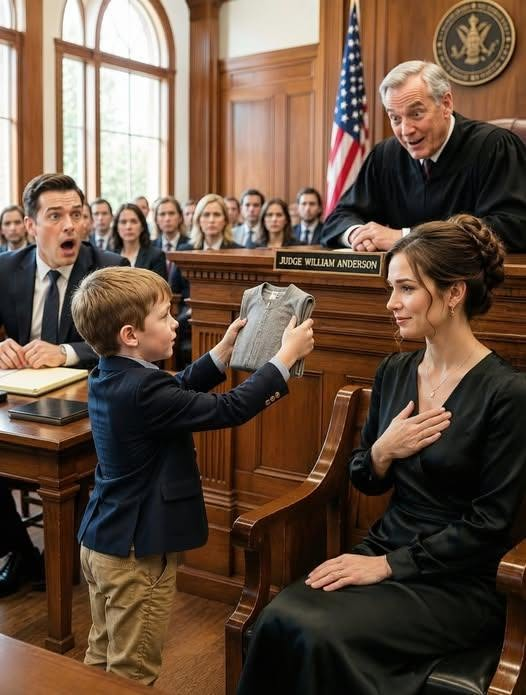
Nolan nodded. He lifted the hem of his shirt, pointing to the tiny, metallic silver numbers written in fine-tip marker along the inner hemline. He read a ten-digit routing and account number, followed by a specific balance: “Two hundred and fourteen thousand dollars.”
Judge Harlan wrote the numbers down on his legal pad with a heavy black pen. He then turned his gaze toward Grant’s lawyer.
“Mr. Carroway,” Judge Harlan said, his voice dropping into a register of terrifying calm. “Your client submitted a sworn financial affidavit to this court three weeks ago under penalty of perjury. That affidavit stated Mr. Bellamy possessed total liquid assets of less than four thousand dollars, which was his justification for requesting that his child support obligations be reduced to zero. Care to explain this?”
Carroway swallowed hard, his throat making a loud clicking sound that was clearly audible in the silent room. “Your… Your Honor… we were not aware… my client assured me that his disclosures were complete and accurate—”
“I don’t care what he assured you, counselor,” Judge Harlan snapped, his eyes flashing with fury. “If those numbers on that child’s shirt match an undisclosed account, your client has committed aggravated perjury and bankruptcy fraud in my court.”
The judge picked up his gavel and looked down at me.
For the first time all morning, I saw something in Judge Harlan’s eyes that made the coldness in my chest melt away: profound, deep respect.
“Mrs. Bellamy,” Judge Harlan said. “Do you have that folder of records you brought with you today?”
“Y-yes, Your Honor,” I stammered, handing my worn paper folder across the divider to the court bailiff, who immediately brought it up to the bench.
Judge Harlan opened my folder. He slowly flipped through my hand-written rent receipts, the dental appointment bills, my Diner work schedules, and the quiet, polite text messages I had sent Grant begging for fifty dollars to buy Nolan winter boots—messages Grant had ignored while holding over two hundred thousand dollars in a hidden account.
The judge read through every single page in absolute silence for ten agonizing minutes.
Nobody in the courtroom moved. Nobody breathed. Grant sat motionless, staring at his polished shoes, his face pale as a sheet, his silk tie suddenly looking like a noose around his neck.
Finally, Judge Harlan closed my folder and set it down beside his legal pad.
He looked at Grant Bellamy.
“Mr. Bellamy,” the judge said, his voice cutting like a razor. “You came into this courtroom today seeking to strip a loving mother of her child because she could not afford brand-new clothes for him. You used your high-priced attorney to mock a shirt that this woman bought with her last remaining dollars after working three jobs to keep a roof over her son’s head.”
Judge Harlan leaned forward, resting his hands flat on his desk.
“In my thirty years on the bench,” the judge continued, “I have rarely seen a display of human arrogance so grotesque, or a deception so utterly pathetic. You hid money from your own child while letting his mother starve herself so he could have an apple in his lunchbox. You thought your wealth made you a superior parent. In reality, it has only exposed the absolute emptiness of your character.”
Chapter 6: The Verdict of the Moon and Stars
Judge Harlan picked up his pen and began writing rapidly on his official order pad.
“Here is my ruling,” the judge announced, his voice ringing through the hall like a church bell.
“First: The petition for full custody filed by Mr. Bellamy is dismissed with prejudice. Primary legal and physical custody of Nolan Bellamy remains entirely and exclusively with his mother, Audrey Bellamy.”
Tears spilled over my lashes, hot and overwhelming, washing away months of suffocating fear. I dropped to my knees beside Nolan, pulling him tightly into my arms, burying my face in his soft dark hair. He wrapped his small arms around my neck, holding me with all the strength his eight-year-old body possessed.
“Second,” Judge Harlan continued loudly over the sound of my quiet sobs. “Mr. Bellamy’s visitation rights are immediately suspended, pending a full psychological evaluation and the completion of court-mandated parenting classes. Any future visitation will be strictly supervised by a court-appointed social worker.”
Grant flinched as if he had been physically struck, his mouth opening in shock, but his lawyer frantically grabbed his shoulder to keep him from speaking.
“Third,” Judge Harlan barked, pointing his pen directly at Grant. “I am issuing an immediate freeze on every asset, bank account, and property registered under Mr. Bellamy’s name or his associates. I am appointing an independent forensic accountant to audit his finances for the past twenty-four months. Until that audit is complete, Mr. Bellamy will pay temporary spousal support and child support in the amount of four thousand five hundred dollars per month, retroactive to the date of his initial departure from the marital home.”
Preston Carroway looked as if he were going to faint. “Your Honor, four thousand five hundred—!”
“Do not push me, Mr. Carroway,” Judge Harlan warned, his voice icy cold. “Or I will order your client taken directly to the Knox County Jail right now to await formal indictment for perjury. In addition, Mr. Bellamy will be responsible for all court costs, forensic auditing fees, and a fifty-thousand-dollar legal trust fund established immediately for Nolan’s future education.”
Judge Harlan slammed his gavel down one final time.
“This hearing is adjourned. The District Attorney’s office will be provided with a full transcript of today’s proceedings by three o’clock this afternoon.”
The judge stood up, gathered his papers, and paused before leaving his bench. He looked down at Nolan one last time, a warm, gentle smile breaking across his stern face.
“Keep wearing that shirt, son,” Judge Harlan said softly. “It suits you.”
Chapter 7: The Unbroken Light
Ten minutes later, we walked out of the heavy double doors of the courthouse into the bright, crisp January afternoon.
The cold air swept across the marble plaza, but for the first time in two years, I didn’t feel frozen. The heavy, suffocating weight that had rested on my chest for twenty-four months was completely gone, replaced by a deep, weightless warmth that filled every corner of my soul.
Behind us, Grant walked out flanked by his lawyer. His tailored suit looked crumpled now; his polished shoes dragged against the marble steps. He looked at me, his eyes filled with a mixture of anger, shock, and profound humiliation.
He took a step toward us, his voice raspy and desperate. “Audrey… wait. We can talk about this. We can work something out before the District Attorney gets involved—”
I turned to face him. I didn’t yell. I didn’t hurl insults. I didn’t show anger.
I simply stood tall in my secondhand cream blazer, holding my son’s hand firmly in mine, looking at the man I had once thought was my entire world.
“We have nothing left to talk about, Grant,” I said, my voice smooth, steady, and unyielding as stone. “You had two years to be a father. You chose to be a shadow. Nolan and I are walking into the sun.”
Grant stood frozen on the steps, unable to utter a single word, as his lawyer dragged him toward a waiting car before the local news reporters could spot them.
I looked down at Nolan. He was smiling up at me, his dark eyes sparkling like twin stars in the winter sunlight.
“Mom?” he asked softly.
“Yes, my brave little astronaut?”
“Can we go home now? Grandma said she was making her famous chicken stew if we won.”
I laughed—a bright, joyous, ringing sound that echoed off the marble buildings of downtown Knoxville. I knelt down, wiping a stray tear from his cheek, and ran my hand over the tiny silver moon stitched onto his navy-blue shirt.
“Yes, sweetheart,” I said, kissing the top of his head. “We’re going home.”
Chapter 8: The Constellation of Home
Six months later.
The early summer sun washed over the small, beautiful yellow house we had rented on the quiet outskirts of Knoxville. It had a wraparound porch, a yard filled with blooming hydrangea bushes, and a massive oak tree in the back with a tire swing hanging from a sturdy branch.
My mother, Ruth, sat on the porch swing, snapping fresh green beans into a plastic bowl, humming an old song softly to herself. Her face looked lighter, her posture relaxed, the deep lines of worry that had etched her forehead for two years finally smoothed away by peace.
Inside, the kitchen smelled of roasted garlic, fresh bread, and sweet summer peaches.
I stood by the kitchen island, organizing my schedule for the upcoming semester. Thanks to the retroactive support payments and the court-ordered settlement, I had been able to leave my cleaning jobs and enroll full-time in the nursing program at the University of Tennessee—a dream I had put on hold nine years ago when Nolan was born.
My phone chimed on the counter.
It was an update from my financial advisor: Nolan’s educational trust has been fully funded. First semester tuition for your nursing program cleared. All accounts secured.
I set the phone down, a quiet, profound wave of gratitude washing over my heart.
The front screen door clicked open, and Nolan ran into the kitchen, his cheeks flushed red from playing in the yard. He was wearing his navy-blue shirt—the same shirt, though my mother had carefully let out the seams so it fit his growing shoulders, and I had stitched a tiny silver constellation of stars alongside the original crescent moon.
He didn’t need to write secrets inside it anymore.
The fabric was clean, soft, and completely blank on the inside—a fresh canvas for a life built on truth, dignity, and unconditional love.
He set a small wooden box on the kitchen counter, his eyes glowing with excitement.
“Look, Mom!” he said, opening the lid to reveal a polished handheld telescope he had bought with his allowance. “The sky is going to be super clear tonight! Mr. Henderson said we might even see Jupiter’s moons!”
I smiled, reaching out to brush a stray lock of dark hair away from his forehead, my heart overflowing with a love so vast it filled the entire room.
“Then we’ll stay up late tonight and watch them,” I said, kissing his cheek. “All of them.”
Nolan wrapped his arms around my waist, leaning his head against my chest, right over my heart.
“Mom?” he whispered softly.
“Yes, sweetie?”
“Do you think the stars ever get lost?”
I looked out the kitchen window at the bright blue sky, then down at the little boy who had saved our lives with a handful of written words and a brave heart.
“No, sweetheart,” I smiled, holding him close as the summer breeze rustled the curtains. “As long as they have someone who loves them to guide them home… they always know exactly where they belong.”
