Dr. Lawson didn’t speak immediately.
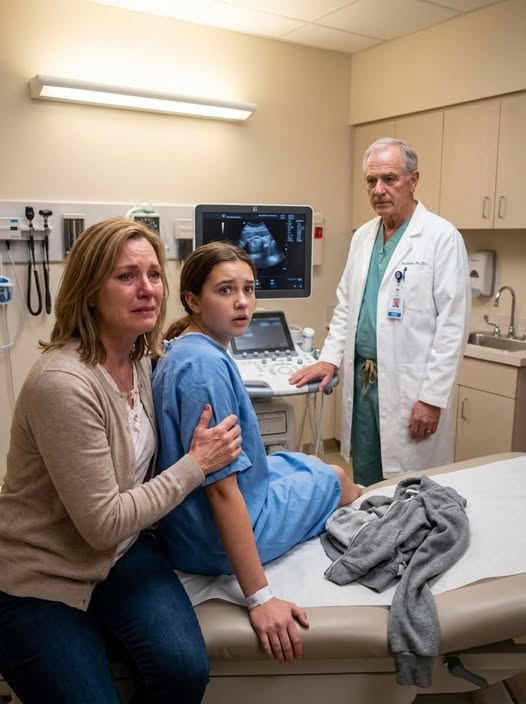
Instead, he pulled a stool closer to Maya’s bed and lowered himself until he was at eye level with her.
“First,” he said gently, “I need to ask a very important question.”
He looked at Maya.
“Has anyone ever hurt you?”
She blinked.
“No.”
“Has anyone touched you in a way that made you uncomfortable?”
She immediately shook her head.
“No.”
He nodded slowly, studying her face.
“I believe you.”
Only then did he turn the monitor toward me.
“There is a large mass inside your daughter’s abdomen.”
I stopped breathing.
“A… mass?”
“Yes.”
My knees nearly gave out.
Maya whispered,
“Is it cancer?”
Dr. Lawson reached over and squeezed her hand.
“We don’t know.”
The words somehow frightened me more than a yes or no.
He pointed toward the screen.
“The ultrasound shows a growth nearly the size of a grapefruit.”
I stared at the blurry image.
It filled far more space than I could understand.
“It’s pressing against her stomach and intestines.”
He looked directly at me.
“That’s why she feels full after only a few bites.”
Every symptom suddenly made sense.
The nausea.
The weight loss.
The constant pain.
The exhaustion.
Every time Robert had said she was pretending…
Our daughter had been carrying something growing inside her body.
Dr. Lawson stood.
“I’ve already requested an emergency CT scan.”
“Today?”
“Immediately.”
Within an hour, Maya was being wheeled through the radiology department.
I held her hand the entire way.
Robert called seven times.
I didn’t answer once.
Finally, a text appeared.
If you’re wasting money at a hospital, don’t bother coming home.
I looked at the message.
Then quietly switched my phone off.
The CT scan confirmed what the ultrasound had suggested.
Dr. Lawson returned with another physician.
A surgical oncologist.
My heart dropped.
He unfolded the images across a light board.
“The good news,” he began carefully, “is that this doesn’t appear to have spread.”
I grabbed onto that single sentence.
“The bad news…”
He pointed to the scan.
“…is that it’s much larger than we expected.”
Nearly nine inches.
Wrapping around one ovary.
Pressing against surrounding organs.
“It needs to come out.”
“When?”
“As soon as possible.”
“Tomorrow morning.”
I looked at Maya.
She was trying so hard to be brave.
“I’m scared, Mom.”
I kissed her forehead.
“So am I.”
At 8:40 that evening, Robert finally stormed into the hospital.
He didn’t ask how Maya felt.
His first words were,
“Do you know what this emergency visit is going to cost?”
Several nurses looked up.
I stood.
“Our daughter needs surgery.”
He frowned.
“For what?”
I handed him the scan.
He barely glanced at it.
“They always exaggerate.”
Dr. Lawson happened to walk into the room.
“Sir.”
Robert turned.
“I’m Dr. Lawson.”
Robert folded his arms.
“My wife panics over everything.”
The doctor’s expression became perfectly still.
“Your daughter has a tumor the size of a grapefruit compressing multiple organs.”
Robert shrugged.
“Can medication handle it?”
“No.”
“So surgery is optional?”
“No.”
“What happens if we wait?”
Dr. Lawson answered without hesitation.
“She could lose ovarian function.”
He paused.
“Or suffer internal rupture.”
Another pause.
“Or die.”
The room became completely silent.
Robert’s face lost all color.
The operation lasted almost six hours.
Every minute felt like another lifetime.
Finally, the surgeon appeared.
His surgical cap was still on.
He smiled.
“We got it all.”
I burst into tears.
“It was a rare benign ovarian tumor.”
Not cancer.
Not malignant.
Benign.
Huge.
Painful.
Dangerous.
But not cancer.
Maya would recover completely.
Three days later, while Maya slept, a hospital social worker asked if she could speak with me privately.
“There are a few concerns.”
My stomach tightened again.
“What concerns?”
She opened Maya’s chart.
“The nursing staff documented repeated delays in seeking medical care despite significant symptoms.”
I felt heat rising into my face.
“My husband…”
She nodded gently.
“I understand.”
She wasn’t accusing me.
She was protecting Maya.
She asked one final question.
“If your daughter becomes seriously ill again…”
She looked me in the eyes.
“…will anyone prevent her from receiving treatment?”
I knew exactly who she meant.
I answered honestly.
“No.”
Because I had already made my decision.
I filed for divorce two weeks later.
Not because Robert was cruel one afternoon.
Because he had spent years convincing our daughter that her pain wasn’t real.
Children remember that.
Long after bruises disappear.
Long after scars heal.
They remember the adults who believed them…
And the ones who didn’t.
A year later, Maya was back on the soccer field.
Running.
Laughing.
Eating everything in sight.
One evening she sat beside me on the porch and asked,
“Mom?”
“Yes?”
“What if you had listened to Dad?”
I looked across the yard where the sunset painted everything gold.
“I don’t.”
She frowned.
“I mean… what would’ve happened?”
I wrapped an arm around her shoulders.
“We’ll never know.”
She leaned against me.
“Because you listened to me instead.”
I smiled through tears.
“Always.”
Sometimes the bravest decision a parent ever makes isn’t standing up to illness.
It’s standing up to the person who tells their child…
“You’re only pretending.”
Because scans can reveal tumors.
But they also reveal something else.
Who truly sees a child’s pain… and who chooses not to.
