The four-star admiral moved with deliberate calm.
Every conversation in the ballroom faded into complete silence as Admiral Thomas Harrington, Commander of U.S. Fleet Forces, walked directly toward me.
No one breathed.
No one moved.
Victoria Reynolds stood beside the military police officer with a satisfied smile that was slowly beginning to crack.
The young MP remained frozen in perfect attention, still holding my identification card with both hands.
The security screen continued displaying my credentials.
Captain Alexandra Morgan.
United States Navy.
Military Intelligence.
Top Secret / SCI Clearance.
Planning Committee—Annual Fleet Strategic Gala.
The admiral stopped precisely two feet in front of me.
Then, before nearly five hundred guests—
He saluted.
A perfect, regulation salute.
“Good evening, Captain Morgan.”
I returned it.
“Good evening, Admiral.”
Only then did he lower his hand.
“I’ve been looking forward to thanking you personally.”
The silence somehow became even heavier.
Victoria blinked.
“What…”
The admiral turned toward the young MP.
“Lieutenant, return Captain Morgan’s identification.”
“Yes, sir.”
The officer practically sprinted forward, handing me the card as though it were priceless.
“I’m very sorry for the interruption, Captain.”
“No apology necessary.”
Then Admiral Harrington finally looked at Victoria.
His expression wasn’t angry.
It was worse.
Professional disappointment.
“Ma’am,” he said evenly, “may I ask why you accused one of my senior intelligence officers of impersonating a naval captain?”
Victoria laughed nervously.
“There must be some misunderstanding.”
“I’m sure there is.”
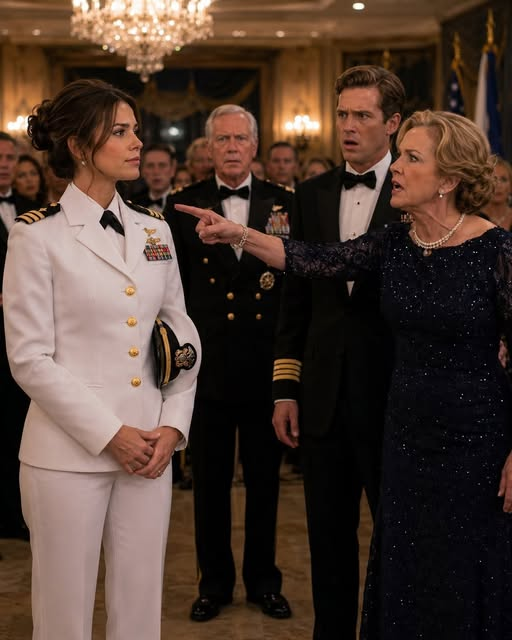
She pointed toward my uniform.
“She works in administration.”
Around the ballroom, several officers exchanged bewildered looks.
The admiral raised one eyebrow.
“Administration?”
“Yes.”
“I’ve known Captain Morgan for nearly twelve years.”
Victoria stopped talking.
The admiral continued.
“She briefed the Joint Chiefs during Operation Sentinel.”
Another ripple spread through the ballroom.
“She coordinated multinational intelligence sharing during Hurricane Artemis.”
More whispers.
“And she received the Legion of Merit last year.”
Someone actually gasped.
Victoria stared at me as though seeing a stranger.
“No…”
The admiral wasn’t finished.
“In fact,” he said, “without Captain Morgan’s work, three destroyer crews and over seven hundred sailors might not have returned home safely during the Black Sea crisis.”
The ballroom became absolutely motionless.
Even Ethan looked stunned.
He knew I worked in intelligence.
He knew I couldn’t discuss deployments.
But even he didn’t know everything.
Because he couldn’t.
Most of it remained classified.
Victoria slowly shook her head.
“That’s impossible.”
“It’s documented.”
She looked desperately toward Ethan.
“Tell them.”
He met her eyes.
“I tried for seven years.”
Victoria’s breathing became uneven.
“I thought…”
“You never asked,” Ethan replied quietly.
The admiral glanced toward the master of ceremonies.
“Ladies and gentlemen…”
He picked up the microphone resting on the podium.
“I hadn’t intended to reveal this tonight.”
Every guest listened.
“As many of you know, this evening includes recognition for exceptional service.”
He smiled toward me.
“Captain Morgan was scheduled to receive that recognition after dessert.”
A projection screen behind the stage suddenly illuminated.
My photograph appeared.
Not in civilian clothing.
In combat gear.
Standing aboard a destroyer.
Beside it appeared words that made Victoria physically stumble backward.
Recipient—Distinguished Service Medal
For extraordinary leadership and strategic intelligence coordination supporting multinational naval operations.
The citation continued.
Much of it remained intentionally vague.
Classified missions always were.
But one sentence stood out.
Her actions directly contributed to the protection of allied naval assets and prevented catastrophic loss of life.
The applause began slowly.
Then spread.
Soon the entire ballroom stood.
Hundreds of officers.
Diplomats.
Military families.
Everyone except Victoria.
She remained rooted to the marble floor.
Hands trembling.
Face completely pale.
The admiral gestured toward the stage.
“Captain Morgan.”
I walked forward.
The room remained standing.
When I reached the podium, Admiral Harrington personally pinned the Distinguished Service Medal onto my uniform.
He leaned closer.
“You’ve spent years refusing public recognition.”
“I prefer doing my job, sir.”
“I know.”
He smiled.
“But tonight seemed appropriate.”
The applause continued.
Then the admiral addressed the audience.
“Many of you know Captain Morgan only through briefings.”
He looked around the ballroom.
“I know her through twenty years of service.”
His voice carried effortlessly.
“She has repeatedly accepted assignments others declined.”
“She has missed birthdays, anniversaries, holidays, and funerals.”
“She has protected people who will never know her name.”
“She has succeeded in missions she can never publicly discuss.”
He paused.
“The finest officers rarely advertise their accomplishments.”
His eyes briefly rested on Victoria.
“They simply serve.”
The meaning landed exactly where intended.
After the ceremony concluded, guests lined up to congratulate me.
Generals.
Foreign defense attachés.
Senior enlisted leaders.
Victoria watched every handshake.
Every salute.
Every respectful conversation.
Her certainty had completely disappeared.
Nearly forty minutes later, she finally approached.
Her voice had lost all confidence.
“Alexandra…”
I turned.
She looked older.
Smaller.
“I… didn’t know.”
“No.”
“I never imagined…”
“I know.”
Tears formed in her eyes.
“I embarrassed you.”
“You tried to have me arrested.”
Her shoulders collapsed.
“I thought I was protecting the Navy.”
I looked at her for several seconds.
“No.”
She lowered her head.
“You were protecting the version of me you needed to believe existed.”
She couldn’t deny it.
Because it was true.
For years, believing I was insignificant had allowed her to feel superior.
Reality threatened that belief.
So she attacked reality instead.
“I’m sorry.”
The words sounded genuine.
Perhaps for the first time.
I nodded politely.
“I accept your apology.”
Hope briefly appeared in her expression.
Then I continued.
“But acceptance and trust aren’t the same thing.”
She closed her eyes.
“I understand.”
“I hope you do.”
She walked away slowly.
Not defeated.
Simply confronted by consequences she’d postponed for seven years.
Later that evening, Ethan and I stood outside beneath the Norfolk night sky.
“I’m sorry,” he said quietly.
“You didn’t accuse me.”
“I should’ve stopped Mom years ago.”
I didn’t answer immediately.
Instead I watched officers laughing inside the ballroom through the tall windows.
Finally I spoke.
“Do you know what hurt most?”
“What?”
“It wasn’t that she underestimated me.”
He waited.
“It was that you kept asking me to tolerate it.”
His face fell.
“I thought keeping the peace was enough.”
“So did she.”
We stood silently for a long time.
Then he reached for my hand.
“I won’t ask you to shrink yourself ever again.”
I believed him.
Not because of tonight.
Because growth sometimes begins with public failure.
Months later, Victoria invited us to dinner.
For the first time in seven years, introductions sounded different.
“This is my daughter-in-law, Captain Alexandra Morgan.”
She hesitated.
Then smiled.
“One of the finest officers in the United States Navy.”
There was no trace of condescension.
Only respect.
Real respect.
After dinner, she quietly handed me a small wooden box.
Inside lay my father’s old Navy challenge coin.
The one I’d believed had disappeared years earlier after helping her move houses.
“I found it in storage,” she whispered.
“I almost threw it away because I didn’t understand why it mattered.”
She looked at the coin.
“Now I do.”
I closed the box gently.
“My father used to tell me something.”
“What?”
“‘A uniform doesn’t create honor.'”
She waited.
“‘It only reveals the character already inside the person wearing it.'”
Victoria nodded silently.
That night, she never once mentioned administrative work.
She never minimized another deployment.
She never again measured someone’s worth by what she assumed she knew.
Because sometimes the loudest lesson in a ballroom isn’t delivered by an accusation.
It’s delivered thirty seconds later…
When one ID scan reveals a lifetime of quiet service that never needed anyone’s permission to matter.
