I kissed my wife’s cold forehead inside her coffin… and when I opened her clenched hand, I found a navy-blue button torn off with force. I recognized it immediately. It belonged to my brother Rodrigo’s jacket. My mother went pale and whispered,
“Julián, don’t make ridiculous assumptions.”
I stared at her without blinking.
“Too late, Mother.”
“Your wife died giving birth… and your son didn’t survive either.”
Those were the first words my mother said when I opened the door of my house, still holding a bouquet of white lilies for Camila.
For three weeks, I had been in Monterrey finalizing a deal to save the family vineyards. Every day, I imagined coming home. I pictured Camila’s smile, her hands resting on her swollen belly, and the way she would tell me our son had kicked again, as if he were already impatient to enter the world.
But when I stepped into our home in San Miguel de Allende, I did not find my wife waiting for me.
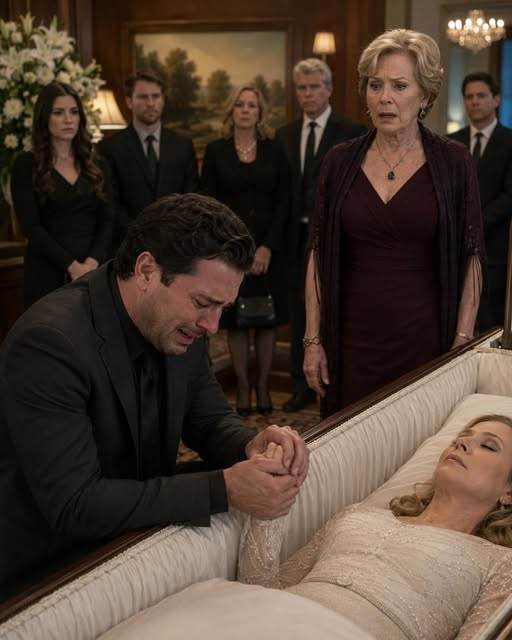
I found a coffin in the center of the living room.
Black curtains covered the windows. Candles burned around the room like someone had staged a perfect scene of grief. The air smelled of melted wax, dying flowers, and lies.
My mother, Teresa Armenta, stood beside the fireplace in a flawless black dress. Her hair was pinned neatly, and her lips were painted a red far too bright for a grieving woman. She was not crying. She was not even pretending.
“Where is Camila?” I asked, though the coffin had already answered me in the cruelest way.
Teresa tilted her head slightly.
“There, son. Be strong.”
The bouquet slipped from my fingers. The white lilies fell to the floor one by one, like pieces of snow.
I walked toward the coffin without hearing anything else. Camila lay inside, pale and beautiful, her hair arranged carefully on a white pillow. She looked asleep, but something about the image tightened my chest more than death itself.
Camila hated when people folded the hands of the dead across their chest.
She always said,
“When I die, don’t arrange me like some saint in a display case. I was a woman, not a statue.”
And yet, one of her hands rested over her chest.
The other was closed.
Tight.
Too tight.
I bent down to touch it.
“Don’t disturb her,” my mother said.
It was not a plea.
It was an order.
I looked at her over the coffin.
“She is my wife.”
“There is nothing you can do for her now, Julián.”
Her coldness broke something inside me, but not only from grief. It was alarm. My mother had always hated my softness. She said I felt too much, that my brother Rodrigo had the strength needed to lead a family like ours.
Camila used to say my calm was not weakness.
It was my shield.
I took my wife’s stiff fingers and carefully began to open them.
Teresa stepped toward me.
“I told you to leave her alone!”
Her shout made the two housemaids move back against the wall. I did not answer. I kept opening Camila’s hand, finger by finger, as gently as if I were touching something sacred and broken.
Then I saw it.
Between Camila’s fingers was a small dark button, ripped away with force. Pressed into her palm, almost hidden beneath her nails, was a thin thread of navy-blue fabric.
My mother was dressed in black.
But my brother Rodrigo almost always wore navy-blue jackets.
I slipped the button into my pocket before anyone noticed.
“I want to see the medical reports,” I said.
Teresa gave a dry laugh.
“Reports? Your wife is dead. Your son is dead. Accept reality and stop turning this into a disgrace.”
At that moment, Rodrigo appeared from the hallway with a glass of whiskey in his hand. He wore dark glasses inside the house, as if mourning were just another expensive accessory.
“Julián,” he said in a rehearsed voice. “Don’t make a scene. It’s already tragic enough that you were late to your own wife’s funeral.”
I looked at him.
There was a fresh scratch on his neck.
A thin red line just below his jaw.
And for the first time since I had entered the house, I stopped trembling.
“You’re right,” I murmured. “I won’t make a scene.”
Rodrigo smiled.
So did my mother.
They thought they had broken me.
But they did not know two things.
First, Camila and I had signed a legal document six months earlier, after discovering that someone had been stealing money from the vineyards.
Second, I had not returned home that day.
I had come back two days earlier than planned.
That night, I did not cry in front of them. I let my mother give orders about the burial. I let Rodrigo accept condolences as if my grief belonged to him. I listened while they spoke about urgent cremation, closing the coffin, and “not prolonging the suffering.”
Then I locked myself inside my father’s office, closed the door, and turned on the green desk lamp.
The safe was still hidden behind my grandfather’s portrait, exactly where Teresa believed no one had looked in years.
Inside was the power of attorney Camila and I had prepared. If she died under suspicious circumstances, I would become the sole administrator of her assets, her shares, and any investigation related to her death.
Camila had not trusted my family.
Neither had I.
Before we married, my mother had tried to convince me to give up my grandfather’s inheritance. Rodrigo wanted to sell the vineyards to a foreign company. Camila had uncovered fake invoices, hidden transfers, and signatures no one could explain.
One night, while we were reviewing papers at the kitchen table, she told me,
“Your mother isn’t afraid of losing you, Julián. She’s afraid of losing control.”
Now I understood.
But it was too late.
I picked up the phone and called Dr. Ana Lucía Méndez, Camila’s friend and the director of the private hospital where my mother claimed my wife had died.
She answered on the second ring.
“Julián,” she whispered. “I’ve been trying to reach you for hours.”
My blood ran cold.
“Tell me the truth.”
Silence followed.
Then her voice dropped even lower.
“Camila was not brought to the hospital alive. They brought her in without identification, without a file, without an admission bracelet. Your mother demanded immediate cremation. I refused.”
The room seemed to tilt beneath me.
“And my son?”
The doctor took a shaky breath.
“I can’t talk about this over the phone. Come tomorrow at six in the morning. Use the emergency entrance. And don’t tell anyone.”
When I hung up, I looked at my reflection in the dark window.
I no longer saw a shattered widower.
I saw a man whose dead wife had left him one final clue inside her hand.
At five thirty the next morning, the house was still silent.
The candles surrounding the coffin had burned low, leaving trails of wax like pale tears along the silver holders. Rodrigo was asleep in one of the guest rooms. My mother had locked herself in the master bedroom after ordering the servants to prepare for the cremation at noon.
I walked downstairs wearing the same clothes from the night before.
Before leaving, I stopped beside Camila.
There was something unnatural about her stillness, as though whoever had arranged her had imitated death without understanding it.
I bent close to her ear.
“I’m going to find out what they did.”
For the first time, I noticed a faint mark beneath the makeup near her temple.
Not a bruise.
A small square of irritated skin.
As though adhesive tape had recently been removed.
I heard footsteps behind me.
Rodrigo stood at the foot of the staircase, still wearing his navy trousers and a white shirt open at the collar.
“Where are you going?”
“To pray.”
He studied me.
“You never pray before sunrise.”
“My wife has never died before.”
His jaw tightened.
Then his gaze moved toward Camila’s hand.
For half a second, fear crossed his face.
It vanished quickly, replaced by contempt.
“You should let the dead rest.”
“You seem very interested in making sure I do.”
He stepped closer.
“We all handled everything while you were away. Mother organized the funeral. I dealt with the hospital. The least you could do is show gratitude.”
“Thank you, Rodrigo.”
The words surprised him.
I walked past him and reached the door.
“Thank you for handling everything,” I continued. “It will make it much easier to know whom to question first.”
His hand closed around my arm.
The movement was instinctive and violent.
“Be careful.”
I looked down at his fingers.
Then at the scratch beneath his jaw.
Camila had fought someone.
I pulled my arm free.
“No,” I said quietly. “You be careful.”
The emergency entrance of the private hospital was deserted when I arrived.
Dr. Ana Lucía was waiting beside a service elevator in blue scrubs and a gray coat. Her face looked exhausted.
She took me to a small office in the basement and locked the door behind us.
On the desk sat a folder, a sealed evidence bag, and a portable tablet.
Ana Lucía did not invite me to sit.
“Before I show you anything, I need you to understand that I may lose my position for this.”
“My wife lost her life.”
Her eyes filled.
“That is precisely why I’m doing it.”
She opened the folder.
Inside were photographs of Camila taken when she had arrived at the hospital.
Her face was pale, but unlike the woman in the coffin, her hair was tangled. There was dirt on her sleeve. A shallow cut marked one eyebrow.
Her wrists bore faint red lines.
I felt something savage rise inside me.
“What happened to her?”
“We don’t know everything yet. But she did not die during childbirth.”
Ana Lucía turned the tablet toward me.
A security recording began to play.
The image showed a loading entrance behind the hospital at 2:14 in the morning. A dark vehicle stopped beside the doors. Two men lifted a stretcher from the back.
My mother stepped out of the passenger seat.
Rodrigo climbed out from the driver’s side.
He was wearing a navy-blue jacket.
The left cuff was missing a button.
I reached into my pocket and placed the button on the desk.
Ana Lucía stared at it.
“Where did you find that?”
“In Camila’s hand.”
The doctor covered her mouth.
On the recording, my mother spoke to a hospital employee. There was no audio, but her movements were sharp and commanding. Rodrigo remained near the stretcher, touching the scratch on his neck.
Then the blanket covering Camila moved.
Barely.
But unmistakably.
I grabbed the edge of the desk.
“She was alive.”
“When she arrived, yes.”
“Then why is she dead?”
Ana Lucía paused the recording.
“She had been sedated. Her breathing was shallow, but she still had a pulse. We stabilized her for fourteen minutes.”
“Fourteen minutes?”
“The medication in her bloodstream was not something normally used during pregnancy. Someone gave her a powerful sedative combined with another substance that suppressed her breathing.”
“Who?”
“We don’t know.”
“You said she was alive. What happened after fourteen minutes?”
The doctor looked at the locked door.
Then she whispered,
“She woke up.”
I stared at her.
“What?”
“Only briefly. She was confused and could barely speak. But she said three words.”
Ana Lucía opened the folder and showed me a nurse’s handwritten note.
Baby.
Basement.
Alive.
The letters blurred before my eyes.
“My son is alive?”
“I don’t know.”
“You told me on the phone—”
“I told you I couldn’t discuss it. Your mother claimed the baby had died before Camila reached the hospital. But we never received an infant. There was no body. No birth record. No death certificate.”
A pressure built behind my ribs until breathing became difficult.
“What happened to Camila after she woke?”
“She suffered another respiratory collapse. We tried to save her.”
Ana Lucía’s voice broke.
“But there is something else.”
She opened the sealed bag.
Inside was a small adhesive patch.
“This was attached behind Camila’s ear. It releases medication through the skin.”
“The mark beneath her makeup.”
“Yes. Someone removed it before the funeral, but a nurse found it stuck to the hospital blanket.”
“Can it be traced?”
“The batch number belongs to a private veterinary supplier.”
My family owned horses.
More importantly, Rodrigo managed the stables.
By seven fifteen, I was sitting inside the office of Inspector Mateo Salgado.
Camila had trusted him. His wife had once worked with her at a women’s legal foundation, and Camila had helped them during a property dispute.
I gave him everything.
The button.
The hospital recording.
The photographs.
The power of attorney.
The documents from the vineyard.
He listened without interrupting.
When I finished, he leaned back.
“If we arrest them now, they will say they brought her to the hospital after finding her unconscious.”
“They kidnapped my son.”
“We suspect they did. But suspicion is not proof.”
“They tried to cremate her.”
“That is stronger. So is the medication. However, if the child is alive, they may move him the moment they sense danger.”
My hands curled into fists.
“What do we do?”
Mateo looked at me for several seconds.
“We let them believe you are still broken.”
When I returned home, the funeral director was already there.
My mother stood beside the coffin, signing the cremation authorization.
“Where have you been?” she demanded.
“I needed air.”
Rodrigo appeared behind her wearing a new black suit.
The navy jacket was gone.
I stepped forward and took the pen from my mother’s hand.
“I will sign.”
Teresa blinked.
“You?”
“I want this finished.”
The relief on her face was almost invisible, but I saw it.
I deliberately signed the wrong page.
Then I let the pen fall.
“Before the cremation, I want one hour alone with Camila.”
“No,” Rodrigo said immediately.
My mother touched his wrist.
“Of course,” she replied. “A husband should say goodbye.”
They left the living room.
The moment the doors closed, Mateo’s forensic team entered through the rear service corridor.
The funeral director had already been informed.
The coffin was quietly transferred into an unmarked vehicle for a full examination. In its place, the team left an identical sealed coffin containing only sandbags.
At noon, my mother watched the false coffin enter the crematorium.
Rodrigo stood beside her.
Neither shed a tear.
I watched the smoke rise from the chimney and understood something terrible.
They were not mourning Camila.
They were celebrating the destruction of evidence.
That evening, I gathered the family in my grandfather’s office.
My mother sat behind his old desk as though it were a throne.
Rodrigo poured himself whiskey.
“What now?” he asked. “Are you planning to spend the rest of your life wandering around looking miserable?”
“No.”
I placed the vineyard documents on the desk.
“I’m selling my shares.”
The glass stopped halfway to his mouth.
My mother’s expression changed.
“To whom?”
“The foreign company Rodrigo has been negotiating with.”
Rodrigo lowered the glass.
“You knew about that?”
“I know they offered enough to clear the vineyard debts.”
Teresa leaned forward.
“Then perhaps tragedy has finally taught you to be practical.”
“I need both of you to sign the final transfer tomorrow.”
Rodrigo smiled slowly.
“And Camila’s shares?”
“They pass to me.”
My mother’s fingers tightened around the desk.
“So you control everything.”
“For now.”
Her face softened with false affection.
“You are doing the right thing, son.”
“No,” I replied. “I’m doing what you always wanted.”
The next morning, we met at the old wine cellar beneath the main vineyard house.
Rodrigo had insisted on privacy. He claimed the workers should not know about the sale until it was complete.
Mateo had placed recording devices inside my coat and beneath the table.
The contract waiting for them was not a sale agreement.
It was a carefully prepared document acknowledging their prior management authority, financial transfers, and responsibility for specific company accounts.
They did not read it closely.
Greed had made them careless.
Rodrigo signed first.
My mother signed next.
Then she leaned back and smiled.
“Your father would be proud.”
“My father hated Rodrigo.”
Silence filled the cellar.
My mother’s smile vanished.
“He loved both of you.”
“No. He knew Rodrigo was stealing from him.”
Rodrigo stood abruptly.
“You have no idea what you’re talking about.”
“I know about the fake invoices.”
I placed copies on the table.
“I know about the transfers to accounts in Panama. I know Camila discovered them. And I know she planned to expose you.”
Teresa rose slowly.
“Julián, grief is making you unstable.”
“Where is my son?”
Neither of them moved.
I repeated the question.
“Where is my son?”
Rodrigo laughed.
“You don’t have a son.”
I looked at the missing button on the jacket displayed in the photograph Mateo had given me.
“Camila tore this from your sleeve.”
His face went still.
My mother whispered his name.
Too late.
Rodrigo slammed both palms onto the table.
“She attacked me!”
The words echoed through the cellar.
Teresa closed her eyes.
I did not move.
“Why?”
“She found the account records. She threatened to call you.”
His breath came faster.
“I only wanted the files. She started screaming. She scratched me and tried to run.”
“And the sedative?”
“I didn’t know how much to use.”
My mother stepped toward him.
“Stop talking.”
But Rodrigo had spent his entire life believing someone else would clean up his mistakes.
“She was supposed to sleep,” he continued. “Just until we moved the money and made her look unstable. But then she went into labor.”
My vision darkened.
“You drugged a pregnant woman.”
“I panicked.”
“And my mother?”
He looked at Teresa.
“She said we had to finish it.”
A sound escaped my mother’s throat.
Not grief.
Rage.
“You weak, stupid boy.”
Then she turned to me.
“Your wife was going to destroy this family.”
“No. She was going to expose it.”
“She was an outsider!”
“She was my wife.”
“And Rodrigo is your blood.”
I stepped closer.
“So is my son.”
For the first time, she looked frightened.
“Where is he?”
Teresa’s gaze shifted toward the stone archway behind me.
I understood.
Not because she confessed.
Because my mother had always looked toward the thing she feared losing.
Behind the archway was a narrow corridor leading to the oldest section of the estate.
The underground storage rooms.
The basement.
Camila’s final clue.
Baby.
Basement.
Alive.
I ran.
Rodrigo grabbed me from behind, but the cellar doors burst open before he could pull me back.
Inspector Mateo entered with four officers.
My mother screamed.
Rodrigo tried to run through the storage corridor.
He made it less than ten meters.
I did not stop to watch them arrest him.
I followed the passage down a flight of narrow stone steps. The air grew colder. At the end stood a reinforced door usually used for storing rare wine.
A woman’s voice came from the other side.
“Who is there?”
Mateo handed me the key taken from my mother.
My hands shook so badly I could barely fit it into the lock.
The door opened.
A dim lamp illuminated a cot, a small refrigerator, blankets, and an elderly nurse named Inés, who had worked for my family when Rodrigo and I were children.
She stood holding a tiny bundle against her chest.
The baby began to cry.
The sound split me open.
I crossed the room without feeling the floor beneath my feet.
Inés was crying.
“I’m sorry, señor Julián. Your mother told me the child would be killed if anyone knew he survived. She said I had to keep him hidden until the papers were signed.”
I looked down.
A small face emerged from the blanket.
Dark hair.
Camila’s mouth.
My chin.
He was alive.
My son was alive.
I reached for him, but stopped before touching him.
I was suddenly terrified that he would disappear.
Inés carefully placed him in my arms.
He weighed almost nothing.
Yet holding him felt like carrying every future I thought had been buried inside that coffin.
“His name is Mateo,” I whispered.
The inspector glanced at me from the doorway.
I almost laughed through my tears.
“No,” I said. “Camila chose his name months ago.”
My son opened his eyes.
And for the first time since returning home, I cried.
Not quietly.
Not with dignity.
I held him against my chest and wept until the grief, fury, and fear poured out of me.
Then Ana Lucía entered the room.
She examined him immediately and confirmed that he was weak but healthy.
“He was born early,” she said. “But someone has been feeding him properly.”
Inés nodded.
“I could not save his mother. But I swore I would protect him.”
I looked at her.
“You did.”
My mother and Rodrigo were charged with unlawful confinement, financial crimes, falsifying records, administering controlled substances, conspiracy, and responsibility for Camila’s death.
The forensic examination proved she had not died from childbirth complications.
She had died from the drugs Rodrigo gave her and the delay caused by my mother’s attempt to avoid official admission records.
The navy-blue button carried fibers from Rodrigo’s jacket.
Beneath Camila’s fingernails, investigators found traces of his skin.
The adhesive patch led directly to a box stored in his private cabinet at the stables.
The fake vineyard invoices led to millions in stolen funds.
But the greatest surprise came from my father’s office.
Inside the safe, beneath the power of attorney, I found a second envelope that Camila had hidden behind the wooden panel.
It was addressed to me.
Julián,
If you are reading this, something has gone wrong.
Do not blame yourself for being away.
I asked you to go to Monterrey because I needed time to finish what I started.
Your mother and Rodrigo believe the vineyard belongs to them because fear has always given them power.
But fear is not ownership.
I transferred my shares into a protected trust for our child.
I also sent copies of every account record to the authorities.
They cannot sell the vineyard.
They cannot take your inheritance.
And they cannot erase the truth.
Please raise our child somewhere love is never used as a debt.
Camila.
I read the letter beneath the green desk lamp while my son slept against my chest.
She had known she was in danger.
Yet even then, she had thought not about revenge, but about protecting us.
Six months later, Rodrigo accepted a plea agreement after my mother blamed everything on him.
Teresa refused every offer.
She believed her name, money, and social connections would save her.
They did not.
During the trial, she stared at me from across the courtroom.
“You destroyed your family,” she said as officers led her away.
I held my son closer.
“No, Mother.”
I looked toward Camila’s photograph resting beside the judge’s bench.
“I finally saved it.”
I did not sell the vineyard.
Instead, I removed my family’s name from the company and renamed it Viñedos Camila.
The stolen money recovered from foreign accounts paid the workers, cleared the debts, and funded a maternal emergency center at Ana Lucía’s hospital.
Inés became my son’s nanny.
Inspector Mateo visited often enough that little Mateo eventually believed he had been named after him.
Perhaps, in a way, he had.
Every year on Camila’s birthday, I carried white lilies to the hill overlooking the vineyards.
When my son was old enough to walk, he came with me.
He had Camila’s eyes and her stubborn way of lifting his chin when he did not understand something.
One afternoon, he noticed the navy-blue button sealed inside a small glass frame beside her photograph.
“What is that?” he asked.
I knelt beside him.
For years, I had thought of the button as proof of cruelty.
But it was more than that.
It was Camila’s final act of defiance.
Her last message.
The small piece of truth my family had failed to burn.
“It belonged to someone who tried to hide what happened,” I said.
My son touched the glass.
“Did Mama find it?”
I looked across the rows of vines shining beneath the late afternoon sun.
“She left it for me.”
“Why?”
I placed my hand over his.
“So I could find you.”
He smiled and ran between the vines, laughing as the wind lifted his hair.
For one impossible second, the sound reminded me of Camila.
Not the woman inside the coffin.
Not the victim described in court.
The woman at our kitchen table, barefoot and determined, telling me that calm was not weakness.
She had been right.
My calm had been my shield.
Her courage had been my compass.
And the button clenched inside her hand had led me through every lie until I found the one thing my mother and brother could never destroy.
The life Camila had fought to save.
