I was thrown out of my parents’ house at nineteen for refusing to abort my baby. For ten years, they believed I was a stubborn, reckless daughter who ruined her future. What they never knew was that I had a reason—a secret so serious that I warned them we would all regret it one day. A decade later, I returned to Ohio with my ten-year-old son, knocked on the same door that had been slammed in my face, and spoke a single sentence that turned the color from their faces. What happened next still haunts me.
My name is Emma, and I’ll never forget the day my life shattered.
I was nineteen, scared out of my mind, and only a few weeks pregnant when I sat across from my parents in our modest Ohio living room. My hands trembled as I held out the positive pregnancy test.
My mother stared at it like it was a bomb.
My father slowly leaned forward in his recliner.
“Who’s the father?” he asked.
I looked down.
“I can’t tell you.”
The silence that followed felt suffocating.
“What do you mean you can’t tell us?” my mother snapped. “Are you protecting someone? Is he married? Is he twice your age?”
“It’s complicated,” I whispered. “But I can’t end this pregnancy. I can’t. And if I do… it won’t just affect me. It’ll affect all of us.”
The second those words left my mouth, everything exploded.
My father shot to his feet.
“Don’t play games with us!”
“Dad, please,” I begged. “I can’t explain right now, but one day you’ll understand.”
“Either you get rid of that baby,” he yelled, pointing toward the door, “or you get out.”
“Please—”
“Get out. Now.”
An hour later, I stood on the porch with a duffel bag and nowhere to go.
My mother cried behind the screen door.
But she never stopped him.
I left Ohio soon after.
Changed my number.
Started over in another state.
And I kept my baby.
His name was Leo.
The next ten years tested me in ways I never imagined. I worked two jobs, attended community college classes, studied after midnight, and survived on determination and caffeine. There were nights I cried myself to sleep from exhaustion.
But every morning, Leo gave me a reason to keep fighting.
He was smart.
Funny.
Kind-hearted.
And far more observant than most kids his age.
As he got older, his questions became harder to answer.
“Mom,” he asked one evening, “why don’t we ever visit Grandma and Grandpa?”
I froze.
Because they chose pride over their daughter.
Because they never wanted you.
Because I wasn’t ready.
But I simply smiled and changed the subject.
Then, on his tenth birthday, he looked at me with those serious blue eyes and quietly said, “Can I meet them? Just once?”
Something inside me shifted.
Maybe he deserved the truth.
Maybe all of us did.
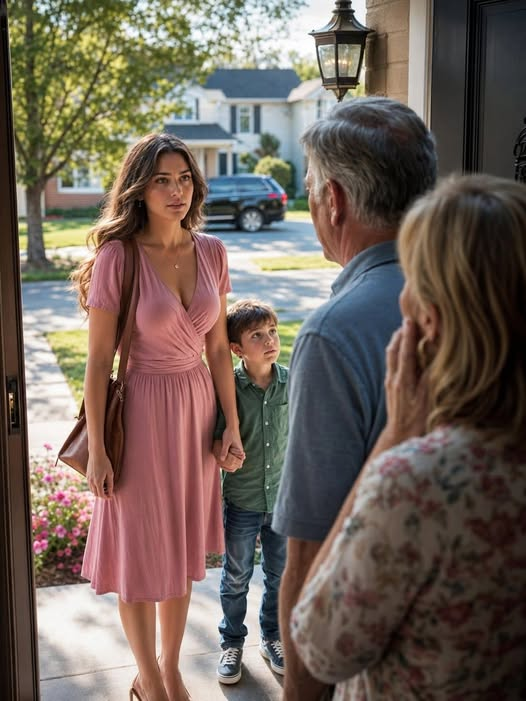
The next weekend, we packed an overnight bag and drove eight hours back to Ohio.
My parents had no idea we were coming.
When I stepped onto that familiar porch, memories hit me like a wave. The same peeling paint. The same porch swing.
The same front door.
I knocked.
A few seconds later, it opened.
My father stared at me.
His face went pale.
“Emma?”
My mother appeared behind him.
Then she noticed Leo.
Her hand flew to her mouth.
Nobody spoke.
Ten years of silence stood between us.
Finally, I took a deep breath.
“I need to tell you the truth.”
My father’s jaw tightened.
“The truth about Leo.”
My mother looked ready to collapse.
“And the real reason I couldn’t get rid of him.”
Both of them stared at my son.
The color drained from their faces.
Their eyes widened.
Then, for the first time since I arrived…
Their hands began to shake.
And when I finally revealed who Leo’s father really was, neither of them could even speak.
“His father was Michael Bennett.”
My father stumbled backward as if someone had struck him in the chest.
My mother gripped the doorframe.
“No,” she whispered.
Leo looked up at me, confused.
“Who’s Michael Bennett?”
My father’s face twisted.
“You’re lying.”
“I wish I were.”
“He died,” my mother said. “Michael died eleven years ago.”
“That’s what you were told.”
My father stared at me with an expression I had never seen before. Not anger. Not disbelief.
Fear.
Pure, unmistakable fear.
Michael Bennett had lived two houses down from us when I was growing up. He was three years older than me, quiet and serious, with dark hair and blue eyes that seemed to notice everything.
He was also the son of my father’s business partner, Robert Bennett.
The Bennett family and ours had once been inseparable. We spent holidays together. Michael taught me how to ride a bicycle. His mother made the chocolate cake I requested every birthday.
Then, when I was sixteen, everything changed.
Robert Bennett was accused of stealing nearly two million dollars from the manufacturing company he shared with my father.
My father testified against him.
Robert was convicted.
Three months later, Robert died in prison after suffering a heart attack.
Michael disappeared soon afterward.
The story around town was that he had driven his truck off a bridge during a storm. The vehicle was found crushed beneath the water.
His body was never recovered.
I believed he was dead until the summer after my high school graduation.
That July, I received a letter with no return address.
Inside were six words.
Meet me where the trains stopped running.
I knew exactly what they meant.
At the edge of our town stood an abandoned railway station where Michael and I had played as children. I went there after midnight, convinced someone was playing a cruel joke.
Michael was waiting inside.
He looked thinner, older and terrified.
When I saw him, I could barely breathe.
“You’re alive.”
He covered my mouth before I could say anything else.
“You can’t tell anyone.”
I should have run.
Instead, I threw my arms around him.
For the next two months, Michael and I met in secret. He told me that his truck had been pushed from the bridge after someone followed him along the county road. He escaped before it sank and spent weeks hiding in an abandoned hunting cabin.
He believed the crash was not an accident.
He also believed his father had been framed.
“By whom?” I asked.
Michael looked away.
“That’s what I’m trying to prove.”
He had documents—copies of invoices, bank transfers and handwritten production records. They suggested that money had been removed from the company for years before Robert supposedly stole it.
Michael had contacted a federal investigator.
He was preparing to enter witness protection until the case could be reopened.
Then he gave me a small black flash drive.
“If anything happens to me, you keep this safe.”
“What’s on it?”
“Everything.”
I stared at him.
“Does my father know?”
Michael’s expression changed.
“I don’t know how much your father knows.”
Those words terrified me.
But I loved him.
Perhaps I had always loved him.
Our relationship was not planned. Neither was the child we created during those desperate weeks.
When I learned I was pregnant, Michael was frightened—but also happier than I had ever seen him.
“We’ll have a family,” he said. “Once this is over, I’ll come back for both of you.”
Three nights later, he vanished again.
This time, there was no letter.
No phone call.
Only a newspaper report claiming that human remains had been discovered in a burned-out cabin in Kentucky, along with a watch belonging to Michael.
The authorities declared him dead.
I didn’t believe them.
Not completely.
Michael had warned me that his enemies might stage his death if they discovered he was cooperating with federal investigators.
I also knew that if I told my parents he was Leo’s father, they would demand answers I could not safely give.
And if the wrong person learned that Michael had trusted me, they might come looking for the flash drive.
That was why I refused to name him.
That was why I said ending my pregnancy would affect all of us.
Because Michael had told the investigator that if he disappeared, his surviving child could legally authorize the release of evidence protected under a sealed trust.
At nineteen, I barely understood what that meant.
I only understood that the life inside me might be the last proof Michael Bennett had ever existed—and the only person who could one day finish what he had started.
Standing on my parents’ porch ten years later, I watched the truth settle over them.
My mother began crying.
My father did not.
He looked at Leo again, studying the boy’s blue eyes and the dimple in his left cheek.
Michael had possessed the same dimple.
“You knew Michael was alive,” I said to my father. “Didn’t you?”
His eyes snapped toward me.
My mother turned to him.
“Thomas?”
“I don’t know what she’s talking about.”
“You’re lying,” I said.
“Emma, stop.”
“I found the letter.”
My father went still.
I reached into my bag and removed a clear plastic sleeve. Inside was a faded sheet of paper I had discovered six months earlier while sorting documents connected to Michael’s sealed trust.
The letter was addressed to my father.
It had been written eleven years ago, days before Michael’s truck went over the bridge.
Thomas,
I know you did not steal the money. I also know you were pressured to testify against my father. Help me expose who did this before another innocent person dies.
Michael
My mother looked from the letter to my father.
“What does he mean, pressured?”
My father’s shoulders sagged.
For ten years, I had imagined this confrontation. I thought I would scream. I thought I would demand that he kneel and apologize for abandoning me.
Instead, I felt strangely calm.
“Who forced you to testify?”
My father stepped away from the door.
“Come inside.”
The living room looked smaller than I remembered. The same family photographs stood on the mantel, except there were no recent pictures of me.
My graduation photograph was still there.
So was a school portrait from when I was twelve.
My mother sat beside Leo on the couch, though she seemed afraid to touch him.
My father remained standing.
“The person who stole the money was Charles Mercer,” he said.
I knew the name.
Mercer had been the company’s financial director. After Robert’s conviction, he became my father’s new business partner.
He was also the richest man in the county.
“He altered the accounts,” my father continued. “When Robert discovered discrepancies, Mercer moved the stolen money through accounts opened in Robert’s name.”
“Then why did you testify against Robert?”
“Mercer threatened your mother.”
My mother stared at him.
“What?”
“He had photographs of you leaving the oncology clinic.”
My mother’s face changed.
At the time, she had undergone treatment for a condition she kept private from nearly everyone.
“He knew the insurance company had denied part of your care,” my father said. “He offered to pay the bills. Then he told me that if I didn’t support his version of events, he would make certain you lost access to treatment. He also threatened Emma.”
“You sacrificed an innocent man,” I said.
“I was terrified.”
“So was I when you threw me out.”
He lowered his eyes.
That finally broke something inside me.
“You stood on that porch and told your pregnant daughter she had no home. You didn’t ask whether I was safe. You didn’t ask whether someone had hurt me. You cared more about controlling my decision than understanding it.”
“I thought I was saving your future.”
“No. You were trying to save yourself from being embarrassed.”
My mother sobbed quietly.
Leo reached for my hand.
His small fingers steadied me.
My father sank into his old recliner.
“Did Michael give you evidence?”
I said nothing.
His reaction answered a question I had carried for years.
He knew the evidence existed.
“Mercer is still watching you,” my father said.
“He doesn’t need to anymore.”
My father looked up.
“What have you done?”
“The sealed trust became accessible on Leo’s tenth birthday.”
The room fell silent.
“That was three days ago,” I continued. “Michael arranged everything through a federal attorney. Once Leo turned ten, I received instructions.”
My father stood again.
“Emma, listen to me. Charles Mercer is not a man you challenge.”
“I already challenged him.”
A vehicle door slammed outside.
My mother rushed to the window.
A black sedan had stopped at the curb.
My father turned white.
Two people stepped out—a gray-haired woman carrying a leather case and a broad-shouldered man in a dark jacket.
The woman came to the porch and knocked.
My father whispered, “Who are they?”
“The woman is Rebecca Sloan, an assistant United States attorney.”
“And the man?”
I looked directly at him.
“He is the investigator Michael contacted eleven years ago.”
When I opened the door, Rebecca entered and introduced herself. The investigator remained near the entrance, scanning the street.
Rebecca placed her leather case on the dining table.
“Mr. and Mrs. Carter,” she said, “information released through the Bennett trust has led to the reopening of Robert Bennett’s case. We have also obtained evidence connecting Charles Mercer to embezzlement, witness intimidation, insurance fraud and two attempted murders.”
My mother covered her mouth.
“Two?”
“Michael’s staged vehicle accident was the first.”
My father stared at her.
“And the second?”
Rebecca looked at me.
“The Kentucky cabin.”
A chill passed through the room.
I had spent ten years imagining flames swallowing an empty building, a watch planted among unidentified remains and Michael escaping into the darkness.
But Rebecca’s expression told me the truth was more complicated.
“Was Michael inside?” I asked.
“We believe he was held there,” she said. “But he escaped before the fire.”
My heart stopped.
“What are you saying?”
Rebecca opened her case and removed a sealed envelope.
“We’re saying the remains found in that cabin were not Michael Bennett’s.”
Leo squeezed my hand.
I could hear the ticking clock above the mantel.
Every sound in the house became painfully sharp.
“Then where is he?”
Rebecca slid the envelope toward me.
“Michael entered federal protective custody eleven years ago under an emergency arrangement. There was a security breach shortly afterward. To protect you and your unborn child, he was advised to maintain no contact.”
My knees weakened.
“Is he alive?”
Rebecca hesitated.
Then she nodded.
“Yes.”
For ten years, I had forced myself not to hope.
Hope was dangerous. Hope kept wounds open.
Yet with one word, every wall I had built collapsed.
I sat down before my legs failed me.
“Why didn’t he come for us?”
“He attempted to contact you twice,” Rebecca said. “The first communication was intercepted. The second was returned.”
My father’s head rose slowly.
I turned toward him.
“What did you do?”
His silence condemned him.
“What did you do?” I repeated.
My mother stared at her husband.
Thomas looked suddenly twenty years older.
“A letter came,” he admitted. “Months after you left.”
My breath caught.
“It was addressed to you. There was no return address, but I recognized Michael’s handwriting.”
“You opened it?”
“I burned it.”
The room seemed to tilt.
My mother rose from the couch.
“You burned our daughter’s letter?”
“I thought Michael had destroyed enough lives.”
“You decided that for me,” I whispered.
“I believed he had filled your head with lies.”
“What did the letter say?”
My father pressed his palms against his knees.
“He said he was alive. He said he would come back when it was safe. He included a telephone number.”
Ten years.
Ten birthdays.
Ten Christmas mornings.
Ten years during which Leo could have known that his father had not abandoned him.
I walked toward my father.
He did not move.
“You didn’t just throw me out,” I said. “You stole a decade from us.”
“I’m sorry.”
The words were barely audible.
I looked at the man who had once seemed larger than the world.
Now he seemed small.
Not evil.
Not powerful.
Just weak.
And sometimes weakness, when combined with pride, could destroy lives as thoroughly as cruelty.
Before I could respond, the investigator at the door touched his earpiece.
His posture changed.
“We have movement across the street.”
A silver SUV had stopped near the corner.
My father moved toward the window.
“Mercer.”
Charles Mercer climbed out.
He was in his late sixties now, with perfectly combed white hair and an expensive coat. He looked less like a criminal than a man arriving for church.
He walked toward the house alone.
The investigator ordered us away from the windows.
Mercer climbed the porch steps and knocked calmly.
Rebecca nodded to the investigator, who opened the door but blocked the entrance.
Mercer smiled.
“I came to speak with Emma.”
“You can speak from there,” Rebecca said.
His eyes found mine.
“You have something that belongs to me.”
“The evidence belongs to the government now.”
His smile disappeared.
“You have no idea what you’ve done.”
“Yes, I do.”
“You think that boy protects you?”
Leo moved closer to my mother.
Mercer looked at him, and I saw recognition flash across his face.
He knew immediately.
Michael’s eyes.
Michael’s dimple.
Michael’s son.
“You should have listened to your parents,” Mercer said.
My father stepped forward.
“No, Charles. She should have had better parents.”
Mercer glanced at him.
For the first time in my life, my father stood between me and the person threatening our family.
It did not erase what he had done.
But it mattered.
Mercer reached inside his coat.
The investigator moved instantly, forcing him against the porch railing.
My mother screamed.
Leo buried his face against me.
The object in Mercer’s pocket was not a gun.
It was a small remote device.
Within seconds, officers surrounded the house. They found an incendiary device attached beneath Rebecca’s sedan, designed to ignite remotely.
Mercer had not come to negotiate.
He had come to destroy the evidence and everyone connected to it.
But by then, it was too late.
The files had already been copied.
The warrants had already been signed.
And Charles Mercer was arrested on the same porch where my father had banished me ten years earlier.
As the officers led him away, Mercer turned toward me.
“You think you won?”
I held Leo close.
“No,” I said. “Michael did.”
Three weeks later, Robert Bennett’s conviction was officially vacated.
My father gave a complete statement admitting that he had testified falsely under coercion. He lost his remaining share of the company and faced charges for perjury, though prosecutors considered his cooperation and the threats made against our family.
My mother asked me to stay in Ohio.
I refused.
Forgiveness was possible.
Trust would take longer.
Before Leo and I left, my father stood beside our car.
“I don’t expect you to forgive me,” he said. “But I need you to know that throwing you out was the worst thing I ever did.”
I looked at him.
“No. The worst thing was convincing yourself you had the right to make my decision.”
He nodded.
“You’re right.”
It was the first time I had ever heard him say those words without defending himself afterward.
Then he crouched in front of Leo.
“I’m your grandfather,” he said. “But I haven’t earned the right to be called that.”
Leo studied him carefully.
“You could start by writing to me.”
My father’s eyes filled with tears.
“I would like that.”
On the drive home, Leo was unusually quiet.
“Are you angry with me?” I asked.
“No.”
“Confused?”
“A little.”
He looked through the window.
“Do I get to meet my dad?”
I had been afraid to ask Rebecca the same question.
Michael remained under federal protection while additional arrests were made. Although Mercer was in custody, several people involved in his financial network had not yet been found.
Two months passed.
Then, on a rainy Thursday afternoon, someone knocked on the door of our apartment.
Leo was at the kitchen table doing homework.
I opened the door.
The man standing in the hallway had gray at his temples and a thin scar along his jaw. He was broader than I remembered. Older.
But his eyes were exactly the same.
Blue.
Serious.
Filled with ten years of grief.
For several seconds, neither of us spoke.
Then he looked past me and saw Leo.
His face crumpled.
“Emma,” he whispered.
I wanted to strike him.
I wanted to embrace him.
I wanted to demand an explanation for every lonely night and every unanswered question.
Instead, I asked the only thing that mattered.
“Did you know about him?”
Michael nodded.
“I knew you were pregnant. I didn’t know whether the baby was a boy or girl until the trust was activated.”
“You could have found another way.”
“I tried. After your father destroyed my letter, my handlers warned me that Mercer was monitoring everyone connected to you. He had already tried to kill me twice. If I came near you, he would have known you had the evidence.”
“So you stayed away.”
“I watched from a distance.”
Anger rose through me.
“You watched?”
“Only through reports. I knew what city you lived in. I knew you attended college. I knew when Leo was born.”
His voice broke on our son’s name.
“I knew you were alive. That was all they would tell me.”
Leo came to the doorway.
“Are you Michael?”
Michael turned.
For a man who had survived attempted murder, false death and eleven years of hiding, he looked terrified.
“Yes.”
“Are you my dad?”
Michael swallowed.
“Yes.”
Leo looked at me first.
I nodded.
Then he walked toward Michael.
Michael slowly lowered himself to one knee.
“I’m sorry,” he said. “I’m sorry I wasn’t there.”
Leo studied his face with the same thoughtful expression he used when solving difficult math problems.
“Mom said sometimes adults make bad choices because they’re scared.”
Michael looked at me.
“She’s right.”
“But she also says being scared doesn’t fix what you broke.”
A sad smile crossed Michael’s face.
“She’s right about that too.”
Leo extended his hand.
“You can start by helping me with my science project.”
Michael stared at the offered hand.
Then he took it.
That evening, the three of us built a model volcano at the kitchen table.
It was awkward.
Painful.
Beautiful.
Michael did not return to our lives as if nothing had happened. There were no miraculous embraces that erased a decade.
We began slowly.
One dinner.
One conversation.
One truth at a time.
He attended therapy.
So did I.
Leo asked questions neither of us wanted to answer, and we answered them anyway.
My parents began writing to him every week. My mother filled her letters with stories about my childhood. My father never asked Leo to call him Grandpa.
Six months later, Leo did it on his own.
Michael and I did not immediately become the young couple we had once imagined. We were strangers carrying memories of people we no longer were.
But we learned each other again.
He learned that I hated coffee despite surviving college on it.
I learned that he could no longer sleep in a room unless he had checked every window.
He learned that I did not need rescuing.
I learned that loving someone did not require pretending their choices had not hurt me.
A year after Mercer’s arrest, Michael took Leo and me to the abandoned railway station in Ohio.
The building was crumbling. Weeds grew between the tracks.
“This is where everything began,” Michael told Leo.
Leo looked around.
“It’s kind of creepy.”
I laughed.
Michael did too.
Then Leo ran ahead to investigate an old signal post.
Michael stood beside me beneath the rusted station sign.
“I used to imagine bringing you back here,” he said.
“So did I.”
“In my version, you forgave me immediately.”
“In mine, I slapped you.”
“That seems fair.”
He reached into his pocket but did not kneel.
There was no ring.
Instead, he held out a new key.
“What is that?”
“A house.”
I stared at him.
“Not for me,” he added quickly. “For us, eventually—only if you choose it. It’s ten minutes from Leo’s school. There’s a room he can turn into a laboratory, and there’s an office for you.”
I had recently completed my degree and begun working with a nonprofit that helped young mothers finish their education.
“And if I say no?”
“I keep showing up until you believe I’m not leaving.”
I closed my fingers around the key.
“That may take a long time.”
“I have time.”
Behind us, Leo shouted that he had found something.
We hurried over.
Half-buried beneath weeds was a small metal plate engraved with the name of the railway line.
Leo brushed away the dirt.
“Can we take it home?”
Michael smiled.
“No. It belongs here.”
Leo frowned.
“But nobody uses this station anymore.”
“That doesn’t mean its history should be erased.”
The words struck all three of us differently.
I looked at my son—the child my parents had ordered me to erase, the child Mercer had feared, the child who had unknowingly carried the key to exposing an eleven-year conspiracy.
Leo had not destroyed my future.
He had protected it.
He had protected all of us.
A year later, Michael and I were married in a small ceremony behind the new house.
My mother helped Leo straighten his tie.
My father stood at the end of the aisle, uncertain whether he had been invited to walk me.
I walked alone.
Not because I hated him.
Not because I had refused to forgive him.
I walked alone because I had learned that no one else had the right to give me away.
At the altar, Michael waited beside Leo.
When I reached them, Leo whispered, “It took you long enough.”
Everyone laughed.
Even my father.
After the ceremony, he approached me beneath the maple tree.
“I’m proud of you,” he said.
For most of my life, those were the words I had wanted from him.
But I no longer needed them to know my worth.
“Thank you,” I replied.
He looked toward Leo and Michael.
“You were right that night.”
“What night?”
“The night I made you leave. You said we would all regret it one day.”
I remembered myself at nineteen—terrified, pregnant and standing on a porch with a duffel bag.
“I didn’t want to be right.”
“I know.”
He looked at the ground.
“Do you think you’ll ever completely forgive me?”
I considered lying to comfort him.
Instead, I gave him the truth.
“I forgive you enough to let you know us. But forgiveness doesn’t rewrite what happened.”
He nodded slowly.
“I understand.”
That was the best ending we could give each other.
Not forgetting.
Not pretending.
Understanding.
Charles Mercer was eventually convicted on multiple federal charges and sentenced to spend the rest of his life in prison. The stolen funds were recovered and used to compensate the families whose lives his crimes had destroyed.
Robert Bennett’s name was cleared publicly.
A plaque was placed outside the rebuilt manufacturing plant.
It read:
ROBERT BENNETT
AN INNOCENT MAN WHOSE TRUTH OUTLIVED THE LIE.
Below his name appeared another line.
Evidence preserved through the courage of Emma Carter and her son, Leo Bennett.
For years, people had called me reckless.
They said I had sacrificed my future for a child.
They were wrong.
The frightened nineteen-year-old standing on that porch had not ruined her life.
She had made the bravest decision of it.
And the baby they wanted me to erase became the reason the truth survived long enough to set us all free.
