“Good afternoon, Colonel Turner.”
The words settled over the diner like a sudden drop in temperature.
Sheriff Harper’s hand froze near his belt.
Travis Cain stopped smiling.
My mother stared at me from behind the counter, the coffee pot still suspended above an empty cup.
The officer who had entered was Lieutenant Colonel Marcus Bell, my executive officer. He stood just inside the door in full service uniform, his expression formal and unreadable.
Behind him, three other people stepped out of the SUVs.
A civilian attorney from the Army’s Criminal Investigation Division.
A special agent from the state bureau of investigation.
And a woman in a dark blue suit whom Sheriff Harper recognized immediately.
Deputy Attorney General Rebecca Sloan.
Harper’s face lost its color.
“Colonel?” Travis repeated.
He looked me over again, from my old sweatshirt to my faded jeans.
“You said she was just some soldier,” he muttered toward the sheriff.
Harper did not answer.
Marcus approached me and saluted.
I returned it.
“Ma’am,” he said, “the requested legal and investigative personnel have arrived.”
“Thank you, Colonel Bell.”
Travis gave a short, uncertain laugh.
“What is this supposed to be? Some kind of intimidation stunt?”
Rebecca Sloan entered the diner and removed a folder from beneath her arm.
“No, Mr. Cain.”
Her voice was calm.
“This is the point at which intimidation stops working.”
Sheriff Harper stepped forward.
“This is a local matter.”
Rebecca looked at him.
“Not anymore.”
She placed the folder on the counter.
“Allegations involving coordinated property fraud, public corruption, witness intimidation, falsification of official records, and possible obstruction of a federal service member’s legal rights are not exclusively local matters.”
Harper’s jaw tightened.
“Nobody obstructed her rights.”
Marcus glanced toward the sheriff.
“Colonel Turner requested emergency leave after receiving evidence that her dependent mother had been assaulted.”
The word assaulted carried across the room.
Not fallen.
Not stumbled.
Not lost her balance.
Assaulted.
The regulars in the booths slowly lifted their heads.
For the first time since I had returned, someone in authority had said the truth aloud.
Travis pointed toward me.
“She came in here making accusations.”
“I asked you about my father,” I said.
“You threatened me.”
“I didn’t threaten anyone.”
Kayla emerged from the kitchen.
Her face was pale, but she held her phone tightly in both hands.
“Yes, you did.”
Travis turned sharply.
Kayla flinched.
Then she looked at me.
I gave her a small nod.
She stepped forward.
“I recorded him.”
The diner became silent.
Sheriff Harper stared at her.
“You told my deputy you didn’t see anything.”
“I was scared.”
“Changing your story makes you an unreliable witness.”
Rebecca Sloan opened the folder.
“Fortunately, the recording does not depend on her memory.”
Travis looked toward the front door.
One of the state investigators quietly moved into his path.
No weapon was drawn.
None was needed.
Rebecca placed a small evidence drive on the counter.
“We have received the complete forty-seven-second recording from three separate preserved sources.”
Harper’s eyes moved toward me.
I met his gaze.
“You should have asked to see my phone.”
His face hardened.
“I handled the information available to me.”
“No,” Rebecca said. “You handled the information you hoped would remain available.”
She opened the folder.
Inside were copies of the county records I had photographed.
Inspection failures.
Disputed liens.
Permit suspensions.
Complaints marked closed without interviews.
Landowners pressured into selling after county actions damaged their businesses or homes.
Thirty families.
Six years.
The same sheriff.
The same mayor.
The same buyer.
Cain Realty Group.
Wade Cain entered the diner before anyone could speak again.
He wore the same expensive gray suit from the video.
He had not rushed.
Men like Wade rarely rushed.
They believed time waited for them.
He paused when he saw the uniforms, the investigators, and the folder on the counter.
Then he looked at his son.
“Travis.”
There was no concern in his voice.
Only irritation.
Travis straightened.
“Dad, they’re making this into something it isn’t.”
Wade’s gaze moved to me.
“So Evelyn’s daughter finally came home.”
“My mother remembers you.”
“I imagine she does.”
He walked toward the counter as though he were arriving for a business meeting.
“Colonel Turner, I respect your service. But military rank does not give you authority over county property disputes.”
“No,” I said.
“Evidence does.”
His expression barely changed.
“You think a few administrative errors prove a conspiracy?”
“I think patterns deserve examination.”
“Patterns can be invented.”
“So can accidents.”
For the first time, Wade stopped moving.
My mother whispered my name.
“Nicole.”
She was warning me.
Not because I was wrong.
Because she had spent years learning what happened to people who said such things aloud.
Wade slowly turned toward her.
“Evelyn, you should have taken my offer.”
My mother placed the coffee pot down.
“No.”
He smiled.
“You are holding onto an old building and a strip of useless land because your husband was too stubborn to understand progress.”
“My husband understood you.”
Wade’s smile disappeared.
Rebecca Sloan stepped between them.
“Mr. Cain, I recommend that you stop speaking.”
“I haven’t been charged with anything.”
“That may change.”
He gave a small laugh.
“You arrived in two government vehicles and expect me to panic?”
“No,” Rebecca replied.
“I expected the warrant to do that.”
The state investigator removed a folded document from his jacket.
Wade’s eyes narrowed.
“What warrant?”
“A search warrant for Cain Realty Group’s offices, your private residence, and three affiliated storage properties.”
The brass bell above the diner door jingled again.
Through the glass, I watched additional vehicles turn onto Main Street.
State police.
Unmarked sedans.
A mobile evidence unit.
For the first time, the regulars did not lower their eyes.
They turned toward the window.
Travis stepped backward.
“This is insane.”
The investigator faced him.
“Travis Cain, you are being detained in connection with the assault of Evelyn Turner and the intimidation of a material witness.”
“It was a shove.”
My mother closed her eyes.
There it was.
The admission.
Small.
Careless.
Spoken by a man who had spent his life believing that consequences belonged to other people.
Rebecca’s gaze sharpened.
“So you did make physical contact with Mrs. Turner.”
Travis realized too late what he had said.
“I meant hypothetically.”
Kayla lifted her phone.
“You said it clearly.”
Sheriff Harper moved toward the door.
Marcus shifted one step.
“Sheriff.”
Harper stopped.
“I have duties to attend to.”
Rebecca looked toward the state agent.
“Sheriff Don Harper, you are required to surrender your department-issued phone and remain available for questioning.”
“You cannot detain an elected sheriff without cause.”
“We have cause.”
She removed another document.
“Your office accessed closed property complaints eleven times in the forty-eight hours after Colonel Turner returned.”
Harper’s mouth tightened.
“That is routine review.”
“You also contacted Wade Cain seven times during the same period.”
The sheriff said nothing.
Rebecca continued.
“And last night, a deputy assigned to your office attempted to enter the county records room after business hours.”
Harper’s face changed.
Only slightly.
But enough.
“Which deputy?” I asked.
Rebecca looked at him.
“He used Sheriff Harper’s access card.”
The regular sitting nearest the counter set down his coffee.
His name was Harold Dean.
He had been eating breakfast at my mother’s diner since I was in high school.
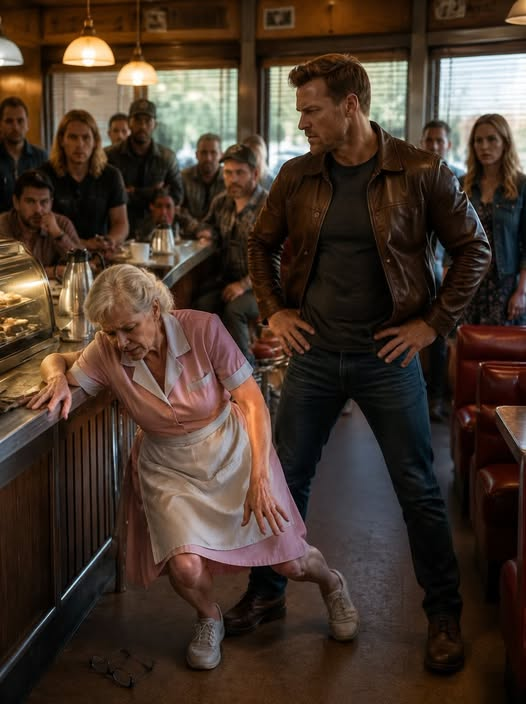
When Travis had shoved her, Harold had stared into his plate.
Now he slowly stood.
“I saw it.”
Every person in the diner turned toward him.
Harold looked at my mother.
“I saw Travis shove you.”
His voice shook.
“I’m sorry, Evelyn.”
My mother’s eyes filled with tears.
Harold faced the investigators.
“Wade came to my farm last year. I refused to sell.”
He swallowed.
“Two weeks later, the county said my well violated a regulation nobody had ever mentioned before.”
A woman in the next booth stood.
“My sister’s bakery failed inspection after she rejected Cain’s offer.”
Then another voice rose from near the window.
“They put a lien on my father’s property.”
Another regular pushed back his chair.
“My complaint disappeared.”
The silence that had protected Wade Cain for years began breaking apart one person at a time.
Not with shouting.
With testimony.
Wade looked around the diner.
“You people should be careful.”
The state investigator stepped closer.
“Is that another warning, Mr. Cain?”
Wade smiled without warmth.
“It is advice.”
My mother reached beneath the counter.
She removed an old ledger bound in cracked brown leather.
My father’s handwriting appeared along the edges of several pages.
“I have something too,” she said.
I moved beside her.
“What is that?”
“Your father’s maintenance book.”
She placed it on the counter.
“He wrote everything down. Deliveries. Repairs. Customers who owed money.”
Her fingers trembled as she opened it.
“And every time Wade Cain came here.”
Dates filled the margins.
Offers.
Threats.
Vehicle descriptions.
Names.
Then my mother turned to one of the final pages.
Three days before my father died, he had written:
Wade says the road can be dangerous at night. Says accidents happen when men become obstacles. Brake pedal felt soft this morning. Taking truck to Samuel.
I stared at the words.
“Who is Samuel?”
“Samuel Pike,” Harold said.
“He owned the old garage near the water tower.”
“Where is he now?”
Harold’s face fell.
“Care home outside Raleigh. He had a stroke two years ago.”
The state investigator photographed the page.
Rebecca looked at my mother.
“Mrs. Turner, why didn’t you give this to law enforcement after your husband died?”
She glanced toward Sheriff Harper.
“I did.”
Every face turned toward him.
My mother’s voice grew steadier.
“I gave Don a copy of the page about the brakes.”
Sheriff Harper shook his head.
“No.”
“You stood in this diner after the funeral.”
“I don’t recall that.”
“You put the copy in your jacket.”
“That never happened.”
My mother reached beneath the ledger again.
This time she removed a small envelope.
Inside was an old photograph printed from the diner’s security system.
The image showed Sheriff Harper at the counter.
A sheet of paper was visible in his hand.
The date in the corner was the morning after my father’s funeral.
Harper looked at the picture.
Then at my mother.
“You kept that?”
She straightened despite the sling around her arm.
“My husband taught me to keep receipts.”
For the first time since entering, Marcus Bell smiled.
Only slightly.
The investigators took Travis, Wade, and Sheriff Harper outside separately.
None of them were handcuffed in the diner.
My mother had requested that.
“This place has seen enough humiliation,” she said.
But the moment they stepped beyond the glass door, the state agents separated them and read each man his rights.
Travis began shouting.
Wade remained silent.
Sheriff Harper looked toward the regulars through the window.
This time, no one lowered their eyes.
Two days later, Samuel Pike was interviewed at his care facility.
His speech was slow, but his memory was clear.
My father had brought his truck to the garage because the brake line had been cut.
Samuel had told him not to drive it.
My father left the vehicle overnight.
Before Samuel could replace the line, a man wearing a county maintenance jacket arrived with paperwork claiming the truck was needed for an official accident inspection.
Samuel had objected.
The man showed a sheriff’s department authorization bearing Don Harper’s signature.
The truck was returned several hours later.
The brakes appeared repaired.
Three days afterward, my father died on Route 9.
The original vehicle inspection report had disappeared.
But Samuel had kept one thing.
A section of the damaged brake line.
He had placed it in a labeled box because he expected someone from law enforcement to collect it.
Nobody ever came.
His nephew later moved the contents of the garage into storage.
The box was still there.
The cut in the line was clean.
Deliberate.
Investigators also recovered emails from Cain Realty’s servers.
Most were ordinary.
Some were not.
Wade rarely wrote direct instructions.
Instead, he used phrases such as:
Increase pressure.
Create urgency.
Make continued ownership uncomfortable.
Beside my father’s property address, he had written only one word.
Escalate.
The mayor resigned before she was arrested.
Sheriff Harper insisted that he had only protected the county from economic disruption.
Wade Cain claimed his son acted independently.
Travis claimed he had shoved my mother because she grabbed him first.
The complete video disproved him.
Weeks passed.
Then months.
The investigation expanded beyond our county.
Cain Realty had used similar tactics in three neighboring jurisdictions.
Officials had been bribed.
Records had been altered.
Inspections had been weaponized.
Businesses had been damaged until desperate owners sold at fractions of their value.
My father’s death became an active homicide investigation.
The day detectives confirmed it, I sat beside my mother in the diner before sunrise.
She poured coffee with her good arm.
Her shoulder was healing.
The bruising had faded.
But grief returned to her face as if six years had collapsed into one morning.
“I knew something was wrong,” she whispered.
“Why didn’t you tell me?”
“You were deployed.”
“You could have called.”
“And said what? That your father might have been killed because we owned a diner?”
“You were alone.”
“So were you.”
I looked down.
She was right.
While I led soldiers through danger, my mother had been fighting a quieter war in a town where everyone knew the enemy and nobody believed resistance would matter.
“I’m sorry,” I said.
She reached across the counter and covered my hand.
“You came when it mattered.”
“No. I came after you were hurt.”
“You came before they convinced me that silence was permanent.”
The diner reopened fully three weeks later.
People who had avoided my mother began returning.
Some apologized.
Some left flowers.
Some simply sat at the counter and looked ashamed.
My mother served them anyway.
“Fear makes cowards of decent people,” she told me.
“Does that excuse them?”
“No.”
She placed a slice of pie in front of Harold.
“But people should be given one chance to become brave again.”
Harold began organizing the affected property owners.
Kayla testified before a grand jury.
Rebecca Sloan’s office created a special task force to review every acquisition connected to Cain Realty Group.
And Marcus returned to Fort Bragg after reminding me that my battalion still required a commander.
Before he left, he stood outside the diner beneath the old red sign.
“Your mother is formidable, ma’am.”
“She always has been.”
“She asked whether the Army could station someone here permanently.”
I almost smiled.
“What did you tell her?”
“That the Army lacks authority to occupy a diner.”
My mother opened the front door.
“But soldiers still eat, don’t they?”
Marcus nodded seriously.
“Yes, ma’am.”
“Then bring them Saturday. First plate is free.”
Within a month, Turner’s Family Diner became crowded every weekend with soldiers, local families, reporters, investigators, and property owners who no longer whispered when the Cain name was mentioned.
The narrow parcel behind the diner was never sold.
My parents had intended to build a community garden there.
The regulars finished it the following spring.
A small stone plaque stood near the entrance.
It carried my father’s name.
Not his death date.
Not the details of what had happened.
Only words he had written inside the maintenance ledger years earlier:
A town does not belong to the richest man in it. It belongs to the people who refuse to abandon one another.
Wade Cain was convicted on charges involving conspiracy, bribery, fraud, witness intimidation, and obstruction.
Sheriff Harper was convicted of corruption and evidence tampering.
The homicide case concerning my father took longer.
Cases built on old evidence often do.
But the truth no longer lived inside a missing report or a frightened witness’s memory.
It existed in ledgers, recordings, emails, physical evidence, and testimony.
Travis accepted a plea agreement after realizing his father would not protect him.
During sentencing, he turned toward my mother.
For the first time, he did not look powerful.
“I didn’t mean for you to get hurt.”
My mother studied him calmly.
“You pushed an old woman because you believed no one would stop you.”
He lowered his eyes.
She continued.
“What you meant no longer matters as much as what you chose.”
I stood behind her in uniform.
Not because rank decided the outcome.
It did not.
My insignia had opened no secret courtroom door.
It had not created the evidence.
It had not made my mother’s injuries more important than anyone else’s.
What rank had given me was access to people who understood procedure, preservation, jurisdiction, and the difference between anger and action.
The Cain family had expected retaliation.
They understood retaliation.
What they did not understand was discipline.
I never threatened them.
I never touched them.
I never raised my voice.
I preserved the video.
I copied the documents.
I protected the witness.
And then I allowed the truth to arrive with proper identification.
Months later, I sat at the diner counter while my mother refilled my coffee.
Her sling was gone.
The red vinyl booths had been repaired.
The brass bell still rang whenever someone opened the door.
“Are you going back overseas?” she asked.
“Not immediately.”
“You could retire.”
“I could.”
She placed both hands on the counter.
“You have done enough.”
I looked around the diner.
At Kayla laughing with customers.
At Harold reading the newspaper.
At the garden visible through the rear window.
At my father’s photograph beside the register.
“I used to think service meant leaving home to defend people.”
My mother smiled.
“And now?”
“Sometimes it means coming back.”
A pair of black SUVs passed outside.
Several customers looked up instinctively.
Then relaxed when the vehicles continued down the street.
My mother noticed.
“They still remember that day.”
“So do I.”
“The day everyone learned you were a colonel?”
I shook my head.
“The day everyone remembered they were witnesses.”
Because Travis Cain had been wrong.
No family decides what disappears.
No sheriff owns the truth.
No powerful man can do whatever he wants forever.
He had shoved my mother believing the room belonged to him.
But rooms change the moment frightened people finally raise their heads.
And sometimes justice does not arrive with sirens.
Sometimes it walks quietly through the door, removes its cap, and addresses the daughter beside the counter by the rank no one knew she held.
